
License plate recognition camera systems in Reading, PA help commercial and industrial facilities turn vehicle activity into searchable records that authorized personnel can review during an investigation, access event, delivery dispute, gate incident, or after-hours occurrence.
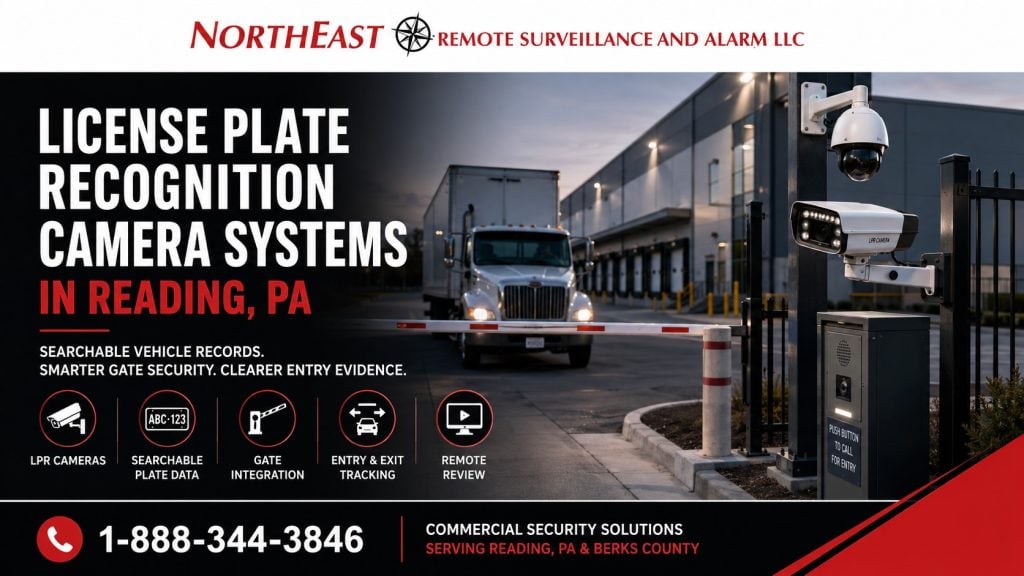
Northeast Remote Surveillance and Alarm, LLC designs, installs, integrates, upgrades, and supports commercial license plate recognition systems for warehouses, manufacturing plants, distribution centers, employee parking areas, truck entrances, contractor yards, fleet facilities, municipal properties, utility sites, industrial campuses, commercial parking facilities, and multi-building organizations throughout Reading and Berks County.
A properly designed system can capture the plate image, convert the characters into searchable data, record the date and time, identify the lane or camera, determine vehicle direction where supported, and preserve related video showing the complete vehicle and surrounding activity.
LPR performance depends on the complete capture environment—not merely the camera’s megapixel rating. Vehicle speed, lane position, capture distance, camera angle, plate size, lighting, headlights, weather, mounting stability, software configuration, and the selected platform must be evaluated together.
For broader regional planning, visit our commercial and industrial security systems in Reading, PA page.
For complete camera-system planning, return to Reading Commercial Video Surveillance Systems.
What a Commercial LPR System Does
A conventional camera records video that an authorized user can review manually.
A license plate recognition system adds software that detects a plate within the image, extracts the characters, and creates a searchable vehicle event. Depending on the selected platform, that event may include:
- Plate number
- Plate image
- Full vehicle image
- Date and time
- Camera or lane
- Entry or exit direction
- Recognition-confidence information
- Vehicle color
- Vehicle make or model
- Vehicle classification
- Approved-list status
- Alert status
- Associated recorded video
Available features vary by camera, software, licensing, region, and video-management platform. Vehicle attributes such as color, make, model, or type should be treated as supplemental search information rather than guaranteed identification.
The purpose is to reduce the time required to locate a vehicle event. Instead of manually reviewing hours of footage, an authorized user may be able to search by a complete or partial plate, date range, entrance, direction, vehicle attribute, or approved list.
License Plate Capture and License Plate Recognition Are Different
License plate capture and license plate recognition are related but distinct functions.
License Plate Capture
License plate capture produces a recorded image from which a person can visually read the plate during playback.
The camera may be optimized for reflective plates and moving vehicles, but it does not necessarily convert the characters into searchable data.
License Plate Recognition
License plate recognition uses optical character recognition and vehicle analytics to extract the plate characters and create a searchable event.
Depending on the platform, LPR may support:
- Plate-number searches
- Partial-plate searches
- Entry and exit filters
- Vehicle lists
- Automatic alerts
- Vehicle-access decisions
- Multi-site searches
- Event reports
- Video-management integration
- Gate-access integration
A property that only needs occasional visual confirmation may require dependable plate capture without advanced recognition software. A high-traffic warehouse, fleet operation, industrial campus, or multi-site organization may benefit from searchable plate data and automated event handling.
NERSA determines the required result before recommending the camera, software, licensing, storage, and integration architecture.
A Dedicated LPR Camera Is Not a General Overview Camera
A wide-angle camera may show the gate, driveway, truck, surrounding property, and vehicle movement while failing to produce a plate image large enough for consistent recognition.
A dedicated LPR camera normally uses a controlled field of view focused on the location where the plate will pass. Exposure, shutter, infrared illumination, focus, and analytics are configured around the plate rather than the entire scene.
That specialized view may make the surrounding property appear dark or provide limited incident context. For that reason, many vehicle entrances benefit from two coordinated views:
- A dedicated LPR camera for plate capture and recognition
- An overview camera showing the vehicle, driver, lane, gate, and surrounding activity
The LPR event identifies the plate. The overview video helps authorized personnel understand what happened.
For overview footage of parking activity and vehicle approaches, see Reading Commercial Parking Lot Security Cameras.
Commercial LPR Applications in Reading and Berks County
License plate recognition can support several commercial vehicle-management applications.
Employee Parking Entrances
An LPR system can record vehicles entering or leaving an employee parking area.
Where approved by the organization, plate information may be associated with an employee or registered vehicle list. The system can help authorized administrators investigate:
- Unrecognized vehicles
- After-hours arrivals
- Vehicles associated with disabled credentials
- Repeated access attempts
- Tailgating
- Parking disputes
- Property damage
- Shift-change incidents
- Entry and exit timing
- Unauthorized use of employee parking
The business should maintain an accurate vehicle-registration process. Plate recognition cannot determine whether the approved employee is actually driving unless the event is supported by additional verification.
Truck and Delivery Entrances
Warehouses and distribution facilities may use LPR to document tractors, delivery vehicles, fleet trucks, service vehicles, and other commercial traffic.
Truck-lane planning may need to account for:
- Higher driver and plate positions
- Front and rear plates
- Tractor and trailer movement
- Long stopping distances
- Wide turning angles
- Multiple lanes
- Nighttime arrivals
- Headlight glare
- Vehicle queues
- Intercom verification
- Gate access events
- Separate entry and exit routes
A tractor plate does not automatically identify the trailer or cargo. Separate overview cameras may be needed to document vehicle markings, trailer numbers, trailer condition, load status, or the complete arrival and departure sequence.
Contractor and Vendor Entrances
Contractor yards, industrial properties, utility sites, and manufacturing plants may need to document vehicles belonging to vendors, subcontractors, maintenance providers, temporary personnel, and project crews.
Searchable plate records can help authorized personnel determine:
- When a contractor arrived
- Which entrance was used
- Whether the vehicle departed
- Whether the plate was registered
- Whether the vehicle appeared outside its approved schedule
- Which video is associated with the event
Plate information should support—not replace—the organization’s contractor approval, visitor verification, escort, and credential procedures.
Fleet Facilities
Fleet operators may use LPR to document company vehicles entering or leaving a controlled property.
Compatible systems may support:
- Registered-fleet lists
- Entry and exit records
- Vehicle-direction reporting
- After-hours alerts
- Vehicle searches
- Gate release
- Multi-location visibility
- Associated overview video
LPR records do not replace formal fleet-management, dispatch, telematics, inspection, or driver-accountability systems. They provide a security and vehicle-event record at the monitored lane.
Industrial Parks and Multi-Tenant Properties
Multi-tenant industrial properties may have shared vehicle entrances used by employees, visitors, trucks, service providers, and contractors from several organizations.
The system should define:
- Who may search plate records
- Whether tenants have separate permissions
- How long data is retained
- Which entrances each tenant can review
- Who manages approved vehicle lists
- How alerts are routed
- How exported evidence is controlled
Role-based administration can help prevent one tenant or department from accessing information outside its responsibilities.
LPR at Controlled Gates
License plates may serve as one factor in a commercial gate-access decision.
A compatible platform can compare a detected plate against an approved vehicle list. When the plate, schedule, lane, and access rules match, the system may send an approved command to the gate-access controller.
Potential applications include:
- Employee parking
- Registered fleet vehicles
- Recurring delivery vehicles
- Authorized contractors
- Municipal vehicles
- Utility personnel
- Multi-site company vehicles
- Controlled commercial parking
LPR-based gate access should include an alternate entry method because plates may be unreadable, missing from the database, obstructed, damaged, dirty, covered by snow, temporarily issued, or entered incorrectly.
Alternate methods may include:
- Card or key-fob credential
- Mobile credential
- Keypad code
- Video intercom
- Guard verification
- Authorized remote release
The system must also distinguish access authorization from gate safety. Vehicle loops, photoelectric sensors, sensing edges, gate controls, and other safety devices perform different functions from the LPR camera.
For operators, credentials, intercoms, vehicle detection, remote release, and complete gate planning, visit our commercial gate access control systems in Reading, PA page.
Approved Vehicle Lists
An approved vehicle list may contain employee vehicles, fleet vehicles, recurring contractors, authorized vendors, municipal vehicles, or other permitted plates.
Each vehicle record may be assigned:
- An approved location
- A specific lane
- Entry or exit permission
- A time schedule
- An effective date
- An expiration date
- A vehicle owner or department
- A classification
- Notes for authorized users
The organization should establish responsibility for maintaining the list.
Former employees, replaced fleet vehicles, expired contractors, sold vehicles, and temporary plates should be removed or updated promptly. Automated entry becomes less reliable when the underlying database is inaccurate.
Alerts and Vehicle Watch Lists
A compatible LPR platform may generate alerts when it detects a plate placed on a customer-approved list.
Commercial examples may include:
- A banned vehicle
- A terminated contractor’s registered vehicle
- A vehicle associated with a previous property incident
- A stolen company vehicle
- A fleet vehicle appearing at an unexpected location
- An approved vehicle arriving outside its schedule
- A vehicle entering through the wrong lane
- An unregistered vehicle entering a restricted property
Every alert should have a defined response.
The organization should determine:
- Who receives the alert
- Whether the event requires immediate review
- Which video should be displayed
- How the plate is verified
- Who may add or remove plates
- When list entries expire
- How incorrect matches are handled
- How the event is documented
- When management or public-safety personnel are contacted
An LPR alert should be reviewed against the plate image and surrounding video before significant action is taken. Recognition software can produce incomplete or incorrect results under difficult conditions.
Searching Recorded Vehicle Activity
Searchable vehicle records are one of the primary advantages of an LPR system.
Depending on the platform, an authorized user may search by:
- Full plate number
- Partial plate number
- Date or time range
- Camera
- Property
- Entry or exit direction
- Approved or unapproved status
- Vehicle color
- Vehicle make or model
- Vehicle category
- Alert type
- Associated access event
A partial-plate search can be useful when a witness remembers only several characters or when part of a plate is obscured.
Search results should display the original plate image and related overview video wherever possible. The recognized text alone should not be treated as conclusive evidence when the image is unclear.
Entry and Exit Lanes
Entry and exit lanes often require separate camera positions.
A camera aimed at the rear plates of entering vehicles may not have a suitable view of vehicles leaving in the opposite direction. Headlights, lane angle, vehicle speed, plate position, and stopping location may also differ between directions.
Separate cameras may be appropriate when the property needs to document:
- Both arrival and departure
- Time on the property
- Tractor or trailer changes
- Fleet movement
- Property removal
- Contractor departure
- After-hours vehicle activity
- Gate damage
- Vehicles using the incorrect direction
- Separate employee and truck lanes
Where the same lane handles traffic in both directions, the camera and analytics must be tested for each path. A successful entry capture does not guarantee dependable exit recognition.
Camera Position, Lane Geometry, and Vehicle Speed
LPR performance begins with a predictable capture zone.
The camera should be positioned where vehicles travel through a controlled portion of the lane and where the plate remains within the supported distance, angle, size, and speed range of the selected equipment.
Planning should evaluate:
- Lane width
- Number of lanes
- Vehicle approach angle
- Vehicle speed
- Expected stopping point
- Passenger vehicles versus trucks
- Camera-to-plate distance
- Mounting height
- Side angle
- Vertical angle
- Plate position in the image
- Entry and exit direction
- Vehicles passing side by side
- Gate or intercom location
- Traffic queues
- Possibility of lane bypass
Manufacturer requirements vary. The final camera position should follow the limits of the selected camera and analytics platform rather than a generic installation formula.
A camera mounted at the most convenient building corner may not be in the correct position for plate recognition.
Daytime and Nighttime Plate Recognition
Vehicle entrances experience severe lighting changes.
During the day, direct sunlight, shadows, windshield reflections, wet pavement, and glare may affect the image. At night, headlights may point directly into the camera while the surrounding lane remains dark.
A dedicated LPR system may use:
- Infrared illumination
- Fast shutter settings
- Controlled exposure
- Visible-light filtering
- Purpose-built optics
- Low-light imaging
- Supplemental lane lighting
- Separate overview and plate cameras
The plate view may appear different from a normal surveillance image because its primary objective is to preserve readable plate characters.
The proposed system should be tested under the conditions that matter to the facility, including daylight, darkness, headlights, trucks, passenger vehicles, rain, and changing seasonal conditions.
Plates That May Be Difficult to Recognize
No LPR system recognizes every plate under every condition.
Recognition may be affected by:
- Dirt or mud
- Snow or ice
- Plate covers
- Bent or damaged plates
- Temporary plates
- Unusual fonts or layouts
- Decorative frames
- Missing characters
- Severe glare
- Excessive vehicle speed
- Poor vehicle position
- Obstructions
- Trailer equipment
- Strong camera vibration
- Incorrect focus
- Inadequate lighting
- Unsupported plate regions
- Incorrect software configuration
The system should retain the original image so an authorized person can review an event when the recognized characters are incomplete or questionable.
NERSA does not promise 100% plate recognition. The objective is to design and test the capture environment for dependable performance within the selected equipment’s documented capabilities.
LPR and Video-Management Integration
A compatible commercial video-management system can place LPR events and ordinary surveillance video within the same operational environment.
Authorized users may be able to:
- Search detected plates
- Open the corresponding plate image
- Review the vehicle overview
- See video before and after the detection
- Filter by location or lane
- Export the relevant footage
- Review gate activity
- Compare the event with access-control records
- Manage several properties
- Receive selected alerts
The architecture may be:
- Locally recorded
- Server based
- Cloud managed
- Hybrid local and cloud
- Edge based
- Centrally managed across multiple sites
The appropriate platform depends on vehicle volume, retention, bandwidth, cybersecurity, licensing, integration, user count, remote-access needs, and expansion plans.
Multi-Site License Plate Recognition
Organizations with several properties may benefit from centralized vehicle searches and administration.
A multi-site platform may allow authorized personnel to:
- Search a plate across approved locations
- Maintain fleet lists
- Apply location-specific permissions
- Review entry and exit activity
- Receive alerts from selected properties
- Compare vehicle events between facilities
- Standardize data retention
- Manage user roles
- Monitor camera health
- Export reports
Centralized access should remain role based. A local manager may need access to one facility while a corporate administrator may be authorized to review several properties.
Multi-site search should not automatically mean that every user can access every camera, plate record, or alert.
Video and LPR Record Retention
LPR systems may store recognized plate text, plate images, full vehicle images, related video, event metadata, and administrator activity.
Retention should be planned around:
- Operational need
- Incident-discovery time
- Vehicle volume
- Camera count
- Image and video resolution
- Storage capacity
- Cloud or local licensing
- Company policy
- Contractual requirements
- Authorized legal guidance
Plate metadata and associated video may have different retention settings.
The organization should avoid retaining data indefinitely merely because the platform permits it. Retention should serve a defined operational, security, contractual, or legal purpose.
Privacy and Authorized Use
License plate information can reveal when a vehicle appeared at a particular location.
The property owner should establish clear rules governing:
- Who may search plate records
- Who may view associated video
- Who may add vehicles to lists
- Who may receive alerts
- How long records are retained
- Who may export data
- How exported records are protected
- When information may be shared
- How incorrect records are corrected
- How former employees or contractors are removed
- How administrator activity is reviewed
NERSA can configure the technical permissions, recording settings, and approved system functions. The customer remains responsible for its employment, privacy, records, disclosure, and data-use policies.
Cybersecurity and Account Protection
An LPR system may connect cameras, video-management software, access control, databases, mobile applications, cloud services, and remote user accounts.
Security planning may include:
- Strong administrator credentials
- Multi-factor authentication where supported
- Role-based user permissions
- Controlled remote access
- Network segmentation
- Secure software updates
- Removal of default accounts
- Device and license documentation
- Accurate time synchronization
- Account activity review
- Backup and recovery procedures
- Expired-user removal
- Approved vendor-access procedures
The customer should retain ownership of administrator credentials, cloud accounts, software licensing, vehicle lists, system documentation, and exported records.
Network, Fiber, Power, and Storage
Vehicle entrances are often located far from the building’s main network equipment.
An LPR installation may require:
- Cat6 or fiber-optic cabling
- Managed network switches
- Point-to-point wireless communication
- Outdoor equipment enclosures
- Power over Ethernet
- Local electrical power
- Battery or UPS support
- Surge protection
- Grounding coordination
- Underground conduit
- Cellular connectivity
- Bandwidth planning
- Local or cloud storage
- Secure remote access
The infrastructure must support both the LPR camera and any associated overview cameras.
An unstable network connection, inadequate storage calculation, poor mounting structure, or unreliable power source can reduce the usefulness of an otherwise capable camera.
Existing LPR System Upgrades and Takeovers
An existing LPR system may produce inconsistent results because of installation, configuration, infrastructure, or equipment problems.
Common deficiencies include:
- Camera positioned at an excessive angle
- Plate too small in the image
- Vehicles traveling outside the supported speed range
- Poor nighttime exposure
- Headlight glare
- Incorrect region settings
- Unreliable focus
- Camera vibration
- Missing overview video
- Incorrect date and time
- Inadequate storage
- Unsupported analytics
- Expired software licenses
- Unavailable administrator credentials
- Poorly maintained vehicle lists
- Unsecured remote access
- Failing network communication
- No documented testing
NERSA can evaluate the cameras, analytics, server, recorder, licenses, network, storage, mounting locations, capture lanes, user accounts, alerts, vehicle lists, and integration capabilities.
Some equipment may remain usable after repositioning, configuration, licensing, infrastructure correction, or software modernization. Other components may require replacement when they are unsupported, locked, unreliable, damaged, or unsuitable for the required result.
NERSA does not automatically recommend replacing every existing camera.
Commercial LPR Assessment Process
NERSA begins with the vehicle workflow and the information the organization needs.
The assessment may include:
- Identifying the property’s vehicle-security objective
- Reviewing employees, visitors, contractors, fleet vehicles, deliveries, and trucks
- Evaluating entry and exit lanes
- Measuring vehicle approach angles and stopping points
- Reviewing expected vehicle speed and volume
- Inspecting daylight and nighttime lighting
- Determining whether plate capture or searchable recognition is required
- Identifying the need for overview, driver, gate, or trailer cameras
- Reviewing gate-access and intercom integration
- Evaluating power, network, fiber, conduit, wireless, and storage
- Defining user permissions, retention, searches, lists, and alerts
- Testing the completed system with representative vehicles
- Training approved administrators
- Delivering relevant system documentation
The result should explain what each camera is intended to capture and how authorized users will search, review, and manage the completed system.
Commercial Properties NERSA Supports
NERSA provides commercial LPR planning for:
- Warehouses
- Distribution centers
- Manufacturing facilities
- Food-processing plants
- Cold-storage properties
- Truck and trailer yards
- Contractor yards
- Fleet facilities
- Industrial parks
- Employee parking entrances
- Commercial parking facilities
- Municipal properties
- Public works facilities
- Utility sites
- Institutional campuses
- Equipment-storage properties
- Multi-building facilities
- Multi-site organizations
NERSA focuses on commercial, industrial, municipal, institutional, and other nonresidential environments.
Why Reading Businesses Choose NERSA
Northeast Remote Surveillance and Alarm, LLC has provided commercial security and low-voltage services since 2008.
Our license plate recognition capabilities include:
- LPR camera design and installation
- Plate-capture cameras
- Searchable plate events
- Entry and exit documentation
- Truck-lane coverage
- Employee parking applications
- Gate-access integration
- Vehicle lists and alerts
- Overview-camera coordination
- Video-management integration
- Multi-site administration
- Network and fiber infrastructure
- Existing-system upgrades
- System takeovers
- User training
- Project documentation
- Long-term commercial support
NERSA supports projects ranging from one controlled commercial driveway to warehouses, manufacturing facilities, municipal properties, industrial campuses, and enterprise organizations with multiple lanes, gates, buildings, and locations.
Reading and Berks County Service Area
NERSA provides commercial license plate recognition camera services throughout Reading and nearby Berks County communities, including West Reading, Wyomissing, Shillington, Sinking Spring, Muhlenberg Township, Exeter Township, Spring Township, Cumru Township, Laureldale, Temple, and surrounding commercial and industrial areas.
Project availability depends on the property, capture lanes, infrastructure, equipment requirements, schedule, and required service response.
Frequently Asked Questions About LPR Cameras
What is the difference between an LPR camera and a regular security camera?
An LPR camera is positioned and configured to capture plate characters and, when recognition software is included, convert them into searchable data. A regular overview camera is normally intended to show the complete vehicle, lane, gate, and surrounding activity.
Is license plate capture the same as license plate recognition?
No. Plate capture records an image that a person can review. Plate recognition extracts the plate characters and creates searchable event data.
Can one camera provide both plate recognition and a wide overview?
Sometimes, but one camera often cannot provide both an optimized plate image and a broad incident overview. Separate plate and overview cameras may produce more dependable results.
Can LPR cameras recognize plates at night?
Yes, when the camera, illumination, exposure, angle, distance, plate size, and vehicle speed are suitable. The actual lane should be tested under nighttime conditions.
Are LPR cameras 100% accurate?
No. Recognition can be affected by weather, glare, dirt, snow, vehicle speed, plate damage, temporary plates, camera angle, focus, obstructions, and software configuration. Important events should be confirmed against the original plate image and related video.
Can an LPR camera automatically open a commercial gate?
Compatible systems can compare the detected plate against an approved list and send an access command. An alternate credential or verification method should remain available.
Can the system alert us when a selected vehicle enters?
Yes. Compatible platforms can generate alerts for customer-approved vehicle lists. Each alert should have an established review and response procedure.
Can authorized users search for only part of a plate number?
Many commercial LPR platforms support partial-plate searches. Exact search capabilities depend on the selected software.
Can LPR identify vehicle color, make, or model?
Some platforms provide vehicle-attribute analytics. These attributes can help narrow a search but should not be treated as guaranteed vehicle identification.
Can LPR cameras cover tractor-trailer entrances?
Yes. Truck entrances may require different mounting positions and separate cameras for the plate, driver, tractor, trailer, gate, and overall lane.
Do we need separate cameras for entry and exit?
Often, yes. Entry and exit vehicles may travel in different directions and present plates at different angles. Each direction should be evaluated separately.
Can NERSA upgrade an existing LPR system?
Yes. NERSA can evaluate the cameras, software, licenses, server, network, storage, mounting positions, image quality, lists, alerts, and administrator access to determine what can remain.
How long can plate records be retained?
Retention depends on the selected platform, storage, licensing, vehicle volume, company policy, and operational requirements. The retention period should be established during system planning.
Can NERSA support a small business and a multi-site enterprise?
Yes. NERSA can design an LPR system for a smaller commercial property with one entrance or for warehouses, industrial campuses, municipal facilities, fleet operations, and enterprise organizations with multiple lanes and locations.
Schedule an LPR Camera Assessment in Reading, PA
A dependable license plate recognition system should capture plates at a predictable point, produce searchable vehicle records, preserve the related image and video, and give authorized personnel a practical way to manage searches, lists, alerts, retention, and system access.
Northeast Remote Surveillance and Alarm, LLC can evaluate your entrances, exits, lanes, traffic, lighting, vehicle types, camera positions, gates, network infrastructure, storage, existing equipment, and operating requirements before recommending a solution.
Call 1-888-344-3846 to schedule a commercial license plate recognition camera assessment in Reading, PA.