
Commercial gate access control systems help Reading businesses control how employees, contractors, vendors, visitors, delivery drivers, fleet vehicles, and trucks enter secured commercial properties.
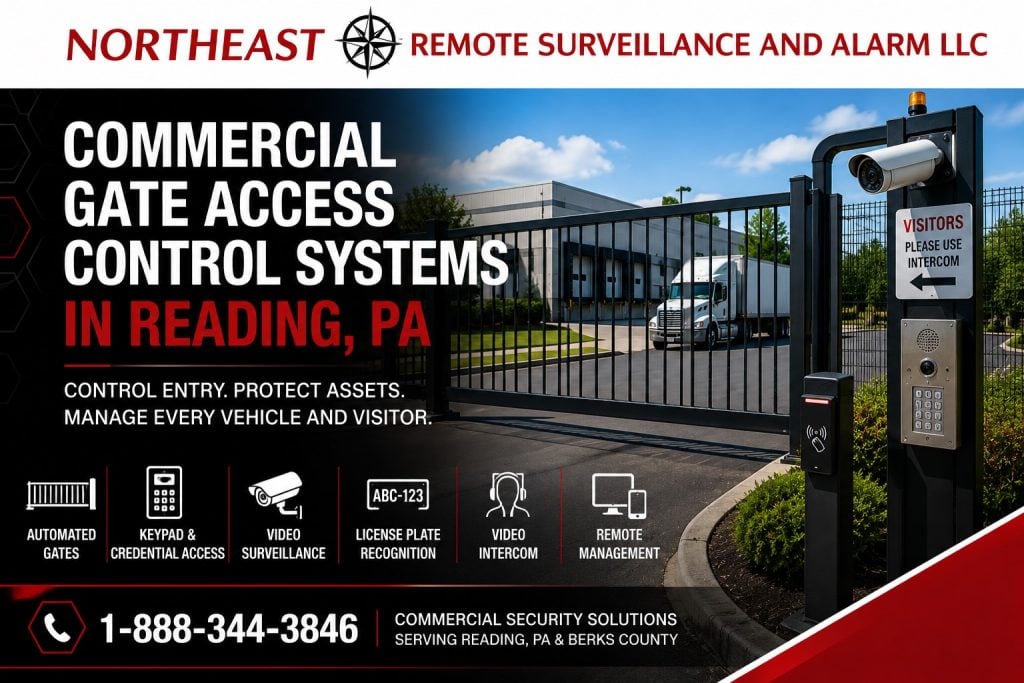
Northeast Remote Surveillance and Alarm, LLC designs, installs, upgrades, expands, and supports commercial vehicle-gate access systems for warehouses, manufacturing plants, distribution centers, truck yards, contractor yards, fleet facilities, employee parking areas, municipal properties, industrial sites, utility facilities, and other nonresidential properties throughout Reading and Berks County.
A dependable vehicle entrance requires more than a gate operator and keypad. The physical gate, vehicle approach, credential method, visitor communication, vehicle detection, safety equipment, cameras, power, communications, gate-position monitoring, emergency procedures, and system administration must operate as one coordinated entrance.
For broader planning involving employee credentials, controlled building doors, readers, controllers, user permissions, and access-control platforms, visit our Commercial Access Control Systems in Reading, PA page.
Commercial & Industrial Properties Only • New Systems • Upgrades • Expansions • Takeovers
Call 1-888-344-3846 to schedule a commercial gate access assessment in Reading, Pennsylvania.
Vehicle Entrances Are Controlled Access Points
A commercial gate is frequently the first controlled opening encountered at a warehouse, manufacturing facility, truck yard, industrial property, or secured commercial campus.
Depending on the property, the entrance may be used by:
- Employees
- Supervisors
- Contractors
- Vendors
- Delivery drivers
- Tractor-trailers
- Fleet vehicles
- Maintenance personnel
- Service companies
- Temporary workers
- Visitors
- Emergency responders
These users should not automatically receive identical access.
A properly designed gate-access system establishes who may enter, which entrance they may use, when access is permitted, how authorization is verified, and what happens when a vehicle arrives without a valid credential.
The objective is to control vehicle entry without unnecessarily slowing legitimate business operations or creating an entrance employees routinely attempt to bypass.
Commercial Properties Using Gate Access Control
NERSA designs vehicle-entry solutions for commercial and industrial properties throughout Reading and Berks County.
Common applications include:
- Warehouses and distribution centers
- Manufacturing facilities
- Truck and trailer yards
- Contractor yards
- Fleet parking properties
- Equipment-storage facilities
- Industrial parks
- Employee parking areas
- Controlled delivery entrances
- Food-processing facilities
- Municipal and public-works properties
- Utility facilities
- Commercial campuses
- Construction-material yards
- Transportation facilities
- Multi-tenant industrial properties
- Remote commercial compounds
The correct design depends on the property.
An employee parking entrance serving predictable shift changes has different requirements from a truck gate receiving tractor-trailers, contractors, vendors, and after-hours deliveries throughout the day.
Employee Parking Gate Access
Commercial gate access can provide controlled employee entry without requiring someone to manually verify every arriving vehicle.
Employees may use individually assigned:
- Keycards
- Key fobs
- Mobile credentials
- Personal identification numbers
- Long-range vehicle credentials
- Other compatible electronic credentials
Permissions can be assigned according to location, department, shift, work schedule, or employee responsibility.
A gate system may support:
- Shift-based schedules
- Holiday schedules
- Individual credential assignment
- Immediate credential deactivation
- Automatic expiration
- Separate employee and supervisor permissions
- Entry and exit records
- Gate-held-open reporting
- Denied-access events
- Temporary employee credentials
- Centralized administration
- Multi-location credential management
Credential management should be supported by clear enrollment, replacement, termination, and access-review procedures.
An electronic gate cannot provide meaningful accountability when unnecessary or former-user credentials remain active indefinitely.
Truck and Distribution-Center Gate Access
Truck entrances require additional planning because vehicle size, turning radius, traffic flow, verification time, queue length, and driver communication can directly affect the operation of the entrance.
A Reading-area warehouse or distribution facility may require:
- Driver call stations
- Video intercoms
- Credential readers
- Keypads
- Temporary delivery codes
- License-plate cameras
- Truck overview cameras
- Remote gate release
- Guard-station controls
- Gate-position monitoring
- Vehicle-presence detection
- Safety photoelectric devices
- Entry and exit event reporting
- After-hours call routing
The entrance should allow a commercial driver to stop where identification and communication can occur without creating an unnecessary traffic hazard or blocking the public roadway.
Truck-gate camera placement should also account for cab height, headlights, reflective surfaces, vehicle length, trailer movement, darkness, weather, and the difference between obtaining a broad vehicle view and capturing a usable license plate.
Contractor and Vendor Gate Access
Contractors and vendors frequently need temporary property access but should not automatically receive unrestricted permanent credentials.
Permissions can be limited according to:
- Date
- Time
- Gate
- Property
- Contractor company
- Project
- Vehicle
- Approved work schedule
- Sponsor or department
- Number of permitted uses
- Credential expiration
A contractor working on a defined project may receive an individually assigned credential that expires when the project is completed.
A one-time visitor may instead communicate through the gate intercom and be admitted remotely after authorization.
Shared permanent gate codes should be avoided where individual accountability is required because shared codes can continue circulating long after an employee, contractor, or vendor should have access.
Visitor and Delivery Gate Entry
Visitors and delivery personnel often arrive without permanent credentials.
A commercial gate intercom gives authorized personnel a way to communicate with the driver before releasing the entrance.
Depending on the property, the person answering the call may be located at:
- A receptionist desk
- Shipping and receiving
- A dispatch office
- A security station
- A facilities office
- Another building
- An approved mobile device
- An after-hours answering location
The business should establish who answers gate calls, what information must be verified, who may authorize entry, and what happens when the intended employee cannot be reached.
A video intercom can also provide visual context before the gate is released.
Gate Credential Options
The appropriate credential method depends on the property, vehicle traffic, security requirement, user population, and administration process.
Cards and Key Fobs
Cards and fobs provide individually assigned credentials that can be activated, suspended, scheduled, or deleted without distributing permanent mechanical keys or shared codes.
The reader should be positioned so a driver can safely present the credential without leaving the vehicle or reaching into the gate’s movement path.
Mobile Credentials
Compatible access-control platforms can allow approved smartphones to operate as gate credentials.
Mobile access can reduce dependence on physical cards, but planning should address employee enrollment, replacement phones, lost devices, wireless performance, licensing, and credential removal when employment or authorization ends.
Keypads and Individual PINs
Keypads can support employees, contractors, vendors, and other approved users.
Individually assigned codes generally provide better accountability than one shared code used by everyone entering the property.
Temporary codes can also be configured with limited schedules or expiration periods where supported.
Long-Range Vehicle Credentials
Long-range credential systems can identify an authorized vehicle as it approaches a controlled entrance.
These systems may be useful for:
- Fleet vehicles
- Frequent employees
- Service vehicles
- High-volume employee entrances
- Repetitive commercial traffic
The design should consider reader distance, lane configuration, vehicle speed, adjacent traffic, credential placement, and the possibility of a credential being transferred to another vehicle.
License-Plate-Based Vehicle Entry
License-plate recognition can be used as an additional vehicle-identification method and, on suitable systems, as part of the access decision.
Dependable plate capture requires planning for:
- Camera angle
- Mounting position
- Lane width
- Vehicle speed
- Headlight glare
- Day and night lighting
- Front or rear plate availability
- Temporary plates
- Dirty or obstructed plates
- Vehicle-list management
- Exception procedures
License-plate recognition should not be treated as infallible.
A property should maintain an alternate process for an authorized vehicle whose plate cannot be read or has not been entered correctly into the approved vehicle database.
Sliding Gates, Swing Gates, and Barrier Arms
Gate-access controls must be matched to the physical vehicle entrance.
Sliding Vehicle Gates
Sliding gates move horizontally along or behind the fence line.
Planning should consider:
- Available gate travel
- Gate weight
- Grade
- Snow accumulation
- Debris
- Wind exposure
- Fence condition
- Operator location
- Vehicle clearance
- Potential entrapment areas
Swing Gates
Swing gates rotate around hinges and require adequate space for the gate leaf to travel without interfering with vehicles, pedestrians, parking areas, roadways, or other property features.
Barrier-Arm Gates
Barrier arms can provide faster vehicle processing for employee lots, guard stations, parking entrances, and other high-volume lanes.
A barrier arm controls vehicle passage but does not provide the same type of perimeter closure as a full sliding or swinging gate.
The surrounding property design should reflect the required level of perimeter control.
Entry and Exit Control
Entry and exit do not always require identical authorization.
Entry may require:
- Credential presentation
- PIN entry
- Intercom approval
- Vehicle identification
- License-plate verification
- Guard approval
Exit may be activated through:
- Vehicle detection
- Credential reader
- Guard control
- Push button
- Another approved release method
Exit operation should be designed so convenient egress does not unintentionally create an uncontrolled route into the property.
The system should also define how vehicles exit during a power failure, communication failure, or gate fault.
Tailgating and Unauthorized Vehicle Follow-Through
A vehicle gate may remain open long enough for more than one vehicle to pass following a single authorization.
This may occur because of traffic volume, gate timing, vehicle spacing, delivery operations, or intentional tailgating.
The entrance design may incorporate:
- Proper gate timing
- Vehicle-presence detection
- Safety loops
- Lane configuration
- Traffic signals
- Overview cameras
- License-plate cameras
- Anti-passback rules
- Guard procedures
- Separate visitor lanes
- Written driver procedures
Safety detection and access authorization perform different functions.
A device that prevents a gate from closing on a vehicle does not automatically determine whether another vehicle following it is authorized to enter.
Video Surveillance at Commercial Gates
Vehicle entrances frequently benefit from dedicated video coverage.
Different cameras may be needed for different objectives, including:
- Overall lane activity
- Driver identification
- Vehicle identification
- License-plate capture
- Gate movement
- Gate-operator condition
- Trailer activity
- Entrance and exit traffic
- Surrounding incident context
A wide-angle overview camera that clearly shows the entire entrance may not provide enough detail to read a license plate.
A dedicated plate camera may capture the plate effectively while providing little useful information about the driver, trailer, or surrounding event.
Camera selection and positioning should therefore begin with the information the business expects to obtain.
Gate Intercom and Remote Release
A gate intercom can connect a visitor or driver with an authorized employee before vehicle entry is permitted.
Calls may be directed to:
- Indoor intercom stations
- Receptionists
- Dispatch offices
- Shipping departments
- Security workstations
- Approved computer applications
- Mobile devices
- Multiple answering locations
Where remote gate release is provided, the employee should understand exactly which entrance is being operated and, when appropriate, have a clear view of the vehicle before releasing the gate.
Gate-position monitoring can also help determine whether the entrance actually opened and returned to its expected secured position.
Power and Communications for Remote Gates
Vehicle gates are often positioned a significant distance from the primary building.
Depending on site conditions, a project may require coordination involving:
- Electrical service
- Gate-operator power
- Low-voltage cabling
- Underground conduit
- Fiber-optic communication
- Network switching
- Wireless bridges
- Cellular communication
- Surge protection
- Grounding
- Battery backup
- Outdoor equipment enclosures
The communication method should be selected according to distance, terrain, structures, available pathways, interference, bandwidth requirements, reliability requirements, and the customer’s information-technology policies.
A gate located hundreds of feet from a building should not automatically be designed around an unreliable consumer wireless connection merely because it is convenient.
Gate Operation During an Outage
Before installation, the property should understand how the vehicle entrance is expected to operate when normal power or communication is unavailable.
Important questions include:
- Does the gate remain secured?
- Can authorized personnel release it manually?
- Is battery backup available?
- Can vehicles still exit?
- How are emergency responders admitted?
- Can the access controller continue making local credential decisions?
- What happens if the intercom is unavailable?
- Who is notified of a gate communication failure?
- What temporary operating procedure should employees follow?
The appropriate response varies according to the property.
An employee parking lot, truck terminal, municipal facility, utility property, and higher-security industrial site may require very different outage procedures.
Commercial Gate Safety
A powered vehicle gate is moving equipment and must be planned as both an access-control point and a safe vehicle entrance.
Depending on the gate and operator, safety provisions may include:
- Monitored photoelectric sensors
- Sensing edges
- Vehicle-detection loops
- Gate-position monitoring
- Warning signage
- Protected rollers
- Guarded pinch points
- Manual-release procedures
- Proper travel limits
- Routine inspection and testing
Safety devices should not be bypassed simply to keep an unreliable gate operating.
Repeated faults may indicate a damaged sensor, alignment problem, wiring failure, gate-operator issue, physical gate problem, or another condition requiring correction.
Pedestrian traffic should also be separated from the travel path of a powered vehicular gate whenever the property requires routine foot traffic through the same area.
Existing Gate Access Control Upgrades
A commercial gate problem does not automatically require replacement of every existing component.
NERSA can evaluate existing:
- Credential readers
- Keypads
- Access-control panels
- Intercoms
- Gate operators
- Vehicle detection
- Safety devices
- Gate-position switches
- Cameras
- License-plate equipment
- Power supplies
- Backup batteries
- Communications
- Cabling
- Conduit
- Software
- Administrator access
The objective is to determine which equipment remains usable and which components are obsolete, unsupported, incompatible, improperly installed, unreliable, or unable to meet the property’s current requirements.
An existing gate operator may remain in service while the credential system is upgraded.
An existing access-control platform may also remain while the intercom or cameras are modernized.
The final recommendation should be based on actual equipment condition rather than an assumption that every inherited component must be replaced.
Gate Access Control Takeovers
NERSA can evaluate commercial gate systems originally installed or maintained by another contractor.
A takeover assessment may include reviewing:
- Equipment model numbers
- Administrator credentials
- Access-control ownership
- Controller passwords
- Software licensing
- Cloud account ownership
- Credential databases
- Gate-operator documentation
- Existing wiring
- Safety devices
- Cameras
- Intercom operation
- Communication paths
- Existing service agreements
- Available system documentation
Proprietary, locked, obsolete, damaged, or unsupported equipment may require partial or complete replacement.
NERSA will not represent an inherited system as fully serviceable until the equipment, account ownership, documentation, physical gate, and operating condition have been evaluated.
Commercial Gate Access Assessment
NERSA begins with the vehicle entrance and the way the property actually operates rather than starting with a predetermined equipment package.
A gate assessment may include:
- Reviewing the property’s vehicle-security objectives.
- Identifying employees, trucks, contractors, vendors, visitors, and other users.
- Reviewing normal and peak vehicle traffic.
- Evaluating lane width, vehicle size, turning area, and queuing.
- Inspecting the existing gate and operator.
- Reviewing vehicle detection and safety equipment.
- Determining appropriate credential methods.
- Reviewing visitor and delivery procedures.
- Evaluating intercom requirements.
- Reviewing camera and license-plate objectives.
- Evaluating power and communication infrastructure.
- Defining entry, exit, emergency, and outage procedures.
- Reviewing administration and credential-management requirements.
- Planning installation, testing, training, and documentation.
The result is a vehicle-entry system designed around the actual property rather than a standardized gate package.
Why Reading Businesses Choose NERSA
Northeast Remote Surveillance and Alarm, LLC has provided commercial and industrial security services since 2008.
Our commercial gate capabilities include:
- Vehicle gate access control
- Credential readers
- Keypads
- Mobile credentials
- Long-range vehicle credentials
- Video intercoms
- Remote gate release
- License-plate camera coordination
- Gate video surveillance
- Gate-position monitoring
- Entry and exit event reporting
- Existing-system upgrades
- System takeovers
- Network and fiber coordination
- Multi-gate administration
- System training and documentation
NERSA supports projects ranging from a single controlled employee parking entrance to vehicle-entry systems serving warehouses, manufacturing plants, truck yards, industrial campuses, municipal facilities, and multi-building commercial properties.
Commercial Gate Access Control in Reading and Berks County
NERSA provides commercial gate access-control services throughout Reading and qualifying commercial and industrial properties across Berks County, including:
- Reading
- West Reading
- Wyomissing
- Shillington
- Sinking Spring
- Muhlenberg Township
- Exeter Township
- Spring Township
- Bern Township
- Fleetwood
- Kutztown
- Hamburg
- Birdsboro
- Douglassville
- Boyertown
- Surrounding Berks County commercial markets
Project availability depends on the property, gate condition, scope, equipment requirements, infrastructure, schedule, and required service response.
Frequently Asked Questions About Commercial Gate Access Control in Reading, PA
Can NERSA add access control to an existing vehicle gate?
Often, yes. The existing gate, operator, safety equipment, electrical service, controls, communications, and physical condition should first be evaluated to determine what equipment can remain in service.
Can employees use the same credential at the gate and building doors?
Yes, when compatible access-control equipment is used. Permissions can still be limited according to the employee, property, gate, door, department, and schedule.
Can employees open a gate with a mobile credential?
Yes, when the selected platform supports mobile credentials and the entrance has been designed for that credential technology.
Can a vehicle gate use license plates for authorization?
Compatible systems can use license-plate recognition as part of a vehicle-entry process when the entrance provides suitable camera position, vehicle alignment, lighting, speed, and plate visibility.
Can visitors call an employee from the gate?
Yes. A commercial audio or video intercom can connect a visitor with an approved answering location before authorized personnel remotely release the gate.
Can temporary gate credentials expire automatically?
Yes. Compatible access-control systems can provide temporary credentials or individual codes with restricted dates, schedules, gates, and expiration periods.
Can we receive an alert if the gate remains open?
Compatible gate-position monitoring can generate an event when a gate does not return to its expected secured position.
Can gate access events be connected with recorded video?
Compatible access-control and video systems can associate gate activity with nearby camera footage to provide additional event context.
Can separate truck and employee gates have different permissions?
Yes. Different gates can use separate credential rules, schedules, cameras, intercom procedures, and administrative permissions.
What happens to the gate during a power failure?
The answer depends on the gate operator, access-control system, backup power, physical entrance, and approved emergency procedure. Outage operation should be determined as part of the system design.
Can NERSA take over a gate system installed by another company?
Often, yes. NERSA first evaluates the gate, operator, access-control equipment, software, credentials, licensing, communications, safety equipment, documentation, and overall system condition.
Can a commercial gate access project be installed in phases?
Yes. A property may begin with one controlled vehicle entrance and later add intercoms, cameras, license-plate capabilities, additional gates, or centralized management when the infrastructure and platform support expansion.
Schedule a Commercial Gate Access Assessment in Reading, PA
A dependable commercial gate system should control vehicle entry without creating unnecessary operating problems for employees, trucks, contractors, visitors, deliveries, or facility personnel.
Northeast Remote Surveillance and Alarm, LLC can evaluate the gate, operator, vehicle approach, credentials, visitor process, intercom, cameras, vehicle detection, safety equipment, power, communications, existing access-control equipment, and future expansion requirements before recommending a solution.