
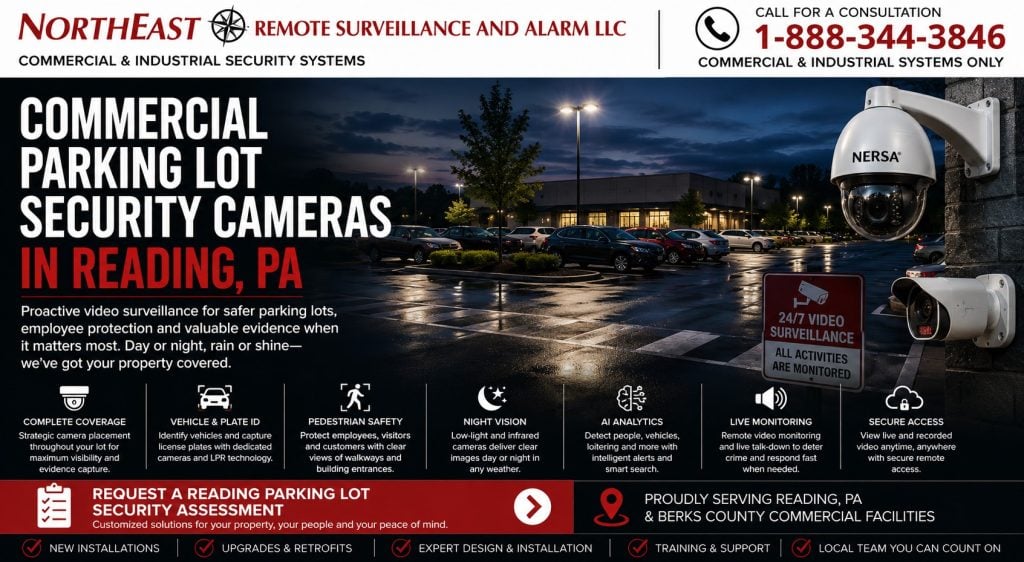
Commercial parking lot security cameras in Reading, PA help businesses review vehicle incidents and pedestrian movement through camera views designed for the evidence each area needs.
For complete camera-system planning, return to Reading Commercial Video Surveillance Systems.
Define the Evidence Each View Must Capture
Start with the incidents the property needs to investigate: damage to parked vehicles, a person approaching an employee entrance, or activity near a closed parking area. Map the parking rows, vehicle entrances, pedestrian routes, and building approaches involved. Give each proposed camera a defined purpose and identify any obstructions, including taller vehicles, landscaping, signs, and snow storage.
Overview views establish where an event occurred and the direction of travel.
Closer views at predictable pedestrian locations provide stronger detail.
A single wide camera may show an incident while leaving the person or vehicle too small to identify; camera resolution alone does not establish useful evidence.
Lens choice, distance, mounting angle, lighting, and movement also matter.
See Axis guidance on pixel density.
Coordinate Parking Rows, Walkways, and Vehicle Lanes
Follow a person’s route between the parking space and the building so that coverage does not stop at the parked cars. Coordinate broader lot views with closer entrance or walkway views. Check accessible routes, rear employee paths, crossings, and isolated rows under the actual parking conditions.
Vehicle overview footage can provide context such as direction, color, and the sequence of movement.
When plate evidence is required, assess the lane separately through Reading License Plate Recognition Camera Systems; a general overview should not be assumed to capture readable plates.
Axis license plate recognition guidance describes that specialized application.
Check Nighttime Images and Mounting Positions
Review moving people and vehicles after dark, including headlight glare, wet-pavement reflections, uneven lighting, and shadows between vehicles.
A clear daytime image does not establish nighttime performance.
Camera exposure and illumination must work together at the intended evidence point; Axis lighting guidance provides additional background.
Building mounts may simplify service access while leaving distant rows obstructed. Pole-mounted cameras can improve viewing angles, but the assessment must confirm suitable mounting, available power, network connections, and service access. For covered parking, check columns, ramps, bright entrances, and pedestrian access points individually. Fixed views should continue covering critical locations while any movable camera is pointed elsewhere.
Record, Find, and Preserve Parking Incidents
Set retention around how long the organization normally takes to discover vehicle damage or receive an incident report. Check available storage against camera count, recording settings, and scene activity. Critical views need a recording method that reliably captures the event; event-based recording requires careful testing of detection rules.
Use clear location names such as “Employee Lot — Rear Walkway” and synchronize camera times so authorized staff can follow an incident across views. Confirm that staff can locate a recording, export the relevant segment, play the exported file, and preserve it before routine overwriting. Assign individual viewing and export permissions and remove access when responsibilities change.
Test and Maintain the Finished Coverage
Acceptance should include representative vehicle and pedestrian movement, daytime and nighttime playback, export, retention settings, user permissions, and recovery after a power or network interruption. Record the purpose of each view, known coverage limits, camera locations, and administrator ownership in the handoff.
Recheck images when landscaping grows, traffic routes change, lighting fails, or new vehicles obstruct a view. Periodically inspect camera position and cleanliness, verify recording, and test playback and export. Project scope depends on the evidence required, mounting and connection work, camera count, recording capacity, and installation access.
Related Reading Services
Remote Video Monitoring — Explore operator review and live intervention for selected parking events.
Gate Access Control — Plan controlled vehicle entry where the lot includes a gate.
Camera Upgrades and Retrofits — Evaluate existing equipment when parking images or recording no longer meet your needs.
Manufacturing Security — Coordinate parking coverage with the wider plant.
Distribution Center Security — Review the wider logistics property beyond passenger-vehicle parking.
Contractor Yard Security — Plan security for equipment and material storage beyond the parking area.
Reading Commercial Security Systems — Explore coordinated services for the full property.
Request a parking lot camera assessment to review your Reading property’s views, lighting, recording, and evidence needs.