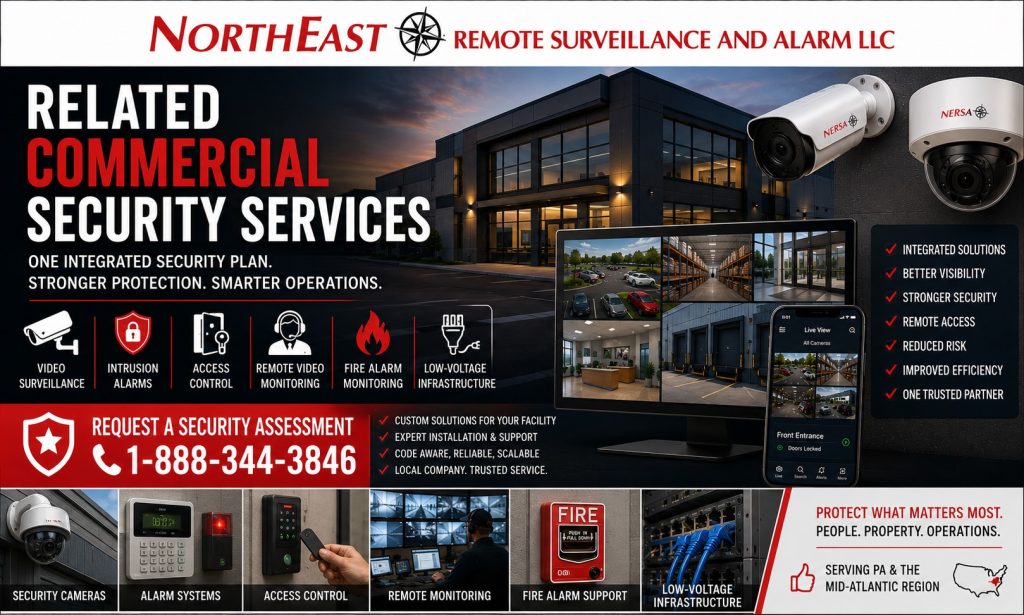
Related commercial security services help businesses connect cameras, alarms, access control, remote video monitoring, fire alarm support, and low-voltage infrastructure into one practical security plan.
Northeast Remote Surveillance and Alarm, LLC designs, installs, monitors, and supports commercial and industrial security systems for facilities that need dependable protection, clear upgrade planning, and long-term service throughout Pennsylvania and selected Mid-Atlantic markets.
For related guidance, see our Commercial and Industrial Security Systems planning for businesses that need more than a one-device solution.
Commercial Security Services That Work Together
A strong commercial security system is rarely just one product. Cameras provide visibility. Alarms detect unauthorized entry. Access control manages who can enter. Remote monitoring helps verify events. Fire alarm support protects life-safety communication. Low-voltage infrastructure keeps the system reliable.
When these services are planned separately, businesses often end up with disconnected equipment, weak documentation, different vendors, unreliable remote access, poor camera coverage, confusing alarm zones, and systems that are difficult to support.
NERSA helps businesses build a complete security plan where each service supports the others.
Commercial Security Camera Installation
Commercial security cameras help protect entrances, parking lots, customer areas, employee entrances, warehouses, loading docks, offices, retail spaces, and exterior doors. A properly designed camera system should provide clear video evidence, dependable recording, remote viewing, and coverage where incidents are most likely to happen.
Camera planning may include:
- Indoor cameras
- Outdoor cameras
- Parking lot cameras
- Loading dock cameras
- Entry and exit cameras
- Remote viewing
- Video recording
- Video retention planning
- Camera upgrades
- Recorder replacement
- Cloud or hybrid video options
- Network and PoE planning
Learn more about Commercial Security Camera Installation.
Commercial Alarm Systems
Commercial alarm systems help detect break-ins, forced doors, glass break events, interior motion, panic events, and unauthorized after-hours activity. A business alarm system should be designed around the doors, glass, employee flow, inventory risk, and monitoring response needs of the facility.
Alarm planning may include:
- Door contacts
- Overhead door contacts
- Motion detection
- Glass break detection
- Alarm keypads
- Cellular alarm communication
- Panic or duress devices
- Sirens
- Zone labeling
- Monitoring setup
- Emergency contact updates
- Alarm takeovers
- Video verification
Learn more about Commercial Alarm Systems.
Commercial and Industrial Access Control Installation
Access control helps businesses manage who can enter specific doors, when they can enter, and what areas they are allowed to access. This is especially useful for employee entrances, office doors, warehouse doors, stock rooms, server rooms, manager offices, multi-tenant spaces, and after-hours staff access.
Access control planning may include:
- Card readers
- Key fobs
- Mobile credentials
- PIN keypads
- Electric strikes
- Electrified locks
- Electrified trim
- Exit-device hardware
- Door position monitoring
- Request-to-exit devices
- Access schedules
- User permissions
- Access history
- Multi-location management
Learn more about Commercial & Industrial Access Control Installation.
Remote Video Monitoring
Remote video monitoring helps businesses improve after-hours protection by using video to support event review, alarm verification, trespass detection, suspicious activity response, and exterior property visibility. For higher-risk facilities, remote video monitoring can provide more useful information than a standard recording-only camera system.
Remote video monitoring may support:
- After-hours property activity
- Parking lot concerns
- Gate and fence line activity
- Loading dock activity
- Door-forced events
- Alarm verification
- Loitering and trespassing concerns
- Multi-site visibility
- Incident documentation
- Video-supported response planning
Learn more about Remote Video Monitoring.
Fire Alarm Monitoring and Life-Safety Support
Commercial fire alarm monitoring helps ensure fire alarm signals are transmitted to the monitoring center through an approved communication path. Many buildings also need communicator upgrades, monitoring account review, inspection readiness support, trouble signal review, supervisory signal review, and coordination with the building owner or authority having jurisdiction.
Fire alarm support may include:
- Fire alarm monitoring
- Cellular communicator upgrades
- IP or dual-path communication review
- Monitoring account updates
- Emergency contact review
- Signal testing support
- Trouble signal review
- Supervisory signal review
- Documentation support
- Inspection readiness planning
Learn more about Fire Alarm Monitoring.
Low-Voltage Cabling and Infrastructure
Low-voltage infrastructure is the foundation that keeps cameras, access control, alarm systems, intercoms, network equipment, PoE switches, wireless bridges, and monitoring equipment working properly. Poor cabling and weak network design can cause unreliable video, dropped cameras, failed access control devices, and repeated service problems.
Low-voltage planning may include:
- Camera cabling
- Access control wiring
- Alarm wiring
- PoE switch planning
- Network equipment cleanup
- Wireless bridges
- Fiber planning
- Equipment mounting
- UPS backup power
- Cable labeling
- Rack cleanup
- System documentation
- Future expansion planning
Learn more about Low-Voltage Cabling and Infrastructure.
Why Related Services Should Be Planned Together
Commercial security works best when the system is planned as one connected environment. A camera at an employee entrance becomes more useful when it supports access control events. An alarm signal becomes more useful when video can help verify what happened. Access control becomes stronger when doors, cameras, alarms, and user permissions are coordinated. Fire alarm monitoring becomes more reliable when the communication path and documentation are reviewed properly.
Planning related services together helps reduce:
- Duplicate equipment
- Poor camera placement
- Unlabeled alarm zones
- Unreliable remote viewing
- Weak door hardware planning
- Disconnected systems
- Conflicting vendor responsibilities
- Repeated service calls
- Future upgrade waste
- Poor documentation
A connected plan helps the business spend money where it matters most.
Common Facilities That Need Related Commercial Security Services
NERSA supports security planning for many commercial and industrial facilities, including:
- Warehouses
- Distribution centers
- Manufacturing facilities
- Offices
- Retail stores
- Restaurants
- Medical offices
- Gyms and fitness studios
- Salons and spas
- Churches and nonprofits
- Contractor shops
- Industrial parks
- Truck yards
- Parking lots
- Multi-location businesses
- Mixed-use commercial properties
Each facility has different risks, but most need a coordinated plan across cameras, alarms, access control, monitoring, and infrastructure.
Common Problems We Help Solve
Business owners often contact NERSA when their security systems are disconnected, outdated, unreliable, or no longer matched to the way the facility operates. Common problems include:
- Cameras that do not show useful detail
- No camera coverage at important doors
- Poor parking lot visibility
- Old alarm systems with unclear zones
- Alarm systems still using outdated communication paths
- Former employees still having access
- Too many keys in circulation
- No video verification for alarm events
- No remote viewing or unreliable remote viewing
- Access control that does not match employee schedules
- Poor low-voltage wiring
- Multiple vendors with no clear system ownership
- Fire alarm monitoring account issues
- No long-term upgrade plan
NERSA helps correct these issues with practical design, cleaner documentation, and serviceable infrastructure.
Our Related Commercial Security Services Approach
A strong commercial security plan starts with a site review. NERSA evaluates the building layout, doors, cameras, alarm system, access control, fire alarm monitoring path, network equipment, low-voltage cabling, parking areas, employee flow, customer flow, after-hours risk, and future expansion needs.
From there, we build a practical plan that may include new installation, retrofit, takeover, replacement, monitoring changes, camera upgrades, access control additions, alarm improvements, fire alarm communicator upgrades, or low-voltage cleanup.
The goal is to protect the facility with a system that works together and can be supported long term.
Request a Commercial Security Assessment
Protect your business with related commercial security services designed around cameras, alarms, access control, monitoring, fire alarm support, and low-voltage infrastructure.
Northeast Remote Surveillance and Alarm, LLC can help you evaluate what you have, identify what is missing, and build a security plan that supports your facility, staff, customers, property, and long-term operations.
Request a Security Assessment
Call 1-888-344-3846
Related Commercial Security Services
Commercial Security Camera Installation
Commercial Alarm Systems
Commercial & Industrial Access Control Installation
Remote Video Monitoring
Fire Alarm Monitoring
Low-Voltage Cabling and Infrastructure
Frequently Asked Questions
What are related commercial security services?
Related commercial security services are the connected security layers that help protect a business, including cameras, alarms, access control, remote video monitoring, fire alarm monitoring, and low-voltage infrastructure.
Why should cameras, alarms, and access control be planned together?
They should be planned together because each system can support the others. Cameras help verify alarm and access events, alarms detect unauthorized activity, and access control helps manage who enters the building.
Can NERSA upgrade only one part of a system?
Yes. NERSA can upgrade one part of a system, such as cameras, alarms, access control, monitoring, fire alarm communication, or low-voltage cabling, while also reviewing how that upgrade affects the rest of the facility.
Can existing equipment be reused?
Sometimes. Existing cameras, wiring, alarm contacts, access control hardware, conduit, or network equipment may be reusable if it is compatible, reliable, properly installed, and still supports the business need.
Do small businesses need all of these services?
Not always. Some businesses only need cameras and an alarm system. Others may need access control, remote monitoring, fire alarm support, or low-voltage upgrades. The right plan depends on the facility, risk, budget, and long-term goals.
Can related services be installed in phases?
Yes. Many commercial security projects can be phased. A business may start with cameras or alarm monitoring, then add access control, remote video monitoring, parking lot coverage, or infrastructure improvements later.
Can NERSA support multi-location businesses?
Yes. NERSA can help businesses standardize cameras, alarms, access control, monitoring, user permissions, remote viewing, and service documentation across multiple locations.
What is the best first step?
The best first step is a commercial security assessment. NERSA can review the current system, identify gaps, determine what can be reused, and recommend a practical plan for cameras, alarms, access control, monitoring, fire alarm support, and low-voltage infrastructure.
Compliance, Codes & Project Standards
NERSA plans commercial and industrial security work with applicable code, documentation, inspection and authority-having-jurisdiction requirements in mind. Requirements vary by system, property and jurisdiction. These resources support project planning; they do not establish legal compliance, certification or AHJ approval.
Related guidance: Regulatory compliance & inspection readiness · NERSA project standards · Documentation, testing & inspection readiness