Lehigh Valley Route 33 industrial corridor security systems should be designed around warehouse, distribution, manufacturing, freight, and industrial properties that operate with heavy vehicle movement, employee traffic, shipping and receiving activity, broad exterior exposure, and after-hours risk.
Northeast Remote Surveillance and Alarm, LLC provides commercial and industrial security systems for businesses along the Lehigh Valley section of the Route 33 corridor that need stronger visibility, tighter control, better event review, and a security design built around the way the property actually operates.
This page is focused specifically on the Lehigh Valley Route 33 Industrial Corridor. It sits under the broader Lehigh Valley Commercial and Industrial Security Systems page and routes businesses into the corridor page that best matches the property type or security concern.
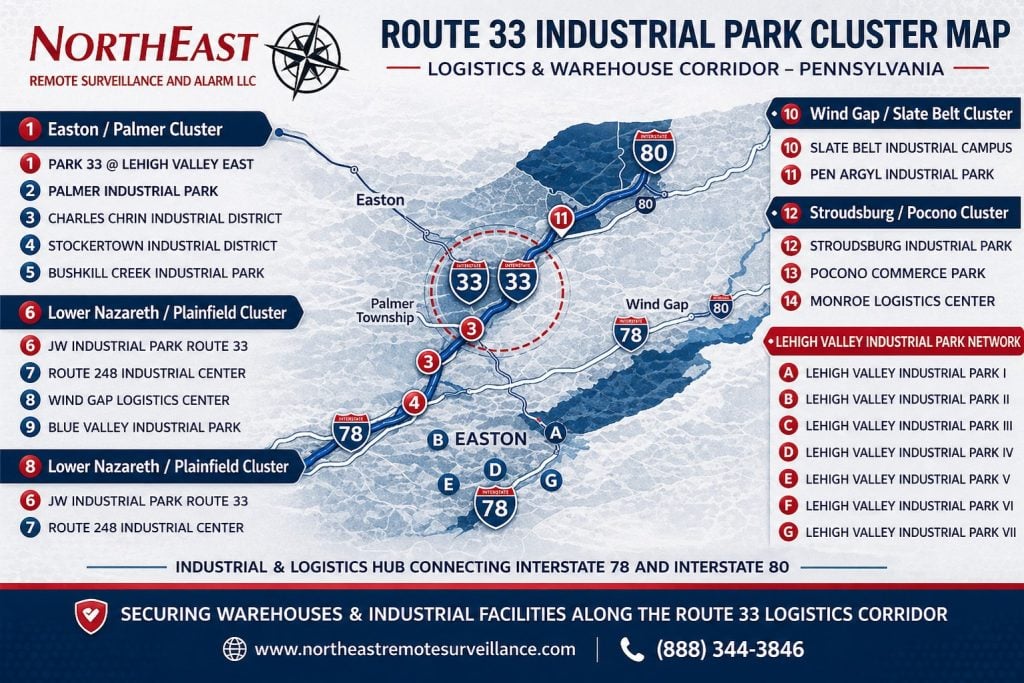
What This Lehigh Valley Route 33 Industrial Corridor Security System Page Covers
This page covers the Lehigh Valley portion of Route 33 only. It is not intended to cover the broader Route 33 corridor farther north outside the Lehigh Valley market.
It is a corridor hub for warehouses, distribution centers, manufacturing facilities, industrial parks, truck courts, loading docks, trailer yards, and multi-building commercial properties that depend on Route 33 for freight movement, site access, and daily operations.
Why the Route 33 Corridor Matters in the Lehigh Valley
The Lehigh Valley section of Route 33 supports a dense concentration of industrial, logistics, warehouse, and manufacturing activity. These facilities often connect to Interstate 78, Route 22, nearby industrial parks, and the broader Lehigh Valley distribution market.
That concentration creates security needs that are different from a small office or light commercial property. Security planning has to follow how vehicles, employees, vendors, freight, and after-hours activity move through the site.
Warehouses and Distribution Centers Along Route 33
Warehouse and distribution properties along Route 33 often need stronger visibility around loading docks, shipping and receiving areas, trailer parking, employee entrances, inventory exposure points, fenced sections, and exterior activity after hours.
For warehouse-focused protection, visit Warehouse Security Systems Along the Lehigh Valley Route 33 Industrial Corridor.
Manufacturing Facilities Along Route 33
Manufacturing facilities along the corridor often need security around production floors, employee entrances, maintenance rooms, raw material storage, finished goods areas, management offices, receiving zones, and exterior access points.
For manufacturing-focused protection, visit Manufacturing Facility Security Systems Along the Lehigh Valley Route 33 Industrial Corridor.
Industrial Parks and Multi-Building Sites
Industrial parks and multi-building sites along Route 33 often need stronger control over shared access points, common exterior areas, parking lots, truck movement, service entrances, and activity across multiple buildings or operating zones.
For broader site and shared-access protection, visit Industrial Park Security Systems Along the Lehigh Valley Route 33 Industrial Corridor.
Loading Docks, Shipping, and Receiving
Many Route 33 corridor properties are defined by freight movement. Loading docks, receiving lanes, outbound shipping areas, dock doors, and freight-handling zones are often where shrink, disputes, accidents, unauthorized access, and after-hours exposure create the greatest operational risk.
For dock-focused protection, visit Loading Dock Security Systems Along the Lehigh Valley Route 33 Industrial Corridor.
Truck Yards, Trailer Areas, and Exterior Flow
Trailer yards, truck courts, gate lanes, fenced sections, service drives, and exterior storage zones often require broader visibility than the rest of the property. These areas may remain exposed overnight even when the building itself is closed or lightly staffed.
For trailer parking, truck movement, yard activity, and perimeter exposure, visit Truck Yard and Trailer Security Systems Along the Lehigh Valley Route 33 Industrial Corridor.
Vehicle Documentation at Gates and Entrances
Some corridor properties need more than broad lot coverage. They need stronger vehicle documentation at truck entrances, service drives, gate lanes, fleet yards, employee parking entrances, or contractor access points.
For vehicle-entry documentation, visit License Plate Recognition Systems Along the Lehigh Valley Route 33 Industrial Corridor.
After-Hours Awareness Along Route 33
Many Route 33 corridor properties become more exposed after normal daytime operations slow down or end. Overnight truck movement, trailer storage, exterior activity, low-staff periods, broad footprints, and separated operating zones often make after-hours awareness a major part of the security plan.
For event-based oversight and exterior visibility, visit License Plate Recognition Systems Along the Lehigh Valley Route 33 Industrial Corridor
Code-Aware Corridor Security Planning
Security systems along the Lehigh Valley Route 33 industrial corridor can support incident documentation, access accountability, workplace safety review, insurance documentation, life-safety coordination, and safer operation around docks, yards, vehicles, restricted areas, and after-hours activity.
Security systems do not replace code compliance, OSHA programs, NFPA standards, or required life-safety procedures. For broader code-conscious planning, visit Code and Compliance for Commercial Security Systems
Use This Hub to Find the Right Route 33 Corridor Page
This page is a corridor routing page. It should help businesses move into the tighter page that matches the property or operational concern.
Start with the warehouse page for warehouse and distribution properties. Use the loading dock page for dock doors, receiving lanes, and freight movement. Use the truck yard page for trailer rows, truck courts, yard lanes, and perimeter exposure. Use the manufacturing page for production operations and restricted spaces. Use the industrial park page for multi-building or shared-access sites. Use the LPR page for vehicle documentation. Use the remote monitoring page for after-hours exterior awareness.
Security Systems for Route 33 Corridor Properties
Northeast Remote Surveillance and Alarm, LLC provides security systems for Route 33 corridor properties that need stronger protection around freight movement, employee access, restricted areas, exterior exposure, and after-hours risk.
These projects often involve warehouses, distribution centers, manufacturing facilities, industrial parks, truck courts, loading docks, fleet areas, and high-traffic industrial properties that operate in a more demanding environment than a standard commercial site.
Request a Route 33 Corridor Security Assessment
If your property operates along the Lehigh Valley Route 33 industrial corridor and needs stronger visibility, tighter control, better after-hours protection, or a more practical commercial and industrial security design, Northeast Remote Surveillance and Alarm, LLC can help.
Call 1-888-344-3846 to request a Route 33 corridor security assessment.
FAQ About Lehigh Valley Route 33 Industrial Corridor Security Systems
What is the Lehigh Valley Route 33 Industrial Corridor?
The Lehigh Valley Route 33 Industrial Corridor is the section of Route 33 supporting warehouse, distribution, manufacturing, industrial park, and freight-heavy properties in and around the Lehigh Valley market.
What types of properties does this page support?
This page supports warehouses, distribution centers, manufacturing facilities, industrial parks, truck courts, trailer yards, loading docks, fleet areas, and multi-building commercial properties along the Lehigh Valley section of Route 33.
Is this page for the entire Lehigh Valley Route 33 Industrial Corridor?
No. This page is focused on the Lehigh Valley section of Route 33 only. Broader Route 33 coverage outside the Lehigh Valley should remain separate if needed.
Why do Route 33 properties need specialized security planning?
Route 33 properties often involve truck traffic, freight movement, multiple entrances, dock activity, trailer storage, employee access, exterior exposure, and after-hours risk that require more planning than a standard commercial site.
Is this page linked to OSHA and NFPA pages?
Not directly unless needed. This corridor hub should keep compliance simple and link to Code and Compliance for Commercial Security Systems, which can route users to OSHA, NFPA, UCC, and related standards pages.