
Manufacturing facility security systems along the Lehigh Valley Route 33 Industrial Corridor should be designed around production areas, employee movement, restricted spaces, material storage, equipment protection, and after-hours exposure.
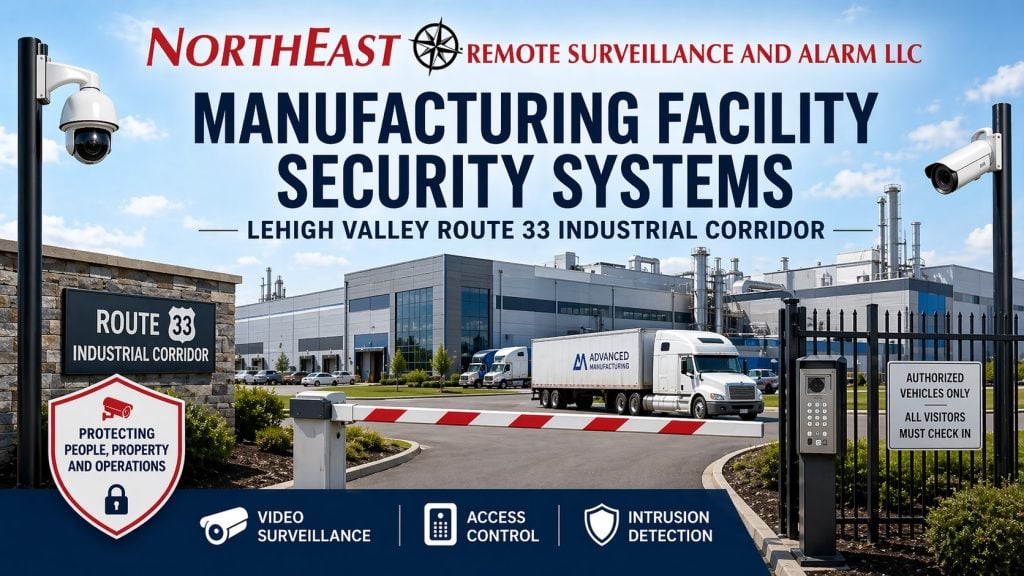
Northeast Remote Surveillance and Alarm, LLC designs and installs manufacturing facility security systems for commercial and industrial properties along the Lehigh Valley Route 33 corridor that need stronger visibility, tighter access control, cleaner incident review, and more dependable protection around daily operations.
For broader corridor planning, visit Lehigh Valley Route 33 Industrial Corridor Security Systems.
Where Manufacturing Facilities Need Stronger Security
Review visibility and entry conditions at employee entrances, production support areas, office-to-plant transitions, maintenance rooms, parts storage, raw material areas, finished goods staging, exterior doors, and after-hours approaches.
Manufacturing security planning addresses production workflow, restricted access, and operational risk.
Production Areas and Internal Visibility
Manufacturing sites often need better visibility around production-adjacent spaces, supervisor areas, internal corridors, support rooms, and selected workflow zones. Proper camera placement can help document incidents, improve accountability, and support review when questions arise about activity inside the facility.
For broader camera system planning, visit commercial and industrial video surveillance systems.
Restricted Rooms and Controlled Access
Manufacturing buildings often include areas that should not be open to every employee, vendor, or visitor. Tool rooms, maintenance rooms, electrical rooms, IT spaces, parts storage, management areas, and raw material spaces may need tighter access control and cleaner entry records.
For broader access control planning, visit commercial access control systems.
After-Hours Protection and Alarm Verification
Many manufacturing facilities operate across shifts or have periods when only limited staff are present. Side doors, rear doors, service entrances, loading-adjacent areas, and isolated building edges often need stronger after-hours protection.
For intrusion detection and alarm planning, visit commercial alarm systems.
If the main need is active off-hours oversight, visit remote video monitoring.
Common Manufacturing Security Priorities
Employee Entrances and Shift Changes
Document normal shifts, overtime approval, contractor windows, and the person who can change a door schedule. Test an approved employee and an out-of-schedule credential at the entrances included in the project.
Office-to-Production Transitions
Define where an office visitor waits, who authorizes entry to production, and which doors separate public or administrative areas from the plant. Review temporary access and escort procedures with the responsible operations team.
Materials, Parts, and Finished Goods
Identify the material handoffs that need a record and where items may be staged before release. Select views that show the relevant movement with normal equipment and stored goods present, then assign responsibility for retrieving the recording.
Mechanical, Electrical, IT, and Maintenance Rooms
Assign room permissions to approved roles and define temporary access for service contractors. Physical entry authorization does not itself authorize equipment operation or replace the facility’s training and safety procedures.
Exterior Doors and Building Edges
Record expected late work, delivery exceptions, and the contacts responsible for reviewing exterior events. If monitoring is included, agree on the covered areas, hours, event types, and response instructions before enabling alerts.
Project Scope and Related Resources
If the facility is more warehouse-driven, visit Warehouse Security Systems Along the Lehigh Valley Route 33 Industrial Corridor.
If the site is distribution-focused, visit Distribution Center Security Systems Along the Lehigh Valley Route 33 Industrial Corridor.
If the main concern is dock activity, visit Loading Dock Security Systems Along the Lehigh Valley Route 33 Industrial Corridor.
If the property is part of a multi-building industrial site or business park, visit Industrial Park Security Systems Along the Lehigh Valley Route 33 Industrial Corridor.
Request Manufacturing Facility Security Along Route 33
Bring a site layout, operating schedules, existing equipment records, and the first issues you need to resolve. Agree on installation phases that fit production, then verify representative camera views, door permissions, alarm events, and recording exports with the staff responsible for the system. Record unresolved conditions and the person assigned to follow up.
Request a Security Assessment to discuss your facility, production workflow, access points, restricted areas, and security needs.
Compliance, Codes & Project Standards
NERSA plans commercial and industrial security work with applicable code, documentation, inspection and authority-having-jurisdiction requirements in mind. Requirements vary by system, property and jurisdiction. These resources support project planning; they do not establish legal compliance, certification or AHJ approval.
Related guidance: Regulatory compliance & inspection readiness · Manufacturing compliance planning · NERSA project standards