
Coordinate Route 33 warehouse security around loading docks, trailer areas, staff entrances, restricted storage, and monitored events.

Contact Northeast Remote Surveillance and Alarm, LLC
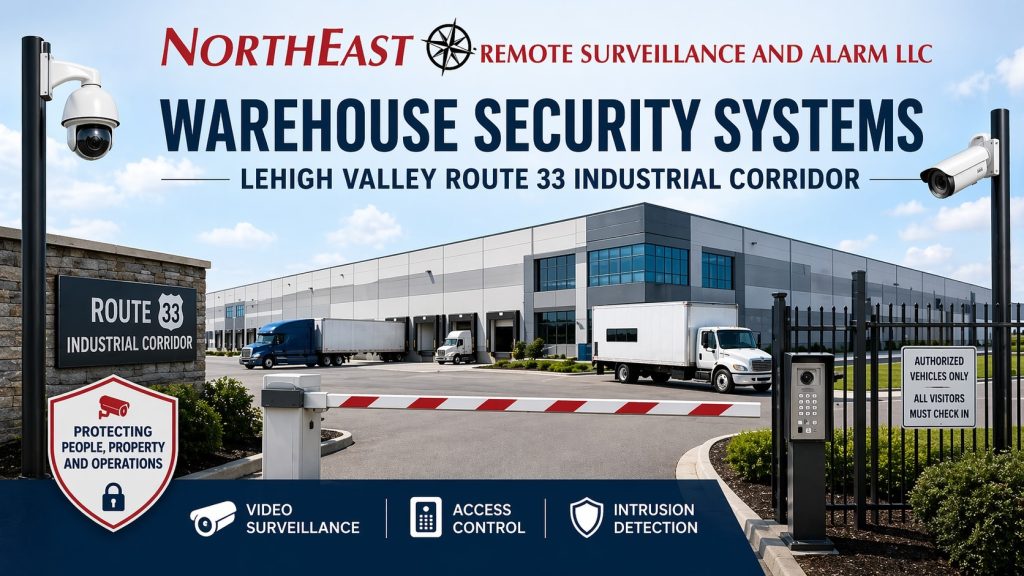
Warehouse properties often have large footprints, multiple access points, employee traffic, vendor activity, inventory exposure, and after-hours risk that require a more deliberate security approach.
NERSA designs and installs warehouse security systems along the Lehigh Valley portion of Route 33.
We plan camera views, controlled access, and event verification around inventory and daily operations.
For related area planning, see the Route 33 corridor security guide.
Warehouse Security Challenges Along the Lehigh Valley Route 33 Corridor
Warehouses often have larger footprints and more exterior doors than other commercial buildings. They may handle trucks, temporary workers, several shifts and multiple staff entrances. Goods and equipment may be staged, stored or moved throughout the day. These conditions shape the security plan.
Route 33 warehouse operators need to see important activity, limit unauthorized entry, improve accountability and verify incidents promptly. Risks include forced entry after hours, uncontrolled movement and gaps in visibility. Poor records and delayed response can also make incidents harder to resolve.
Warehouse security planning should support how the building actually functions, not rely on generic equipment placement that leaves important areas exposed.
What a Warehouse Security System Should Help Accomplish
Better Visibility in Critical Warehouse Areas
Warehouse facilities often need stronger visibility at employee entrances, exterior doors, warehouse-floor transition points, inventory-adjacent areas, and selected exterior sections of the building. Better visibility helps managers review events, verify incidents, and understand what happened during active operations or after hours.
For broader camera planning, visit our commercial and industrial video surveillance systems page.
More Controlled Entry and Interior Movement
Warehouse properties also benefit from better control over who can enter the building, when certain doors are accessible, and which areas should remain restricted. This can improve accountability while reducing unauthorized access to operational areas, offices, storage zones, and support spaces.
For deeper entry-control planning, visit our commercial access control systems page or our Warehouse Access Control Systems Along the Lehigh Valley Route 33 Industrial Corridor page.
Faster Verification When Alarm Events Occur
After-hours events, weekend activity, and unexpected openings can create major problems if there is no reliable way to verify what is happening. A better warehouse security design helps improve response by making alarm conditions more useful and easier to assess.
For broader alarm planning, visit our commercial alarm systems page.
Common Areas of Concern at Warehouse Facilities
Warehouse properties often share certain recurring risk points. A good warehouse security system should be designed around those areas rather than treated like a one-size-fits-all package.
Employee Entrances and Shift Change Activity
Employee entry points often see concentrated movement at the beginning and end of shifts. These areas can become weak points when traffic is heavy and supervision is limited. Clear visibility and controlled access can improve accountability without disrupting operations.
Office-to-Warehouse Transition Points
Many warehouse buildings include front office areas, dispatch spaces, management offices, and operational warehouse sections that should not all be treated the same. Security planning often needs to reflect the transition between public-facing or administrative areas and restricted warehouse operations.
Inventory and Staging Areas
Not every part of a warehouse needs the same level of protection, but areas connected to stored product, staged materials, higher-value items, or operational support often justify stronger visibility and tighter control. These spaces can affect both shrink risk and operational continuity.
Exterior Doors and Building Edges
Warehouses often have side doors, rear doors, service entrances, and less visible exterior sections that are more vulnerable after hours. These parts of the building frequently require stronger planning than the front entrance alone.
Dock-Adjacent Movement Areas
Shipping and receiving areas create warehouse security needs around dock traffic, material movement, and controlled entry.
Review the Route 33 loading dock security guide for dock-specific planning.
For more dock-specific planning, visit our Loading Dock Security Systems Along the Lehigh Valley Route 33 Industrial Corridor page.
Why Warehouse Security Along Route 33 Requires a Site-Specific Approach
The Lehigh Valley Route 33 Industrial Corridor includes a high concentration of industrial and logistics properties with active employee traffic, delivery activity, contractor access, and varied operating schedules. Warehouse buildings along this corridor are not all used the same way. Some support regional distribution, some serve mixed storage and operational functions, and some operate as part of larger industrial or logistics campuses.
Because of that, warehouse security systems should be designed around the actual building layout, traffic flow, operational schedule, and exposure points of the specific property. A warehouse with large employee counts and steady shipping activity will not have the same priorities as a lower-traffic storage-oriented facility. A site with multiple tenant areas, office transitions, or isolated exterior sections may also require a different approach than a straightforward single-user building.
Project Scope and Related Resources
Use this guide to plan warehouse security along Route 33, then explore the related guides for loading docks, vehicle entrances, and other areas of your property.
If the property is primarily focused on broader logistics or distribution flow, visit our Distribution Center Security Systems Along the Lehigh Valley Route 33 Industrial Corridor page.
If the biggest concern is dock activity, trailer movement, and shipping or receiving exposure, visit our Loading Dock Security Systems Along the Lehigh Valley Route 33 Industrial Corridor page.
If the main objective is stronger control of warehouse entry points, credentials, and restricted doors, visit our Warehouse Access Control Systems Along the Lehigh Valley Route 33 Industrial Corridor page.
If the priority is theft deterrence and loss prevention around high-risk logistics activity, visit our Cargo Theft Prevention Systems Along the Lehigh Valley Route 33 Industrial Corridor page.
If the property is part of a broader multi-building or park-wide environment, visit our Industrial Park Security Systems Along the Lehigh Valley Route 33 Industrial Corridor page.
If the building is more production-oriented than warehouse-oriented, visit our Manufacturing Facility Security Systems Along the Lehigh Valley Route 33 Industrial Corridor page.
Work With a Commercial and Industrial Security Integrator That Understands Warehouse Operations
Northeast Remote Surveillance and Alarm, LLC provides warehouse security systems along the Lehigh Valley Route 33 Industrial Corridor for businesses that need more than generic security installation. We design systems around how warehouse facilities actually operate, where visibility matters most, which areas need stronger control, and how to improve protection without creating unnecessary disruption.
NERSA can assess your warehouse along the Lehigh Valley Route 33 corridor. Tell us about camera coverage, controlled access, and after-hours protection. We can plan connected improvements around your site and daily operations.
Contact Northeast Remote Surveillance and Alarm, LLC to discuss warehouse security systems along the Lehigh Valley Route 33 Industrial Corridor.
Compliance, Codes & Project Standards
NERSA plans commercial and industrial security work with applicable code, documentation, inspection and authority-having-jurisdiction requirements in mind. Requirements vary by system, property and jurisdiction. These resources support project planning; they do not establish legal compliance, certification or AHJ approval.
Related guidance: Regulatory compliance & inspection readiness · Warehouse & logistics compliance · NERSA project standards