
Plan Scranton loading dock surveillance so your team can review freight handoffs, door activity, and vehicle movement.

Commercial & Industrial Security and Life Safety Assessment
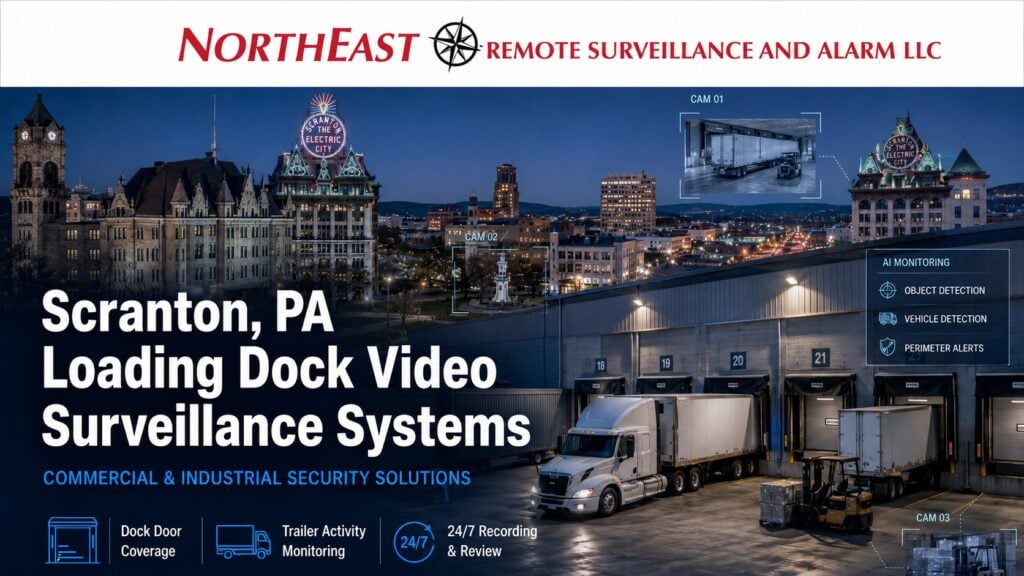
For the broader system plan and related facility applications, visit the Scranton commercial video surveillance guide.
Loading docks bring employees, drivers, vendors, forklifts, trailers, inventory, vehicles, and open doors together in a relatively small operating zone. Dedicated camera views help staff document freight handoffs, door activity, and incidents in that shared space.
Northeast Remote Surveillance and Alarm, LLC (NERSA) designs and installs loading dock cameras in Scranton, Pennsylvania. We plan views for usable incident records and daily oversight, with connections to the facility’s broader security systems.
Explore this guide: Loading Dock Video Surveillance in Scranton, PA · Why Loading Docks Require Dedicated Camera Design · Camera Coverage for Loading Dock Doors · Interior Loading Dock Cameras · Frequently Asked Questions
Loading Dock Video Surveillance in Scranton, PA
A properly designed loading dock surveillance system should help answer important questions after an incident:
- Which trailer was at the dock?
- When did it arrive and leave?
- Who entered or exited the loading area?
- What product was loaded or unloaded?
- Was inventory damaged?
- Was freight missing?
- Which employee or driver was involved?
- Did a forklift strike a dock, trailer, rack, or person?
- Was a dock door left open?
- Did unauthorized activity occur after hours?
The objective is not simply to record the area.
The objective is to create usable video evidence that allows management, security personnel, and operations teams to reconstruct what occurred.
Why Loading Docks Require Dedicated Camera Design
Loading docks create difficult surveillance conditions.
Common challenges include:
- Strong daylight entering through open dock doors
- Dark interior warehouse conditions
- Trailer interiors
- High ceilings
- Rapid forklift movement
- Frequent door opening and closing
- Employees standing close to cameras
- Large vehicles blocking views
- Changing trailer positions
- Exterior weather conditions
- Nighttime deliveries
- Multiple adjacent dock positions
A general warehouse camera mounted high above the dock may provide useful overview coverage but insufficient detail for identification.
Dedicated loading dock cameras should be selected and positioned according to the specific information the facility needs to capture.
Camera Coverage for Loading Dock Doors
Each loading dock should be evaluated separately.
Camera coverage may include:
- Interior dock approach
- Exterior dock face
- Trailer connection point
- Loading area
- Driver access door
- Dock staging area
- Adjacent pedestrian routes
- Forklift travel lanes
Depending on the facility, one dock position may require more than one view.
A wide-angle camera can provide situational awareness while a second camera provides closer identification or shipment-detail coverage.
Interior Loading Dock Cameras
Interior cameras can document activity immediately inside the warehouse.
Typical applications include:
- Pallet movement
- Forklift activity
- Product staging
- Employee activity
- Shipment preparation
- Inventory transfer
- Dock-door activity
- Safety incidents
Camera positions should minimize obstruction from racking, stored products, forklifts, and trailers.
Mounting height should also be considered carefully.
A camera mounted too high may show the overall event but fail to capture enough detail to identify people, products, or actions.
Exterior Loading Dock Cameras
Exterior cameras can provide visibility of the trailer and surrounding yard.
Important areas may include:
- Trailer approaches
- Dock positions
- Vehicle staging
- Driver movement
- Trailer doors
- Exterior employee doors
- Adjacent yard traffic
- Building perimeter
Outdoor loading dock cameras should be selected for the expected weather, lighting, and environmental conditions.
Shipping and Receiving Documentation
Loading dock video can be valuable for investigating shipping and receiving discrepancies.
Recorded video may help establish:
- When a carrier arrived
- Which trailer used a dock
- When unloading began
- What personnel were present
- How cargo was handled
- Whether visible damage existed
- When the trailer departed
This information can support internal investigations involving missing, damaged, or disputed shipments.
Forklift Incident Investigation
Forklifts and other material-handling equipment create significant activity around loading areas.
Video surveillance can help reconstruct incidents involving:
- Dock impacts
- Trailer strikes
- Rack damage
- Product damage
- Equipment collisions
- Pedestrian incidents
- Unsafe maneuvering
Camera placement should provide sufficient context to determine how the event developed rather than focusing only on a narrow area.
Trailer Yard and Dock Integration
Loading dock surveillance should often be coordinated with exterior yard coverage.
A complete dock-area design may include cameras monitoring:
- Yard entrances
- Trailer staging areas
- Dock positions
- Trailer parking
- Employee parking
- Gates
- Perimeter fencing
This allows an investigation to follow a vehicle from the property entrance to the loading dock and back out again.
License Plate Recognition at Logistics Facilities
Facilities requiring vehicle identification may also use dedicated license plate recognition.
LPR can be useful at:
- Truck entrances
- Exit lanes
- Controlled gates
- Employee vehicle entrances
- Restricted logistics areas
Reliable license plate capture requires dedicated design.
Important factors include:
- Vehicle speed
- Camera angle
- Lane width
- Capture distance
- Lighting
- Headlight glare
- Lens selection
- Exposure settings
A general dock or parking-lot camera should not be expected to perform the same function as a dedicated LPR camera.
AI Video Analytics for Loading Dock Security
Modern video surveillance systems may use analytics to classify defined activity.
Depending on the platform, analytics may detect:
- People
- Vehicles
- Trucks
- Movement direction
- Restricted-area entry
- Line crossing
- Loitering
- After-hours activity
Analytics can help security teams locate relevant events more quickly and may support proactive alerts.
They should be configured specifically for the loading dock environment to avoid unnecessary alarms caused by routine operational activity.
After-Hours Loading Dock Monitoring
Loading docks can become vulnerable when normal operations stop.
After-hours concerns may include:
- Unauthorized vehicles
- Theft
- Trespassing
- Open dock doors
- Trailer tampering
- Exterior equipment theft
- Unauthorized employee activity
Video analytics and remote monitoring may be used to identify selected activity during periods when the site is lightly staffed or unoccupied.
Loading Dock Lighting Conditions
Lighting can vary dramatically around loading docks.
Typical conditions include:
- Bright exterior daylight
- Dark trailer interiors
- Dim warehouse interiors
- Headlights
- Security lighting
- Nighttime delivery conditions
Wide dynamic range and low-light capabilities may be important where cameras must view both bright exterior areas and darker interior spaces.
Camera selection should be based on real site conditions rather than resolution alone.
Recording and Video Retention
Loading dock investigations may not occur immediately after the event.
Organizations should therefore determine how long recorded video must be retained.
Retention requirements may depend on:
- Internal policy
- Shipping investigation timelines
- Insurance requirements
- Camera quantity
- Resolution
- Recording method
- Available storage
Storage requirements should be calculated as part of the surveillance design.
Integrating Loading Dock Video With Access Control
Many warehouse and logistics facilities use controlled employee or driver entrances near loading docks.
Video surveillance can be integrated with access control to provide additional event context.
An investigation may include:
- Credential used
- Door accessed
- Event time
- Associated camera footage
This can simplify review of employee, vendor, and contractor activity.
Video-Verified Intrusion Protection
Loading docks can also be part of a commercial intrusion system.
When a dock-door contact, motion detector, perimeter device, or other sensor activates, associated video may provide visual context.
This can help determine whether the event involves:
- Authorized personnel
- Unauthorized activity
- A vehicle
- An open dock door
- Environmental movement
Video verification can provide more useful information than an alarm signal alone.
Network Infrastructure for Loading Dock Cameras
Loading dock cameras are typically part of a larger IP surveillance network.
Infrastructure may include:
- Cat6 cabling
- PoE network switches
- Fiber-optic backbone connections
- Network closets
- Equipment racks
- UPS backup
- Surge protection
- Secure remote access
Large warehouse facilities may require fiber between distant areas or separate buildings.
Infrastructure should be planned with future camera expansion in mind.
Existing Loading Dock Camera Upgrades
A complete replacement may not always be necessary.
Existing infrastructure may sometimes be retained, including:
- IP cameras
- Ethernet cabling
- Fiber
- Network switches
- Racks
- Recording servers
An upgrade assessment can identify weak coverage, outdated cameras, poor image quality, insufficient storage, or compatibility limitations.
Modernization can then focus on the components that actually need replacement.
Common Loading Dock Surveillance Design Mistakes
Common problems include:
- Cameras mounted too high
- Excessively wide fields of view
- No dedicated facial identification coverage
- Poor exterior lighting compensation
- Cameras blocked by trailers
- No coverage of driver entrances
- Insufficient recording retention
- No yard integration
- No redundancy for critical areas
- Network switches with inadequate PoE capacity
These issues are easier to correct during the design stage than after installation.
Scranton Loading Dock Video Surveillance Planning Checklist
Before installing or upgrading a loading dock surveillance system, evaluate:
- How many dock positions require coverage?
- Is interior and exterior coverage needed?
- Are driver entrances monitored?
- Is facial identification required?
- Must shipment movement be documented?
- Are forklift incidents a concern?
- Is trailer-yard coverage required?
- Is license plate capture required?
- Are nighttime deliveries common?
- How long must video be retained?
- Should video integrate with access control?
- Should video verify intrusion alarms?
- Are AI analytics required?
- Is remote monitoring required?
- How much future expansion is expected?
Loading Dock Surveillance for Scranton Warehouses and Industrial Facilities
Scranton-area warehouses, manufacturing facilities, logistics centers, and distribution operations can benefit from surveillance systems specifically designed around loading dock activity.
A complete loading dock surveillance strategy may combine:
dock cameras + yard surveillance + LPR + analytics + recording + access control integration + intrusion verification + network infrastructure.
Each component should support the facility’s actual operating and security requirements.
Northeast Remote Surveillance and Alarm, LLC
Northeast Remote Surveillance and Alarm, LLC (NERSA) provides professional commercial and industrial security-system design and installation throughout Scranton and Northeastern Pennsylvania.
NERSA designs loading dock video surveillance as part of a broader security architecture that may include:
- Commercial video surveillance
- AI video analytics
- Warehouse surveillance
- Access control
- Intrusion detection
- Remote video monitoring
- License plate recognition
- Network and fiber infrastructure
For broader Scranton video-surveillance planning, continue to the primary:
Scranton, PA Commercial Video Surveillance Systems
For broader regional security planning, continue to:
Northeastern Pennsylvania Commercial & Industrial Security Systems
Request a Loading Dock Video Surveillance Assessment
For professional loading dock surveillance design and installation in Scranton, PA, contact Northeast Remote Surveillance and Alarm, LLC (NERSA) at 1-888-344-3846 or schedule a Commercial & Industrial Security and Life Safety Assessment
Frequently Asked Questions
What cameras are best for loading docks?
The correct cameras depend on the surveillance objective. Loading docks may use fixed, multi-sensor, low-light, wide-dynamic-range, exterior, or specialized cameras in different locations.
Does every loading dock need its own camera?
Not necessarily, but each dock position should have sufficient coverage to document the required activity. Some facilities use shared overview cameras combined with dedicated cameras at higher-risk dock positions.
Can loading dock cameras identify drivers?
Yes, when cameras are positioned specifically for facial identification. High-mounted overview cameras may not provide sufficient facial detail.
Can cameras document damaged freight?
Video can help document loading, unloading, handling, and visible events surrounding freight movement, depending on camera position and image quality.
Can loading dock cameras monitor forklifts?
Yes. Properly positioned cameras can support investigation of forklift activity, equipment impacts, product damage, and workplace incidents.
Can video surveillance capture license plates at loading docks?
Reliable license plate capture usually requires dedicated LPR camera design. General surveillance cameras may not consistently provide readable plates.
Can loading dock video integrate with access control?
Yes. Video can be associated with door and credential events to provide additional context during investigations.
Can loading dock cameras be monitored remotely?
Yes. Depending on the selected system and network architecture, authorized users may be able to securely view live and recorded video remotely.
Can AI analytics detect after-hours activity?
Many modern platforms can classify people, vehicles, and other defined activity. Analytics must be properly configured for the specific dock and yard environment.
Can an existing loading dock surveillance system be upgraded?
Often yes. Existing cameras, cabling, fiber, switches, and recording infrastructure may sometimes be reused when they remain compatible and reliable.
Compliance, Codes & Project Standards
NERSA plans commercial and industrial security work with applicable code, documentation, inspection and authority-having-jurisdiction requirements in mind. Requirements vary by system, property and jurisdiction. These resources support project planning; they do not establish legal compliance, certification or AHJ approval.
Related guidance: Regulatory compliance & inspection readiness · Video surveillance compliance · NERSA project standards