A Complete Guide to Protecting Warehouses, 3PL Facilities, Cross-Dock Operations & Industrial Campuses
Commercial Video Surveillance for Logistics & Distribution Centers by Northeast Remote Surveillance and Alarm, LLC (NERSA). Logistics and distribution centers are built for velocity—trailers in, freight staged, cartons scanned, pallets wrapped, trucks out. That speed and volume create risk concentration points: dock doors, staging lanes, returns processing, high-value cages, employee entrances, yard approaches, and shared parking. In this environment, commercial video surveillance is not just recording—it is operational intelligence, loss prevention, and risk documentation.
n This comprehensive guide explains how to design, deploy, and govern video surveillance systems for logistics and distribution centers so they reduce shrink, support safety compliance, accelerate investigations, and scale across multi-building campuses.
Call NERSA for an assessment. 1-888-344-3846
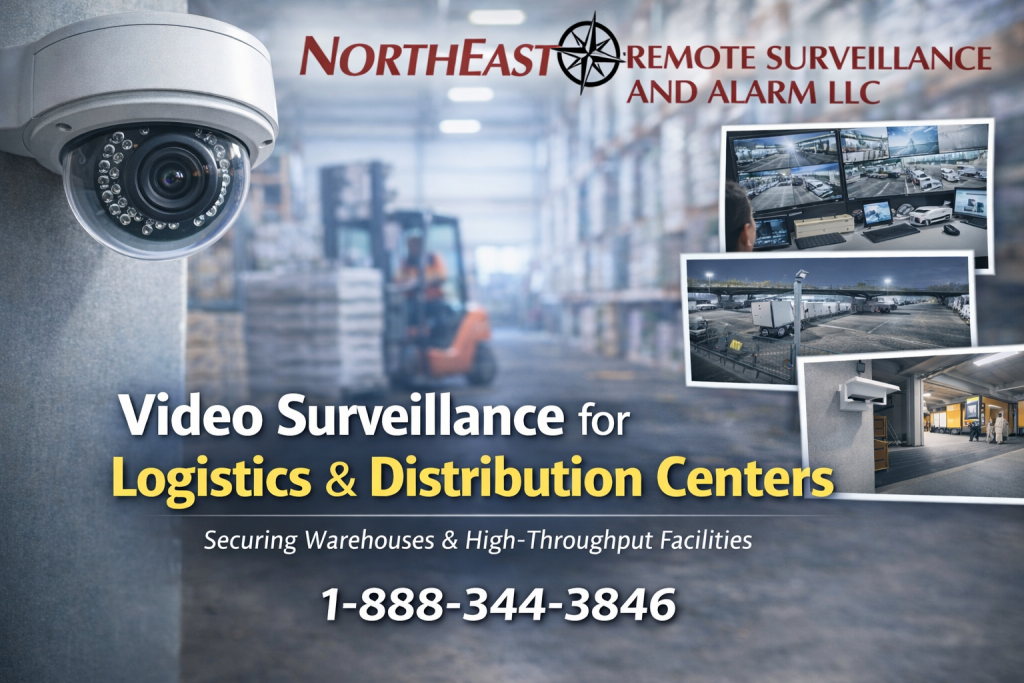
Why Distribution Centers Require Specialized Video Surveillance
Warehouses and logistics facilities differ from office and retail properties in several critical ways:
- Massive square footage with high ceilings
- Long cable runs and infrastructure challenges
- Continuous dock activity and trailer turnover
- Third-party driver traffic
- Seasonal workforce surges
- High-value inventory concentrated at touchpoints
- Multi-shift operations
- Exterior yards often spanning acres
Video systems in these environments must be engineered—not “installed.”
The 7 Critical Surveillance Zones in Logistics Facilities
A properly engineered warehouse surveillance system covers distinct risk layers.
Zone 1: Vehicle Ingress & Egress
Objective: Create an audit trail of all vehicles entering and leaving.
Key Considerations:
- Front plate capture where feasible
- Wide context view to identify vehicle type and driver
- Lighting compatibility for day/night
- Coverage of guard shacks or scale houses
If you cannot document who entered your property, you cannot investigate yard loss effectively.
Zone 2: Yard & Perimeter Coverage
Large DC campuses often have extensive yard areas.
Challenges:
- Low lighting at night
- Long fence lines
- Equipment storage and trailer staging
- Blind corners at building setbacks
Best Practice:
- Cover approach paths rather than simply pointing cameras at fences
- Avoid over-reliance on ultra-wide lenses that cannot identify individuals
- Pair video with analytics only where response procedures exist
Zone 3: Dock Door Exterior Coverage
Dock doors represent the highest shrink exposure in most logistics operations.
Critical Camera Views:
- Trailer backing position
- Dock seal area
- Driver interaction with dock equipment
- Exterior staging
Common Mistake:
Only covering the interior side of the dock.
Zone 4: Dock Door Interior & Staging
Inside the building, surveillance must document:
- Pallet staging
- Scan stations
- Cross-dock transfers
- Returns processing
- High-value item handling
Design Principles:
- Identification-level resolution at critical touchpoints
- Overviews for context
- Avoid camera placement directly in forklift path
Zone 5: Employee Entrances & Time-Clock Areas
Shift changes create predictable vulnerability windows.
Coverage Should Include:
- Credential presentation point
- Face-level identification
- Wide view for tailgating documentation
Integration with access control provides powerful investigative capability.
Zone 6: High-Value & Restricted Areas
Areas such as:
- IT/server rooms
- Tool cribs
- High-value inventory cages
- HR offices
Require:
- Tight field-of-view identification
- Continuous recording
- Clear retention policy
Zone 7: Shared Spaces & Parking
Parking lots and pedestrian routes are often overlooked.
Reasons to Monitor:
- Workplace incidents
- After-hours loitering
- Vehicle damage claims
- Employee safety
Designing an Evidence-First Surveillance System
Video that “looks good” is not the same as video that holds up in investigation.
An evidence-first system answers:
- Can you clearly identify a person at a door?
- Can you document who touched a pallet?
- Can you show vehicle movement through the yard?
- Can you export video quickly and securely?
- Can you verify access events with video?
- Learn more about NERSA Video Surveillance Solutions
Resolution Strategy for Warehouses
High ceilings and large open spaces require careful lens and mounting selection.
General Guidelines:
- Identification zones → Higher resolution, tighter field of view
- Context zones → Balanced resolution for coverage
- Yard/perimeter → Designed for distance clarity
Avoid:
- Mounting too high without lens adjustment
- Using only wide-angle cameras
AI Video Analytics in Logistics Environments
Artificial intelligence can enhance DC surveillance—but must be deployed carefully.
Common Applications:
- Person detection after hours
- Vehicle detection in restricted areas
- Line-crossing alerts at yard boundaries
- Loitering detection near dock doors
- Object classification (person vs forklift vs truck)
Key Principle:
Analytics should reduce workload, not create alert fatigue.
Learn more about fully customizable AI Video Surveillance we can provide alerts or just AI search ask us about the abilities of AI it is improving every day.
Video Retention & Storage Planning
Retention planning must reflect:
- Claims discovery timelines
- Insurance requirements
- Internal audit needs
- Shrink history
Typical DC retention:
30–90 days depending on risk profile.
Storage planning must include:
- Throughput capacity
- Network bandwidth
- Redundancy considerations
- Health monitoring alerts
Integrating Surveillance with Access Control
Video becomes exponentially more powerful when paired with access systems.
Benefits:
- Door event triggers camera bookmark
- Faster investigations
- Proof of credential misuse
- Reduced internal theft
Example:
Access log shows employee entry at 11:04 PM. Video confirms whether it was legitimate or tailgated.
Learn more about NERSA Access Control Solutions or Logistics and Distribution Center Access Control
Surveillance & OSHA Considerations
Distribution centers involve forklift traffic and heavy equipment.
Occupational Safety and Health Administration (OSHA) standards governing powered industrial trucks highlight the importance of safe warehouse environments.
Video surveillance can assist with:
- Incident documentation
- Near-miss analysis
- Workflow evaluation
- Training review
OSHA Standard Reference:
29 CFR 1910.178 – Powered Industrial Trucks
https://www.osha.gov/laws-regs/regulations/standardnumber/1910/1910.178
Learn more about regulatory and compliance
Cybersecurity for Surveillance Systems
Modern commercial cameras are IP devices.
Cybersecurity and Infrastructure Security Agency emphasizes cybersecurity and physical security convergence.
Best Practices:
- VLAN segmentation
- Strong password policy
- MFA where supported
- Firmware updates
- Controlled remote access
Structured Cabling & Infrastructure Requirements
Large logistics facilities require proper infrastructure planning.
Telecommunications Industry Association
Structured cabling standards such as TIA-568 provide framework for commercial deployments.
Best Practices:
- Fiber backbone for long runs
- PoE budget planning
- Industrial-grade cable protection
- Proper labeling and documentation
For more infromation on NERSA cabling and infrastructure for reliability and performance
Monitoring & Incident Workflow
A surveillance system must be operationally integrated.
Questions to Answer:
- Who reviews alerts?
- How are incidents escalated?
- Who exports footage?
- How is evidence stored?
- What is the response protocol?
Without workflow, cameras become passive recorders rather than active risk tools.
Commissioning & Testing
Professional deployment includes:
- Camera angle validation
- Day/night testing
- Glare and lighting adjustment
- Alert testing
- Export testing
- Documentation delivery
Annual review is recommended for high-throughput facilities.
Common Surveillance Mistakes in Distribution Centers
- Over-reliance on wide-angle cameras
- Ignoring dock exterior views
- No yard strategy
- Underestimating storage needs
- No health monitoring
- Poor cable management
- No cybersecurity planning
- No integration with access control
ROI of Commercial Surveillance in Logistics
Properly engineered systems provide:
- Reduced shrink
- Faster investigations
- Lower liability exposure
- Insurance support
- Improved operational oversight
- Better vendor accountability
- Safer workplace documentation
Scalability for Multi-Site Logistics Operations
Enterprise DC operators often have:
- Regional distribution hubs
- Cross-dock facilities
- Satellite warehouses
Surveillance systems should support:
- Centralized management
- Remote viewing
- Standardized camera naming
- Consistent retention policies
- Unified reporting
The Future of Logistics Surveillance
Emerging trends include:
- AI-assisted operational analytics
- Integrated access + video dashboards
- Cloud/hybrid storage models
- Automated alert filtering
- Enterprise security convergence
Facilities that treat surveillance as a business intelligence tool—not just a theft deterrent—gain measurable operational advantages.
Call For an Assement today! 1-888-344-3846
Conclusion
Commercial video surveillance for logistics and distribution centers must be engineered for:
- High throughput
- Large square footage
- Multi-shift staffing
- Dock-centric risk
- Yard exposure
- Cyber-physical convergence
When properly designed, surveillance becomes:
- A loss-prevention engine
- An operational audit tool
- A safety documentation system
- A scalable enterprise asset
- for more detailed information on NERSA Video Surveillance Systems
FAQ Warehouse Video Surveillance Questions
1. Why do logistics and distribution centers need specialized video surveillance?
Warehouses have high ceilings, dock activity, yard exposure, and multi-shift staffing, requiring engineered camera placement and industrial-grade infrastructure.
2. What is the biggest surveillance vulnerability in a distribution center?
Dock doors and pallet staging areas.
3. How many cameras does a typical distribution center need?
It depends on dock count, square footage, yard size, and risk profile. Large facilities may require 40–100+ cameras.
4. Is warehouse CCTV different from retail surveillance?
Yes. Warehouses require identification-level views at long distances and dock-specific coverage.
5. Should cameras record 24/7 or motion only?
Most distribution centers use continuous recording at docks and entrances.
Dock Door & Cross-Dock Surveillance
6. Should dock doors have cameras inside and outside?
Yes—dual coverage reduces blind spots and supports chain-of-custody documentation.
7. Can cameras capture trailer activity clearly?
Yes, when properly mounted and lens-selected for distance.
8. What resolution is best for dock cameras?
High-resolution (4K-class) cameras are recommended for identification zones.
9. Can surveillance reduce dock shrink?
Yes—clear accountability reduces opportunity theft.
10. Should scan stations be covered?
Yes—especially in high-volume 3PL facilities.
Yard & Perimeter Surveillance
11. Should distribution centers monitor trailer yards?
Yes—yard surveillance protects staged freight and equipment.
12. What is perimeter line-cross detection?
Analytics that trigger alerts when someone crosses a virtual boundary.
13. Are thermal cameras useful for yards?
In low-light environments, yes.
14. Should employee parking lots be monitored?
Yes—for safety and liability protection.
15. Is LPR (License Plate Recognition) recommended for logistics facilities?
Often beneficial at entry/exit lanes.
Employee & Access Integration
16. Can video integrate with access control?
Yes—door events can trigger video bookmarks.
17. Should employee entrances be monitored closely?
Yes—face-level identification reduces tailgating.
18. Can cameras document after-hours access?
Yes—especially when tied to alert rules.
19. Is video helpful in HR investigations?
Yes—timestamped footage supports documentation.
20. Should time-clock areas be covered?
In many facilities, yes.
AI & Analytics in Warehouses
21. Can AI detect unauthorized activity after hours?
Yes—person and vehicle detection analytics can alert management.
22. Does AI reduce false alarms?
When properly configured, yes.
23. Can analytics detect loitering near dock doors?
Yes.
24. Should forklift aisles be monitored with AI?
In safety-focused environments, analytics can assist review processes.
25. Is AI necessary for every camera?
No—use it strategically.
Video Retention & Storage
26. How long should warehouse video be retained?
Typically 30–90 days.
27. What determines retention length?
Insurance requirements, claims history, and internal policy.
28. Can retention be expanded later?
Yes, with proper storage planning.
29. What happens if storage fails?
Health monitoring should notify administrators.
30. Is cloud storage appropriate for logistics sites?
Hybrid or cloud solutions can be appropriate depending on bandwidth and policy.
Cybersecurity & Network Concerns
31. Are IP cameras vulnerable to hacking?
If poorly secured, yes.
32. Should cameras be on a separate VLAN?
Yes—segmentation improves security.
33. Should firmware be updated regularly?
Yes.
34. Does CISA address cyber-physical convergence?
Yes—networked security devices must follow cybersecurity best practices.
35. Should remote viewing require secure authentication?
Absolutely.
Infrastructure & Installation
36. What cabling standards apply to warehouse surveillance?
Commercial structured cabling standards such as TIA-568.
37. Do large warehouses require fiber backbones?
Often yes, due to distance limitations.
38. Should surveillance switches have UPS backup?
Yes.
39. Can wireless bridges connect remote buildings?
Yes, when engineered correctly.
40. How long does installation take?
Typically 4–10 weeks depending on size.
Compliance & Safety
41. Does OSHA impact surveillance design?
Video can assist documentation of forklift and workplace incidents.
42. Can surveillance interfere with emergency egress?
No—systems must not obstruct life safety.
43. Should video support emergency action plans?
Yes—documentation and situational awareness are valuable.
44. Are privacy considerations important in warehouses?
Yes—follow policy and legal guidance.
45. Should signage be posted?
Often recommended.
Monitoring & Operations
46. Who should monitor warehouse cameras?
Operations leadership, security staff, or a centralized monitoring team.
47. Should alerts be sent for camera failures?
Yes.
48. Can alerts notify managers via mobile app?
Yes.
49. Is live monitoring required 24/7?
Not always—depends on risk profile.
50. Should incident export be tested periodically?
Yes.
ROI & Business Value
51. Can surveillance reduce insurance premiums?
Sometimes.
52. Does surveillance reduce internal theft?
Yes—accountability deters misconduct.
53. Can cameras improve operational efficiency?
Yes—workflow review and congestion analysis.
54. Does surveillance assist with vendor accountability?
Yes.
55. What is the typical ROI timeframe?
Varies by shrink reduction and claim avoidance.
Advanced Logistics Surveillance
56. Can multi-site operators centralize video management?
Yes.
57. Should distribution hubs standardize camera placement?
Yes—for consistency.
58. Can AI analyze loading dock congestion?
Some advanced platforms can.
59. Is thermal imaging useful for remote sites?
Yes in low-light perimeters.
60. Should server rooms have dedicated cameras?
Yes.
Security Governance
61. How often should camera angles be audited?
Annually.
62. Should we perform quarterly health checks?
Recommended.
63. Can video integrate with alarm systems?
Yes—verification improves response.
64. What is the most common surveillance mistake?
Poor lens selection for identification.
65. Should camera placement consider forklift vibration?
Yes—mounting hardware must be secure.
Multi-Tenant & 3PL Considerations
66. Can tenants have segmented camera access?
Yes.
67. Should common areas be centrally managed?
Yes.
68. Can different tenants have separate retention policies?
Yes, depending on system design.
69. Is shared yard coverage recommended?
Yes.
70. Can surveillance scale with tenant turnover?
Yes.
Technical & Performance Questions
71. What frame rate is ideal?
Depends on use case—higher at dock interaction points.
72. Should cameras support wide dynamic range (WDR)?
Yes for dock glare control.
73. Are dome or bullet cameras better for warehouses?
Both are used depending on zone.
74. Should we use vandal-resistant housings?
Yes in accessible areas.
75. How often should firmware be reviewed?
At least annually.
Executive-Level Questions
76. Is surveillance part of enterprise risk management?
Yes.
77. Does surveillance support corporate compliance programs?
Yes.
78. Can centralized dashboards improve oversight?
Yes.
79. Is video surveillance scalable for automation-heavy DCs?
Yes.
80. Should surveillance align with cybersecurity policy?
Absolutely.
Contact NERSA today for your assessment or call 1-888-344-3846
•