
Sprinkler system monitoring helps commercial buildings transmit waterflow, valve tamper, low air, supervisory, trouble, and restoral signals from sprinkler-related equipment to the fire alarm and monitoring path.

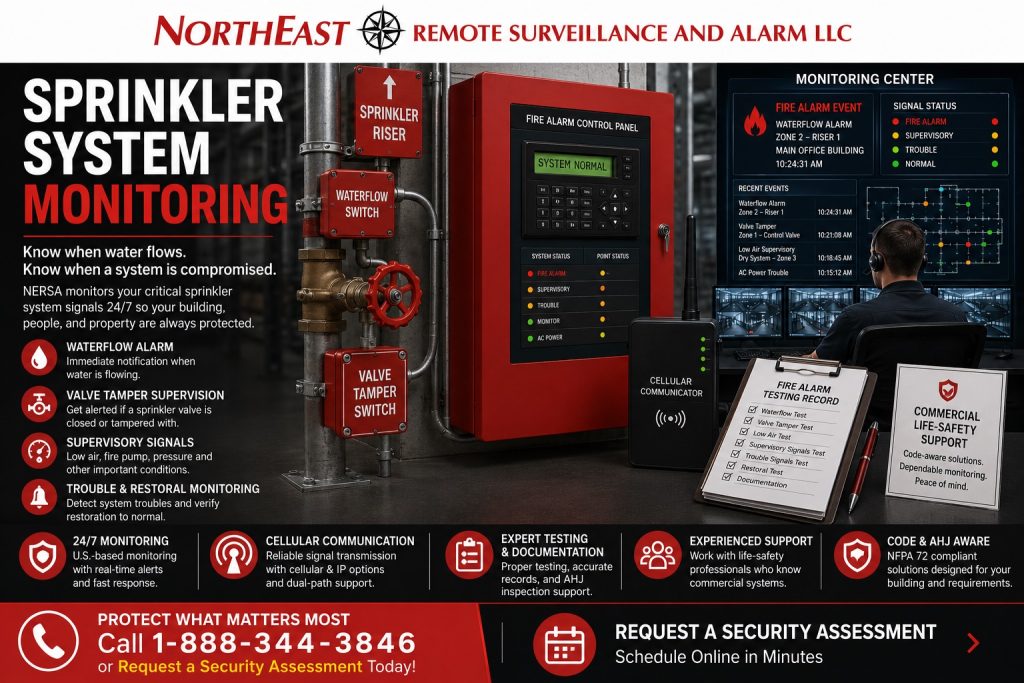
Northeast Remote Surveillance and Alarm, LLC helps commercial and industrial facilities review sprinkler monitoring points, fire alarm communicator paths, monitoring account information, signal descriptions, documentation, and testing support.
For related guidance, see our Fire Alarm Monitoring and Supervision guide and Commercial & Industrial Fire Alarm Installation and Life Safety services.
Commercial Sprinkler System Monitoring
A commercial sprinkler system should not be treated as a silent piece of building infrastructure.
When water flows, a valve is moved, a dry system reports low air, or a supervised condition changes, the building owner needs a dependable way to know that the condition occurred. Sprinkler system monitoring connects those important sprinkler-related signals to the fire alarm system, communicator, monitoring center, and documentation process.
The goal is simple: if a sprinkler-related condition matters, it should report clearly, be tested properly, and be documented accurately.
What Sprinkler System Monitoring Includes
Sprinkler system monitoring may include several different signal types depending on the building, fire alarm design, sprinkler system, monitoring arrangement, and AHJ requirements.
Common monitored sprinkler-related conditions may include:
- Waterflow alarm signals
- Valve tamper supervisory signals
- Low air supervisory signals
- Fire pump supervisory signals where applicable
- Pressure supervisory signals where applicable
- Dry system supervisory conditions
- Trouble signals
- Restoral signals
- Communication trouble signals
- Monitoring path signals
- Sprinkler riser or zone descriptions
Each signal should be identified clearly so the building owner, monitoring center, service provider, and AHJ can understand what condition was reported.
Waterflow Monitoring
Waterflow monitoring helps report when water is moving through the sprinkler system.
In many commercial buildings, a waterflow switch is connected to the fire alarm system so sprinkler water movement can transmit as an alarm condition. The exact setup depends on the sprinkler system, fire alarm panel, monitoring account, adopted requirements, and AHJ direction.
Waterflow monitoring may apply to:
- Sprinkler risers
- Wet sprinkler systems
- Dry sprinkler systems
- Warehouse sprinkler zones
- Multi-tenant building sprinkler zones
- Industrial sprinkler systems
- Commercial office sprinkler systems
- School and institutional sprinkler systems
- Healthcare office sprinkler systems
- Retail and mixed-use properties
Waterflow signal descriptions should not be vague. A signal should identify the correct building, riser, floor, area, zone, or protected section where the system design allows.
For a tighter page focused only on waterflow and valve tamper points, see Fire Alarm Waterflow and Tamper Monitoring.
Valve Tamper Monitoring
Valve tamper monitoring helps report when a supervised sprinkler control valve is moved from its normal position or needs attention.
This matters because a sprinkler system may not be able to protect the building properly if a control valve is closed or partially closed. A tamper switch helps identify that the valve condition should be reviewed.
Valve tamper monitoring may apply to:
- Sprinkler control valves
- Outside screw and yoke valves
- Post indicator valves
- Butterfly valves
- Sectional control valves
- Riser valves
- Fire protection system valves
- Other supervised sprinkler valves where applicable
Tamper signals are commonly treated as supervisory signals rather than waterflow fire alarm signals. The correct signal type, account description, and response process should match the system design and AHJ expectations.
Low Air and Dry System Supervisory Monitoring
Dry sprinkler systems may require low air supervisory monitoring.
A low air signal may indicate that system air pressure has dropped below the intended level. That condition may need attention before it becomes a larger fire protection or system reliability issue.
Low air supervisory monitoring may apply to:
- Dry sprinkler systems
- Preaction systems where applicable
- Cold storage areas
- Loading dock areas
- Warehouses
- Industrial buildings
- Unheated spaces
- Fire protection zones with air pressure supervision
Low air and pressure-related signals should be described clearly so the monitoring center and facility team know what condition was reported.
Fire Pump and Pressure Supervisory Signals
Some commercial properties may have fire pump or pressure-related supervisory signals connected to the fire alarm or monitoring path.
These signals depend on the building’s fire protection system design. They may include pump running, pump trouble, power-related conditions, pressure supervisory points, or other fire protection equipment supervisory conditions where applicable.
Fire pump and pressure supervisory signals should be reviewed carefully because vague signal descriptions can create confusion during service, testing, or emergency response.
Why Sprinkler Monitoring Matters
Sprinkler monitoring helps building owners avoid blind spots in the fire protection system.
A properly monitored sprinkler system can help:
- Report sprinkler waterflow activity.
- Identify sprinkler valve tamper conditions.
- Report low air or supervisory conditions.
- Support monitoring center response.
- Improve inspection and testing documentation.
- Reduce uncertainty around sprinkler-related signals.
- Help service providers locate the correct riser, valve, or area.
- Support long-term fire alarm and sprinkler supervision planning.
The sprinkler system, fire alarm system, communicator, and monitoring account should work together clearly.
Existing Sprinkler Monitoring Review
Before adding, correcting, or upgrading sprinkler monitoring, NERSA reviews the existing fire alarm and monitoring setup.
The review may include:
- Fire alarm control panel
- Sprinkler riser locations
- Waterflow switches
- Valve tamper switches
- Low air supervisory points
- Fire pump supervisory points where applicable
- Monitor modules or zones
- Zone or point descriptions
- Fire alarm communicator
- Current monitoring path
- Monitoring account information
- Trouble or supervisory conditions
- Current signal descriptions
- Existing documentation
- AHJ or inspection concerns
- Future upgrade needs
This review helps determine whether the system needs signal cleanup, device review, communicator upgrades, documentation correction, or broader fire alarm monitoring support.
Fire Alarm Control Panel Connection
Sprinkler monitoring signals typically connect to the fire alarm control panel through zones, monitor modules, addressable devices, or other approved inputs depending on the system.
The fire alarm panel should identify sprinkler-related conditions clearly. The monitoring account should also receive the correct signal type and description.
Important review items include:
- Device connection
- Zone or point type
- Alarm vs. supervisory classification
- Restoral reporting
- Panel display description
- Monitoring account description
- Communicator transmission
- Testing documentation
A sprinkler monitoring point is only useful if it reports accurately and can be understood by the people responsible for response and service.
Fire Alarm Communicator Path
Sprinkler monitoring depends on the fire alarm communication path.
If the fire alarm communicator is outdated, disconnected, unreliable, still tied to old phone lines, or not tested properly, sprinkler-related signals may not report the way the owner expects.
Communicator review may include:
- Existing communicator type
- Cellular communicator options
- IP communicator options
- Legacy phone-line dependence
- Dual-path communication where applicable
- Panel compatibility
- Signal transmission testing
- Communication trouble review
- Monitoring account programming
- Backup power
- Documentation
For dedicated communicator planning, see Fire Alarm Communicator Upgrades.
Fire Alarm Phone Line Replacement
Many older fire alarm and sprinkler monitoring systems still rely on legacy phone-line communication.
That can create risk when phone service is changed, converted, removed, or no longer supports dependable signal transmission. A fire alarm phone-line replacement may help modernize how sprinkler-related signals reach the monitoring path.
Phone-line replacement planning may include:
- Existing phone-line review
- Fire alarm communicator review
- Cellular signal review
- IP communication review
- Monitoring account setup
- Signal testing
- Documentation updates
- AHJ-aware planning
For dedicated planning, see Fire Alarm Phone Line Replacement.
Monitoring Account Review
Sprinkler monitoring depends on accurate monitoring account information.
If the monitoring center receives a waterflow, valve tamper, low air, or supervisory signal with a vague or incorrect description, response and service can become confusing.
Monitoring account review may include:
- Site name
- Site address
- Monitoring account information
- Emergency contact list
- Call list order
- Waterflow signal descriptions
- Valve tamper signal descriptions
- Low air supervisory descriptions
- Fire pump supervisory descriptions where applicable
- Trouble and restoral descriptions
- Signal test records
- Monitoring center receipt confirmation
For dedicated account cleanup planning, see Fire Alarm Monitoring Account Review.
Signal Testing and Verification
Sprinkler monitoring should be tested and verified.
A device that appears connected is not enough. The fire alarm panel should receive the correct input, the communicator should transmit the signal, and the monitoring center should receive the correct description from the correct account.
Testing may include:
- Waterflow signal testing
- Valve tamper signal testing
- Low air supervisory testing where applicable
- Fire pump supervisory testing where applicable
- Trouble signal testing
- Restoral testing
- Communication path testing
- Monitoring center receipt confirmation
- Account identification confirmation
- Documentation of test results
Testing should be coordinated properly with the monitoring center, facility staff, fire alarm provider, sprinkler contractor where needed, and AHJ requirements where applicable.
Trouble and Supervisory Signal Review
Sprinkler monitoring often involves supervisory and trouble signals that should not be ignored.
A supervisory signal may indicate a condition that affects fire protection readiness. A trouble signal may indicate a wiring, device, panel, communication, battery, power, or system issue.
Common sprinkler-related supervisory and trouble concerns may include:
- Valve tamper condition
- Low air condition
- Pressure supervisory condition
- Device trouble
- Wiring trouble
- Monitor module trouble
- Communication trouble
- Panel trouble
- Battery trouble
- AC power trouble
- Restoral failure
For broader signal planning, see Fire Alarm Trouble and Supervisory Signals.
Documentation and Inspection Readiness
Sprinkler monitoring should be documented clearly.
Documentation may include:
- Sprinkler riser locations
- Waterflow switch locations
- Valve tamper switch locations
- Low air supervisory points
- Fire pump supervisory points where applicable
- Device labels
- Point or zone names
- Monitoring signal descriptions
- Communicator information
- Monitoring account notes
- Signal testing records
- Trouble history where applicable
- Service notes
- AHJ or inspection records where applicable
Clean documentation helps with service calls, monitoring account updates, inspections, testing, and future upgrades.
For related planning, see Fire Alarm Inspection Readiness.
AHJ and Code-Aware Planning
Sprinkler system monitoring must be handled with code awareness.
The Authority Having Jurisdiction has final authority over fire alarm approval, inspection, and acceptance. Requirements may vary by municipality, building type, occupancy, sprinkler system, fire alarm design, communicator type, monitoring arrangement, and adopted code.
NERSA plans sprinkler monitoring with attention to:
- AHJ expectations
- Fire alarm panel requirements
- Sprinkler monitoring needs
- Manufacturer instructions
- Monitoring provider requirements
- Signal descriptions
- Communication path supervision
- Backup power
- Documentation
- Testing and inspection readiness
For broader code planning, see NFPA 72 Fire Alarm Standards for Commercial Buildings.
Sprinkler Monitoring vs. Sprinkler Service
Fire alarm monitoring receives and reports sprinkler-related signals.
Sprinkler design, installation, repair, and inspection require separate coordination. Sprinkler contractors, fire protection contractors, engineers, and AHJs may be involved in the sprinkler system itself.
NERSA’s role is focused on the fire alarm and monitoring side, including signal reporting, fire alarm panel inputs, communicator paths, monitoring account information, documentation, testing coordination, and life-safety system support.
Sprinkler Monitoring for Warehouses
Warehouses and distribution facilities often rely heavily on sprinkler monitoring.
Large buildings, dock areas, rack storage, storage configurations, truck courts, and after-hours operations make clear signal reporting important. A waterflow signal should identify the correct protected area where possible, and tamper conditions should not be ignored.
Warehouse sprinkler monitoring may involve:
- Sprinkler riser monitoring
- Dock-area sprinkler zones
- Warehouse waterflow switches
- Valve tamper switches
- Low air supervisory signals where applicable
- Dry system supervisory signals where applicable
- Monitoring account descriptions
- Communicator review
- Signal testing
- Inspection documentation
Sprinkler Monitoring for Industrial Facilities
Industrial facilities may have more complex fire protection and supervisory needs.
Manufacturing, processing, utility rooms, equipment areas, industrial storage, production environments, and multi-building industrial properties may require careful coordination between sprinkler supervision, fire alarm reporting, monitoring accounts, and documentation.
Industrial sprinkler monitoring review may include:
- Waterflow points
- Valve tamper points
- Low air supervisory points
- Pressure supervisory points
- Fire pump-related signals where applicable
- Communicator path review
- Trouble condition review
- Signal testing
- Documentation cleanup
- AHJ coordination where required
Sprinkler Monitoring for Multi-Tenant Buildings
Multi-tenant commercial buildings need clear signal descriptions.
If a waterflow, tamper, or supervisory condition reports from the wrong area or with a vague label, building management may not know where to look. Clear zone or point naming helps identify the correct riser, tenant area, floor, building section, or protected area when applicable.
Multi-tenant monitoring planning may include:
- Building-by-building descriptions
- Floor or suite references where applicable
- Riser and valve labeling
- Property manager contacts
- Tenant coordination where needed
- Emergency contact review
- Documentation and service notes
Before and After
| Before Sprinkler Monitoring Review | After Sprinkler Monitoring Review |
|---|---|
| Waterflow signal descriptions were unclear | Waterflow points can be reviewed and documented |
| Valve tamper signals were vague | Tamper points can be identified more clearly |
| Low air or supervisory points were not clearly understood | Supervisory conditions can be reviewed and labeled |
| Monitoring account information may be outdated | Contact lists and signal descriptions can be reviewed |
| Signal reporting was assumed | Waterflow, tamper, supervisory, trouble, and restoral signals can be tested |
| Communicator path was uncertain | Cellular, IP, or approved communication options can be reviewed |
| Old phone-line dependence created risk | Phone-line replacement options can be evaluated |
| Documentation was limited | Better records for inspection and service readiness |
| Owner had uncertainty | Clearer long-term sprinkler monitoring support |
Commercial Facilities That Need Sprinkler System Monitoring
Sprinkler system monitoring is common in:
- Warehouses
- Distribution centers
- Manufacturing facilities
- Industrial buildings
- Office buildings
- Healthcare offices
- Schools and education facilities
- Retail stores
- Industrial parks
- Multi-tenant commercial buildings
- Logistics facilities
- Professional offices
- Municipal buildings
- Institutional properties
- Buildings with wet sprinkler systems
- Buildings with dry sprinkler systems
- Buildings with fire pump equipment where applicable
- Buildings with monitored fire alarm systems
- Buildings changing phone or internet service
Each facility should be reviewed based on the sprinkler system, fire alarm system, monitoring requirements, communication path, documentation, and AHJ expectations.
Related Planning
Coordinate sprinkler monitoring with the sprinkler contractor, fire alarm professionals, required testing, and local authority review.
Why Businesses Choose NERSA for Sprinkler System Monitoring
Northeast Remote Surveillance and Alarm, LLC focuses on commercial, industrial, institutional, and business and facility security and life-safety systems.
Sprinkler monitoring requires more than connecting a switch to a panel. It requires signal review, communicator path review, monitoring center coordination, account cleanup, documentation, testing, and AHJ-aware planning.
NERSA helps commercial facilities understand how sprinkler-related fire alarm signals report and what needs to be corrected before communication or documentation gaps become bigger life-safety problems.
When to Request Sprinkler Monitoring Review
A commercial facility should request sprinkler monitoring review if:
- The building has a sprinkler system tied to fire alarm monitoring.
- Waterflow or tamper signals have unclear descriptions.
- Low air or supervisory signals need review.
- The monitoring account information is outdated.
- The fire alarm system still uses old phone lines.
- The panel shows trouble or supervisory conditions.
- Signal testing has not been documented recently.
- The communicator is obsolete or unsupported.
- The facility is preparing for inspection.
- The building is changing tenants, ownership, phone service, or monitoring provider.
- The owner wants a clearer long-term monitoring support path.
Sprinkler System Monitoring Checklist
Before reviewing sprinkler system monitoring, evaluate:
- Fire alarm control panel
- Sprinkler riser locations
- Waterflow switch locations
- Valve tamper switch locations
- Low air supervisory points
- Fire pump supervisory points where applicable
- Monitor modules or zones
- Point descriptions
- Supervisory signal descriptions
- Restoral reporting
- Existing communicator
- Current monitoring path
- Phone-line dependence
- Cellular or IP options
- Monitoring account information
- Emergency contact list
- Call list order
- Signal testing records
- Trouble conditions
- Documentation
- AHJ expectations
- Future system upgrade needs
Request Sprinkler System Monitoring Support
NERSA can review sprinkler monitoring, waterflow, valve tamper and low air supervisory signals at commercial properties. We can also help with communicators, monitoring accounts, signal testing and records.
Frequently Asked Questions About Sprinkler System Monitoring
What is sprinkler system monitoring?
Sprinkler system monitoring connects sprinkler-related conditions such as waterflow, valve tamper, low air, supervisory, trouble, and restoral signals to the fire alarm system and monitoring path so important conditions can be reported.
What is waterflow monitoring?
Waterflow monitoring reports when water is moving through the sprinkler system. In many commercial buildings, waterflow reports as a fire alarm condition through the fire alarm system and monitoring path.
What is valve tamper monitoring?
Valve tamper monitoring supervises sprinkler control valves and reports when a valve changes from its normal position or requires attention. These signals are commonly treated as supervisory conditions.
What is low air supervisory monitoring?
Low air supervisory monitoring is commonly used with dry sprinkler systems and reports when air pressure drops below the intended level or requires review.
Are waterflow and tamper signals the same?
No. Waterflow is generally associated with water movement through the sprinkler system. Tamper is generally associated with a supervised valve or device changing from its normal condition.
Can sprinkler signals be monitored through the fire alarm system?
Yes. Many commercial buildings monitor sprinkler waterflow, valve tamper, low air, and other supervisory conditions through the fire alarm system or approved monitoring arrangement depending on the building, system design, and AHJ direction.
Should sprinkler monitoring signals be tested?
Yes. Waterflow, tamper, supervisory, trouble, and restoral signals should be tested where applicable to confirm that the fire alarm panel and monitoring center receive the correct signal descriptions.
Can old phone lines affect sprinkler system monitoring?
Yes. If the fire alarm communicator still uses legacy phone lines, signal reporting can be affected by phone service changes, communication trouble, or outdated equipment. Communicator upgrades may be needed.
Does NERSA install sprinkler systems?
This guide covers fire alarm monitoring of sprinkler-related signals, not sprinkler installation or sprinkler system design. Sprinkler work may require a sprinkler contractor or fire protection contractor depending on the project.
How do we start a sprinkler system monitoring review?
Call 1-888-344-3846 or use Request a Security Assessment.
NERSA can review the fire alarm panel, sprinkler monitoring points, communicator path, signal descriptions, monitoring account, documentation, and testing needs before recommending the right path.
Compliance, Codes & Project Standards
NERSA plans commercial and industrial security work with applicable code, documentation, inspection and authority-having-jurisdiction requirements in mind. Requirements vary by system, property and jurisdiction. These resources support project planning; they do not establish legal compliance, certification or AHJ approval.
Related guidance: Regulatory compliance & inspection readiness · NERSA project standards · Documentation, testing & inspection readiness