
Truck yard and trailer security systems protect exterior vehicle areas where trailers, trucks, fleet vehicles, staged equipment, freight, and service activity remain exposed outside the main building.

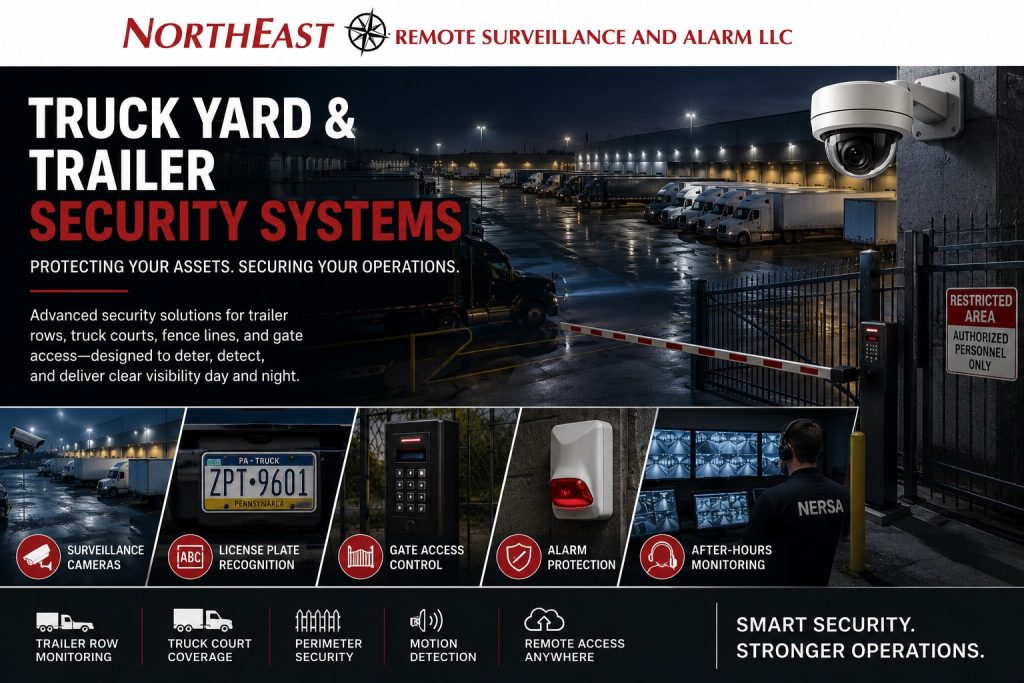
Planning covers commercial and industrial truck courts, trailer rows, yard lanes, fleet areas, fenced vehicle areas, and exterior staging zones.
For broader warehouse and logistics protection, start with Warehouse Security Systems.
Security Planning for Truck and Trailer Yards
Truck yards and trailer areas often sit outside the main building and operate early or late. Outside drivers, staged trailers and freight left after staff leave can increase exposure. Plan security around those operating conditions.
A basic camera mounted on a building is rarely enough. Trailer areas need planned visibility, reliable after-hours awareness, gate activity review, vehicle documentation, lighting awareness, alarm response, and practical system management.
Truck yard security planning should account for:
- Trailer rows and parked trailers
- Truck courts and yard lanes
- Fleet parking areas
- Gate entrances and exits
- Driver access points
- Exterior staging areas
- Fenced storage zones
- Loading-area approaches
- After-hours movement
- Lighting conditions
- Vehicle identification
- Alarm response procedures
- Monitoring workflows
- Network and power availability
The goal is to create a system that helps the business understand what happened, where it happened, when it happened, which vehicle was involved, and how the event should be reviewed or escalated.
Why Truck Yards Need Dedicated Security Planning
Truck yards are different from interior warehouse spaces, office buildings, and standard parking lots. They involve larger vehicles, wider camera views, exterior lighting issues, more movement, more blind spots, and higher after-hours exposure.
Common truck yard security challenges include:
- Trailers blocking camera views
- Dark yard corners
- Long fence lines
- Uncontrolled vehicle entry
- Unverified driver activity
- Staged freight exposure
- Cut fencing or rear-yard access
- Poor plate capture angles
- Weak Wi-Fi or network coverage
- Camera views that are too wide to identify useful detail
- No clear event review process
- No active monitoring after hours
A properly planned truck yard system should be built around real yard movement, not just building-mounted cameras.
Video Surveillance for Trailer Rows and Yard Lanes
For the handoff between yard movements and the building, review loading-dock camera planning.
Regional examples address Wilkes-Barre truck yards and docks and Scranton truck yards and docks.
Video surveillance is usually the core layer of truck yard security. Cameras should be positioned to document vehicle movement, gate activity, trailer rows, yard lanes, fence lines, exterior storage zones, and high-risk corners.
Match camera views to the yard. A small fleet yard may need gate, parking and storage coverage. A larger trailer yard may need overviews, focused choke-point views and long-range cameras. Nighttime image detail also matters.
Camera planning should consider:
- Trailer row spacing
- Truck turning paths
- Gate entrances and exits
- Lighting direction
- Pole or building mounting options
- Camera height
- Lens selection
- Nighttime image quality
- Weather exposure
- Network pathway
- Recording retention
- Remote access needs
- Evidence review requirements
For nearby dock and receiving-area visibility, use Loading Dock Security Systems.
Gate Activity and Vehicle Accountability
Yards may use gates, fences, doors, chains, keypads, intercoms, card readers or manual entry procedures. Record who enters, when they enter and which vehicle is involved. Clear entry records help staff check whether activity was authorized.
Gate-area planning may include:
- Entry and exit cameras
- Gate lane cameras
- Access control readers
- Intercom or call station support
- Driver communication
- Keypad or credentialed access
- Gate operator coordination
- Vehicle approach visibility
- Alarm or monitoring integration
- Event history review
The gate should be treated as a control point, not just a fence opening.
License Plate Recognition for Truck Yards
License plate recognition can help document vehicles entering and leaving truck yards, fleet areas, contractor yards, service drives, and trailer storage properties. It can support incident review, vehicle accountability, recurring vehicle identification, and gate-lane documentation.
LPR planning is different from general surveillance. A camera that gives a nice overview of the yard may not capture plates reliably. Plate capture usually requires the correct angle, distance, mounting position, lighting control, lane focus, and camera selection.
For vehicle entry review and searchable plate records, continue to License Plate Recognition Camera Systems.
After-Hours Monitoring for Exterior Yard Exposure
Many truck yard problems happen when the property is closed, lightly staffed, or between shifts. After-hours exposure can include unauthorized vehicles, trespassing, trailer tampering, equipment theft, fence-line activity, loitering, vandalism, and suspicious movement near gates or parked trailers.
Remote video monitoring can help reduce blind spots by allowing events to be reviewed when activity occurs. Depending on the property, monitoring may support alert verification, operator response, live talk-down, escalation procedures, and better incident documentation.
For active exterior review, alert verification, and live response support, use Remote Video Monitoring.
Alarm Protection for Truck Yards and Exterior Storage
Alarm systems can support truck yard security when exterior areas include gates, storage containers, office trailers, equipment cages, fuel areas, utility rooms, or vulnerable access points. Alarm protection may include contacts, motion detection, outdoor detection, gate status, equipment-area protection, or integration with monitored camera events.
Outdoor alarm planning requires care. Exterior environments create more variables than interior spaces, including weather, animals, lighting changes, vehicle movement, wind, and normal site activity. The system must be designed to reduce nuisance alerts while still supporting meaningful response.
Truck yard alarm planning should define:
- What areas need detection
- When those areas are active
- Who is allowed in the yard
- What happens after an alert
- Whether cameras verify activity
- Who receives notifications
- Whether monitoring should escalate the event
- How false alarms are reduced
Lighting, Network, and Infrastructure Considerations
Truck yard security depends heavily on infrastructure. Exterior cameras, gate controls, wireless links, intercoms, alarm devices, and monitoring equipment all need reliable power, communications, mounting locations, and service access.
Common infrastructure concerns include:
- Long cable distances
- Lack of poles or mounting points
- Weak nighttime lighting
- Network distance from the building
- Outdoor equipment exposure
- Power availability at gates
- Wireless bridge requirements
- Fiber pathway requirements
- Battery backup needs
- Surge protection
- Equipment enclosure locations
- Future expansion capacity
The security design should be realistic about where devices can be mounted, how they will communicate, and how they will be serviced over time.
What a Truck Yard Security Assessment Should Review
A truck yard or trailer security assessment should look at the entire exterior operating environment.
The review should include how vehicles enter, where trailers are parked, how employees and drivers move, where cameras can see, what happens after hours, and how incidents are currently reviewed.
For camera coverage of parked trailers, gate movements, and freight handoffs, review trailer-yard and truck-parking surveillance.
A practical assessment should review:
- Gate entrances and exit points
- Trailer rows and yard lanes
- Truck courts and turning areas
- Fence lines and rear approaches
- Parking areas and fleet zones
- Loading-area approaches
- Lighting conditions
- Existing cameras and blind spots
- Network and power availability
- Alarm communication
- Monitoring expectations
- Vehicle documentation needs
- Current response procedures
- Future expansion needs
The result should be a security plan that matches how the yard operates instead of a generic camera package.
Compliance and Safety Awareness
Truck yard security systems should be planned with awareness of workplace safety, emergency access, lighting conditions, vehicle movement, gate operation, accessible paths, fire department access, and building operations.
Security systems do not replace safety programs, driver procedures, emergency plans, fire codes, access policies, or workplace training. They can, however, support incident documentation, vehicle accountability, alarm response, access review, and better visibility when events need to be investigated.
Security planning should avoid creating unsafe gate conditions, blocked emergency access, confusing vehicle paths, or access-control problems that interfere with required egress or emergency response.
Why Businesses Choose Northeast Remote Surveillance and Alarm, LLC
Northeast Remote Surveillance and Alarm, LLC designs commercial and industrial security systems around real operating conditions, not single-family home alarm packages or generic camera layouts.
Truck yards and trailer areas require practical planning because the risk is outside the building, spread across larger spaces, and often active during early morning, late evening, overnight, or low-staffing periods.
NERSA helps businesses review:
- Trailer-area visibility
- Gate control
- Vehicle movement
- License plate documentation
- After-hours monitoring
- Alarm response
- Camera placement
- Lighting and infrastructure
- Network requirements
- Long-term service support
The objective is a truck yard security system that helps protect assets, document activity, support response, and give decision-makers clearer visibility into exterior operations.
Frequently Asked Questions About Truck Yard and Trailer Security Systems
What is a Truck Yard and Trailer Security System?
A truck yard security system is a planned combination of cameras, gate controls, alarms, monitoring, vehicle documentation, and supporting infrastructure designed to protect exterior truck courts, trailer rows, fleet areas, and vehicle staging zones.
Why are truck yards harder to secure than standard parking lots?
Trailers can block camera views, and moving vehicles may cross wide outdoor areas. Uneven lighting and after-hours activity add to the challenge. Multiple access points, fence lines, gates, and staging zones all need attention.
What cameras work best for trailer yards?
The best camera layout depends on the yard. Most trailer yards need a mix of overview cameras, focused gate views, trailer-row coverage, long-range exterior views, and nighttime-capable cameras positioned for useful identification and event review.
Should truck yards use license plate recognition?
License plate recognition is useful when the business needs searchable vehicle records, gate-lane documentation, recurring vehicle review, or better investigation support. LPR should be planned separately from general surveillance because plate capture requires the right angle, lighting, distance, and lane focus.
Can truck yards be monitored after hours?
Yes. Remote video monitoring can help review exterior activity after hours, verify alerts, support operator response, provide live talk-down where appropriate, and improve documentation of suspicious movement around trailers, gates, parking areas, and exterior storage zones.
Do truck yards need access control?
Many truck yards benefit from access control at gates, driver entrances, office doors, storage areas, or restricted zones. The right approach depends on how drivers, employees, contractors, vendors, and fleet vehicles enter and move through the property.
Can alarms protect outdoor truck yards?
Yes, but outdoor alarm design must be planned carefully. Exterior areas can create nuisance alerts from weather, animals, lighting changes, and normal vehicle movement, so alarm devices should be selected and positioned around real site conditions.
What should be reviewed before designing a truck yard security system?
A proper review should look at gate locations, trailer rows, truck movement, lighting, fence lines, camera mounting points, network access, power availability, alarm response, monitoring expectations, and how incidents are currently investigated.
How does the site’s location affect truck yard security?
The property’s location, surrounding activity, vehicle routes, operating hours, and response arrangements help determine the appropriate truck yard security plan.
How does Northeast Remote Surveillance and Alarm, LLC design truck yard security systems?
NERSA reviews vehicle entrances, trailer staging, staffing, blind spots, and after-hours activity. We also check available infrastructure. These findings guide recommendations for cameras, monitoring, gate control, alarms, and vehicle documentation.
Request a Truck Yard Security Assessment
NERSA can help assess your truck yard, trailer area, fleet lot, fenced storage, or vehicle staging area. Tell us about visibility, gate control, license plate documentation, alarms, and remote monitoring. We can help develop a clearer after-hours security plan.
Call 1-888-344-3846 or use Request a Security Assessment to review your yard layout, trailer rows, gate activity, vehicle movement, exterior exposure, camera views, alarm response, monitoring needs, infrastructure conditions, and long-term security goals.
Compliance, Codes & Project Standards
NERSA plans commercial and industrial security work with applicable code, documentation, inspection and authority-having-jurisdiction requirements in mind. Requirements vary by system, property and jurisdiction. These resources support project planning; they do not establish legal compliance, certification or AHJ approval.
Related guidance: Regulatory compliance & inspection readiness · Warehouse & logistics compliance · NERSA project standards