Industrial Surveillance Systems for Logistics Yards, Truck Courts, and Distribution Center Parking Areas
Modern warehouses and distribution centers depend on large trailer yards and truck parking areas to keep goods moving efficiently through the supply chain. Across major logistics markets such as the Lehigh Valley logistics corridor, the Route 33 industrial corridor, the I-78 warehouse and distribution corridor, the Greater Scranton logistics hub, and the Reading regional manufacturing and distribution region, these yards often contain millions of dollars in inventory staged in trailers, parked trucks, container chassis, and shipping lanes waiting for transport.
However, trailer yards are also one of the most vulnerable operational areas inside logistics facilities.
Cargo theft, unauthorized access, vehicle damage, and operational incidents frequently occur in truck courts and trailer parking lots. Because these areas operate around the clock with constant truck traffic and trailer movement, they require specialized surveillance systems engineered for large outdoor industrial environments.
Trailer yard security camera systems allow warehouse operators to monitor truck movements, protect cargo assets, improve employee safety, and maintain operational visibility across expansive logistics properties.
Northeast Remote Surveillance and Alarm, LLC (NERSA) designs and installs industrial-grade surveillance systems built specifically for trailer yards, truck parking areas, and distribution center logistics zones throughout the Lehigh Valley, Route 33 logistics corridor, Interstate 78 warehouse corridor, Reading distribution region, and the Greater Scranton industrial hub.
I

Why Trailer Yards Are a High-Risk Area in Logistics Facilities
Trailer yards are essential to the daily operations of warehouses and distribution centers, but they also present unique security challenges.
These areas often include:
- hundreds of parked trailers
- tractor parking areas
- container staging zones
- truck loading lanes
- trailer storage rows
- gate access points
Because trailers frequently sit unattended while waiting for loading or transport, they can become targets for theft and unauthorized access.
In addition to cargo theft, trailer yards experience other security risks including:
- trailer tampering
- vehicle collisions
- unauthorized truck entry
- employee safety incidents
- equipment theft
- damage claims and liability disputes
Without surveillance coverage, it can be difficult for facility operators to determine exactly what happened during an incident.
Security cameras provide the visibility needed to monitor these large operational zones.
Key Areas That Require Trailer Yard Surveillance
Proper surveillance coverage should be designed around the operational layout of the facility.
Critical areas typically include:
Trailer Parking Rows
Many distribution centers store dozens or even hundreds of trailers in designated parking rows.
Camera coverage ensures that trailers remain secure and allows operators to review activity when cargo discrepancies occur.
Truck Courts
Truck courts are high-traffic areas where trailers move in and out of loading docks.
Because forklifts, yard trucks, and tractor trailers all operate in the same space, these areas benefit from surveillance monitoring to document activity and improve safety.
Yard Entrances and Exit Gates
Truck traffic entering and exiting the facility should always be monitored.
Security cameras combined with license plate recognition systems can record truck arrivals and departures.
Container Storage Areas
Many logistics facilities store shipping containers in outdoor storage areas.
These containers can contain valuable goods and require surveillance coverage to prevent tampering or theft.
Yard Tractor Operations
Yard tractors move trailers around distribution facilities.
Monitoring these operations helps prevent accidents and provides video documentation if equipment damage occurs.
Types of Security Cameras Used in Trailer Yards
Industrial trailer yards require cameras designed for large outdoor environments with wide coverage areas.
Several types of cameras are commonly used.
Long-Range Surveillance Cameras
Long-range cameras provide visibility across large sections of trailer yards.
These cameras are designed to monitor wide areas where trailers are parked.
Pan-Tilt-Zoom (PTZ) Cameras
PTZ cameras allow operators to zoom in on specific areas of the yard.
Security personnel can remotely control these cameras to investigate suspicious activity.
License Plate Recognition Cameras
LPR cameras automatically capture license plates of trucks entering or leaving the facility.
These systems help track vehicle movement and improve access control.
Thermal Cameras
Thermal imaging cameras can detect activity in low-light conditions and across large outdoor areas.
These cameras are useful for perimeter monitoring around large industrial properties.
Benefits of Trailer Yard Surveillance Systems
Installing surveillance cameras in trailer yards provides multiple operational benefits.
Prevent Cargo Theft
Trailer yards often contain high-value goods waiting to be shipped.
Visible security cameras deter theft and provide evidence if incidents occur.
Improve Operational Visibility
Managers can monitor truck movements and yard operations in real time.
This helps logistics teams understand how the yard is functioning.
Reduce Liability Claims
Accidents involving trucks, forklifts, and equipment can occur in trailer yards.
Video documentation helps resolve disputes and identify the cause of incidents.
Enhance Employee Safety
Surveillance cameras can help identify unsafe behavior and improve operational safety.
Track Truck Traffic
Video monitoring allows companies to analyze truck traffic patterns and improve yard management.
Designing a Trailer Yard Surveillance System
Every logistics facility has a unique layout, so security systems must be engineered accordingly.
Key design considerations include:
Yard Size
Trailer yards can span several acres.
Camera placement must ensure coverage across the entire property.
Lighting Conditions
Many logistics yards operate overnight.
Cameras must perform well in low-light environments.
Vehicle Traffic Patterns
Camera locations should account for truck routes and trailer parking areas.
Dock Locations
Loading dock areas often connect directly to trailer yards and require coverage.
Entry and Exit Points
Gate access points should always be monitored.
Advanced Security Technology for Logistics Yards
Modern surveillance systems offer several advanced features that improve security and operational oversight.
These include:
Video Analytics
Analytics software can detect unusual behavior such as:
- unauthorized vehicle entry
- people entering restricted areas
- vehicles parked in prohibited zones
Remote Monitoring
Facility managers and security teams can view live camera feeds remotely from mobile devices or monitoring centers.
Automated Alerts
Security systems can trigger alerts when motion is detected in restricted areas.
Integration with Access Control
Surveillance cameras can be integrated with gate systems and access control infrastructure.
Industrial Security Solutions by Northeast Remote Surveillance and Alarm
Northeast Remote Surveillance and Alarm, LLC specializes in surveillance systems for industrial environments and logistics operations.
Our team designs camera systems specifically for:
- warehouse trailer yards
- truck parking areas
- distribution center logistics zones
- container storage yards
- manufacturing shipping yards
NERSA systems provide coverage across:
- trailer rows
- yard gates
- truck courts
- loading dock approaches
- perimeter fencing
These systems allow facility operators to monitor activity and maintain control over high-value logistics operations.
Protecting Logistics Facilities Across the Mid-Atlantic
NERSA provides surveillance system installation and monitoring services throughout major industrial regions including:
- Lehigh Valley logistics corridor
- Route 33 industrial corridor
- Interstate 78 warehouse corridor
- Reading distribution region
- Greater Scranton logistics hub
- Pennsylvania and Mid-Atlantic industrial markets
Our solutions are engineered for large warehouses, distribution centers, and industrial campuses.
Schedule a Trailer Yard Security Consultation
If your warehouse or distribution center operates a trailer yard or truck parking facility, surveillance systems are critical to protecting your operations.
Northeast Remote Surveillance and Alarm, LLC can design a security system tailored to your logistics facility.
Call today:
📞 1-888-344-3846 or Schedule a security assessment
Visit:
www.northeastremotesurveillance.com
Secure Your Trailer Yard. Protect Your Cargo. Monitor Your Operations.
From distribution center trailer yards to large logistics campuses, NERSA provides surveillance systems designed for the demands of modern supply chain operations.
Trailer Yard Security Camera Placement Guide
Surveillance Design for Warehouse Trailer Yards and Truck Parking Areas (50,000 – 1,000,000+ Square Feet)
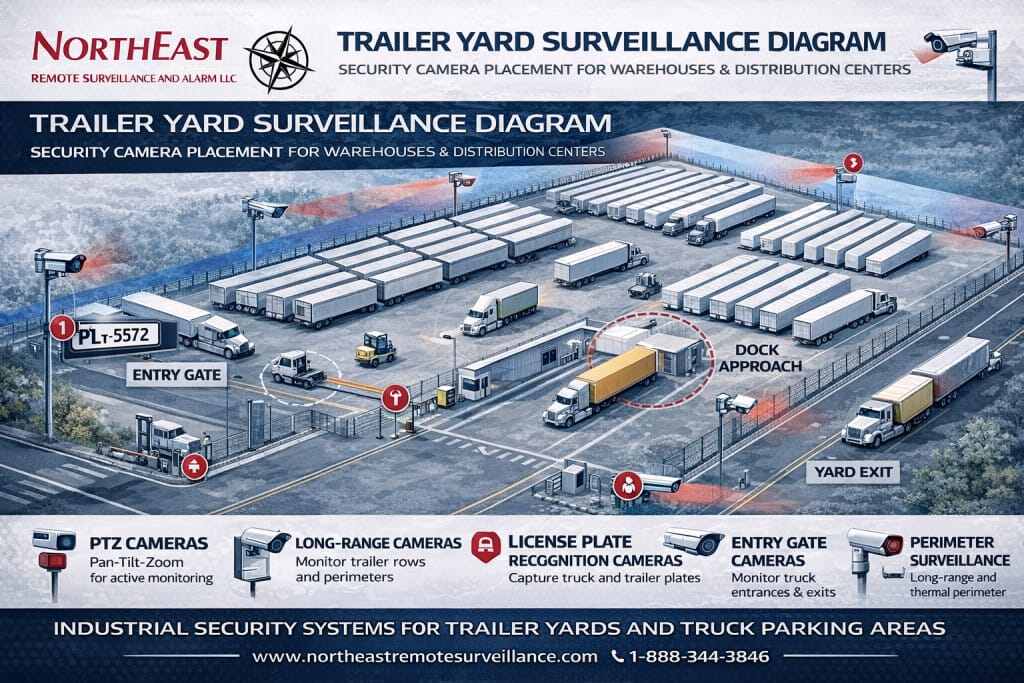
Trailer yards and truck parking areas are among the largest and most operationally complex spaces inside modern warehouses and distribution centers. These areas often cover several acres and contain dozens or hundreds of parked trailers, making effective surveillance design essential.
A properly designed camera system must provide complete visibility across trailer rows, vehicle lanes, dock approaches, and facility perimeters while also supporting night operations, high vehicle traffic, and wide open outdoor environments.
Security camera placement in trailer yards must be engineered carefully to ensure that no critical operational areas become blind spots.
Core Security Objectives for Trailer Yard Surveillance
Before determining camera placement, it is important to identify the primary goals of the surveillance system.
Trailer yard security systems are typically designed to accomplish the following objectives:
• Monitor trailer parking areas
• Track truck arrivals and departures
• Record activity at loading dock approaches
• Protect cargo stored in parked trailers
• Detect unauthorized entry into yard areas
• Document vehicle collisions or safety incidents
• Provide evidence for theft or damage claims
• Improve operational awareness for facility managers
Because trailer yards often operate 24 hours a day, surveillance systems must provide reliable coverage both day and night.
Typical Trailer Yard Layout in Distribution Centers
Most warehouse trailer yards contain several operational zones that require surveillance coverage:
Trailer Parking Rows
Long rows where trailers are parked while awaiting loading or shipment.
Truck Traffic Lanes
Drive lanes where tractor trailers maneuver between docks and parking areas.
Dock Approach Zones
Areas where trucks back into loading docks.
Yard Entrances and Exit Gates
Access control points for vehicles entering and leaving the facility.
Yard Tractor Operations
Zones where yard jockeys move trailers throughout the facility.
Perimeter Fence Lines
Property boundaries where unauthorized access could occur.
Camera Placement for Trailer Yard Entrances
Entrance gates are one of the most critical surveillance points in any logistics facility.
Cameras should capture:
• incoming truck traffic
• outgoing truck traffic
• license plate information
• driver activity at the gate
Recommended equipment includes:
• License Plate Recognition (LPR) cameras
• High-resolution overview cameras
These cameras should be mounted approximately 10–16 feet high and positioned to capture clear views of truck fronts and rear plates.
Surveillance Coverage for Trailer Parking Rows
Trailer parking rows can extend hundreds of feet across large logistics yards.
Camera placement should ensure that every trailer row is visible without blind spots.
Typical deployment includes:
• pole-mounted cameras positioned between rows
• wide-angle cameras covering multiple trailer lanes
• long-range cameras for extended viewing distances
For large yards, cameras are often installed on 30–40 foot light poles to maximize coverage.
Monitoring Truck Courts and Maneuvering Areas
Truck courts are high-activity zones where:
• trailers back into docks
• yard tractors reposition trailers
• forklifts and workers operate near trucks
These areas require high-resolution cameras capable of capturing:
• vehicle movement
• driver activity
• dock door operations
Pan-Tilt-Zoom (PTZ) cameras are often used here to allow operators to zoom in on incidents.
Dock Approach Surveillance
Loading docks connect the warehouse interior to the exterior trailer yard.
Surveillance cameras should monitor:
• trucks backing into docks
• trailer doors being opened
• cargo handling activity
Recommended placement includes cameras mounted:
• above dock doors
• on building corners overlooking dock lanes
• along dock canopies
Dock cameras are extremely valuable when investigating cargo disputes or damage claims.
Trailer Yard Perimeter Monitoring
Large trailer yards often span several acres and include perimeter fencing.
Security cameras should be installed along the perimeter to detect:
• unauthorized entry
• fence breaches
• suspicious activity near parked trailers
Recommended camera types include:
• long-range fixed cameras
• thermal cameras for night detection
• PTZ cameras for active monitoring
Perimeter cameras should be mounted high enough to prevent tampering while maintaining clear visibility of fence lines.
Lighting Considerations for Trailer Yard Cameras
Trailer yards often operate overnight, so cameras must perform well in low-light conditions.
Security cameras used in trailer yards typically include:
• infrared night vision
• low-light sensors
• wide dynamic range imaging
Facilities may also install additional LED lighting in darker sections of the yard to improve video quality.
Recommended Camera Quantities by Facility Size
The number of cameras required depends heavily on yard size and operational complexity.
Below are general guidelines.
50,000 – 150,000 sq ft warehouses
Trailer yards typically require:
10 – 20 cameras
Coverage includes:
• yard entrance
• trailer rows
• dock approaches
• perimeter areas
150,000 – 500,000 sq ft distribution centers
Large facilities may require:
25 – 60 cameras
These systems monitor:
• multiple trailer parking zones
• truck courts
• dock lanes
• entry gates
• perimeter fences
500,000 – 1,000,000+ sq ft logistics campuses
Major distribution centers may deploy:
60 – 150+ cameras
These systems cover:
• extensive trailer storage areas
• multiple dock clusters
• gate access points
• container yards
• truck staging areas
Mounting Infrastructure for Trailer Yard Cameras
Camera mounting options include:
Light Poles
Most common installation location in trailer yards.
Building Corners
Useful for monitoring dock areas and nearby truck courts.
Dedicated Surveillance Poles
Installed specifically to support camera coverage in large yards.
Mounting heights usually range between:
20 – 40 feet depending on yard size and viewing distance.
Video Monitoring and Recording Systems
Large trailer yard systems typically include:
• network video recorders (NVRs)
• remote monitoring capabilities
• motion detection alerts
• video analytics software
These systems allow facility managers and security teams to review footage when incidents occur.
Trailer Yard Surveillance for Large Logistics Operations
Modern supply chains rely heavily on efficient trailer yard management. Surveillance systems play a major role in supporting these operations by providing visibility across large outdoor logistics environments.
Security cameras help distribution centers:
• monitor trailer inventory
• prevent cargo theft
• document operational incidents
• improve safety for workers and drivers
• maintain control over high-value logistics assets
Industrial Trailer Yard Surveillance by Northeast Remote Surveillance and Alarm
Northeast Remote Surveillance and Alarm, LLC specializes in industrial surveillance systems engineered for warehouse and distribution center environments.
Our systems are designed to monitor:
• trailer yards
• truck parking areas
• loading dock approaches
• warehouse perimeters
• logistics facility entry gates
NERSA security solutions are deployed throughout major logistics regions including:
• Lehigh Valley logistics corridor
• Route 33 industrial corridor
• I-78 warehouse corridor
• Reading distribution region
• Greater Scranton logistics hub
Schedule a Trailer Yard Security Assessment
If your warehouse or distribution center operates a large trailer yard, a professionally designed surveillance system can dramatically improve security and operational visibility.
To schedule a consultation:
📞 Call Northeast Remote Surveillance and Alarm
1-888-344-3846
🌐 Visit
www.northeastremotesurveillance.com
Protect Your Trailer Yard. Secure Your Cargo. Monitor Your Logistics Operations.
NERSA designs security infrastructure specifically for large industrial environments, warehouses, and logistics facilities operating throughout the Mid-Atlantic region.
Industrial Security Case Studies for Logistics Facilities
Real-World Surveillance Solutions for Warehouses, Distribution Centers, and Trailer Yards
Modern logistics facilities operate in highly complex environments where trucks, trailers, forklifts, and employees interact across large industrial properties. Security incidents can occur quickly in these high-traffic areas, making surveillance infrastructure a critical component of warehouse operations.
Below are examples of how industrial surveillance systems can improve safety, prevent theft, and provide operational visibility across large logistics facilities.
Case Study 1
Preventing Trailer Cargo Theft at a Regional Distribution Center
Facility Overview
A 420,000 square foot distribution center located within a major logistics corridor experienced repeated incidents of cargo theft from trailers parked in its yard overnight.
The facility maintained a trailer yard containing more than 160 trailer parking positions.
Because trailers were staged overnight awaiting early morning shipments, they often remained unattended for long periods.
Security Challenges
Facility management identified several vulnerabilities:
• Poor visibility across trailer parking rows
• Limited monitoring of yard entrances
• No system to track vehicles entering the property
• Blind spots between long trailer rows
• Difficulty identifying when theft occurred
These issues resulted in several incidents involving unauthorized trailer access and cargo removal.
Security Solution
A comprehensive surveillance system was deployed that included:
• Long-range cameras monitoring trailer rows
• License plate recognition cameras at the gate
• PTZ cameras covering truck maneuvering areas
• Perimeter surveillance along fence lines
• remote monitoring capabilities
The system provided full visibility across the entire trailer yard.
Results
Within the first year after installation:
• Cargo theft incidents were eliminated
• Unauthorized vehicles were quickly identified
• management gained real-time operational visibility
• video evidence resolved liability disputes
The facility reported a significant improvement in security and operational awareness.
Case Study 2
Improving Safety in a High-Traffic Truck Court
Facility Overview
A large e-commerce fulfillment center operating a 650,000 square foot warehouse experienced frequent safety concerns in its truck court area.
The truck court served more than 90 loading docks and supported continuous truck traffic.
Security Challenges
Facility managers struggled to monitor:
• trucks backing into docks
• forklift traffic near trailers
• employee activity around loading areas
• near-miss safety incidents
Without surveillance footage, investigating accidents and damage claims was difficult.
Security Solution
A surveillance system was designed to monitor the entire truck court.
The deployment included:
• high-resolution cameras mounted above dock doors
• wide-angle cameras covering truck maneuvering lanes
• PTZ cameras for remote monitoring
• video analytics detecting unusual activity
Results
After installation:
• safety incidents decreased
• management could review forklift and truck activity
• accident investigations became faster
• employee training improved using recorded footage
Video monitoring became an essential safety management tool for the facility.
Case Study 3
Monitoring Truck Traffic at a Large Logistics Campus
Facility Overview
A logistics campus containing multiple distribution buildings totaling over 1 million square feet required improved monitoring of truck traffic entering and exiting the property.
The site processed hundreds of truck movements daily.
Security Challenges
The facility lacked reliable records of vehicle traffic.
Problems included:
• trucks entering without proper authorization
• limited visibility of gate activity
• difficulty tracking trailer movement
• congestion during peak delivery hours
Security Solution
The surveillance system included:
• license plate recognition cameras at entry gates
• overview cameras covering vehicle queues
• remote monitoring of gate operations
• integration with facility access control
Results
The system allowed operators to:
• track every truck entering the campus
• maintain accurate vehicle logs
• improve gate security procedures
• reduce unauthorized vehicle entry
The new surveillance infrastructure significantly improved operational control over the facility.
Case Study 4
Securing a Large Trailer Yard in a Manufacturing Facility
Facility Overview
A manufacturing plant operating a large outdoor trailer yard used the area to stage raw materials and outbound shipments.
The yard contained over 200 parked trailers.
Security Challenges
The company experienced:
• trailer tampering
• theft of materials stored in trailers
• difficulty monitoring overnight activity
• limited visibility across large outdoor spaces
Security Solution
The facility installed a surveillance system featuring:
• pole-mounted long-range cameras
• thermal cameras for night monitoring
• PTZ cameras for active surveillance
• perimeter monitoring systems
Results
The system provided full visibility across the yard.
Benefits included:
• improved overnight monitoring
• reduction in unauthorized access
• faster investigation of incidents
• better protection of high-value materials
Case Study 5
Reducing Liability in Warehouse Truck Parking Areas
Facility Overview
A logistics company operating multiple regional distribution centers experienced several claims involving truck damage and accidents within parking areas.
Security Challenges
Without surveillance footage, it was difficult to determine:
• which vehicles caused damage
• when incidents occurred
• whether claims were legitimate
Security Solution
Security cameras were installed covering:
• truck parking lanes
• trailer staging areas
• employee parking lots
• dock approach zones
Results
After installation:
• liability claims dropped significantly
• video evidence resolved disputes
• fleet operators improved safety practices
The system ultimately saved the company significant operational costs.
Why Surveillance Systems Are Essential for Logistics Facilities
Modern warehouses and distribution centers operate in fast-moving environments where large vehicles, valuable cargo, and complex logistics operations intersect.
Security camera systems help facility operators:
• prevent cargo theft
• monitor trailer yards
• improve worker safety
• track truck traffic
• resolve liability claims
• maintain operational visibility
For facilities handling millions of dollars in goods each day, surveillance infrastructure has become a critical operational tool.
Industrial Security Solutions by Northeast Remote Surveillance and Alarm
Northeast Remote Surveillance and Alarm, LLC specializes in industrial surveillance systems engineered for warehouse and logistics environments.
NERSA provides security solutions for:
• distribution centers
• manufacturing facilities
• trailer yards
• trucking terminals
• logistics campuses
Our surveillance systems are designed specifically for large industrial environments where visibility, safety, and operational control are essential.
Schedule an Industrial Security Consultation
If your warehouse or logistics facility needs improved surveillance coverage, Northeast Remote Surveillance and Alarm can design a system tailored to your property.
📞 Call: 1-888-344-3846
🌐 Visit:
www.northeastremotesurveillance.com
Secure Your Logistics Facility with Industrial-Grade Surveillance
From trailer yards and truck courts to large distribution campuses, NERSA provides surveillance systems designed to protect the critical infrastructure that powers modern supply chains.
Trailer Yard Security FAQ
Surveillance Systems for Warehouse Trailer Yards & Truck Parking Areas
General Trailer Yard Security Questions
1. What is trailer yard security?
Trailer yard security refers to surveillance systems and procedures designed to protect parked trailers, trucks, and cargo in warehouse or distribution center yards.
2. Why do trailer yards need security cameras?
Trailer yards often contain valuable cargo stored in trailers and require monitoring to prevent theft and unauthorized access.
3. What types of facilities use trailer yard surveillance systems?
Warehouses, distribution centers, manufacturing plants, logistics hubs, and trucking terminals commonly use trailer yard surveillance.
4. What are the most common risks in trailer yards?
Common risks include cargo theft, trailer tampering, vehicle collisions, unauthorized access, and equipment theft.
5. How large are typical trailer yards at distribution centers?
Trailer yards can range from one acre to more than ten acres depending on facility size.
6. Are trailer yards monitored 24 hours a day?
Most modern logistics facilities operate continuously and require surveillance systems capable of 24-hour monitoring.
7. What is a truck yard in a warehouse facility?
A truck yard is an outdoor area where tractor trailers park, stage shipments, and maneuver near loading docks.
8. What is a logistics yard?
A logistics yard is an outdoor operational area used for storing trailers, containers, and transportation equipment.
9. Why are trailer yards common targets for cargo theft?
Trailers may sit unattended for long periods while waiting for loading or shipment.
10. How do surveillance cameras reduce theft in trailer yards?
Visible cameras deter criminals and provide video evidence if incidents occur.
Trailer Yard Security Camera Questions
11. What types of cameras are used in trailer yards?
Common cameras include PTZ cameras, long-range fixed cameras, license plate recognition cameras, and thermal cameras.
12. What is a PTZ camera in trailer yard security?
PTZ stands for pan-tilt-zoom and allows operators to remotely move the camera to monitor large areas.
13. What are long-range surveillance cameras?
Long-range cameras are designed to monitor large outdoor areas like trailer rows.
14. What are license plate recognition cameras?
LPR cameras capture vehicle license plates entering and exiting the yard.
15. Are thermal cameras used in trailer yards?
Yes. Thermal cameras detect motion and heat signatures in low-light environments.
16. What camera resolution is recommended for trailer yards?
Most industrial systems use 4MP to 8MP cameras for clear image quality.
17. How high should trailer yard cameras be mounted?
Cameras are typically mounted between 20 and 40 feet high.
18. Can cameras monitor trailer parking rows?
Yes. Long-range cameras can monitor multiple trailer rows simultaneously.
19. Can security cameras capture truck license plates at night?
License plate recognition cameras are designed to capture plates day and night.
20. Do trailer yards require infrared cameras?
Infrared technology is often used to monitor yards in low-light conditions.
Trailer Yard Surveillance Placement Questions
21. Where should cameras be placed in a trailer yard?
Cameras should monitor entrances, trailer rows, dock approaches, truck lanes, and perimeter fences.
22. Why should entry gates be monitored with cameras?
Gate cameras track vehicles entering and leaving the property.
23. What areas near loading docks require cameras?
Dock approaches and trailer staging areas require surveillance coverage.
24. Should truck parking areas have security cameras?
Yes. Truck parking areas often contain high-value vehicles and cargo.
25. What is perimeter surveillance in logistics yards?
Perimeter surveillance monitors fence lines and facility boundaries.
26. Should trailer yards have camera coverage between trailer rows?
Yes. Cameras positioned between rows help eliminate blind spots.
27. How are large trailer yards monitored effectively?
Large yards typically use a combination of fixed cameras and PTZ cameras.
28. What is the best camera angle for monitoring truck traffic?
Cameras should face traffic lanes to capture vehicle movement.
29. Are overhead cameras used in trailer yards?
Yes. Cameras mounted on poles provide wide-area coverage.
30. Do trailer yards need cameras at exit gates?
Exit cameras record trucks leaving the facility.
Warehouse Truck Yard Security Questions
31. What security risks exist in warehouse truck yards?
Risks include theft, vandalism, accidents, and unauthorized vehicle entry.
32. Why are truck yards difficult to secure?
They cover large areas and experience constant vehicle movement.
33. Can surveillance cameras monitor truck maneuvering areas?
Yes. Cameras can record trucks backing into docks and navigating the yard.
34. How do cameras improve truck yard safety?
Video monitoring helps identify unsafe driving behavior.
35. Can cameras monitor forklift activity near trailers?
Yes. Cameras can capture forklift traffic near loading areas.
36. Are security cameras useful for accident investigations?
Yes. Video footage helps determine the cause of incidents.
37. Do truck yards require perimeter fencing?
Most facilities install fencing to control access.
38. Can surveillance systems monitor multiple buildings in a logistics campus?
Yes. Large systems can monitor several buildings simultaneously.
39. Do logistics companies use remote camera monitoring?
Many companies monitor cameras remotely.
40. Can trailer yard cameras integrate with alarm systems?
Yes. Cameras can work with intrusion detection and alarm systems.
Trailer Yard Surveillance Technology Questions
41. What is video analytics in security cameras?
Video analytics detects unusual activity such as motion or unauthorized access.
42. Can cameras detect unauthorized vehicles?
Video analytics can identify unusual vehicle movement.
43. What is motion detection in surveillance systems?
Motion detection triggers recording when movement occurs.
44. What is remote monitoring?
Remote monitoring allows cameras to be viewed from another location.
45. Can warehouse managers view cameras on mobile devices?
Many systems allow viewing through mobile apps.
46. What is network video recording?
Network video recorders store digital camera footage.
47. How long is surveillance footage stored?
Most systems store footage between 30 and 90 days.
48. Can security cameras record continuously?
Yes. Cameras can record continuously or only when motion occurs.
49. What is cloud video storage?
Cloud storage allows footage to be stored online.
50. Are security cameras connected through IP networks?
Most modern surveillance cameras use IP technology.
Cargo Theft Prevention Questions
51. What is cargo theft?
Cargo theft occurs when goods are stolen from trailers or shipments.
52. How common is cargo theft in logistics yards?
Cargo theft remains a significant problem in supply chains.
53. Can cameras deter cargo theft?
Visible cameras often discourage criminal activity.
54. What is trailer tampering?
Trailer tampering involves unauthorized access to cargo trailers.
55. How do cameras detect trailer tampering?
Video footage can capture individuals approaching trailers.
Industrial Security System Questions
56. What is industrial surveillance?
Industrial surveillance refers to camera systems used in warehouses and manufacturing facilities.
57. How many cameras are needed for a trailer yard?
The number depends on yard size and layout.
58. How many cameras are used in large distribution centers?
Large facilities may deploy dozens or even hundreds of cameras.
59. What is yard management monitoring?
Surveillance helps track trailer movement within the yard.
60. Can cameras monitor container storage areas?
Yes. Cameras can monitor container yards.
Logistics Facility Security Questions
61. Why is logistics security important?
Supply chains depend on protecting goods in transit and storage.
62. What industries use trailer yard surveillance?
Retail distribution, manufacturing, and trucking industries use these systems.
63. Do e-commerce warehouses use yard surveillance?
Yes. Fulfillment centers rely heavily on surveillance systems.
64. What is a distribution center truck court?
A truck court is the area where trailers connect to loading docks.
65. Are dock doors monitored with cameras?
Most warehouses install cameras above dock doors.
Trailer Yard Monitoring Questions
66. Can surveillance cameras track trailer movement?
Yes. Cameras can record trailers being moved in the yard.
67. Do security cameras help manage trailer inventory?
Video footage can assist with tracking trailers.
68. What is yard traffic monitoring?
Monitoring truck traffic helps improve logistics operations.
69. Can surveillance systems monitor multiple trailer yards?
Yes. Systems can monitor multiple locations.
70. Do logistics yards require dedicated security infrastructure?
Large yards typically require specialized surveillance systems.
Trailer Yard Security System Installation Questions
71. Who installs trailer yard security cameras?
Professional security integrators install industrial surveillance systems.
72. How long does installation take?
Installation time depends on yard size and infrastructure.
73. Do cameras require new poles for mounting?
Some installations require dedicated surveillance poles.
74. Can existing light poles be used for cameras?
Yes. Many systems mount cameras on light poles.
75. Are security cameras weatherproof?
Industrial cameras are designed for outdoor environments.
Trailer Yard Security Cost Questions
76. How much does trailer yard surveillance cost?
Costs depend on system size and camera quantity.
77. Are surveillance systems scalable?
Yes. Systems can be expanded as facilities grow.
78. Can security systems integrate with existing cameras?
Often new cameras can integrate with existing infrastructure.
79. Do large logistics yards require fiber networks?
Some large systems use fiber connectivity.
80. Can wireless cameras be used in trailer yards?
Wireless solutions are sometimes used for remote areas.
Trailer Yard Security Best Practices
81. What is the best way to secure a trailer yard?
Combine surveillance cameras, lighting, fencing, and access control.
82. Why is lighting important in trailer yards?
Proper lighting improves camera visibility.
83. Should cameras cover every trailer row?
Yes. Coverage prevents blind spots.
84. Why should surveillance cameras be mounted high?
High mounting improves viewing distance and reduces tampering.
85. Should facilities monitor yard entrances continuously?
Gate monitoring helps control access.
Logistics Security Provider Questions
86. What companies install warehouse surveillance systems?
Industrial security integrators design and install these systems.
87. What services do surveillance providers offer?
Installation, monitoring, system design, and maintenance.
88. Can surveillance systems be customized for logistics facilities?
Yes. Systems are designed based on facility layout.
89. What regions use logistics surveillance systems?
Major warehouse markets throughout the U.S.
90. Are surveillance systems used in large logistics corridors?
Yes. Industrial corridors depend on surveillance infrastructure.
Final Trailer Yard Security Questions
91. What is trailer yard video monitoring?
Monitoring cameras across trailer yards to protect cargo.
92. Can cameras detect suspicious activity automatically?
Advanced analytics can detect unusual movement.
93. What is yard perimeter monitoring?
Monitoring fence lines and property boundaries.
94. Why do logistics facilities install camera systems?
To protect cargo, improve safety, and monitor operations.
95. Can cameras operate in extreme weather?
Industrial cameras are built for harsh environments.
96. What is the role of security cameras in supply chains?
They protect goods moving through logistics networks.
97. Are trailer yard cameras monitored remotely?
Many facilities use remote monitoring.
98. Can surveillance systems help manage logistics operations?
Yes. Video monitoring improves operational oversight.
99. Why is video evidence important in distribution centers?
It helps resolve disputes and incidents.
100. How can warehouses improve trailer yard security?
By installing professionally designed surveillance systems.
Secure Your Trailer Yard Before the Next Incident Happens
Trailer yards and truck parking areas are some of the most active and highest-risk zones inside modern warehouses and distribution centers. Every day trucks arrive, trailers are staged for shipment, forklifts move cargo, and employees operate throughout the yard. Without proper surveillance coverage, these areas can quickly become blind spots where theft, accidents, or unauthorized access occur.
A professionally designed surveillance system provides the visibility needed to protect cargo, monitor truck traffic, and maintain control over logistics operations.
Northeast Remote Surveillance and Alarm, LLC specializes in industrial security systems engineered specifically for warehouse trailer yards and distribution center truck courts.
Our systems are designed to monitor critical areas such as:
• trailer parking rows
• truck maneuvering lanes
• loading dock approaches
• yard entry and exit gates
• perimeter fencing
• container storage areas
By combining long-range cameras, PTZ monitoring systems, license plate recognition technology, and perimeter surveillance, NERSA delivers complete visibility across even the largest logistics properties.
Industrial Security Solutions for Logistics Facilities
NERSA provides security system design and installation for warehouses and industrial facilities throughout the Mid-Atlantic logistics region, including:
• Lehigh Valley logistics corridor
• Route 33 industrial corridor
• I-78 warehouse corridor
• Reading distribution region
• Greater Scranton logistics hub
Whether you operate a regional distribution center, manufacturing facility, trucking terminal, or large logistics campus, our team can design a surveillance system built specifically for your property.
Schedule a Trailer Yard Security Assessment
If your facility manages a large trailer yard, truck parking lot, or distribution center truck court, now is the time to strengthen your security infrastructure.
A professionally engineered surveillance system can help your team:
• prevent cargo theft
• monitor truck activity
• reduce liability claims
• improve employee safety
• maintain operational visibility
📞 Call Northeast Remote Surveillance and Alarm today:
1-888-344-3846
🌐 Visit:
www.northeastremotesurveillance.com
Protect Your Cargo. Monitor Your Yard. Secure Your Operations.
From warehouse trailer yards to multi-building logistics campuses, Northeast Remote Surveillance and Alarm provides surveillance systems designed for the demanding environments of modern supply chains.