Compare commercial surveillance camera types by the scene, mounting position, lighting, viewing distance, and evidence your facility needs.
request a Security, Fire Alarm & Life Safety Assessment
This resource stays focused on camera types for commercial and industrial properties; for broader system planning, start with Commercial and Industrial Video Surveillance Systems.
Northeast Remote Surveillance and Alarm, LLC helps warehouses, offices, manufacturing facilities, logistics operations, campuses, and multi-building properties select cameras based on risk areas, lighting, mounting conditions, field of view, and long-term reliability.
Video Surveillance Camera Types for Commercial / Industrial Properties and Why Camera Selection Matters
A strong video surveillance system is not built by installing the same camera everywhere.
Different areas of a property need different camera styles. A loading dock may need a fixed bullet camera with strong low-light performance. A lobby may need a vandal-resistant dome. A truck entrance may need a license plate recognition camera. A large parking lot may need a multi-sensor or PTZ-supported design.
Camera type affects:
- Image detail
- Coverage width
- Deterrence
- Tamper resistance
- Night visibility
- Mounting options
- Searchability
- AI analytics performance
- Evidence quality
- Long-term serviceability
The correct camera type should be selected around the security goal of each area, not just the camera’s resolution.
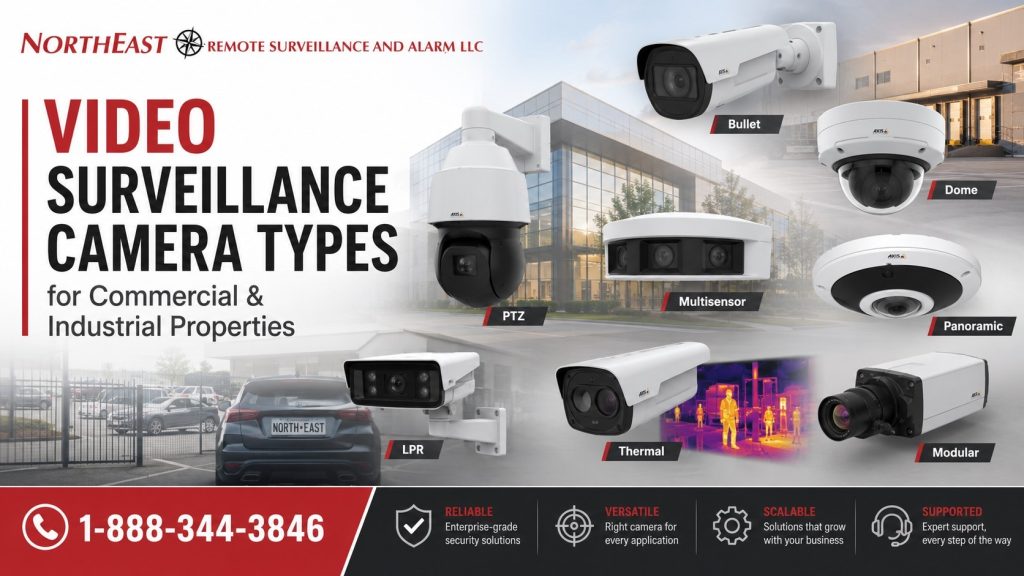
Bullet Cameras
Bullet cameras are one of the most common choices for exterior commercial and industrial security.
They are highly visible, easy to aim, and effective for focused views of specific areas. Their shape also provides a strong deterrent because people can usually tell where the camera is pointed.
Bullet cameras are commonly used for:
- Building perimeters
- Parking lots
- Loading docks
- Truck courts
- Gates
- Exterior doors
- Equipment yards
- Fence lines
- Drive lanes
Bullet cameras work well when the property needs a clear, directed view. They are especially useful when a camera must watch a doorway, vehicle lane, gate, dock position, or exterior approach.
They are not always the best choice for low interior ceilings, public-facing areas where tamper resistance matters, or wide areas where one fixed view is not enough.
Dome Cameras
Dome cameras are commonly used where a lower-profile, more protected camera is needed.
Their housing makes them harder to grab, redirect, or tamper with. Dome cameras are often used inside commercial buildings because they look cleaner than exposed bullet cameras and can blend better into office, lobby, corridor, and retail-style environments.
Dome cameras are commonly used for:
- Office interiors
- Lobbies
- Hallways
- Reception areas
- Elevators
- Interior entrances
- Public-facing spaces
- Schools
- Healthcare support areas
- Multi-tenant commercial buildings
Dome cameras can be a strong choice where appearance and tamper resistance matter. However, they must be installed carefully because dirty, scratched, or poorly positioned domes can reduce night image quality and create infrared reflection problems.
Turret Cameras
Turret cameras are a strong all-around option for many commercial and industrial properties.
They provide a cleaner profile than bullet cameras while often avoiding some of the infrared reflection issues that can affect dome cameras. Turrets are also easy to aim and service, making them useful across warehouses, office buildings, retail properties, and industrial sites.
Turret cameras are commonly used for:
- Interior warehouse aisles
- Exterior doors
- Office corridors
- Mechanical areas
- Small loading areas
- Storage rooms
- Utility spaces
- Employee entrances
- Commercial building perimeters
Turret cameras are often a practical choice when the system needs fixed coverage, good serviceability, and reliable night performance without a large visible camera body.
PTZ Cameras
PTZ cameras, or pan-tilt-zoom cameras, can move and zoom across large areas.
They are useful for active monitoring, guard stations, command centers, and remote viewing environments where an operator may need to follow activity or zoom into a specific area. PTZ cameras can be valuable on large commercial and industrial properties, but they must be used correctly.
PTZ cameras are commonly used for:
- Large parking lots
- Truck yards
- Industrial yards
- Campus roads
- Exterior perimeters
- Guard-monitored facilities
- Logistics properties
- Large open commercial areas
A PTZ camera should not replace fixed camera coverage for critical evidence points. A PTZ only records the area where it is pointed at that moment. For that reason, PTZ cameras work best as part of a layered design with fixed cameras covering important doors, lanes, docks, and perimeter points.
Multi-Sensor Cameras
Multi-sensor cameras use multiple lenses in one camera body to cover a wider area.
They are useful when a property needs broad coverage from one mounting location. A properly placed multi-sensor camera can reduce blind spots and may reduce the number of separate camera housings required.
Multi-sensor cameras are commonly used for:
- Building corners
- Parking lots
- Warehouse exteriors
- Truck courts
- Loading dock aprons
- Campus intersections
- Large interior open spaces
- Exterior wall coverage
- Commercial property perimeters
Multi-sensor cameras can provide 180-degree, 270-degree, or 360-degree style coverage depending on the model and lens layout. They are especially useful on commercial buildings where one corner can see two sides of the property.
They should still be planned carefully. Wide coverage does not always mean close detail. If the goal is facial detail, license plate capture, or a narrow evidence point, additional fixed cameras may still be needed.
Panoramic and Fisheye Cameras
Panoramic and fisheye cameras are designed to provide very wide views from a single camera location.
They can be useful for general awareness in open areas, especially where the goal is to see movement and activity across a full room or common space.
Panoramic and fisheye cameras are commonly used for:
- Lobbies
- Open office areas
- Retail floors
- Warehouse common areas
- Cafeterias
- Training rooms
- Public counters
- Small open commercial interiors
These cameras are best for situational awareness, not long-distance identification. They can show what happened in a broad space, but they may not provide the same detail as a properly placed fixed camera watching a doorway, register, gate, or access point.
License Plate Recognition Cameras
License plate recognition cameras are designed for vehicle identification, not general parking lot viewing.
A true LPR camera must be aimed, mounted, and configured around the lane, vehicle speed, camera angle, lighting, and expected capture distance. Standard cameras may show vehicles, but they often fail to capture readable plates at night or during motion.
LPR cameras are commonly used for:
- Gated entrances
- Truck entrances
- Employee lots
- Visitor lots
- Industrial yards
- Logistics facilities
- Parking lot entrances
- HOA and campus roads
- Municipal and commercial properties
LPR cameras should be treated as a specialty camera type. They are strongest when paired with overview cameras that show the full vehicle, driver area, gate, or surrounding activity.
Thermal Cameras
Thermal cameras detect heat signatures instead of relying only on visible light.
They are useful in areas where darkness, distance, fog, vegetation, glare, or large perimeter zones make standard cameras less reliable. Thermal cameras are commonly used for detection rather than identification.
Thermal cameras are commonly used for:
- Fence lines
- Remote perimeters
- Industrial yards
- Utility sites
- Large exterior lots
- Critical infrastructure
- Dark exterior areas
- Unlit storage yards
A thermal camera may detect a person or vehicle in difficult conditions, but it usually does not provide facial detail, clothing detail, plate detail, or color evidence. For that reason, thermal cameras are often paired with visible-light cameras or monitoring workflows.
Low-Light and Color-at-Night Cameras
Low-light and color-at-night cameras are designed to improve image quality in dark or poorly lit areas.
These cameras can be valuable for commercial and industrial properties where after-hours evidence matters. A strong low-light camera can help capture better detail in parking lots, docks, exterior doors, and yards.
Low-light cameras are commonly used for:
- Parking lots
- Exterior entrances
- Loading docks
- Truck courts
- Walkways
- Employee entrances
- Building perimeters
- Outdoor storage areas
Lighting still matters. Even the best camera performs better when the property has proper illumination, reduced glare, and a clean line of sight. A camera should not be expected to solve every lighting problem by itself.
Specialty Industrial Cameras
Some commercial and industrial environments require specialty camera equipment.
This may include cameras designed for harsh weather, extreme temperatures, washdown areas, corrosive environments, hazardous locations, or high-vibration industrial settings. These cameras are not selected by appearance alone. They must be matched to the operating environment.
Specialty camera considerations may include:
- Weather rating
- Vandal resistance
- Temperature rating
- Corrosion resistance
- Explosion-rated requirements
- Mounting surface
- Power availability
- Network distance
- Maintenance access
- Environmental exposure
For industrial properties, camera selection should account for both security performance and long-term durability.
AI-Ready Camera Selection
Camera type also affects analytics performance.
AI video detection works best when cameras are positioned correctly and when the field of view supports the activity being detected. A camera placed too high, too far away, or at the wrong angle may record video but still perform poorly for people detection, vehicle detection, line crossing, loitering alerts, or restricted-area alerts.
For AI-focused planning, continue with AI Video Surveillance & Real-Time Alerting.
Good AI camera planning should consider:
- Mounting height
- Viewing angle
- Object size
- Lighting
- Background movement
- Detection zones
- Distance to the target
- Expected movement direction
- Camera resolution
- Lens selection
AI does not fix poor camera placement. The camera still has to see the right activity at the right angle.
Camera Type and Recording Method Should Work Together
Camera selection should also match the recording method.
A high-resolution camera may require more storage. A multi-sensor camera may affect licensing and bandwidth. A remote yard camera may need a different network path than an office hallway camera. A critical evidence camera may need longer retention than a general overview camera.
For storage and retention planning, use Video Surveillance Recording Methods for Commercial and Industrial Properties.
Camera type, recording platform, network design, and retention policy should be planned together before installation begins.
NDAA and Procurement Considerations
Commercial and industrial buyers also need to consider procurement standards.
Camera selection may be affected by company policy, government contract requirements, cyber risk, insurance expectations, or NDAA-related purchasing restrictions. This is especially important for municipal, education, healthcare, utility, infrastructure, and enterprise environments.
For compliance-focused camera planning, use NDAA-Compliant Security Camera Systems.
The correct camera type must meet the visibility requirement and the organization’s purchasing standards.
Video Surveillance Camera Types for Commercial and Industrial Properties, Best Camera Types by Area
| Property Area | Common Camera Types | Main Purpose |
|---|---|---|
| Main entrances | Dome, turret, bullet | Entry visibility and identification |
| Parking lots | Bullet, multi-sensor, PTZ, low-light | Vehicle and pedestrian awareness |
| Loading docks | Bullet, turret, multi-sensor | Dock activity and incident review |
| Truck yards | Bullet, PTZ, thermal, multi-sensor | Wide-area coverage and after-hours detection |
| Gates | Bullet, LPR, overview camera | Vehicle capture and access documentation |
| Office interiors | Dome, turret | Clean interior monitoring |
| Warehouse aisles | Turret, bullet, panoramic | Movement and activity review |
| Building corners | Multi-sensor | Broad exterior coverage |
| Fence lines | Bullet, thermal | Perimeter detection |
| Lobbies | Dome, panoramic | Visitor and public-area visibility |
| Equipment rooms | Turret, dome | Restricted-area documentation |
| Exterior doors | Bullet, turret | Door activity and approach detection |
How NERSA Selects Commercial Camera Types
Northeast Remote Surveillance and Alarm, LLC does not design camera systems by guessing.
NERSA evaluates the property, the risk areas, the mounting conditions, and the evidence goals before selecting camera types. A warehouse, office, manufacturing facility, truck yard, and multi-building campus may all need different camera styles, even when they are part of the same organization.
NERSA considers:
- What needs to be seen
- How much detail is required
- Whether the area is interior or exterior
- Whether deterrence matters
- Whether tamper resistance is needed
- Whether the area has poor lighting
- Whether vehicles or plates must be captured
- Whether AI detection will be used
- Whether the camera must survive harsh conditions
- How the footage will be stored and reviewed
- How the system will scale over time
The result is a camera layout designed around business risk, not a generic equipment list.
Request a Commercial Video Surveillance Assessment
The right camera type can improve visibility, reduce blind spots, strengthen evidence quality, and make the entire video surveillance system more useful.
Northeast Remote Surveillance and Alarm, LLC designs commercial and industrial camera systems around real property conditions, risk areas, lighting, recording needs, and long-term reliability.
To begin planning, request a Security, Fire Alarm & Life Safety Assessment.
Frequently Asked Questions for Video Surveillance Camera Types for Commercial and Industrial Properties
What is the best camera type for a commercial property?
There is no single best camera type for every commercial property. Bullet cameras, dome cameras, turret cameras, PTZ cameras, multi-sensor cameras, LPR cameras, and thermal cameras all serve different purposes depending on the area being protected.
Are bullet cameras better than dome cameras?
Bullet cameras are often better for visible exterior deterrence and focused long-range views. Dome cameras are often better for interior spaces, public-facing areas, and locations where tamper resistance or a cleaner appearance matters.
When should a business use a PTZ camera?
A PTZ camera is useful for large areas where an operator may need to move or zoom the camera. It should usually be paired with fixed cameras because a PTZ only records the area where it is pointed at that time.
What are multi-sensor cameras used for?
Multi-sensor cameras are used for wide-area coverage, such as building corners, parking lots, loading dock aprons, truck courts, and campus intersections. They can reduce blind spots when mounted correctly.
Can a regular security camera read license plates?
Sometimes during ideal daytime conditions, but regular cameras usually fail at reliable plate capture during motion, glare, poor angles, or night conditions. A true LPR camera should be designed specifically for the lane, distance, lighting, and vehicle speed.
Are thermal cameras good for identification?
Thermal cameras are better for detection than identification. They can detect heat signatures in difficult conditions, but they usually do not provide facial detail, clothing color, or license plate information.
Do AI cameras require special camera placement?
Yes. AI analytics depend on camera angle, distance, object size, lighting, and detection-zone setup. A poorly placed camera may record video but still perform poorly for AI detection.
Who installs commercial and industrial video surveillance camera systems?
Northeast Remote Surveillance and Alarm, LLC designs and installs commercial and industrial video surveillance systems for warehouses, offices, manufacturing facilities, logistics sites, campuses, and multi-building properties.
Compliance, Codes & Project Standards
NERSA plans commercial and industrial security work with applicable code, documentation, inspection and authority-having-jurisdiction requirements in mind. Requirements vary by system, property and jurisdiction. These resources support project planning; they do not establish legal compliance, certification or AHJ approval.
Related guidance: Regulatory compliance & inspection readiness · Video surveillance compliance · NERSA project standards