Protect Route 33 commercial properties with intrusion detection designed around the doors, spaces, and schedules that create real risk.
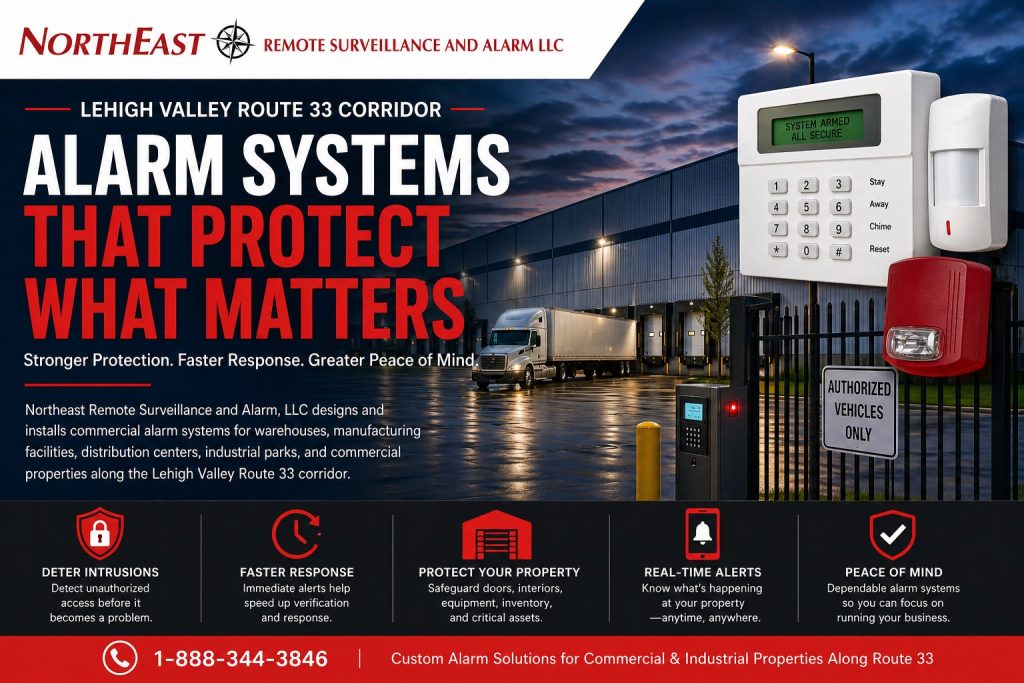
Northeast Remote Surveillance and Alarm, LLC designs commercial alarm systems for warehouses, manufacturers, contractor facilities, offices, and industrial properties along the Lehigh Valley Route 33 corridor. Each system is planned around building use, access points, operating hours, users, and the response required when the property is closed.
Protect the Right Openings and Areas
Exterior doors, overhead doors, side entrances, office-to-warehouse transitions, windows, interior rooms, and detached buildings may not carry the same risk. We identify the openings and spaces that need detection instead of applying one generic sensor package to the entire property.
Choose Commercial Intrusion Devices
A system may include door contacts, motion detection, glass protection, overhead-door contacts, panic devices, environmental inputs, sirens, keypads, and supervised communication. Device choice depends on the building, environment, schedule, and expected activity in each protected area.
Organize Users, Areas, and Schedules
Employees should have individual codes or credentials where the platform supports them. Warehouses, offices, and tenant areas may need separate partitions so one team can operate without disarming unrelated spaces. Clear zone names and opening or closing procedures make alerts easier to understand.
Use Monitoring With a Defined Response
Professional monitoring can receive covered alarm, panic, trouble, or other approved events and follow the customer’s call list and response instructions. Contact information, permits, passwords, and escalation procedures must stay current. Monitoring does not replace good locks, lighting, access control, or employee training.
Add Video Context When Useful
Compatible cameras can help an authorized user or monitoring workflow understand what occurred near an alarm zone.
For sites that need active camera review, see Route 33 remote video monitoring.
Alarm and video coverage should share clear names, timestamps, and responsibilities.
Upgrade an Existing Alarm System
An inherited installation may have useful sensors, wiring, or communication equipment. We review condition, compatibility, account ownership, monitoring agreements, user codes, zone descriptions, cellular or network paths, and service support before recommending reuse or replacement.
Frequently Asked Questions
Can a warehouse have separate alarm areas?
Yes. Compatible systems can partition offices, warehouse spaces, tenants, or other operating areas.
Can employees have individual codes?
Yes, and individual users improve accountability compared with one shared code.
Can an alarm system work with cameras?
Often. Compatibility and the intended video or monitoring workflow must be confirmed.
Can NERSA take over an existing alarm?
Frequently. We first verify equipment, programming access, communication, monitoring, and ownership.
Request a Route 33 Alarm Assessment
Use our security assessment form to review an existing system or plan commercial intrusion protection.
For the complete area overview, visit the Route 33 security systems guide.
Compliance, Codes & Project Standards
NERSA plans commercial and industrial security work with applicable code, documentation, inspection and authority-having-jurisdiction requirements in mind. Requirements vary by system, property and jurisdiction. These resources support project planning; they do not establish legal compliance, certification or AHJ approval.
Related guidance: Regulatory compliance & inspection readiness · NERSA project standards · Documentation, testing & inspection readiness