
Logistics access control helps distribution teams manage employee entry, visiting drivers, deliveries, and restricted work areas.

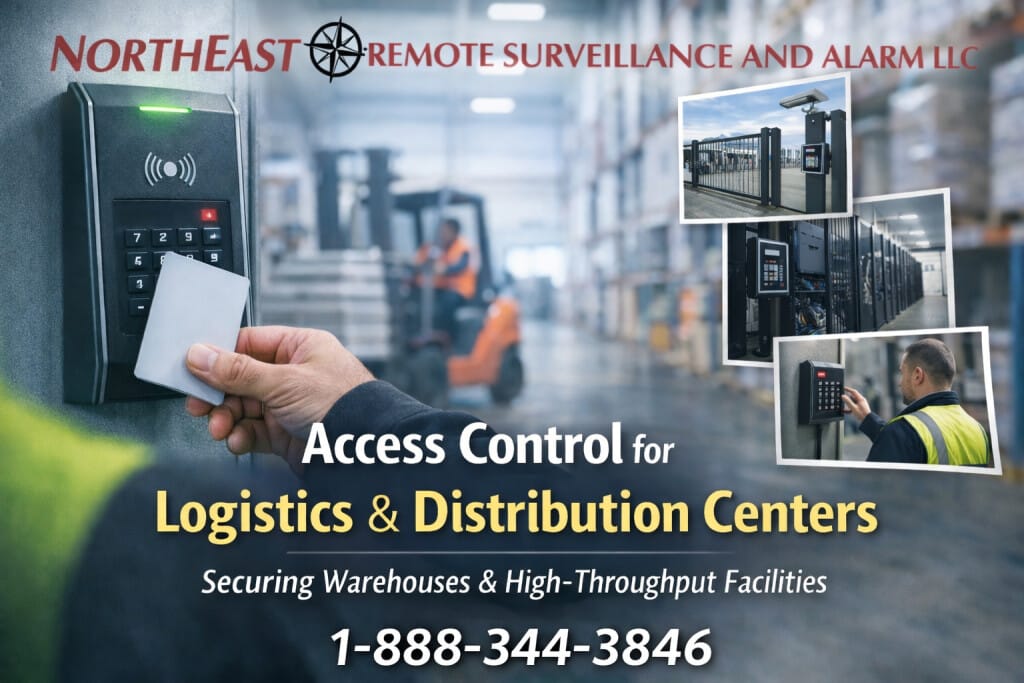
Northeast Remote Surveillance and Alarm, LLC (NERSA) plans controlled access around the way freight and people move through a facility.
For local door and credential workflows, review warehouse access-control planning in Scranton.
First, identify the points where visitors need staff approval and where employees need regular access. Separate driver check-in, dock offices, employee entrances, and restricted rooms so each opening has a clear purpose.
Plan Logistics Access Control Around Arrival and Check-In
Review how a driver finds the correct entrance, contacts staff, and receives directions. Then define the route from check-in to the approved waiting or delivery area. A visitor should not need unrestricted access to the building to reach the right person.
For example, an intercom can support an unstaffed entrance when the facility has a reliable way to answer calls. Agree on who verifies the visit and who can release the door. Also define the procedure when the intended contact is unavailable.
Coordinate Doors With Shifts and Work Areas
Map employee entrances, dock offices, dispatch rooms, maintenance spaces, and other controlled areas. Set schedules around actual shifts and approved exceptions. Keep the rules clear for temporary workers, contractors, and staff who move between departments.
Next, identify who approves access changes and how quickly expired permissions should be removed. Individual credentials make it easier to review a user’s access without changing a shared code for the whole team.
Connect the Access Record to the Freight Workflow
Use clear door names and consistent timestamps so staff can find the relevant event during a review. Where compatible cameras help document an entrance, coordinate the view with the controlled opening.
However, an access event records the credential or action presented to the system; it does not by itself establish who handled a shipment. Review it alongside the facility’s dispatch, delivery, and incident procedures.
Review Existing Equipment and Plan Growth
Inspect readers, controllers, door hardware, network connections, power, and account ownership before a change. Confirm that each opening operates as intended and that the proposed equipment works with the existing system.
Logistics access control can expand in phases when capacity and compatibility allow.
Plan for additional doors, users, and buildings while keeping site responsibilities clear.
For broader equipment changes, review commercial security upgrades, retrofits, and takeovers.
Frequently Asked Questions
How should access control handle delivery drivers at a distribution center?
Define a driver check-in point, staff contact, approval step, and route to the authorized waiting or delivery area. Drivers should not need unrestricted building access to reach the right person. Coordinate that workflow with dock offices, dispatch, and employee entrances.
Does an access-control record prove who handled a shipment?
No. An access-control event records the credential or action presented to the system; it does not by itself establish who handled freight. Review it alongside dispatch records, delivery procedures, incident information, and any relevant camera evidence.
Can logistics access control expand to additional doors or buildings?
Expansion can be phased when controller capacity, equipment compatibility, and supporting infrastructure allow. Review existing readers, controllers, door hardware, power, networks, and account ownership first. Keep each site’s permission approvals and operating responsibilities clear.
For a local project example, review the Easton Route 33 warehouse security-camera and access-control upgrade case study.
For vehicles and fenced yards, see commercial gate access-control systems before finalizing driver and visitor entry workflows.
Test the Entry Process and Handover
Finally, test approved and denied access, schedules, visitor calls, and event records. Include the people who manage check-in and shift changes. Provide authorized staff with practical instructions, equipment names, and support contacts.
For complete system options, explore commercial access control systems.
To review your facility’s entry workflow, request a security assessment.
Compliance, Codes & Project Standards
NERSA plans commercial and industrial security work with applicable code, documentation, inspection and authority-having-jurisdiction requirements in mind. Requirements vary by system, property and jurisdiction. These resources support project planning; they do not establish legal compliance, certification or AHJ approval.
Related guidance: Regulatory compliance & inspection readiness · Access control & door hardware standards · NFPA 101 & egress planning · ADA access-control planning