
Two-way communication and IP speaker systems help commercial and industrial facilities move beyond passive video recording by allowing live announcements, remote talk-down, gate communication, perimeter warnings, and event-based audio response.

request a two-way communication and IP speaker system assessment
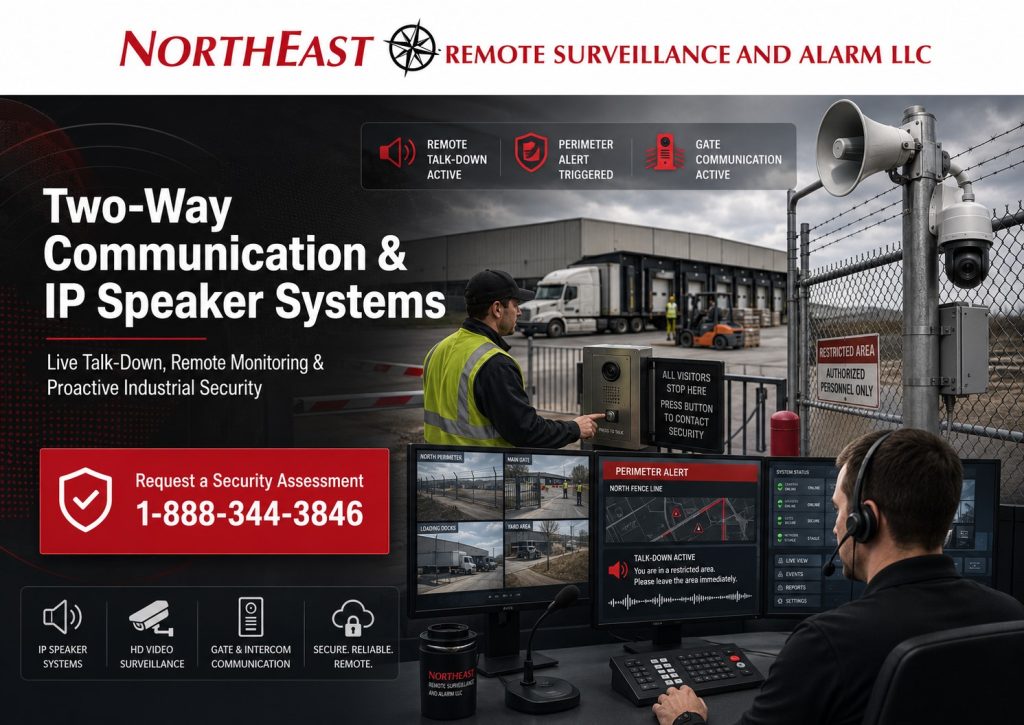
Northeast Remote Surveillance and Alarm, LLC designs network audio systems for warehouses, logistics centers, manufacturing facilities, industrial yards, contractor yards, commercial campuses, municipal properties, and multi-site business environments.
For broader active response planning, visit Remote Video Monitoring and Live Talk-Down.
Cameras document activity. Access control restricts movement. Intrusion alarms detect protected-area activity. Two-way communication and IP speaker systems add another layer: the ability to communicate while an event is still happening.
For commercial and industrial properties, that can matter. A person near a fenced yard, a vehicle at a closed gate, a delivery driver at the wrong dock, a trespasser near stored equipment, or a loitering event near a warehouse entrance may not require immediate dispatch if a remote operator can issue a clear warning or instruction first.
Call 1-888-344-3846 to request a two-way communication and IP speaker system assessment for your commercial or industrial facility.
Two-Way Communication & IP Speaker Systems
Two-way communication and IP speaker systems help commercial and industrial facilities move beyond passive video recording by allowing live announcements, remote talk-down, gate communication, perimeter warnings, and event-based audio response.
Northeast Remote Surveillance and Alarm, LLC designs network audio systems for warehouses, logistics centers, manufacturing facilities, industrial yards, contractor yards, commercial campuses, municipal properties, and multi-site business environments.
For broader active response planning, visit Remote Video Monitoring and Live Talk-Down.
Cameras document activity. Access control restricts movement. Intrusion alarms detect protected-area activity. Two-way communication and IP speaker systems add another layer: the ability to communicate while an event is still happening.
For commercial and industrial properties, that can matter. A person near a fenced yard, a vehicle at a closed gate, a delivery driver at the wrong dock, a trespasser near stored equipment, or a loitering event near a warehouse entrance may not require immediate dispatch if a remote operator can issue a clear warning or instruction first.
Call 1-888-344-3846 to request a two-way communication and IP speaker system assessment for your commercial or industrial facility.
Two-Way Communication and IP Speaker Systems for Commercial Security
Two-way communication and IP speaker systems are used to support live talk-down, remote announcements, paging, gate communication, dock communication, perimeter deterrence, zone alerts, and event-based audio response.
These systems are especially useful when audio needs to work with cameras, remote video monitoring, access control, gates, intrusion alarms, or security procedures. Instead of only recording activity for later review, a facility can create a response workflow that allows authorized users or monitoring operators to speak into the site when something is happening.
Northeast Remote Surveillance and Alarm, LLC designs these systems around real operating conditions, including site layout, camera views, network infrastructure, monitoring procedures, speaker placement, background noise, user permissions, and response expectations.
For coordinated system planning, visit Commercial & Enterprise Unified Integrated Security Systems.
What Is an IP Speaker System?
An IP speaker system is a network-connected audio system used for live announcements, automated messages, remote talk-down, paging, zone communication, and event-based audio response. Many IP speakers are powered by PoE, which allows power and data to run over the same network cable when properly designed.
Unlike traditional analog paging, IP speaker systems can be connected to security workflows. Depending on the platform and design, they may support remote operator announcements, pre-recorded messages, scheduled announcements, analytics-triggered alerts, multi-zone communication, mobile or desktop control, and event logging.
In commercial and industrial environments, IP speakers may be used for:
Perimeter deterrence
Yard and gate communication
Loading dock announcements
Remote monitoring talk-down
Visitor and delivery direction
After-hours warning messages
Interior operational announcements
Multi-site audio management
Event-based security response
Safety reminder announcements
Exterior parking lot communication
Contractor or vendor instruction
The system should be designed around the property’s layout and risk profile, not installed as random speakers on a wall.
Why Two-Way Talk-Down Matters
Two-way talk-down gives monitoring operators, security staff, or authorized users the ability to speak into a site remotely when suspicious, unauthorized, or confusing activity is detected.
That may include:
A trespasser near a fence line
A vehicle entering a yard after hours
A person loitering near loading docks
Activity near exterior storage areas
A driver approaching the wrong gate
Unauthorized movement near equipment
After-hours activity near building entrances
A gate or service area that needs remote instruction
A delivery driver who needs direction
A perimeter camera alert that needs verbal response
The purpose is early intervention. A clear voice announcement can deter activity before it becomes theft, vandalism, damage, trespassing, or a larger response event.
Perimeter and Fence Line Talk-Down
Perimeter areas are one of the strongest use cases for IP speaker systems. Industrial yards, warehouse properties, contractor yards, municipal lots, logistics sites, and fleet facilities often have fence lines, rear approaches, gates, storage areas, and exterior equipment zones that are difficult to supervise after hours.
A properly designed system can allow a monitoring operator to review a camera alert and issue a warning through a speaker aimed at the correct zone. In some cases, a pre-recorded message may be triggered by analytics, scheduling, or an approved monitoring workflow.
Perimeter audio should be planned around speaker direction, volume, distance, camera coverage, background noise, neighboring properties, wind exposure, and response procedures.
For monitored deterrence planning, visit Commercial and Industrial Security Monitoring.
Yard, Gate, and Vehicle Communication
Industrial properties often need communication around gates, truck yards, trailer areas, contractor entrances, and vehicle access points. IP speaker systems can help direct drivers, vendors, visitors, and contractors without requiring staff to be physically present at every entry point.
Common uses include:
- Directing delivery drivers to the correct dock
- Warning unauthorized vehicles after hours
- Communicating with visitors at a gate
- Supporting remote guard workflows
- Announcing yard restrictions
- Coordinating traffic movement
- Supporting camera-based gate review
- Giving instructions during gate access events
- Supporting contractor and vendor arrival procedures
When audio, video, access control, and gate activity are coordinated, the property has a stronger way to manage vehicle movement and exterior access.
Loading Dock Communication and Audio Response
Loading docks are active operational areas where people, freight, vehicles, open doors, staging areas, and equipment movement intersect. IP speakers can help support communication around dock assignments, delivery instructions, restricted access reminders, and after-hours activity.
For logistics and warehouse properties, audio can support remote receiving workflows, driver direction, dock safety reminders, and monitoring procedures when paired with camera coverage.
Speaker placement should account for truck noise, dock door locations, wall reflections, wind, equipment noise, and whether the message needs to reach drivers outside, staff inside, or both.
Interior Warehouse and Manufacturing Announcements
IP speaker systems may also support interior communication in warehouses, manufacturing plants, and commercial facilities. Interior network audio may be useful for operational announcements, safety reminders, zone-specific messaging, shift communication, and event-based alerts.
Industrial interiors can be challenging because of machinery noise, forklift traffic, high ceilings, reflective surfaces, and large open areas. Speaker type, placement, volume, and zoning should be planned carefully so announcements are understandable without creating unnecessary noise or confusion.
Interior speaker systems may support:
- Warehouse announcements
- Manufacturing floor messaging
- Receiving area communication
- Shift change announcements
- Restricted area reminders
- Safety reminders
- Zone-specific instructions
- Operational paging
- Event-based audio response
The goal is clear communication, not unnecessary noise.
Automated Audio Alerts and AI Analytics
IP speaker systems become more useful when they are coordinated with cameras, AI analytics, alarms, or monitoring workflows. A camera may detect a person after hours. Analytics may identify line crossing near a fence. An alarm may trigger at a rear door. A gate event may show unauthorized movement.
Depending on the system design, these events may trigger an alert for review, activate a pre-recorded message, notify a remote operator, or support live talk-down.
Automated audio should be planned carefully. The message should be clear, the zone should be correct, and the workflow should avoid unnecessary noise, false alarms, or confusion for employees, neighbors, vendors, or responders.
For broader coordination between cameras, access control, alarms, monitoring, gates, intercoms, and reporting, visit Security System Integration for Commercial Facilities.
Types of IP Speaker and Two-Way Communication Devices
Commercial and industrial sites may use different types of network audio devices depending on the environment, coverage area, mounting location, and intended response workflow.
Outdoor Horn Speakers
Outdoor horn speakers are commonly used for perimeter areas, yards, gates, parking lots, loading areas, and exterior security zones. They are designed to project audio across larger spaces and may require weather-rated construction, surge protection, proper mounting, and zone planning.
Wall-Mount and Ceiling Speakers
Wall-mount and ceiling speakers may be used inside warehouses, office areas, manufacturing support spaces, corridors, receiving areas, or commercial interiors. These are often used for announcements, paging, or interior zone communication.
Speaker and Strobe Combinations
Some applications may use audio and visual notification together. Speaker and strobe combinations can be useful in loud environments, industrial areas, or places where visual confirmation helps reinforce an announcement or alert.
Two-Way Speaker and Microphone Units
Some network audio devices support two-way communication when paired with compatible software and proper policies. These can allow an authorized operator to speak and, where appropriate and properly reviewed, listen during a security, gate, intercom, or access event.
Audio recording and listening features should be reviewed carefully before activation because audio creates different legal, privacy, labor, and policy considerations than video-only surveillance.
Infrastructure Behind IP Speaker Systems
IP speaker systems depend on reliable infrastructure. Speakers, microphones, intercoms, cameras, monitoring platforms, and network devices all rely on cabling, switching, power, bandwidth, VLAN planning, surge protection, weather protection, and documentation.
Outdoor and industrial installations may require additional planning because of distance, environmental exposure, grounding, electrical interference, mounting vibration, harsh conditions, and network reliability.
A proper infrastructure plan may include:
- PoE switch capacity
- Structured cabling
- Fiber connections
- Wireless bridge links
- Surge protection
- UPS backup
- Network segmentation
- Secure remote access
- Weather-rated enclosures
- Device labeling
- Speaker zone documentation
- User permissions
- Future expansion planning
A network audio system is only as reliable as the infrastructure behind it.
For a facility-wide review of security, life-safety, and low-voltage infrastructure, visit Physical Plant Security Assessment.
Acoustic Planning and Speaker Placement
Industrial facilities are often loud. A speaker that works well in a quiet office may not be effective in a truck yard, loading dock, manufacturing floor, or equipment area.
Audio design should consider:
- Distance from the speaker to the target area
- Background noise levels
- Speaker direction
- Sound pressure requirements
- Weather and wind exposure
- Echo and reflection
- Overlapping audio zones
- Neighboring properties
- Mounting height
- Wall and ceiling materials
- Truck and equipment noise
- Whether the message must be heard indoors, outdoors, or both
The goal is clear communication, not just loud sound. A system that is too quiet will not be useful. A system that is too loud or poorly aimed may create unnecessary disturbance.
Remote Monitoring and Guard Workflows
Two-way audio is often used with remote video monitoring. A camera or analytic event identifies activity. A monitoring operator reviews the event. If the activity appears unauthorized or concerning, the operator can issue a live verbal warning or instruction through the speaker.
This model can support exterior yards, industrial parks, contractor yards, warehouse perimeters, municipal lots, loading areas, parking lots, gates, and other exposed commercial properties.
Remote talk-down does not replace every security measure, but it can reduce the gap between detection and response.
A strong monitoring workflow should define:
- Which camera events require review
- Which speaker zones may be used
- Who is authorized to speak
- What announcements should be used
- When dispatch should be requested
- How events are documented
- How false alarms are reduced
- How customers review activity afterward
The best systems combine clear camera views, properly aimed speakers, defined procedures, and secure user permissions.
IP Speakers With Intrusion Alarms
IP speakers may also support intrusion alarm workflows when properly planned. An alarm event at a rear door, fenced yard, detached building, storage area, gate, or restricted space may need video review and audio response before escalation.
When cameras, alarms, and audio are coordinated, the system can help management understand whether the event appears to be unauthorized activity, employee access, contractor movement, or a false alarm.
For alarm-system planning, visit Commercial & Enterprise Intrusion Alarm Systems.
Cybersecurity and User Permissions
Because IP speakers are network-connected devices, they should be treated as part of the security infrastructure. Poorly configured network audio can create unnecessary risk.
A secure design should consider:
- Strong device credentials
- Role-based user permissions
- Network segmentation
- Controlled remote access
- Firmware lifecycle management
- Disabled unused features
- Logging where supported
- Documented users and zones
- Physical protection for outdoor devices
- Limited administrative access
- Secure mobile or desktop access
Only authorized users should be able to trigger announcements, access audio features, change schedules, or modify system settings.
Audio, Privacy, and Policy Considerations
Audio systems require more careful policy review than video-only systems. Microphones, listening features, audio recording, intercom capture, and two-way communication may create legal, privacy, labor, and workplace-policy concerns depending on the state, facility, and use case.
As a best practice, commercial and industrial facilities should avoid enabling audio recording casually. Written policies, signage, employee communication, legal review, and role-based permissions should be considered before activating listening or recording features.
Two-way talk-down for exterior security applications may be useful, but it should still be documented and governed. The facility should know which devices have audio capability, who can use them, when announcements are made, and whether any audio is recorded.
Compliance-Aware IP Speaker Planning
IP speaker systems are not fire alarm systems, emergency communication systems, mass notification systems, or code-required life-safety notification systems unless specifically designed, approved, and installed for that purpose. They may support operational communication, safety reminders, remote deterrence, and security workflows, but they should not be treated as a substitute for required life-safety systems.
Security audio should never interfere with required emergency notification, door function, fire alarm operation, safe egress, or authority-having-jurisdiction expectations.
A compliance-aware design should consider documentation, low-voltage installation quality, privacy expectations, workplace communication policies, cybersecurity, user permissions, and long-term serviceability.
For broader code and inspection planning, visit Regulatory and Compliance Hub for Commercial Security, Fire Alarm and Life Safety.
How Security Audio Fits Your Site
This service covers two-way communication, IP speaker systems, network audio, remote talk-down, perimeter announcements, gate communication, dock audio, and event-based security communication for commercial and industrial facilities.
Coordinate IP speakers with the systems they serve; broader monitoring, paging, intercom and life-safety requirements need their own design review.
Where Two-Way Communication and IP Speakers Are Most Useful
Two-way communication and IP speaker systems may be useful for:
- Warehouses
- Distribution centers
- Logistics hubs
- Manufacturing plants
- Industrial parks
- Contractor yards
- Truck yards
- Municipal properties
- Utility yards
- Equipment storage areas
- Commercial campuses
- Multi-tenant industrial properties
- Loading dock areas
- Gated entrances
- Exterior parking areas
- Remote or lightly staffed facilities
- Fenced storage yards
- Fleet areas
- School exterior areas
- Public works properties
The system should be designed around real site activity, not a generic speaker package.
Why Businesses Choose NERSA for IP Speaker and Talk-Down Systems
Northeast Remote Surveillance and Alarm, LLC designs two-way communication and IP speaker systems as part of a broader commercial and industrial security strategy.
NERSA plans the camera views, monitoring workflow, speaker coverage, network infrastructure, user permissions, response procedures, and documentation needed to make talk-down audio useful in real commercial and industrial conditions.
The goal is not simply to install speakers. The goal is to improve deterrence, response speed, site control, communication, and operational awareness.
For broader commercial and industrial service planning, visit Commercial & Industrial Security Services.
What NERSA Reviews During an IP Speaker Assessment
A two-way communication and IP speaker assessment may review:
- Camera coverage
- Speaker zones
- Perimeter areas
- Gate locations
- Loading docks
- Yard activity
- Parking lots
- Warehouse interiors
- Background noise
- Mounting locations
- PoE and network infrastructure
- Fiber or wireless bridge needs
- Remote access requirements
- Monitoring workflows
- Audio policies
- User permissions
- Legal and privacy considerations
- Neighboring properties
- Response procedures
- Future expansion needs
This process helps prevent weak audio coverage, poorly aimed speakers, unclear workflows, unnecessary noise, security gaps, and network problems.
Frequently Asked Questions About Two-Way Communication and IP Speaker Systems
What is a two-way communication and IP speaker system?
A two-way communication and IP speaker system is a network-connected audio system used for announcements, paging, talk-down, automated messages, zone communication, gate communication, and event-based audio response in commercial or industrial environments.
What is two-way talk-down?
Two-way talk-down allows an authorized user or monitoring operator to speak into a property remotely during a security event. It is often used to warn trespassers, direct drivers, communicate at gates, or support after-hours event response.
Where are IP speakers used in industrial security?
Common locations include fence lines, yards, gates, loading docks, employee entrances, contractor entrances, parking areas, receiving areas, warehouses, manufacturing floors, exterior storage areas, and truck courts.
Can IP speakers integrate with security cameras?
Yes. IP speakers can be coordinated with cameras so operators can review video and issue a live or automated announcement when activity is detected.
Can AI analytics trigger speaker messages?
Yes, depending on the system design. AI analytics may trigger alerts or pre-recorded messages for line crossing, person detection, vehicle detection, loitering, or after-hours activity.
Are IP speaker systems powered by PoE?
Many commercial IP speakers are powered by PoE, but requirements depend on the device, output level, cable distance, switch capacity, and installation environment.
Are IP speakers loud enough for industrial yards?
Outdoor horn speakers can be designed for yard and perimeter applications, but effectiveness depends on speaker selection, placement, background noise, distance, wind, mounting height, and zone planning.
Can IP speakers be used at loading docks?
Yes. IP speakers can support dock communication, delivery direction, restricted access reminders, safety announcements, and remote receiving workflows.
Can IP speakers work with access control?
Yes. IP speakers may be coordinated with access control events such as forced doors, held doors, gate activity, visitor entry, or restricted-area movement.
Can IP speakers support remote monitoring?
Yes. Remote monitoring operators can use IP speakers for live talk-down or event-based communication when camera views, alert rules, and response procedures are designed properly.
Can announcements be automated?
Yes. Some systems support pre-recorded announcements triggered by schedules, analytics, alarms, or operator workflows.
Should audio recording be enabled?
Audio recording should not be enabled casually. Facilities should review state law, employee policies, signage, privacy expectations, and legal requirements before enabling microphones or recording features.
Are IP speakers the same as a fire alarm system?
No. IP speakers are not a substitute for code-required fire alarm, emergency communication, or life-safety notification systems. They may support security or operational communication, but life-safety systems must be planned separately and properly.
Do IP speakers need cybersecurity planning?
Yes. IP speakers are network-connected devices and should be protected with strong credentials, user permissions, network segmentation, firmware management, and controlled remote access.
Can IP speakers be used in municipal or public works properties?
Yes. Municipal yards, public works facilities, utility properties, parking areas, and service buildings may use IP speakers for gate communication, perimeter warnings, yard announcements, and remote monitoring response.
What is the next step for planning an IP speaker system?
The next step is a site-specific assessment. NERSA reviews camera views, speaker zones, background noise, network infrastructure, monitoring workflows, audio policy needs, and response procedures before recommending a system design.
Request a Two-Way Communication Assessment
If your facility needs live talk-down, perimeter audio deterrence, gate communication, dock announcements, remote monitoring audio, or IP speaker planning for a commercial or industrial property, Northeast Remote Surveillance and Alarm, LLC can help design the system around the way your site actually operates.
Call 1-888-344-3846 or visit Physical Plant Security Assessment to request a two-way communication and IP speaker system assessment.