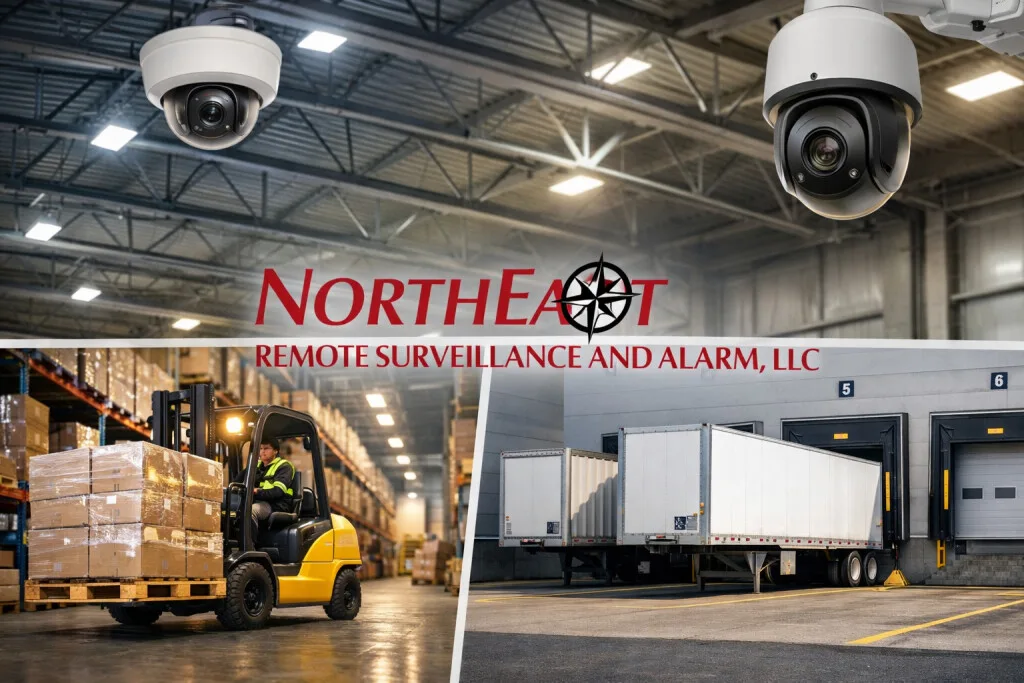
Plan loading dock video coverage around trailer movement, cargo transfer, forklifts, dock doors, staging areas, and surrounding yards.
Request a loading-dock security assessment
Loading Dock Cameras Planned for Usable Evidence
Loading docks bring vehicles, employees, drivers, contractors, forklifts, and cargo into the same fast-moving area. A useful surveillance design must account for those overlapping activities and define what each camera is expected to show.
Northeast Remote Surveillance and Alarm, LLC designs commercial video surveillance around the facility and its operations. The objective is dependable coverage that helps authorized personnel review events, verify activity, and understand what occurred without relying on a generic camera layout.
Priority Loading Dock Views
Dock Doors and Thresholds
- Trailer arrival and door position
- Dock-plate and threshold activity
- Loading and unloading events
- People and equipment entering the building
Staging and Material Movement
- Pallet and cargo staging
- Forklift routes and intersections
- Shipping and receiving activity
- High-value or restricted handling areas
Truck Courts and Exterior Areas
- Trailer approaches and backing lanes
- Truck courts and waiting areas
- Trailer staging and exterior storage
- Drive lanes, gates, and site approaches
What Determines Camera Placement?
Camera placement follows the required result. An overview camera may show traffic across several doors, while a dedicated view may be needed to document activity at a specific threshold, lane, or staging point. The right combination depends on the building, the operating process, and the incident questions the video must help answer.
- Viewing objective: awareness, recognition, identification, or detailed review.
- Lighting conditions: open doors, backlighting, headlights, shadows, reflective trailers, and nighttime operation.
- Mounting conditions: ceiling height, rooflines, obstructions, vibration, weather exposure, and maintenance access.
- Operational movement: forklift paths, pedestrian routes, trailer turns, staging practices, and peak activity.
- Recording requirements: image quality, frame rate, storage capacity, retention, event search, and export procedures.
Interior and Exterior Coverage Working Together
Loading-dock incidents often begin outside and continue through the dock door. Coordinated interior and exterior views can provide a clearer sequence of trailer arrival, door assignment, unloading, staging, and departure. Where appropriate, coverage may extend to truck gates, parking areas, perimeter approaches, detached buildings, or trailer yards.
For broader facility planning, see Warehouse Surveillance Systems and Warehouse and Logistics Security Systems.
Integration, Monitoring, and Existing Systems
When compatible and useful, dock video can support access control, gate entry, intrusion detection, intercoms, and selected remote-monitoring workflows. The purpose of integration is to improve investigation, administration, or response—not to add complexity without a clear benefit.
NERSA can also evaluate existing cameras, recorders, cabling, fiber, networks, power, software, user permissions, and documentation. A practical upgrade may retain serviceable infrastructure while correcting weak views, unreliable equipment, storage limitations, or account-control problems.
How a Loading Dock Surveillance Project Begins
- Operational review: document dock count, vehicle flow, staging, shifts, users, and known concerns.
- Existing-system assessment: evaluate installed equipment, infrastructure, accounts, and available documentation.
- Coverage design: define each view, confirm lighting and mounting conditions, and plan recording requirements.
- Installation and commissioning: install, configure, aim, test, label, and document the approved system.
- Training and support: show authorized users how to view, search, export, and administer the system.
Verify the Recorded Dock Sequence
Before accepting the coverage, agree on a short sequence that represents normal work: a trailer approaches, backs into position, the dock opens, cargo is transferred, and the vehicle leaves. Review the recording with a warehouse representative to confirm which views answer each incident question and where people, trailers, or stacked freight obscure detail.
Repeat the relevant checks during the lighting conditions in the approved scope, including open-door backlighting or nighttime work. Confirm that camera names, timestamps, and retention settings allow staff to follow the same event across interior and exterior views. An authorized user should search for the sequence and export it, then verify that the exported file plays and contains the required detail.
Where monitoring is included, test the agreed alert and contact process without treating the presence of cameras as proof that every view is watched continuously. Record blind spots, failed tests, permissions problems, and other unresolved items with an assigned person and follow-up date. Keep the approved view list and test results with the system handover records.
Related Commercial Security Services
Use these services to plan recording, monitored response, vehicle entry, or upgrades around your dock operations.
- Commercial and Industrial Video Surveillance — Plan camera coverage and recorded evidence beyond the dock area.
- Remote Video Monitoring and Live Talk-Down — Define how operators should review dock activity and respond.
- Commercial Gate Access Control — Coordinate vehicle admission with receiving and dock procedures.
- Security System Upgrades, Retrofits, and Takeovers — Review whether existing dock equipment can support the intended improvements.
Frequently Asked Questions
Can cameras document trailer backing and dock-door activity?
Yes. Camera locations can be planned around trailer approaches, backing lanes, dock doors, and thresholds. The usable detail depends on distance, angle, lighting, lens selection, and mounting conditions.
Can loading-dock surveillance include forklift and cargo staging areas?
Yes. Interior coverage can include forklift routes, staging zones, cargo-transfer points, and shipping or receiving areas when those views are part of the approved scope.
Can NERSA upgrade an existing dock camera system?
Yes. Existing cameras and infrastructure can be assessed before deciding what should be retained, repaired, repositioned, expanded, migrated, or replaced.
Does NERSA install single-family home camera systems?
No. NERSA does not provide security installations for individual homes or single-family residences. We serve businesses, industrial and institutional facilities, and professionally managed apartment communities, including shared entrances, common areas, and grounds.
Request a Loading Dock Security Assessment
Request a loading-dock security assessment to review camera views, lighting, network paths, recording capacity, and the evidence your staff needs.
Compliance, Codes & Project Standards
NERSA plans commercial and industrial security work with applicable code, documentation, inspection and authority-having-jurisdiction requirements in mind. Requirements vary by system, property and jurisdiction. These resources support project planning; they do not establish legal compliance, certification or AHJ approval.
Related guidance: Regulatory compliance & inspection readiness · NERSA project standards · Documentation, testing & inspection readiness