Warehouse Security Camera Systems for Distribution Centers and Logistics Facilities

.


Enterprise Security Camera Systems for Distribution Centers and Logistics Facilities

Warehouse Security Camera Systems for Distribution Centers and Logistics Facilities by Northeast Remote Surveillance and Alarm, LLC (NERSA). Modern warehouses and distribution centers in Pennsylvania and Mid Atlantic are among the most dynamic operational environments in the industrial economy. Large logistics facilities may process thousands of pallets daily, manage fleets of forklifts and yard tractors, and operate shipping and receiving docks around the clock. In these environments, maintaining visibility into facility operations is essential for safety, asset protection, operational accountability and Complinance.

Warehouse security camera systems provide the visual intelligence required to monitor cargo movement, observe forklift traffic, document shipping and receiving operations, and protect valuable inventory. Properly engineered surveillance systems help facility managers maintain situational awareness across complex industrial environments while supporting incident investigation and operational analysis.

Learn more about Industrial Video Surveillance and Loading Dock Surveillance Systems

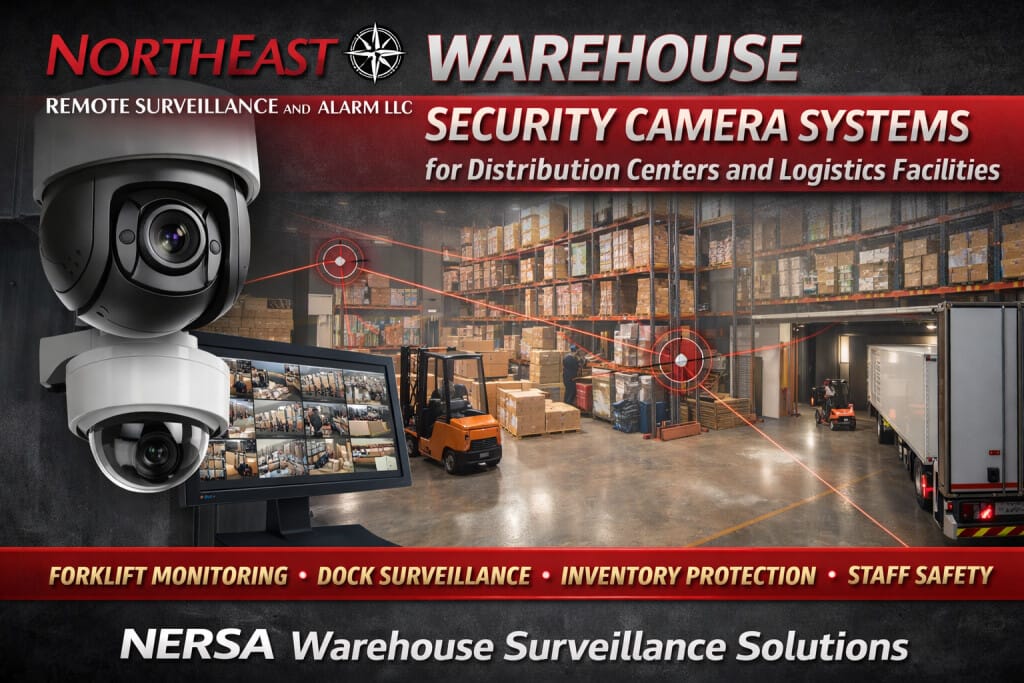
Warehouse security camera system monitoring forklifts, pallet storage aisles, and loading dock operations inside a distribution center using industrial surveillance cameras.
Warehouse security camera systems designed for logistics facilities and distribution centers to monitor forklift traffic, cargo staging areas, and loading dock operations.

At Northeast Remote Surveillance and Alarm, LLC (NERSA), warehouse surveillance systems are engineered specifically for the operational realities of modern logistics facilities. Rather than deploying generic camera installations, NERSA designs surveillance infrastructure based on warehouse layout, equipment movement patterns, cargo staging procedures, and security objectives.

This engineering-focused approach allows warehouse operators to maintain reliable monitoring of critical facility areas such as dock doors, storage aisles, trailer yards, staging zones, and forklift traffic lanes.


Why Warehouse Surveillance Is Critical

Warehouses and distribution centers often contain millions of dollars in inventory and equipment. At the same time, these facilities experience continuous activity involving employees, contractors, drivers, and delivery personnel.

Without adequate surveillance coverage, organizations may struggle to investigate incidents such as:

  • cargo damage or loss
  • forklift accidents
  • unauthorized facility access
  • trailer docking incidents
  • workplace safety violations

Security camera systems provide documentation of operational activity, allowing facility managers and safety teams to review events objectively.

Surveillance systems can also help organizations analyze workflow efficiency, identify safety risks, and maintain operational transparency.


Key Areas of Warehouse Surveillance Coverage

Warehouse surveillance systems must monitor a wide variety of operational zones. Each area requires different camera placement strategies and coverage objectives.

Dock Door Monitoring

Loading dock areas represent one of the most active sections of any warehouse facility. Cameras positioned above dock doors and within the warehouse ceiling structure can monitor:

  • trailer docking procedures
  • forklift loading operations
  • cargo transfer between trailers and staging areas

Dock surveillance systems are often designed to provide identification-level video clarity near the dock door threshold.

For a detailed engineering discussion, see the Loading Dock Surveillance Systems page on the NERSA website.


Warehouse Storage Aisles

High-bay storage aisles present unique surveillance challenges due to long viewing distances and tall rack structures.

Surveillance coverage in these areas helps monitor:

  • inventory access
  • employee activity
  • equipment movement

Camera placement must account for aisle width, shelving height, and forklift travel routes to maintain clear visibility.


Cargo Staging Areas

Before cargo is loaded or shipped, pallets are typically staged near dock doors or shipping lanes.

Surveillance cameras positioned above staging zones allow managers to monitor:

  • pallet movement
  • shipment preparation
  • inventory handling procedures

This coverage can be particularly valuable when investigating missing shipments or cargo damage.


Forklift Travel Routes

Forklifts represent one of the most significant operational risks within warehouse environments. Cameras positioned along forklift travel lanes provide visibility into equipment movement and potential safety hazards.

Footage from these cameras can be used to review incidents, analyze traffic flow, and support safety training initiatives.


Exterior Trailer Yards

Many distribution facilities maintain large trailer staging yards where trailers wait to be assigned to dock doors.

Cameras positioned on building walls or lighting poles can monitor:

  • trailer inventory
  • yard tractor activity
  • vehicle entry and exit

Yard surveillance provides an additional layer of visibility across the entire logistics operation.


Warehouse Camera Engineering Principles

Designing surveillance systems for warehouses requires careful engineering to ensure cameras capture usable footage rather than general observations.

Pixel Density and Image Clarity

The most important metric in surveillance design is pixel density, often measured in pixels per foot (PPF).

Security engineering guidelines referenced by organizations such as ASIS International often recommend the following thresholds:

Surveillance ObjectivePixels Per Foot
Identification40+
Recognition20+
Observation10+

In warehouse environments, identification-level coverage is often required near dock doors and cargo transfer zones.


Camera Mounting Height

Warehouse cameras are typically installed on ceilings or structural beams.

Common mounting heights include:

  • 20–30 feet in standard warehouses
  • 30–40 feet in high-bay logistics centers

Mounting height influences camera lens selection and field-of-view calculations.


Lighting Conditions

Warehouses often experience mixed lighting environments where indoor lighting meets exterior daylight at dock doors.

Modern surveillance cameras use technologies such as:

  • wide dynamic range (WDR)
  • low-light sensors
  • exposure control algorithms

These features help maintain image clarity in complex lighting conditions.


Types of Cameras Used in Warehouse Surveillance

Several camera types are commonly used in warehouse environments.

Dome Cameras

Dome cameras are frequently mounted on warehouse ceilings to provide wide-area coverage of operational zones.


Bullet Cameras

Bullet cameras are often used outdoors or near dock doors where directional monitoring is required.


Pan-Tilt-Zoom Cameras

PTZ cameras allow operators to adjust camera angles remotely, making them useful for monitoring large warehouse areas.


Multi-Sensor Cameras

Multi-sensor cameras use multiple lenses within a single housing to monitor large areas with fewer devices.


Video Management Platforms

Warehouse surveillance systems rely on enterprise video management software to organize and record footage.

Two widely used platforms include:

  • Avigilon Control Center
  • Genetec Security Center

These platforms allow security teams to manage hundreds of cameras across multiple facilities while maintaining centralized monitoring.


Cybersecurity for Warehouse Surveillance Systems

Because modern surveillance systems operate on network infrastructure, cybersecurity must be considered during system design.

Organizations such as National Institute of Standards and Technology publish widely adopted cybersecurity frameworks that help organizations secure connected devices.

Best practices may include:

  • network segmentation
  • secure authentication
  • firmware updates
  • controlled remote access

These measures help protect surveillance systems from unauthorized access.


Operational Benefits of Warehouse Surveillance

Organizations implementing engineered surveillance systems often experience several operational advantages.

Improved Workplace Safety

Monitoring forklift routes and cargo transfer areas helps identify unsafe practices.


Cargo Accountability

Video documentation provides evidence when investigating shipping disputes.


Theft Deterrence

Visible surveillance systems can discourage unauthorized activity.


Operational Visibility

Managers can review footage to analyze workflow patterns and improve logistics efficiency.


Warehouse Surveillance in the Mid-Atlantic Logistics Corridor

The Mid-Atlantic region contains one of the most active logistics networks in the United States. Major warehouse clusters in Pennsylvania, New Jersey, and Delaware serve as distribution hubs for national supply chains.

Facilities operating in these regions often process high shipping volumes and require reliable surveillance systems to monitor large industrial spaces.

Northeast Remote Surveillance and Alarm, LLC designs surveillance systems tailored specifically for these high-throughput logistics environments.


Warehouse Surveillance Engineering Process

NERSA follows a structured engineering approach when designing warehouse surveillance systems.

1. Facility Assessment

Evaluation of warehouse layout, operations, and security objectives.

2. Coverage Planning

Mapping of camera positions to eliminate blind spots.

3. Equipment Selection

Selection of cameras, lenses, and recording infrastructure.

4. Installation

Professional installation of cameras and network infrastructure.

5. System Commissioning

Testing and calibration of camera views and recording functions.


Warehouse Security Camera Systems FAQ

(Insert your 100-question warehouse surveillance FAQ block here.)


Industry References and Technical Guidance

The engineering practices used in warehouse surveillance system design are informed by guidance from organizations such as:

  • ASIS International
  • Occupational Safety and Health Administration
  • National Institute of Standards and Technology

These organizations publish resources related to security management, workplace safety, and cybersecurity practices that influence surveillance system design.


Warehouse Surveillance Solutions from NERSA

Industrial warehouses require surveillance systems that are engineered for complex operational environments rather than simple camera installations.

By combining security engineering principles, modern surveillance technology, and operational awareness, Northeast Remote Surveillance and Alarm, LLC delivers warehouse security camera systems that provide reliable monitoring across distribution centers, manufacturing facilities, and logistics operations.

Organizations seeking improved operational visibility and facility security can contact NERSA to discuss warehouse surveillance system design and installation. Call Today for an Enterprise Security and life Safety Assessment 1-888-344-3846


I


Enterprise Camera Placement Guide for 50,000–1,000,000 Square Foot Facilities

Warehouse surveillance systems must be engineered differently depending on the size, layout, and operational complexity of the facility. A 50,000-square-foot regional warehouse may have fewer dock doors and simpler traffic patterns, while a 1,000,000-square-foot distribution center may operate hundreds of forklifts, dozens of dock positions, and multiple cargo staging zones simultaneously.

Effective warehouse surveillance design requires a structured approach to camera placement that considers facility geometry, equipment movement patterns, and security objectives. At Northeast Remote Surveillance and Alarm, LLC, warehouse camera placement is designed to provide operational visibility while ensuring that cameras capture usable video evidence rather than simply general monitoring footage.

The following guidelines illustrate how surveillance systems are commonly structured for warehouses of varying sizes.


Surveillance Design for 50,000–100,000 Square Foot Warehouses

Facilities within this size range typically include:

  • 6–20 dock doors
  • moderate forklift activity
  • pallet rack storage aisles
  • small staging areas

Surveillance systems for these warehouses are designed to monitor key operational areas without excessive camera density.

Typical Coverage Areas

Camera coverage commonly focuses on:

  • dock door operations
  • forklift travel lanes
  • cargo staging zones
  • warehouse entrances and exits

Typical Camera Deployment

Typical installations may include:

  • cameras positioned above each dock door
  • ceiling-mounted cameras covering staging areas
  • cameras monitoring main forklift traffic lanes
  • exterior cameras monitoring trailer parking areas

This configuration provides reliable visibility across the warehouse floor while minimizing blind spots.


Surveillance Design for 100,000–300,000 Square Foot Distribution Centers

Mid-size distribution centers often have more complex operational patterns and higher cargo throughput.

Facilities in this range may include:

  • 20–60 dock doors
  • multiple staging lanes
  • high-density storage racks
  • multiple forklift routes

Surveillance systems for these facilities must provide broader coverage across larger operational zones.

Camera Placement Strategy

Camera placement typically includes:

  • cameras above each dock door monitoring loading activity
  • long-range aisle cameras observing rack storage areas
  • wide-area ceiling cameras monitoring staging zones
  • cameras observing main forklift traffic corridors
  • exterior cameras monitoring trailer approach lanes

Additional cameras may be installed in shipping offices and inventory control areas to document administrative activity related to cargo movement.


Surveillance Design for 300,000–600,000 Square Foot Logistics Facilities

Large logistics facilities often operate with multiple shipping carriers, large trailer yards, and continuous cargo movement.

Facilities in this size range may include:

  • 60–120 dock doors
  • extensive staging zones
  • automated conveyor systems
  • multiple trailer staging yards

Because of the scale of these environments, surveillance systems must be designed with layered coverage zones.

Layered Surveillance Coverage

Layered surveillance typically includes:

Dock Door Coverage

Cameras monitoring trailer alignment, cargo transfer, and forklift loading activity.

Aisle Monitoring

Cameras positioned to observe long warehouse aisles and equipment movement.

Operational Zone Monitoring

Cameras monitoring pallet staging areas and conveyor systems.

Exterior Yard Monitoring

Cameras covering trailer staging areas and facility perimeter zones.


Surveillance Design for 600,000–1,000,000 Square Foot Mega Distribution Centers

Large logistics campuses require enterprise-level surveillance architecture. These facilities may process thousands of shipments per day and operate multiple shifts around the clock.

Facilities of this scale may include:

  • 100–200+ dock doors
  • multiple warehouse buildings
  • large trailer yards
  • automated material handling systems

Surveillance systems for these environments must provide both operational monitoring and centralized security management.

Camera Coverage Zones

Surveillance coverage commonly includes:

Dock Operations

Each dock door and loading lane is monitored for trailer movement and cargo transfer.

Forklift Traffic Corridors

Cameras monitor major forklift travel routes connecting storage areas to dock doors.

Automated Conveyor Systems

Cameras observe high-value equipment and cargo handling systems.

High-Value Storage Zones

Cameras monitor inventory areas containing high-value goods.

Exterior Logistics Areas

Cameras monitor trailer yards, truck staging lanes, and facility entrances.


Camera Density Considerations

Camera density varies depending on operational complexity and security objectives.

Typical industrial warehouse deployments may include:

Facility SizeTypical Camera Range
50,000 sq ft20–40 cameras
100,000 sq ft40–80 cameras
300,000 sq ft80–150 cameras
600,000 sq ft150–300 cameras
1,000,000 sq ft300+ cameras

Actual system design depends heavily on:

  • ceiling height
  • rack configuration
  • dock door count
  • operational workflows

Maintaining Identification-Level Video Coverage

Proper camera placement ensures that surveillance footage retains sufficient clarity for investigative use.

Security engineers commonly reference guidelines from organizations such as ASIS International when determining pixel density requirements.

Areas such as dock doors and cargo transfer zones are often designed to achieve identification-level detail, typically around 40 pixels per foot.

This ensures that video footage can capture meaningful visual detail when incidents occur.


Surveillance Infrastructure for Large Warehouses

As warehouse size increases, surveillance systems must incorporate scalable infrastructure.

Large surveillance deployments typically include:

  • enterprise video management platforms such as Avigilon Control Center or Genetec Security Center
  • network switches distributed throughout the facility
  • centralized recording servers
  • monitoring workstations for security personnel

This architecture allows organizations to manage hundreds of cameras across large facilities while maintaining reliable recording and monitoring capabilities.


Operational Awareness Through Surveillance

Beyond traditional security monitoring, warehouse surveillance systems provide valuable operational insights. Managers can review footage to analyze workflow patterns, evaluate forklift traffic, and identify potential safety risks.

For large logistics facilities operating within the Mid-Atlantic distribution corridor, this operational visibility can support continuous improvement across warehouse operations.

By designing surveillance systems around the actual operational geometry of warehouse facilities, Northeast Remote Surveillance and Alarm, LLC provides camera deployments that deliver both security monitoring and meaningful operational awareness. Call Today for a security assessment 1-888-344-3846


Key Takeaway

Warehouse surveillance systems should not be designed using generic camera layouts. Each facility requires a placement strategy tailored to its size, operational complexity, and logistics workflows.

Through careful planning of camera coverage zones, identification-level image clarity, and scalable recording infrastructure, properly engineered surveillance systems provide the visibility needed to monitor warehouse operations effectively.

Organizations operating distribution centers, logistics hubs, and industrial warehouses can benefit from surveillance systems engineered specifically for their facility environment.


Warehouse Surveillance Case Studies

Warehouse surveillance systems often prove their value during real operational situations where video documentation becomes critical. In high-throughput logistics facilities, thousands of pallets and shipments may move through the building every day. When incidents occur involving equipment, cargo, or safety concerns, recorded video can provide valuable insight into what actually happened.

The following examples illustrate how properly engineered warehouse surveillance systems can support safety investigations, operational analysis, and security reviews.


Case Study 1: Forklift Collision in a High-Bay Storage Aisle

In a large regional distribution center, two forklifts collided while maneuvering pallets in a high-bay storage aisle. The collision resulted in minor equipment damage and temporary disruption of warehouse operations.

Because the facility had installed ceiling-mounted surveillance cameras covering major forklift travel routes, the incident was recorded from multiple angles.

Reviewing the footage revealed several contributing factors:

  • both forklifts entered the aisle simultaneously from opposite ends
  • pallet staging partially obstructed visibility
  • one operator attempted to accelerate through the aisle before the other vehicle cleared the path

The safety team used the footage to revise internal forklift traffic procedures and improve aisle visibility guidelines.

The incident also demonstrated the value of surveillance coverage in large storage aisles where equipment traffic is frequent.


Case Study 2: Cargo Damage Investigation at a Dock Door

A logistics company reported receiving a shipment of consumer goods that arrived damaged at a warehouse distribution center. The shipping carrier suggested the cargo had been mishandled during unloading.

The facility’s dock surveillance system captured the entire unloading process.

Video footage showed:

  • the trailer arriving and aligning with the dock door
  • forklift operators unloading pallets from the trailer
  • the visible condition of packaging during unloading

The footage confirmed that the cargo had already been damaged before unloading began. This allowed the warehouse operator to provide documentation during the shipping claim investigation.

Without video documentation, determining when the damage occurred would have been difficult.


Case Study 3: Unauthorized Entry into Warehouse Staging Area

During overnight hours at a logistics facility, surveillance cameras detected movement near a cargo staging area adjacent to several dock doors.

Reviewing recorded footage revealed that an individual had entered the warehouse through an unsecured service entrance and attempted to access staged cargo.

The surveillance system documented:

  • the entry point used by the individual
  • movement through the staging area
  • attempted access to pallets awaiting shipment

Security personnel were able to review the footage and strengthen facility access controls to prevent similar incidents in the future.

The case demonstrated how surveillance coverage of staging zones can help identify vulnerabilities in facility security procedures.


Case Study 4: Trailer Yard Congestion Affecting Dock Operations

A distribution center experienced recurring delays during peak shipping periods when trailers were unable to access available dock doors efficiently.

The facility reviewed footage from exterior surveillance cameras monitoring the trailer yard and dock approach lanes.

Video analysis revealed that:

  • trailers were frequently parked in areas that restricted turning paths
  • yard tractors were repositioning trailers inefficiently
  • congestion near the dock lanes slowed trailer alignment

Using the surveillance footage, logistics managers redesigned the trailer staging layout to improve traffic flow. After adjustments were implemented, trailer docking times improved and congestion was reduced.

This example illustrates how surveillance systems can provide operational insights beyond traditional security monitoring.


Case Study 5: Forklift Operating Outside Designated Safety Routes

In a warehouse facility handling high volumes of palletized freight, safety managers noticed an increase in near-miss incidents involving forklifts and pedestrians.

Surveillance cameras positioned along forklift travel routes revealed that operators frequently used unofficial shortcut paths between staging zones.

Although these shortcuts reduced travel time, they created increased interaction between forklifts and workers moving through the area.

After reviewing the surveillance footage, the facility introduced new floor markings and revised traffic policies to enforce designated equipment routes.

Video monitoring helped identify a pattern that would have been difficult to detect through manual observation alone.


Case Study 6: Inventory Accountability Investigation

A warehouse operator experienced discrepancies in inventory counts involving high-value electronics shipments.

The facility’s surveillance system was used to review activity near the staging area where the inventory was stored prior to shipment.

Footage revealed that several pallets had been relocated to a different staging zone earlier in the day during routine warehouse operations.

Because the surveillance system documented pallet movement throughout the warehouse floor, managers were able to trace the inventory transfer and confirm that the shipment had not been lost.

The incident highlighted how surveillance systems can support inventory accountability in complex logistics environments.


Case Study 7: Trailer Departure with Forklift Inside

One of the most serious hazards in warehouse dock operations occurs when a trailer departs from a dock door while a forklift remains inside.

In a large distribution center, surveillance footage captured a near-miss incident in which a driver began pulling away from the dock while a forklift operator was still completing the final pallet transfer.

Because the incident was recorded clearly, supervisors were able to review the sequence of events and identify a breakdown in communication between the dock crew and the driver.

The facility implemented additional procedures for confirming trailer release before departure.

The recorded footage served as a valuable training example during safety meetings.


Operational Value of Warehouse Surveillance

These case studies illustrate how warehouse surveillance systems provide benefits beyond basic security monitoring. Properly designed camera systems help organizations:

  • review workplace safety incidents
  • investigate cargo disputes
  • monitor equipment traffic
  • identify workflow inefficiencies
  • strengthen facility security procedures

In modern logistics environments where operational activity is constant, video surveillance provides a valuable record of events that can support both safety management and operational improvement.

By designing surveillance systems around the operational realities of warehouses and distribution centers, Northeast Remote Surveillance and Alarm, LLC provides monitoring solutions that deliver meaningful visibility across complex industrial facilities.


Warehouse Security Camera Systems FAQ

General Warehouse Surveillance

1. What are warehouse security camera systems?

Warehouse security camera systems are surveillance networks designed to monitor cargo movement, forklift activity, dock operations, and facility access within logistics and distribution centers.

2. Why do warehouses install surveillance cameras?

Warehouses use cameras to improve security, monitor operations, investigate incidents, and protect inventory.

3. Are warehouse surveillance systems used for safety monitoring?

Yes. Cameras allow safety managers to review forklift movement, worker activity, and potential hazards.

4. Can surveillance cameras help prevent theft in warehouses?

Visible camera systems often discourage unauthorized activity and improve inventory accountability.

5. Do warehouse cameras operate continuously?

Most surveillance systems record 24 hours a day.

6. Are cameras common in large distribution centers?

Yes. Most modern logistics facilities use extensive surveillance systems.

7. Can warehouse cameras monitor employee activity?

Cameras may capture operational activity in shared work areas such as docks and staging zones.

8. Can surveillance systems monitor cargo transfers?

Yes. Cameras positioned near dock doors can observe cargo loading and unloading.

9. Do warehouse surveillance systems require monitoring personnel?

Some systems are monitored by security teams, while others record footage for later review.

10. Are cameras used in automated warehouses?

Yes. Even highly automated facilities use cameras to monitor equipment and cargo flow.


Dock Door Monitoring

11. Why are dock doors monitored by cameras?

Dock doors are high-activity areas where trailers arrive and cargo transfers occur.

12. Can cameras capture trailer docking activity?

Yes. Cameras positioned above dock doors often capture trailer alignment and docking.

13. Can cameras see inside trailers?

If positioned properly, cameras may capture views inside the trailer opening during loading.

14. Do cameras monitor dock workers?

Cameras may capture worker activity during loading operations.

15. Can dock cameras record cargo damage incidents?

Footage may help determine when damage occurred during cargo handling.

16. Do cameras monitor dock plate operations?

Some cameras are positioned to observe dock plates and loading procedures.

17. Can cameras monitor dock door safety restraints?

Yes. Cameras can capture whether restraints are engaged.

18. Can surveillance help investigate loading accidents?

Recorded footage can provide valuable documentation during incident investigations.

19. Are cameras installed above every dock door?

Many warehouses install one camera per dock door or dock zone.

20. Can dock cameras monitor forklift loading operations?

Yes. Cameras can capture forklifts transferring pallets into trailers.


Forklift Monitoring

21. Why monitor forklift activity with cameras?

Forklifts represent one of the largest operational risks within warehouses.

22. Can cameras capture forklift collisions?

If positioned correctly, cameras may record collisions or near-miss events.

23. Can surveillance help improve forklift safety?

Safety managers may review footage to identify unsafe driving patterns.

24. Can cameras monitor forklift traffic routes?

Yes. Cameras can observe equipment movement along travel lanes.

25. Do warehouse cameras monitor forklift loading procedures?

They often capture forklift interaction with cargo during loading.

26. Can cameras monitor forklift congestion areas?

Yes. Cameras can help identify busy traffic zones.

27. Are ceiling cameras used to monitor forklifts?

Ceiling-mounted cameras often provide wide coverage of forklift activity.

28. Can forklift incidents be reviewed using recorded footage?

Recorded video may provide evidence when investigating incidents.

29. Can surveillance improve forklift route planning?

Managers may analyze footage to optimize equipment movement.

30. Do warehouse cameras monitor pedestrian interaction with forklifts?

Yes. Cameras may capture worker movement near equipment routes.


Cargo Monitoring

31. Can cameras monitor pallet staging areas?

Yes. Staging zones are commonly covered by surveillance cameras.

32. Can cameras track pallet movement?

Footage may show pallets being moved between zones.

33. Can surveillance help investigate missing inventory?

Video documentation may reveal when inventory moved through certain areas.

34. Can cameras observe packaging conditions?

Footage may capture the visible condition of cargo packaging.

35. Can surveillance verify loading procedures?

Managers can review whether loading procedures were followed.

36. Are cameras used in high-value inventory areas?

Facilities often increase surveillance coverage for valuable goods.

37. Can cameras detect cargo tampering?

Video may reveal unauthorized access to shipments.

38. Can surveillance systems monitor packaging stations?

Yes. Cameras can observe packing or labeling operations.

39. Can cameras monitor returns processing areas?

Surveillance may document returned merchandise handling.

40. Can video footage help resolve cargo disputes?

Yes. Recorded video may clarify when damage occurred.


Warehouse Facility Monitoring

41. Can surveillance monitor warehouse entrances?

Yes. Cameras are often installed at building entrances.

42. Are cameras installed in shipping offices?

Some facilities monitor administrative areas related to cargo processing.

43. Can cameras monitor warehouse hallways?

Yes. Cameras may observe internal movement corridors.

44. Do cameras monitor emergency exits?

Surveillance may capture activity near emergency exits.

45. Can surveillance monitor employee parking areas?

Exterior cameras often monitor parking areas.

46. Can cameras monitor trailer yards?

Yes. Cameras positioned outside warehouses can observe trailer staging areas.

47. Can surveillance monitor facility gates?

Cameras are often installed near entry gates.

48. Can cameras monitor conveyor systems?

Yes. Cameras can observe automated material handling equipment.

49. Can surveillance monitor facility perimeters?

Exterior cameras may monitor building perimeters.

50. Can surveillance monitor security checkpoints?

Yes. Cameras can document checkpoint operations.


Surveillance Technology

51. What types of cameras are used in warehouses?

Common camera types include dome cameras, bullet cameras, PTZ cameras, and multi-sensor cameras.

52. Are high-resolution cameras used in warehouses?

Yes. Higher resolution cameras help capture greater detail.

53. Can cameras operate in low-light warehouse environments?

Many cameras include low-light sensors and advanced imaging technology.

54. Are cameras connected to network systems?

Most modern surveillance systems operate over IP networks.

55. Can cameras stream live video feeds?

Authorized users can view live camera footage.

56. Are cameras powered by Ethernet cables?

Many systems use Power-over-Ethernet (PoE) technology.

57. Can cameras integrate with alarm systems?

Yes. Some systems integrate surveillance with alarm monitoring.

58. Can cameras use artificial intelligence analytics?

Modern systems may include AI-based video analytics.

59. Do cameras require software platforms?

Video management software is used to manage camera networks.

60. Can surveillance systems monitor multiple buildings?

Enterprise systems allow monitoring across large facilities.


Storage and Monitoring

61. Where is surveillance footage stored?

Video is typically stored on dedicated recording servers or network storage.

62. How long do warehouses retain footage?

Retention policies vary depending on operational needs.

63. Can security teams search video footage by time?

Video management software allows time-based searches.

64. Can footage be exported for investigations?

Recorded video can be exported when needed.

65. Can surveillance systems generate alerts?

Some systems trigger alerts based on motion or analytics.

66. Can cameras be viewed remotely?

Authorized personnel may access systems remotely.

67. Can surveillance monitor multiple warehouses?

Enterprise systems allow centralized monitoring.

68. Do warehouses monitor cameras live?

Some facilities maintain active monitoring centers.

69. Can recorded footage support insurance investigations?

Video evidence may help clarify incident details.

70. Can surveillance assist compliance reviews?

Video documentation may support operational audits.


Warehouse Surveillance Design

71. How many cameras does a warehouse need?

The number depends on facility size, layout, and operational complexity.

72. Should every dock door have a camera?

Many warehouses install at least one camera per dock door.

73. Can one camera cover multiple aisles?

Wide-angle cameras may cover multiple aisles, but clarity may decrease.

74. Do large warehouses require more cameras?

Yes. Larger facilities often require extensive surveillance coverage.

75. Are ceiling cameras used in warehouses?

Yes. Ceiling cameras provide wide coverage across operational areas.

76. Are pole cameras used outdoors?

Pole-mounted cameras often monitor trailer yards.

77. Can cameras eliminate blind spots?

Proper engineering reduces blind spots.

78. Should surveillance systems be professionally designed?

Professional design improves reliability and coverage.

79. Are cameras adjusted during installation?

Installers calibrate camera angles for optimal views.

80. Do systems require maintenance?

Periodic inspections help ensure proper operation.


NERSA Warehouse Surveillance Services

81. Does NERSA design warehouse surveillance systems?

Yes. Northeast Remote Surveillance and Alarm, LLC designs surveillance systems tailored for industrial warehouses and logistics facilities.

82. Does NERSA perform warehouse site surveys?

Yes. Site surveys help determine camera placement and coverage.

83. Can NERSA upgrade existing surveillance systems?

Yes. Older systems can often be upgraded or expanded.

84. Does NERSA install dock surveillance cameras?

Yes. Dock monitoring systems are commonly deployed in warehouse environments.

85. Can NERSA design trailer yard monitoring systems?

Yes. Exterior surveillance can monitor trailer staging areas.

86. Does NERSA install monitoring workstations?

Yes. Security personnel may use monitoring stations for live viewing.

87. Can NERSA integrate cameras with security systems?

Yes. Surveillance systems can integrate with other security technologies.

88. Does NERSA support large warehouse deployments?

Yes. Systems can be designed for large distribution centers.

89. Can NERSA deploy AI video analytics?

Advanced analytics may be integrated depending on system design.

90. Does NERSA design surveillance for logistics facilities?

Yes. Logistics hubs and distribution centers are common deployment environments.

91. Can NERSA support warehouse security planning?

Yes. Surveillance consultation may assist facility planning.

92. Does NERSA support multi-building surveillance systems?

Yes. Enterprise deployments can span multiple buildings.

93. Can NERSA install cameras in high-bay warehouses?

Yes. Systems can be designed for high-ceiling environments.

94. Does NERSA support system commissioning?

Yes. Systems are tested and calibrated during commissioning.

95. Can NERSA support warehouse modernization projects?

Yes. Surveillance upgrades may be part of modernization initiatives.

96. Does NERSA support long-term surveillance infrastructure planning?

Yes. Systems are designed to scale with facility growth.

97. Can NERSA help monitor cargo operations?

Yes. Surveillance systems provide visibility into cargo handling.

98. Does NERSA design surveillance for large logistics parks?

Yes. Systems can be deployed across large industrial campuses.

99. Can NERSA engineer camera coverage for complex warehouse layouts?

Yes. Surveillance coverage is engineered based on facility geometry.

100. How can organizations contact NERSA about warehouse surveillance?

Organizations seeking warehouse surveillance systems can contact Northeast Remote Surveillance and Alarm, LLC to discuss surveillance system design, installation, and monitoring solutions. Call 1-888-344-3846 for an assessment


Scroll to Top
1-888-344-3846