
Allentown copper phone line replacement starts by identifying the security functions connected to each legacy line.

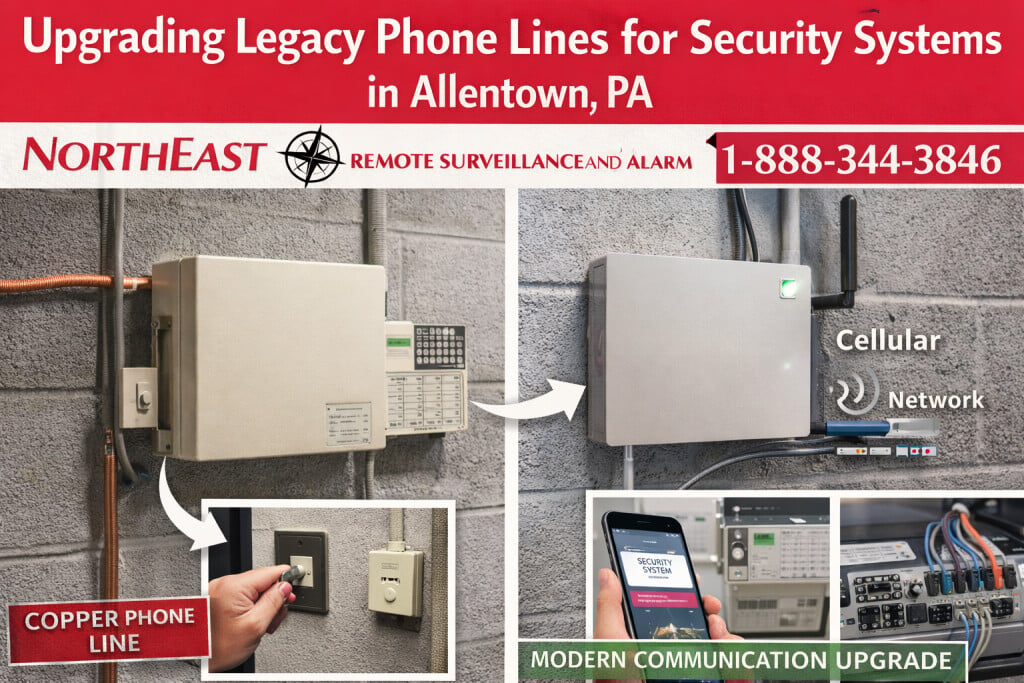
Fit this work into the wider alarm and response plan with Allentown commercial alarm systems.
NERSA plans POTS alarm transitions and other supported security communication changes around verified operation before the old service is retired.
Plan Allentown Copper Line Replacement
Trace the line at the equipment and compare it with account records. An intrusion panel, telephone-entry device, gate call box, or other older system may depend on the same service. The phone bill alone may not show those connections.
Record equipment models, wiring, service ownership, monitoring details, and existing faults. Separate a communication problem from a device or programming problem before choosing replacement equipment.
Choose a Supported Alarm Communication Path
For alarm POTS replacement, review panel and communicator compatibility, cellular conditions, available network service, power, and monitoring support. A cellular, IP, or supported combination must fit the actual system and account. A basic voice adapter is not a substitute for that review.
Document zones, partitions, contact lists, schedules, and response instructions used by the monitoring account. Confirm who will coordinate the transition and receive test results. Keep system owners informed about the planned work and any interruption.
Test the Replacement Before Retiring POTS
Agree on the required alarm, restoration, trouble, and test signals before the cutover. Verify their receipt and identification at the intended monitoring account. Also review the relevant backup and communication-failure behavior with the service team.
Retire the copper service only after the replacement has passed the agreed testing and acceptance. Update equipment labels, account records, and service contacts so future technicians can identify the active path.
Coordinate Other Security-Line Dependencies
Entry systems and gate communication need their own device compatibility and operating tests.
Review calling, answer, release, and administration where those functions apply.
Keep fire-alarm communicator work within the dedicated fire-alarm communicator project and its responsible team.
For multiple sites, use a common inventory and cutover checklist while reviewing conditions at each location. Bring line records, panel details, provider notices, and known faults to the assessment. These records help NERSA define a practical transition sequence.
Inventory every device using the old telephone line
Commercial alarm panels, elevator communication, emergency phones, intercoms and other equipment may share or depend on legacy copper service. Before ending a carrier contract, identify each connected device and who owns its communications obligations. An intrusion alarm communicator replacement does not automatically address a required fire-alarm or elevator communication path.
Choose the replacement channel by listing and support
Review whether the existing panel supports a listed cellular or IP communicator, whether a dual path is required and whether the chosen carrier or network performs adequately at the site. Record power backup, supervision, provider account access, recurring fees and any applicable authority or monitoring-station review. An ordinary VoIP phone adapter is not automatically an acceptable substitute for an approved alarm transmission method.
Cutover tests before cancellation
- Test actual signal receipt, trouble conditions and recovery with the monitoring provider.
- Verify device and account identification at the receiving station.
- Demonstrate the required backup path and supervise communication failures where specified.
- Document the old circuit number, new equipment, provider contacts and final acceptance.
- Retire the copper line only after every dependent device has been checked and approved.
Inventory each existing POTS-dependent device
Older commercial alarms, fire alarm communicators, entry panels and elevator or other building systems may still depend on analog telephone service. Record the make, model, firmware, telephone interface, monitoring receiver and exact supervisory requirements of each system. A provider ending copper service does not automatically mean that a basic VoIP adapter meets the device’s communication or regulatory requirements. Classify each application separately, especially where it performs a life-safety or emergency function, and verify supported replacement options with the equipment manufacturer.
Compare approved transmission paths
Depending on the system and local requirements, a supported cellular, IP or dual-path communicator may replace an existing line. Evaluate approved signaling format, provider network coverage, antenna location, secure backhaul, supervision interval, account ownership, standby power and reporting to the correct receiving service. IP service should be reviewed for router or modem power loss and network outages; cellular service should be checked for indoor signal quality and carrier lifecycle. Do not assume that the least expensive voice service will reliably carry an alarm format.
Coordinate before the carrier disconnects service
Identify who administers the telecom account, who controls the alarm programming, and who has permission to schedule testing or an outage. Plan the migration before the termination date, including a monitored test window and escalation path if a new communicator fails. Fire alarm changes may need permits, acceptance testing and the responsible authority’s review. Keep the existing signal path available until the replacement has successfully reported every required event and any necessary approvals are complete.
Document a complete communication test
Verify an event at the panel, reception at the monitoring location, loss-of-path supervision, trouble and restoration, and any required backup path. Test utility failure and standby power under authorized procedures. The records should identify equipment model, SIM or network service account ownership where relevant, programmed destinations, maintenance responsibilities and the next communications review. An alarm that locally sounds is not proof that the new connection delivered a usable signal.
Related Allentown Services
Use these Allentown resources to coordinate the communication change with alarm operation, maintenance, and broader site planning.
Commercial intrusion alarm systems in Allentown, PA
Allentown, PA Security System Maintenance & Health Monitoring
Commercial security systems in Allentown, PA
Request an Assessment
Discuss your property, existing equipment, and intended operating process with NERSA.
Request a security assessment.
Compliance, Codes & Project Standards
NERSA plans commercial and industrial security work with applicable code, documentation, inspection and authority-having-jurisdiction requirements in mind. Requirements vary by system, property and jurisdiction. These resources support project planning; they do not establish legal compliance, certification or AHJ approval.
Related guidance: Regulatory compliance & inspection readiness · NERSA project standards · Documentation, testing & inspection readiness