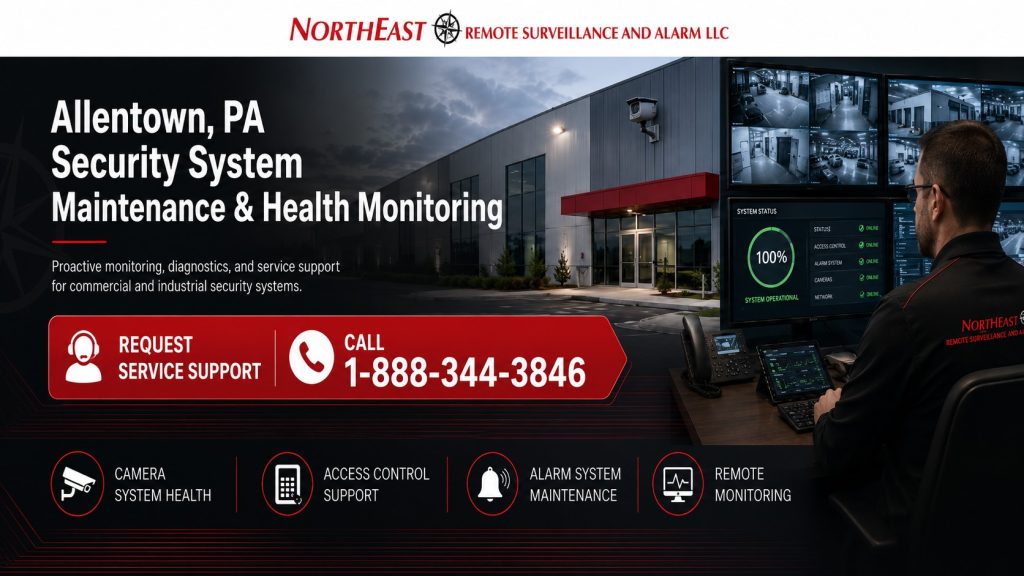
Commercial security system maintenance and health monitoring in Allentown, PA starts with verifying whether cameras record useful footage, controlled doors respond correctly, intrusion alarms communicate, and the supporting network and power equipment remain dependable.
NERSA helps property managers, facilities staff and commercial operators document faults, plan repairs, test accepted functions and identify equipment that needs replacement. Preventive service, automated device-health alerts and staffed alarm or video monitoring are different services; the written scope should state which are included and who receives escalation notices.
A maintenance visit investigates an agreed equipment issue or performs scheduled service. Health monitoring watches for specified faults and routes notifications. Ask the proposal to define covered devices, who gets alerts, and which diagnostic or repair work is included.
Coordinate cameras, doors, alarms and monitoring through Allentown commercial security planning.
Use these guides to choose a repair path or organize ongoing checks and service responsibilities.
Choose Repair or Ongoing Health Review
Use the access-control repair guide for a door, reader, or permission problem. Camera health guidance addresses recording and device availability. The broader system-health guide helps organize checks across several platforms. Identify the affected function first so the service request reaches the right starting point.
Report the Fault With Useful Context
Record the location, time, and symptoms of the problem. Note whether it happens continuously, during a shift change, or after power or network work. For video, describe the missing view or recording period. For access control, distinguish a denied credential from a door that accepts access but fails to release.
An Allentown business with several managers should assign a contact to gather this information and track the service result. Keep equipment names consistent across the site plan, application, and maintenance records. That makes recurring faults easier to identify.
Plan Allentown Security System Maintenance
Bring the equipment inventory, current service arrangements, known faults, and available records. Define which checks are remote, which require a visit, and who acts on a reported issue. Equipment health notifications need a responsible recipient and a documented follow-up.
NERSA can then help establish priorities and a practical service scope. After work, verify the affected function and record the result. Update the device list and service contacts so future troubleshooting begins with current information.
Include Intrusion Panels and Alarm Communication in Health Checks
For an Allentown commercial intrusion system, maintenance should check the status of the panel, reporting connection, batteries and backup power, keypads, sensor supervision and any recurring trouble history. Review whether zones remain properly named after tenant or storage changes and whether approved user permissions and opening or closing routines still match operations. A report of an online panel does not prove every sensor works.
When a failed component is found, separate immediate corrective service from an equipment upgrade or complete new installation.
Record the affected zone, corrective work, functional test, alarm-transmission verification when monitoring is included, and any remaining limitation.
New or replacement intrusion equipment can be planned through Allentown commercial intrusion alarm installation; this page stays focused on maintenance and health checks.
Maintenance and System-Health Guides
Choose camera supervision, access-control repair, or broader health monitoring according to the affected function.
- Proactive Camera-System Health Monitoring, Device Supervision, Maintenance, Testing, and Long-Term Support — Review camera supervision, maintenance, and testing.
- Access Control Repair & Maintenance in Allentown — Review access-control repair and maintenance in Allentown.
- Commercial Security System Health Monitoring — Plan ongoing checks of commercial security-system health.
What a useful security-system maintenance report includes
When a camera, access-controlled door or intrusion communicator fails, identify the affected device and the operational impact before assuming a full replacement is required. Record the first observed fault, frequency, network or power changes, recent work and whether another device on the same switch, panel or supply is affected. Distinguish a failed camera from lost recording or lost remote viewing: each can have a different cause and corrective scope.
Test and document the repair
- Video: confirm live image, recorded playback, correct time, retention and expected alert behavior.
- Door access: confirm valid and denied entry, mechanical closing and latching, applicable egress and recorded events.
- Intrusion: test supervised zones, user controls, communicator trouble and verified monitoring signals with the receiving party.
- Infrastructure: inspect relevant power, battery, PoE, cable and network conditions against equipment specifications.
- After repair: update the device list, firmware/configuration record, test results and responsible service contacts.
Preventive monitoring can reveal device faults earlier, but a dashboard status alone does not replace periodic physical tests of doors, camera coverage and alarm communications. NERSA can help separate a targeted repair from a documented upgrade or replacement when equipment is no longer supported.
Define which faults the system must notice
Commercial security system health is more than whether an app opens. Record the availability of cameras, recorders, storage, access controllers, alarm communicators, power supplies, backup batteries, network switches and required integrations. Distinguish a failed camera from failed recording, a controller offline alert from a door that cannot latch, and a monitoring communications fault from a sensor activation. Each monitored condition needs a severity, responsible recipient, expected action and closure record.
Choose thresholds that produce useful alarms
Check expected maintenance windows, network restarts, temporary Wi-Fi loss and known industrial environmental conditions before selecting alert thresholds. A system that sends hundreds of repeated low-value warnings may be less useful than one with fewer well-prioritized messages. Document which faults demand prompt response, which can wait for the next business day, and when escalation should occur. Health monitoring should make recurring door-held problems or camera recording gaps visible early enough to investigate underlying causes.
Preserve evidence of maintenance and remediation
Maintain a device inventory with model, serial, support status, firmware, location, last inspection, battery date, warranty and assigned technician. Track fault acknowledgement, replacement parts, test results, and who authorized a change. For camera systems, periodically verify image detail and playback rather than relying solely on an online indicator. For access-control doors, test closing/latching, required egress, reader function, contact status and power under the site-approved procedure.
Prepare for replacement and service handover
Review end-of-life warnings, expired cloud subscriptions, service passwords, backup exports and network dependencies before a critical failure. Establish a customer-controlled administrator and recovery process. When a controller or recorder is replaced, confirm that events, permissions, camera retention and alarm routing resume correctly. Provide property managers with a clear exception register and schedule for verification rather than an unqualified statement that everything is monitored.
Request an Allentown System-Service Assessment
Request an assessment to review current equipment, recurring faults, and maintenance priorities.
Compliance, Codes & Project Standards
NERSA plans commercial and industrial security work with applicable code, documentation, inspection and authority-having-jurisdiction requirements in mind. Requirements vary by system, property and jurisdiction. These resources support project planning; they do not establish legal compliance, certification or AHJ approval.
Related guidance: Regulatory compliance & inspection readiness · NERSA project standards · Documentation, testing & inspection readiness