Protect the movement of people, vehicles, trailers, and inventory through Route 33 distribution centers.
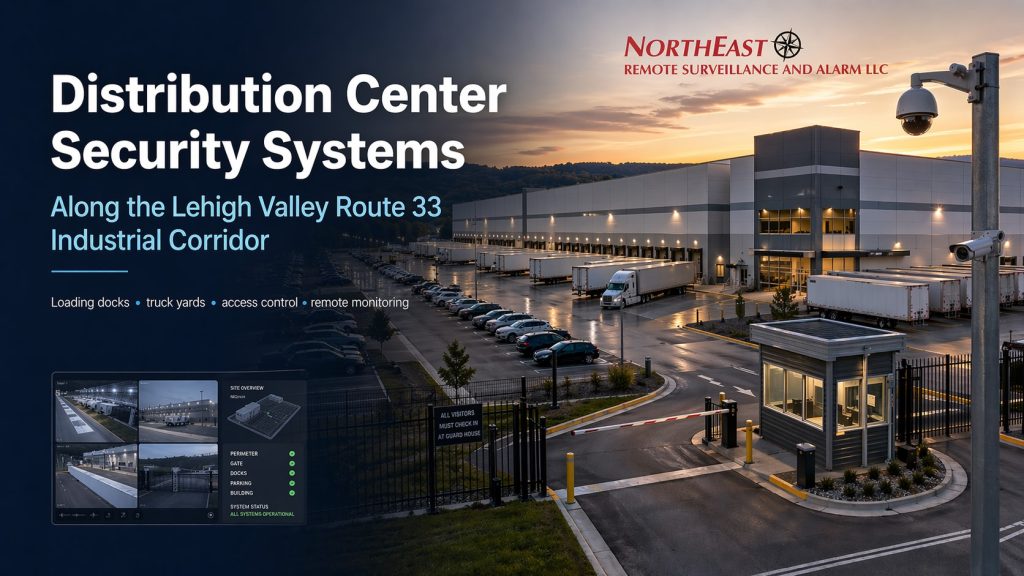
Northeast Remote Surveillance and Alarm, LLC plans integrated security for distribution centers along the Lehigh Valley Route 33 corridor. We coordinate video surveillance, access control, intrusion alarms, monitoring, intercoms, gates, and supporting infrastructure around how freight, employees, drivers, visitors, and contractors move through the site.
Start With the Distribution Workflow
Security should follow the operation from vehicle arrival through gate entry, dock assignment, unloading, staging, storage, picking, shipping, and departure. We review shift changes, driver check-in, employee entrances, office transitions, restricted inventory, yard activity, and after-hours exposure before recommending equipment.
See Docks, Freight, and Staging
Camera views may cover dock doors, trailer positions, dock aprons, receiving, outbound lanes, staging, high-value inventory, and key handoff points. Overview views show movement; focused views provide detail. Lighting, obstructions, trailer placement, retention, and accurate timestamps affect whether footage answers the customer’s question.
Control Employee and Visitor Entry
Access control can assign permissions by person, department, door, site, and schedule. Employee entrances, office-to-warehouse doors, IT rooms, inventory cages, and other restricted areas may need different rules. Intercoms can support visitor or driver communication at selected entrances.
Protect Gates, Yards, and Trailers
Gate cameras, access control, vehicle lanes, yard overviews, fence-line views, and focused trailer-row coverage can help document vehicle movement and after-hours activity. Plate capture requires a dedicated objective, suitable camera, controlled angle, distance, lighting, and vehicle path.
Detect After-Hours Intrusion
Commercial alarms may protect exterior doors, overhead doors, offices, interior areas, and other defined zones.
Monitoring instructions, user codes, call lists, zone names, and communication paths should match the facility’s shifts and closing procedures.
See our Route 33 alarm systems.
Add Active Video Monitoring Where It Fits
Selected exterior events may benefit from analytics, operator review, audio talk-down, and an agreed escalation process. Monitoring is most useful where cameras provide clear views and operators have practical instructions. It supplements recording, alarms, lighting, barriers, and onsite procedures.
Document a Serviceable System
We label cameras, doors, alarm zones, switch ports, cabinets, and network connections. Administrator ownership, user permissions, retention, schedules, licensing, remote access, and escalation contacts are documented and tested so the system can be managed after installation.
Frequently Asked Questions
Can existing warehouse cameras be reused?
Often. We evaluate condition, coverage, compatibility, ownership, recording, and network support first.
Can one platform manage several sites?
Yes, when the selected platform and network design support centralized users, events, and video.
Do distribution centers need access control?
Many benefit from individual credentials, schedules, and restricted-area permissions instead of unmanaged keys.
Can upgrades be completed in phases?
Yes. Critical gates, docks, doors, alarms, accounts, or camera gaps can be addressed first.
Request a Route 33 Distribution Assessment
Use our security assessment form to review an existing system or plan layered protection for a Route 33 distribution facility.
Compliance, Codes & Project Standards
NERSA plans commercial and industrial security work with applicable code, documentation, inspection and authority-having-jurisdiction requirements in mind. Requirements vary by system, property and jurisdiction. These resources support project planning; they do not establish legal compliance, certification or AHJ approval.
Related guidance: Regulatory compliance & inspection readiness · Warehouse & logistics compliance · NERSA project standards