Remote Video Monitoring Along the Lehigh Valley Route 33 Industrial Corridor

Remote video monitoring along the Lehigh Valley Route 33 industrial corridor should be built around the way industrial properties are actually exposed after hours, during low-staff periods, and across large exterior areas. Truck yards, loading docks, fence lines, gate lanes, trailer rows, exterior storage areas, employee entrances, and side and rear approaches often create security demands that standard recording alone does not fully address. A properly designed system should improve awareness, support faster event verification, and provide stronger oversight across the parts of the property where after-hours activity and exterior risk are most concentrated.

Northeast Remote Surveillance and Alarm, LLC provides remote video monitoring along the Lehigh Valley Route 33 industrial corridor for properties that need stronger after-hours visibility, better event verification, more deliberate monitoring around exterior risk zones, and a more practical security design built around how industrial sites actually operate.

This page is focused specifically on remote video monitoring along the Lehigh Valley Route 33 industrial corridor. For broader corridor planning, visit Lehigh Valley Route 33 Industrial Corridor Security Systems. For broader warehouse-focused coverage, visit [Warehouse Security Systems Along the Lehigh Valley Route 33 Industrial Corridor]. For yard-focused protection, visit Truck Yard and Trailer Security Systems Along the Lehigh Valley Route 33 Industrial Corridor.

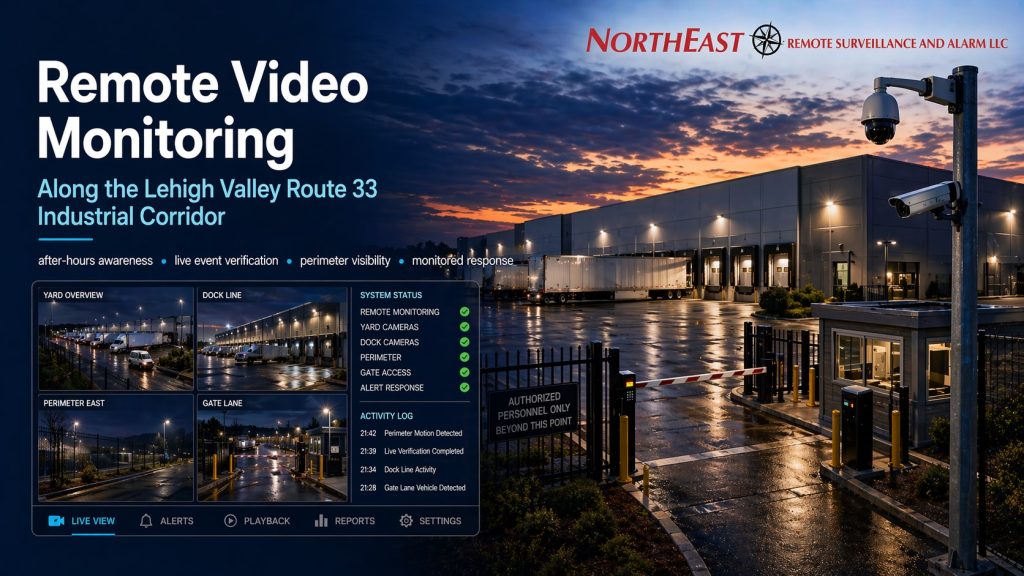
Hero image showing remote video monitoring for an industrial property along the Lehigh Valley Route 33 industrial corridor with perimeter fencing, gate access, warehouse docks, surveillance cameras, monitored site views, and Northeast Remote Surveillance and Alarm LLC branding.

Security Systems Built for After-Hours Awareness

Remote video monitoring is different from general video recording. A standard camera system may store footage for later review, but that does not always help when suspicious activity is unfolding in real time or close enough in time to matter. Remote video monitoring adds a more active layer of awareness by helping properties identify unusual activity faster, review events sooner, and improve oversight across the areas that remain exposed when staffing drops or the site quiets down.

That is especially important along the Lehigh Valley Route 33 industrial corridor, where many properties operate with broad exterior footprints, recurring truck traffic, detached trailer areas, large paved yards, multiple approaches, and periods when only part of the site is actively observed by on-site staff.

What Route 33 Corridor Properties Commonly Need to Watch More Closely

Properties along the Lehigh Valley Route 33 corridor often need stronger monitored visibility around the exact parts of the site where suspicious activity, unauthorized movement, or after-hours exposure create the greatest operational risk.

Truck Yards and Trailer Rows

Truck yards, trailer rows, and detached staging areas often remain exposed after normal daytime activity slows down. These areas may need stronger monitored visibility around parked trailers, vehicle movement, yard lanes, and outer yard sections.

For yard-focused protection, visit Truck Yard and Trailer Security Systems Along the Lehigh Valley Route 33 Industrial Corridor.

Loading Docks and Exterior Freight Zones

Loading dock lines, receiving aprons, shipping lanes, and dock-adjacent exterior areas often remain active or exposed after the building quiets down. These areas may need stronger after-hours awareness than a general dock camera layout provides.

For dock-focused protection, visit Loading Dock Security Systems Along the Lehigh Valley Route 33 Industrial Corridor.

Gate Lanes and Vehicle Approaches

Gate lanes, truck entrances, service drives, and controlled entry approaches often need stronger monitored visibility because they are natural chokepoints where unusual or unauthorized vehicle movement first appears.

For vehicle documentation intent, visit License Plate Recognition Systems Along the Lehigh Valley Route 33 Industrial Corridor.

Fence Lines and Perimeter Edges

Fence lines, outer lot edges, rear boundaries, and side approaches often become more vulnerable when visibility drops or when the site is operating with limited staff. These areas often benefit from stronger monitored oversight tied directly to the real perimeter risk points.

Employee Entrances and Side or Rear Openings

Some properties also need stronger after-hours visibility around employee entrances, side doors, rear doors, and other openings tied to lower-traffic periods or limited overnight activity.

Remote Video Monitoring Should Be Built Around Real Risk Points

A remote video monitoring system should not be built around the easiest camera mounts or the broadest views alone. It should be planned around the actual places where suspicious activity is most likely to develop, where trespassing or unauthorized vehicle movement is most likely to begin, and where after-hours exposure has the greatest operational impact.

This is especially important along the Lehigh Valley Route 33 industrial corridor, where industrial properties often combine broad exterior space, frequent vehicle movement, detached yard areas, multiple approaches, and lighting conditions that vary across the site. A stronger monitored-video strategy should follow the real layout, the real traffic flow, and the real after-hours risk pattern of the property.

Common Security Priorities for Remote Video Monitoring Along Route 33

Faster Event Verification

One of the biggest advantages of remote video monitoring is faster event verification. When suspicious movement, unusual vehicle activity, perimeter motion, or after-hours intrusion concerns develop, monitored video helps provide a clearer understanding of whether there is a real issue, a nuisance event, or activity that needs a more immediate response.

Better After-Hours Awareness

Many Route 33 corridor properties remain exposed well beyond normal staffed hours. Remote video monitoring helps provide a stronger layer of awareness during overnight periods, weekends, holiday shutdowns, and other low-staff times.

Better Oversight Across Exterior Risk Zones

Truck yards, loading dock lines, trailer sections, fence lines, and side approaches often sit outside the parts of the property that receive the most direct attention during the day. Remote video monitoring helps keep those areas under stronger review.

Better Support for Large Industrial Footprints

Large industrial properties often have more exterior space, more detached activity zones, and more separated operating areas than standard commercial sites. Remote monitoring helps support those environments by providing stronger visibility across the parts of the site that cannot be watched consistently in person.

Better Coordination With Broader Site Security

Remote video monitoring often works best when it is designed as part of a larger security strategy rather than treated as a stand-alone add-on. It may support yard awareness, dock visibility, perimeter review, vehicle-entry oversight, or broader warehouse protection depending on how the site operates.

Remote Video Monitoring Is Not the Same as General Camera Coverage

This page is intentionally focused on remote video monitoring. It should not drift into a general security camera page, a truck-yard page, a loading-dock page, an LPR page, or a full warehouse-security page. The purpose here is stronger after-hours awareness, faster event verification, and better monitored oversight across exterior risk areas.

If the main concern is broader warehouse protection, visit Warehouse Security Systems Along the Lehigh Valley Route 33 Industrial Corridor. If the main concern is trailer rows, yard lanes, and perimeter exposure, visit Truck Yard and Trailer Security Systems Along the Lehigh Valley Route 33 Industrial Corridor. If the main concern is dock-specific activity, visit Loading Dock Security Systems Along the Lehigh Valley Route 33 Industrial Corridor. If the main concern is vehicle identification at entrances, visit License Plate Recognition Systems Along the Lehigh Valley Route 33 Industrial Corridor.

Security Systems for Remote Video Monitoring Along the Lehigh Valley Route 33 Industrial Corridor

Northeast Remote Surveillance and Alarm, LLC designs remote video monitoring solutions for properties that need stronger after-hours awareness around truck yards, dock lines, gate approaches, perimeter edges, exterior storage areas, employee entrances, and other exposed industrial zones. These systems may involve stronger review of suspicious activity, better awareness across low-staff periods, more deliberate visibility across detached exterior sections, and better oversight of the parts of the property where after-hours operational risk is most concentrated.

The right design depends on the size of the property, the exterior layout, the traffic pattern, the lighting conditions, the level of after-hours exposure, and the areas where monitored awareness provides the most value.

Get a Quote for Remote Video Monitoring Along the Lehigh Valley Route 33 Industrial Corridor

If your property operates along the Lehigh Valley Route 33 industrial corridor and needs stronger after-hours visibility, better event verification, more deliberate monitoring across exterior risk zones, or a more practical remote video monitoring system built around real site conditions, Northeast Remote Surveillance and Alarm, LLC can help design a solution around the way your property actually functions.

For broader corridor planning, visit Lehigh Valley Route 33 Industrial Corridor Security Systems.

Scroll to Top
1-888-344-3846