
Industrial park security systems along the Lehigh Valley Route 33 corridor should be designed around the way large, multi-building commercial and industrial properties actually operate.

Request a Commercial Security Assessment
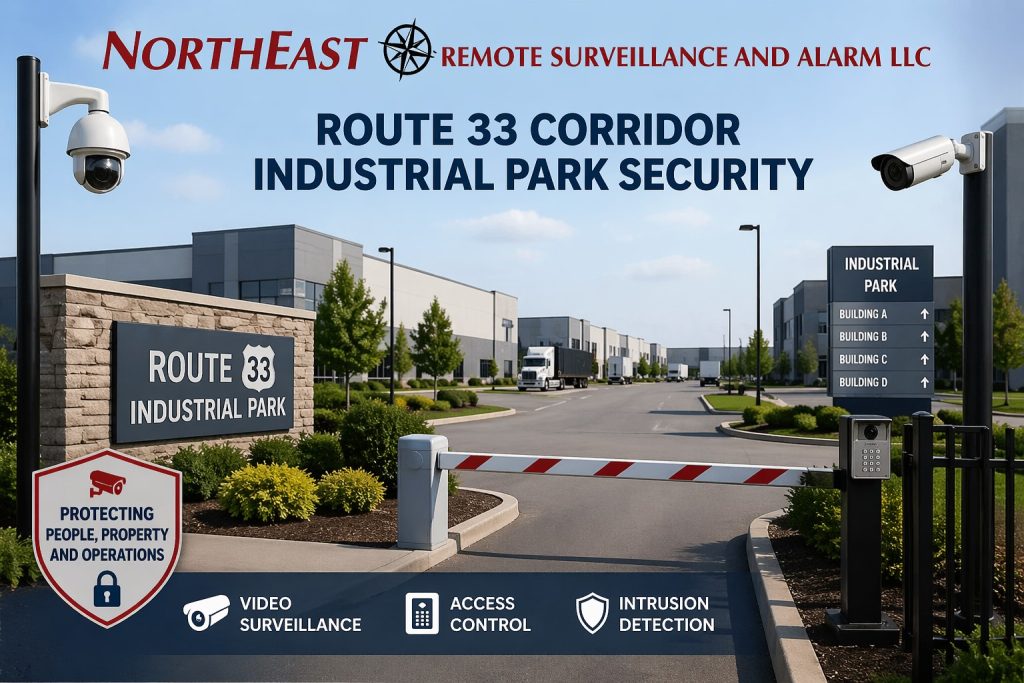
Route 33 industrial corridor security planning should connect building entrances, loading areas, truck routes, gates, parking, and shared exterior spaces into one coordinated site strategy.
An industrial park may combine warehouses, manufacturers, offices, maintenance structures and contractor operations. Shared areas can include parking, roads, truck routes, entrances, loading areas and outdoor storage. Security must account for staff, tenants, vendors and visitors.
Those conditions create a different security environment than a single warehouse or stand-alone commercial building.
NERSA designs security systems for industrial parks along Route 33. Planning addresses visibility across shared areas, control at common entrances, and records of vehicle and visitor activity. It also considers separation between operating areas and after-hours coverage across the property.
For broader planning throughout the corridor, visit Lehigh Valley Route 33 Industrial Corridor Security Systems.
Call 1-888-344-3846 to request an industrial park security assessment.
Security Designed Around the Entire Industrial Property
Industrial parks are not simply larger buildings.
They are connected operating environments.
A single property may include:
- Multiple commercial buildings
- Several employee entrances
- Shared vehicle entrances
- Internal roads
- Truck circulation routes
- Common parking areas
- Tenant-specific parking
- Loading and receiving activity
- Detached maintenance buildings
- Storage areas
- Shared exterior spaces
- Gates
- Fence lines
- Utility areas
- Remote property boundaries
- Different operating schedules
Security planning should account for how these areas interact.
A camera protecting one warehouse entrance may provide excellent coverage of that doorway while doing nothing to document a vehicle moving between buildings.
An alarm protecting one tenant space may not address after-hours activity along a common perimeter.
A credential system controlling one building may not solve a shared vehicle-entry problem affecting the entire industrial park.
The complete site should therefore be evaluated before individual security devices are selected.
Shared Industrial Park Entrances
The main entrance to an industrial park can affect every business and building inside the property.
Employees, visitors, contractors, delivery vehicles, service companies, freight carriers, and unfamiliar vehicles may all use the same entrance.
That makes common access points important locations for visibility, documentation, and controlled entry.
Security planning may consider:
- Vehicle approach visibility
- Entrance cameras
- Gate activity
- Visitor communication
- Contractor access
- Employee vehicle traffic
- After-hours entry
- Delivery activity
- Credentialed gate access
- Intercom communication
- Vehicle identification
The appropriate design depends on whether the entrance remains open during business hours, uses a staffed gate, operates automatically, serves several tenants, or requires different access rules at different times.
The objective is to make the entrance understandable and manageable without unnecessarily restricting legitimate business activity.
Internal Roads and Vehicle Movement
Large industrial parks may contain substantial road networks inside the property.
Trucks can move between buildings.
Employees may travel from one section of the property to another.
Vendors may serve several tenants during the same visit.
Delivery drivers may enter through one gate and travel hundreds or thousands of feet before reaching the correct loading area.
These internal traffic patterns create security concerns that do not exist at a small commercial property.
A site assessment may consider:
- Main drive lanes
- Truck routes
- Service roads
- Building approaches
- Intersections
- Trailer circulation
- Gate-to-building movement
- Parking entrances
- Restricted drive areas
- Low-traffic roads after hours
Video and vehicle documentation should be planned around useful decision points rather than attempting to cover every foot of roadway equally.
The most valuable locations are often where traffic enters, changes direction, approaches a building, enters a restricted area, or moves between different operating sections of the industrial park.
Shared Parking and Common Exterior Areas
Parking areas can be complicated in multi-building industrial properties.
Some spaces may serve one tenant.
Others may be shared.
Employees may work different shifts.
Visitors may park in areas that remain active during the day but nearly empty after hours.
Contractor vehicles may appear temporarily.
Truck parking may overlap with employee or visitor circulation.
Security planning should distinguish these operating conditions rather than treating all parking areas as one identical environment.
Important considerations may include:
- Employee parking
- Visitor parking
- Tenant-specific parking
- Building entrances
- Pedestrian routes
- Drive aisles
- Lighting conditions
- Vehicle entrances
- Remote parking sections
- After-hours activity
The objective is to provide useful visibility around the portions of the parking environment where activity, property exposure, or incident documentation matters most.
Multi-Building Security Coordination
An industrial park may contain buildings with very different purposes.
One building might contain warehouse operations.
Another may contain manufacturing.
Another may house administrative offices.
A detached structure may contain maintenance equipment, utility systems, tools, or storage.
Treating every building independently can create unnecessary gaps between those individual systems.
A site-wide security plan should identify:
- Which buildings operate together
- Which buildings have separate management
- Whether systems should share administration
- Which entrances serve multiple buildings
- Which user groups require access to several structures
- Which buildings remain occupied after others close
- Which common areas affect the entire property
- Which systems should remain tenant-specific
- Which systems should be managed at the property level
The goal is not necessarily to place every device on one platform.
The goal is to make sure security responsibilities and system boundaries match the way the property actually operates.
Tenant and User Separation
Multi-tenant industrial parks require particularly careful planning.
A property owner may need access to common areas while individual tenants retain control over their own buildings.
One tenant should not automatically receive access to another tenant’s alarm information, cameras, credentials, or restricted areas.
Security planning may need to distinguish between:
- Property-management users
- Tenant administrators
- Tenant employees
- Contractors
- Cleaning personnel
- Maintenance staff
- Visitors
- Delivery personnel
- Emergency access
Permissions should reflect responsibility.
A property manager may need visibility at the main gate and common parking areas without needing unrestricted access to every tenant’s interior cameras.
A tenant may need control of its own employee entrances without having authority over another building.
These distinctions become increasingly important as industrial properties expand or tenants change.
Common-Area Video Surveillance
Industrial park video surveillance should concentrate on views that help management understand what occurred across shared parts of the property.
Potential common-area camera locations may include:
- Main entrances
- Secondary entrances
- Internal intersections
- Shared parking areas
- Common drive lanes
- Building approaches
- Gate areas
- Common loading approaches
- Exterior storage approaches
- Property boundaries
- Remote corners
- Shared pedestrian routes
Camera placement should be designed around the information the customer expects to retrieve.
A wide overview may help document general movement but provide limited identification.
A tighter entrance view may provide better vehicle or person detail but cover a smaller area.
Larger industrial properties often require both types of coverage at carefully selected locations.
Shared Access Control
Some industrial parks benefit from access control at common entry points.
Depending on the property, controlled access may involve:
- Vehicle gates
- Shared employee entrances
- Common facilities
- Maintenance areas
- Restricted utility spaces
- Shared office areas
- Property-management locations
The system should establish who may enter, where they may enter, and when those permissions apply.
Multi-building access planning can also help prevent a common problem: credentials remaining active long after an employee, contractor, vendor, or tenant relationship has ended.
Administrative responsibility should therefore be clearly established.
After-Hours Industrial Park Security
After normal working hours, an industrial park can become a very different property.
One tenant may operate continuously while another closes completely.
A manufacturing building may run a second shift while neighboring warehouses are empty.
Cleaning personnel may be present after office staff leave.
Trucks may arrive before normal receiving hours.
Remote parking areas and perimeter sections may remain unused for long periods.
Security should be able to distinguish expected activity from activity that requires attention.
After-hours planning may address:
- Common entrances
- Building approaches
- Gates
- Empty parking areas
- Fence lines
- Detached structures
- Exterior storage
- Internal roads
- Loading areas
- Restricted sections
The design should match actual operating schedules rather than assuming the entire industrial park becomes vacant at one specific time.
Perimeter and Outer Property Boundaries
Large industrial sites may have substantial perimeter exposure.
Fence lines, rear property boundaries, wooded edges, utility corridors, service roads, drainage areas, neighboring properties, and low-traffic corners can be difficult to observe from the main buildings.
These locations may become particularly important after hours.
A perimeter review may evaluate:
- Existing fencing
- Gates
- Lighting
- Natural barriers
- Camera visibility
- Exterior approaches
- Adjacent properties
- Vegetation
- Remote structures
- Access roads
- Power availability
- Communications
Not every perimeter section requires identical treatment.
The security design should prioritize locations where unauthorized access is practical, activity is difficult to observe, or valuable property is exposed.
Vehicle Activity and Site-Wide Documentation
Vehicle documentation can be especially useful at industrial parks because one vehicle may interact with several areas of the property.
Management may need to determine:
- When a vehicle entered
- Which entrance it used
- Where it traveled
- Which building it approached
- Whether it remained after normal hours
- Whether it returned repeatedly
- When it exited
The appropriate technology depends on the type of property and the level of documentation required.
Some locations may need only general vehicle visibility.
Others may require stronger identification at gates or main entrances.
The design should reflect the actual operational need rather than adding specialized vehicle technology without a defined purpose.
Security for Changing Industrial Parks
Industrial properties change.
New tenants move in.
Warehouses expand.
Buildings change use.
Parking areas are reconfigured.
A property adds another gate.
A manufacturing tenant increases production.
A warehouse extends operating hours.
A previously unused building becomes occupied.
Security infrastructure should allow the property to adapt without forcing unnecessary replacement every time the industrial park changes.
Expansion planning may include:
- Additional cameras
- Additional access-controlled entrances
- New alarm zones
- New buildings
- Additional network capacity
- Fiber between buildings
- Wireless communication
- More recording capacity
- Additional users
- New tenant groups
- Additional gates
- Remote monitoring capability
Planning for expansion early can make future security work cleaner and less disruptive.
Existing Industrial Park Security System Upgrades
Many Route 33 industrial properties already have security equipment.
The issue may be that the systems were installed at different times, by different contractors, for different tenants, or without a coordinated site-wide plan.
An existing property may have:
- Several unrelated camera systems
- Aging recorders
- Different access-control platforms
- Shared mechanical keys
- Legacy alarm panels
- Undocumented wiring
- Unmanaged network equipment
- Old gate controls
- Separate tenant accounts
- Inconsistent administrator access
- Limited common-area coverage
A security assessment should determine what can remain and what actually needs improvement.
Existing equipment does not need to be replaced solely because a site-wide security plan is being developed.
Serviceable devices may be retained when they remain compatible, supportable, dependable, and appropriate for the intended system.
Security Planning for Property Owners and Tenants
Industrial park security works best when responsibilities are clearly established.
The property owner may be responsible for:
- Main vehicle entrances
- Shared roads
- Common parking
- Property perimeter
- Shared exterior areas
- Common utility structures
Individual tenants may be responsible for:
- Their own building entrances
- Interior cameras
- Tenant alarm systems
- Restricted rooms
- Employee credentials
- Internal warehouse or production areas
Actual responsibility depends on the property, leases, ownership, and operating agreements.
Security planning should identify these boundaries before system administration becomes unnecessarily complicated.
Industrial Park Security Assessment Along Route 33
A Route 33 industrial park security assessment may review:
- Number of buildings
- Property entrances
- Common gates
- Internal roads
- Truck circulation
- Employee parking
- Visitor parking
- Loading areas
- Tenant boundaries
- Shared exterior spaces
- Detached buildings
- Exterior storage
- Fence lines
- Lighting
- Existing cameras
- Existing access control
- Existing alarms
- Network infrastructure
- Communications
- After-hours operations
- Administrative responsibility
- Future expansion
The objective is to identify where site-wide security provides meaningful value and where building-specific systems should remain independent.
Frequently Asked Questions
What makes industrial park security different from warehouse security?
An industrial park typically includes multiple buildings, shared roads, common entrances, parking areas, different user groups, and site-wide exterior exposure. Warehouse security is normally centered on one primary facility and its immediate operating areas.
Can several buildings use the same security system?
They can when the selected platforms, network infrastructure, communications, permissions, and operating requirements support centralized management. Some properties are better served by coordinated but separate systems.
Can different tenants have separate security permissions?
Yes. Commercial access, video, alarm, and administrative permissions can often be separated so tenants retain control over their own areas while property management controls appropriate common areas.
Should industrial park entrances have cameras?
Main entrances are often valuable locations for video because vehicles, employees, visitors, contractors, and delivery traffic may all pass through the same access point.
Can vehicle activity be documented?
Yes. Depending on the property and required level of detail, cameras or specialized vehicle-identification systems can support documentation of traffic entering and leaving the site.
Do industrial parks need perimeter cameras?
Some do. The need depends on fencing, site size, exterior exposure, lighting, neighboring properties, valuable outdoor assets, and the ability to observe remote sections of the property.
Can existing security equipment be reused?
Often yes. Existing cameras, alarm devices, access-control equipment, cabling, network infrastructure, and other components can be evaluated for condition, compatibility, and continued supportability.
Can security be expanded when another building is added?
Yes. A properly planned system should provide a practical path for adding buildings, users, cameras, doors, gates, networking, and monitoring as the property changes.
Industrial Park Security Systems Along the Lehigh Valley Route 33 Corridor
Industrial parks along Route 33 require security planning that reflects how the entire property functions.
Shared entrances, internal roads, parking areas, detached buildings, truck movement, multiple tenants, perimeter exposure, and different operating schedules create challenges that cannot always be solved one building at a time.
Northeast Remote Surveillance and Alarm, LLC designs commercial and industrial security systems around those site-wide operating conditions.
NERSA can assess security at Route 33 industrial properties. We review shared-area visibility, common entrances, vehicle records and activity after hours. For properties with several buildings, we can plan coordinated coverage and controls.
Request a Commercial Security Assessment.
Northeast Remote Surveillance and Alarm, LLC
Commercial & Industrial Security Systems
Lehigh Valley Route 33 Industrial Corridor
Compliance, Codes & Project Standards
NERSA plans commercial and industrial security work with applicable code, documentation, inspection and authority-having-jurisdiction requirements in mind. Requirements vary by system, property and jurisdiction. These resources support project planning; they do not establish legal compliance, certification or AHJ approval.
Related guidance: Regulatory compliance & inspection readiness · NERSA project standards · Documentation, testing & inspection readiness