
Commercial intrusion alarm systems along the Lehigh Valley Route 22 Industrial Corridor should be designed around unauthorized entry, after-hours exposure, vulnerable doors, warehouse openings, office areas, storage rooms, and exterior access points.

Physical Plant Security Assessment
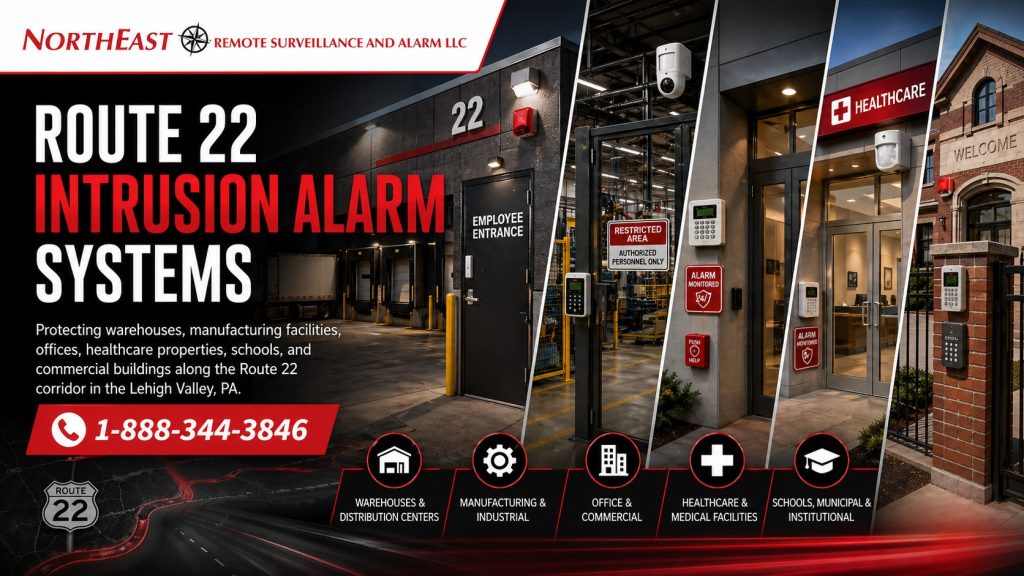
Warehouses, distribution centers, manufacturing facilities, contractor yards, offices, logistics sites, retail support properties, and multi-tenant commercial buildings along Route 22 often need alarm protection that goes beyond a basic keypad and door contact.
Northeast Remote Surveillance and Alarm, LLC designs and installs commercial intrusion alarm systems for Route 22 corridor properties that need better after-hours protection, cleaner alarm verification, stronger zone planning, and more dependable event response.
For broader corridor planning, visit Route 22 Industrial Corridor Security Systems in the Lehigh Valley, PA.
Intrusion Alarm Planning Along Route 22
Route 22 properties often have multiple entry points, long building perimeters, active loading areas, employee doors, overhead doors, office suites, storage rooms, and exterior service entrances. These areas can become weak points when the building is closed, partially staffed, or operating with limited supervision.
A commercial intrusion alarm system should be planned around the actual risk points of the property. The goal is not just to trigger an alarm. The goal is to detect unauthorized activity, identify the affected zone, support faster review, and help the business respond with better information.
For broader alarm-system planning, visit Commercial Intrusion Alarm Systems.
Common Alarm Points Along Route 22 Facilities
Route 22 properties may need alarms at exterior and staff entrances, warehouse doors, overhead doors and storefronts. Interior areas can include shipping offices, inventory and tool rooms, mechanical and server rooms, office suites and other restricted spaces.
Larger properties may also need alarm zones separated by building area, department, tenant space, warehouse section, office area, dock zone, or restricted room. Proper zone design helps managers understand where an alarm event started instead of treating the entire building as one generic alarm area.
Intrusion Alarms for Warehouses and Distribution Facilities
Warehouses and distribution centers along Route 22 often need alarm systems designed around dock doors, receiving areas, shipping offices, employee entrances, warehouse interiors, inventory storage, trailer-adjacent doors, and after-hours building access.
Alarm protection should account for shift schedules, early deliveries, late pickups, cleaning crews, managers, drivers, vendors, and other authorized users who may need access outside normal business hours.
For warehouse-focused planning along this corridor, visit Route 22 Warehouse Security Systems.
Door Contacts, Motion Detection, and Zone Design
A commercial alarm system may include door contacts, overhead door contacts, motion detectors, glass-break detection, panic or duress devices, control panels, keypads, sirens, cellular or IP communication, backup power, and monitored alarm signals.
The right design depends on the building layout, number of doors, ceiling height, warehouse activity, office layout, user groups, after-hours procedures, and whether the site needs basic intrusion detection or more advanced alarm verification.
Alarm devices should be placed where they support real detection and clean reporting, not just where installation is easiest.
Video Verification and Alarm Review
Intrusion alarms become stronger when they are paired with video verification. A door alarm, motion event, or after-hours alert is more useful when nearby cameras can help confirm what happened.
Video verification can help determine whether an alarm was caused by a person, vehicle, delivery, employee error, weather condition, animal, or equipment issue. This can reduce confusion, improve response decisions, and provide better documentation after an event.
For camera-focused planning along the same corridor, visit Route 22 Commercial Video Surveillance Systems.
Alarm Systems for Offices, Manufacturing, Contractor Yards, and Multi-Tenant Buildings
Not every Route 22 alarm system is warehouse-focused. Office-commercial buildings may need intrusion protection for tenant suites, server rooms, lobbies, storage rooms, and after-hours entrances. Manufacturing facilities may need alarms for production areas, tool rooms, maintenance spaces, inventory rooms, and restricted sections.
Contractor yards and commercial sites may need alarm protection coordinated with gates, exterior cameras, storage buildings, and fenced areas. Multi-tenant buildings may need separate alarm areas so each tenant or department can manage its own space without compromising the rest of the property.
Monitoring, Communication Paths, and User Control
Commercial alarm systems should be planned around reliable communication and practical user management. That may include cellular communication, IP communication, backup paths, user codes, schedules, arming permissions, opening and closing reports, notifications, and monitoring procedures.
A good alarm design should make it easier to manage employees, vendors, cleaning crews, managers, and after-hours users without creating unnecessary false alarms or weak access practices.
Intrusion Alarm Systems We Install
NERSA designs commercial intrusion alarms around the property. Equipment may include panels, keypads, door and overhead-door contacts, motion and glass-break detectors, panic devices and sirens. Communication options include cellular, IP and monitored reporting, with backup power. Video verification and links to cameras or access control may be included where appropriate.
This guide covers intrusion detection and unauthorized entry protection. Fire alarm, life-safety, and code-required fire protection systems should be planned separately from commercial intrusion alarm design.
Route 22 Intrusion Alarm Assessment
NERSA can assess alarm needs at warehouses, distribution centers, manufacturers and offices along Route 22. We also serve contractor yards, logistics sites, retail support properties and multi-tenant commercial buildings.
An intrusion alarm assessment may review exterior doors, overhead doors, office areas, warehouse interiors, restricted rooms, dock access, after-hours procedures, alarm zones, user permissions, communication paths, video verification needs, and monitoring requirements.
For broader corridor planning, return to Route 22 Industrial Corridor Security Systems in the Lehigh Valley, PA.
To begin site-specific planning, visit Physical Plant Security Assessment.
Compliance, Codes & Project Standards
NERSA plans commercial and industrial security work with applicable code, documentation, inspection and authority-having-jurisdiction requirements in mind. Requirements vary by system, property and jurisdiction. These resources support project planning; they do not establish legal compliance, certification or AHJ approval.
Related guidance: Regulatory compliance & inspection readiness · NERSA project standards · Documentation, testing & inspection readiness