
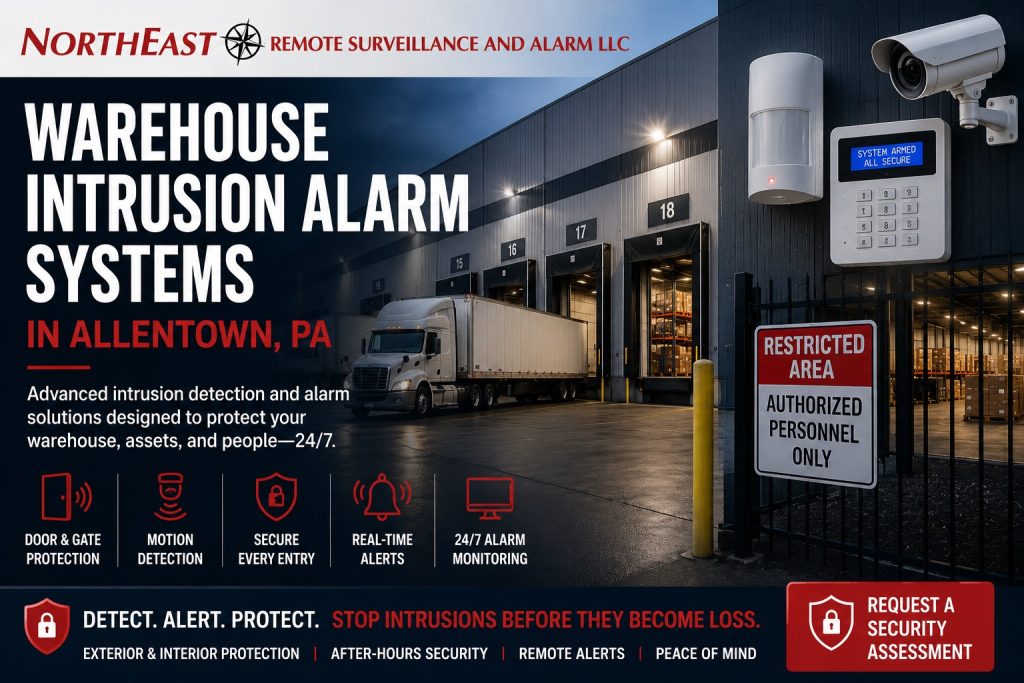
Warehouse intrusion alarm systems in Allentown, PA detect unauthorized entry at doors, docks, offices and restricted interior areas.

Fit this work into the wider alarm and response plan with Allentown commercial alarm systems.
Intrusion Detection for Warehouse Operations
Warehouse buildings often have many exterior openings and changing work schedules. First, NERSA reviews doors, dock positions, windows, interior zones and after-hours activity. Next, we define detection around the site’s real operating pattern.
The system should identify a security event without disrupting normal work. Therefore, zones and schedules must reflect shifts, cleaning, deliveries and approved late access.
Devices for Doors, Docks and Interior Areas
- Door contacts at employee and service entrances
- Overhead door contacts at selected dock positions
- Motion detection in offices and restricted zones
- Glass protection where the building design requires it
- Keypads or managed arming controls
- Audible devices and monitored communication
For example, staff can arm an office zone while warehouse activity continues. A manager can later secure remaining areas when the final shift leaves. Individual partitions make that sequence practical.
Alerts, Monitoring and Response
A monitored alarm communicates events according to the response plan. In addition, designated contacts can receive selected notifications for openings, trouble or alarm activity. NERSA defines the routing before system turnover.
Meanwhile, nearby cameras can provide context for an event. The alarm still handles intrusion detection, while video supports review. This coordination helps staff respond with better information.
Reduce Avoidable Alarms
Good design accounts for airflow, equipment movement, animals and other site conditions. Likewise, clear user training helps employees arm and disarm the correct areas. Regular service keeps devices and communication paths dependable.
Scalable for One Warehouse or Many
A smaller facility may secure a few exterior doors and one office. By contrast, an enterprise may manage many partitions across several locations. Standardized user roles and response procedures can support both.
Most importantly, every site keeps schedules and zones that match local operations. Over time, the system can expand with new doors, areas or buildings.
Zone the warehouse around actual use
Divide exterior personnel doors, overhead docks, shipping offices, protected stock and equipment areas into alarm partitions or zones that fit the property’s staffing and loading patterns. Truck departures, late carriers and cleaning crews may continue after ordinary office hours. A single all-or-nothing arming schedule often causes bypasses and false activations. Define who can arm each area and how a legitimate late arrival is handled.
Device selection and communications checks
Door contacts, overhead-door sensors, motion detectors, glass-break devices and selected exterior detection equipment have different strengths and limits. Inventory temperatures, airflow, vibration, dust, forklifts and long communication runs before assigning each device. Check primary and backup communication, battery condition, signal supervision and how a monitoring service receives an alarm during an internet outage.
Alarm acceptance with warehouse personnel
- Exercise valid arming and disarming for each shift and assigned user role.
- Test opening, motion and tamper conditions at representative doors and restricted zones.
- Confirm monitored signals, zone labels and escalation contacts with the receiving party.
- Where video verification is used, check that footage belongs to the same event and time.
- Train designated managers on temporary bypasses and returning the system to its intended state.
The scope here is detection and alarm response; door hardware and camera placement should remain in their dedicated Allentown guides.
Zone intrusion detection around actual operating boundaries
Receiving docks, overhead doors, perimeter personnel entries, shipping offices, stock aisles, and restricted rooms often have different occupied hours. Divide these areas according to how the facility is armed, who is authorized to operate each partition, and which routes workers must traverse after hours. A warehouse alarm panel should not arm a busy shipping office merely because the main office is closed. Record bypass authority, automatic schedules, and responsibility for reopening a zone after a shift or maintenance window.
Select detectors for warehouse environmental conditions
Overhead doors and pedestrian doors may require different contact designs, mounting protection and supervision. Motion detectors should be checked for shelf movements, dock doors, temperature variation, drafts, moving equipment and changing layouts. Glass-break and vibration sensors address other intrusion mechanisms and need application-specific placement. Evaluate wireless radio paths through racks, structural steel and stock, along with battery supervision. Each detection point must have a recognizable name that identifies a physical location rather than an unexplained panel zone number.
Communications, verification and monitoring rules
Decide whether signals reach a central station, internal operators, or both. Record the primary and backup communication path, loss-of-communication reporting, opening and closing signals, user code administration, and alarm response instructions. Video verification can help when a relevant camera captures a usable view, but a motion alarm and a camera analytic should not be assumed to constitute independent proof without testing. Define who can cancel or escalate alarms and how staff handle known legitimate deliveries outside the usual schedule.
Acceptance under real shift conditions
With operations personnel present, test the correct partition being armed, a normal employee exit, an expired user code, an unexpected overhead-door opening, a communications failure, and an alarm during a supervised maintenance activity. Verify the central station’s event descriptors and response records when monitoring is in scope. Review every nuisance alarm after commissioning; unresolved false alarms encourage unsafe bypasses and undermine operator trust.
Related Allentown Warehouse Services
For complete facility planning, review warehouse security systems in Allentown.
Also explore warehouse perimeter security and loading dock security.
Schedule an Intrusion Assessment
Finally, schedule an assessment to review openings, zones, schedules and alarm response for your Allentown warehouse.
Compliance, Codes & Project Standards
NERSA plans commercial and industrial security work with applicable code, documentation, inspection and authority-having-jurisdiction requirements in mind. Requirements vary by system, property and jurisdiction. These resources support project planning; they do not establish legal compliance, certification or AHJ approval.
Related guidance: Regulatory compliance & inspection readiness · Warehouse & logistics compliance · NERSA project standards