Northeast Remote Surveillance and Alarm, LLC uses documentation and handoff standards to help commercial and industrial clients understand, operate, support, and expand their security systems after installation.
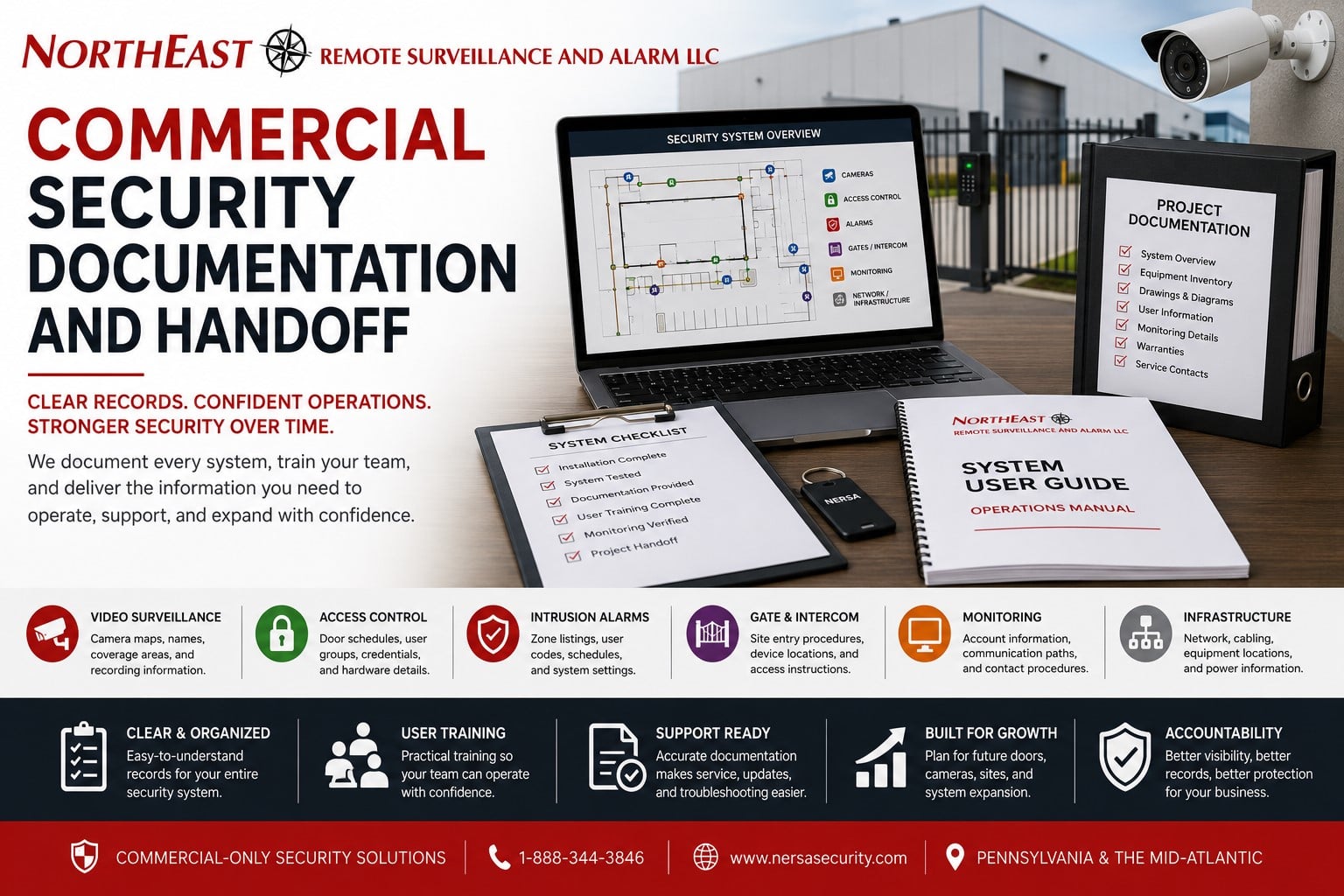
Records, training, system notes, user guidance, and turnover procedures help cameras, access control, alarms, monitoring, gates, intercoms, and infrastructure remain usable after the project is complete.
For the broader project framework, start with NERSA Project Delivery Standards .
Documentation Turns an Installation Into a Usable System
A commercial security system should not be left as a collection of devices that only the installer understands. The customer should know what was installed, how the system is organized, how basic functions work, and how to request support when changes are needed.
Documentation and handoff are what connect installation quality to long-term usability. Cameras, access control doors, alarm zones, monitoring paths, user permissions, gate devices, intercoms, and low-voltage infrastructure all become easier to manage when the system is documented clearly.
NERSA treats documentation and handoff as part of the project, not an afterthought.
Why Commercial Security Handoff Matters
Commercial and industrial properties depend on security systems for daily operations. Managers may need to review video, remove a former employee’s access, update alarm users, check a door event, understand a camera name, or explain a system issue during a service request.
Without proper handoff, customers can face problems such as:
- Unclear camera names
- Unknown device locations
- Confusing alarm zones
- Outdated user lists
- Poor access control records
- Unclear monitoring contact procedures
- No record of equipment installed
- Unclear service history
- Weak support information
- Difficulty planning future expansion
A strong handoff helps the customer use the system with confidence instead of relying on memory, guesswork, or emergency troubleshooting.
Built for Commercial and Industrial Systems
NERSA’s documentation and handoff standards are built for business and professionally managed environments where security systems often include multiple users, doors, cameras, buildings, gates, monitoring paths, and future expansion needs.
These environments may include:
- Warehouses
- Distribution centers
- Logistics facilities
- Manufacturing plants
- Office buildings
- Medical and healthcare facilities
- Municipal buildings
- Schools
- Contractor yards
- Truck yards
- Industrial parks
- Multi-tenant commercial properties
- Multi-site commercial organizations
A residential-style handoff is usually not enough for these properties. Commercial customers need records that support operations, service, user management, accountability, and future growth.
What Commercial Security Documentation May Include
The exact documentation depends on the project scope, but a commercial security handoff may include records related to:
- Camera locations
- Camera names
- Access-controlled doors
- Door hardware notes
- Alarm zones
- User codes or user management guidance
- Access control groups
- Credential procedures
- Monitoring account information
- Responsible contact procedures
- Gate or intercom notes
- Recorder or server information
- Network or infrastructure notes
- Equipment records
- Basic system operating guidance
- Future expansion notes
- Known limitations or recommended next steps
The goal is not to create paperwork for its own sake. The goal is to make the system easier to understand, support, and expand.
Camera System Documentation
Commercial video surveillance systems are only useful if the customer can understand the camera layout and retrieve footage when needed. Poor camera naming or unclear layout can make incident review slower and more frustrating.
NERSA may document camera-related items such as:
- Camera locations
- Camera names
- Coverage areas
- Recorder or video platform information
- Remote viewing guidance
- Search and playback basics
- Retention planning notes
- View limitations
- Areas planned for future camera expansion
For example, a camera named “Camera 7” is less useful than a camera named “Warehouse Dock Door 3” or “Main Employee Entrance.” Clear naming helps managers, owners, and support teams understand the system faster.
Access Control Documentation
Access control systems require strong documentation because users, permissions, schedules, doors, credentials, and roles change over time. Without clear access control records, a business can lose control over who has access and why.
NERSA may document access control items such as:
- Controlled door names
- Reader locations
- Access groups
- Credential types
- User management notes
- Schedule information
- Door hardware notes
- Gate access notes
- Restricted-area control
- Multi-tenant or department access needs
- Future door expansion planning
Access control handoff should help the customer understand how access is organized, not just how to open a door.
Alarm System Documentation
Commercial alarm documentation helps the customer understand what is protected, how users interact with the system, and how alarm activity is monitored or reviewed.
NERSA may document alarm-related items such as:
- Alarm zone names
- Door contacts
- Motion detection areas
- Overhead door protection
- Glass-break detection
- Keypad locations
- User code guidance
- Opening and closing schedule notes
- Monitoring communication notes
- Areas recommended for future alarm expansion
Clear alarm documentation helps reduce confusion, user errors, false dispatch issues, and uncertainty during service calls.
Monitoring and Contact Handoff
Monitoring support depends on accurate information. Responsible parties, call lists, signal types, account procedures, and communication paths may all affect how events are handled.
NERSA may review monitoring-related handoff items such as:
- Monitoring account basics
- Responsible contact procedures
- Signal communication notes
- Alarm communication paths
- Opening and closing expectations
- Changes that require customer updates
- Fire/life-safety monitoring coordination where applicable
- How to request monitoring-related changes
This is especially important for businesses with changing managers, rotating staff, multiple departments, or after-hours operations.
Gate, Intercom, and Visitor Entry Documentation
Gates, intercoms, call boxes, and visitor entry systems affect who can enter the property. These systems should be documented clearly because they are often tied to vendors, visitors, deliveries, employees, and vehicle access.
Handoff may include:
- Gate access procedures
- Keypad or credential guidance
- Intercom operation
- Remote release notes
- Visitor entry procedures
- Camera views tied to entry points
- Access schedule notes
- Vendor or delivery access considerations
- Future gate or visitor-entry expansion needs
For truck yards, contractor yards, warehouses, schools, offices, and municipal properties, entry documentation helps prevent confusion at the perimeter.
Infrastructure and Low-Voltage Notes
Security systems depend on cabling, network conditions, power supplies, device locations, recorders, controllers, communicators, and equipment mounting. Infrastructure notes help future service and expansion.
Documentation may include:
- Cable pathway notes
- Equipment locations
- Recorder or server locations
- Door controller locations
- Power supply locations
- Network closet notes
- Exterior device conditions
- Backup power considerations
- Known infrastructure limitations
- Future cabling recommendations
For broader system planning across cameras, access control, alarms, monitoring, life-safety coordination, and infrastructure, use Commercial & Industrial Security Systems in Pennsylvania and the Mid-Atlantic .
Customer Training and Practical Handoff
Documentation is stronger when it is paired with practical handoff. The customer should understand how to use the system at a basic operational level and know when to request support.
Depending on the system, handoff may include guidance on:
- Viewing live cameras
- Searching recorded video
- Managing access control users
- Adding or removing credentials
- Understanding door events
- Arming and disarming alarms
- Responding to alarm issues
- Requesting monitoring changes
- Reporting system problems
- Planning future expansion
The goal is to help the customer operate the system confidently without overwhelming them with unnecessary technical detail.
Documentation Supports Service and Support
Good documentation makes future support easier. When a customer calls for help, clear records can help identify the system, device, location, issue, and possible next step faster.
Documentation can support:
- Troubleshooting
- User changes
- Equipment replacement
- Camera adjustments
- Access control updates
- Alarm zone review
- Monitoring changes
- Expansion planning
- Service history
- Upgrade recommendations
For ongoing support after installation, use NERSA Service and Support Standards as the supporting page.
Documentation Helps Future Expansion
Commercial properties change. A warehouse may add dock doors. An office may add tenants. A school may change entry procedures. A manufacturing plant may add restricted areas. A contractor yard may expand vehicle gates or outdoor storage.
Documentation helps future expansion by showing:
- What is already installed
- Where devices are located
- How the system is named
- Which areas are covered
- Which doors are controlled
- Which alarm zones exist
- Which infrastructure limitations remain
- Which future improvements were identified
This prevents future upgrades from starting from zero.
Code-Aware and Life-Safety-Aware Handoff
Commercial security documentation may also support better coordination when systems affect doors, egress, fire alarm interfaces, low-voltage wiring, backup power, emergency access, monitoring paths, or inspection readiness.
Documentation may help clarify:
- Which doors are access controlled
- Where electrified hardware is used
- Where alarm or monitoring paths exist
- Where fire/life-safety coordination may apply
- Where emergency access considerations were discussed
- Where future review may be needed
This does not replace the authority having jurisdiction, engineer, architect, code consultant, insurance provider, or legal review where required. It helps commercial clients avoid losing important system context after installation.
Documentation and Long-Term Support
NERSA Project Delivery Standards cover assessment, scope, installation, testing, training, documentation, and support.
Documentation and handoff give the customer the records and operating guidance needed after installation.
Service and support continue after the system is active and the customer needs troubleshooting, changes, updates, or expansion. Documentation and handoff create the foundation that makes that future support easier.
Why NERSA Prioritizes Documentation and Handoff
NERSA prioritizes documentation and handoff because commercial security systems are long-term operating tools. They need to remain understandable after installation, after employee changes, after management turnover, after system expansion, and after future service calls.
A clean handoff helps the customer know:
- What was installed
- How the system is organized
- How to use basic functions
- What information matters for support
- How to request changes
- What future improvements may be needed
That creates a better customer experience and a more dependable security system.
Request a Commercial Security Review
Commercial security documentation and handoff help businesses avoid confusion after installation. Cameras, access control, alarms, monitoring, gates, intercoms, and infrastructure all become stronger when the customer understands how the system is organized and how it should be supported.
Northeast Remote Surveillance and Alarm, LLC helps commercial and industrial clients plan, document, hand off, support, and expand security systems with long-term usability in mind.
To review your facility or plan your next security project, call 1-888-344-3846 or use Request a Security Assessment to schedule the next step.
Frequently Asked Questions About Commercial Security Documentation and Handoff
What is commercial security documentation?
Commercial security documentation includes records that help a business understand its cameras, access control, alarms, monitoring, gates, intercoms, infrastructure, equipment, users, device locations, and future expansion needs.
Why does security system handoff matter?
Security system handoff matters because the customer needs to understand how to use, manage, support, and expand the system after installation. Without proper handoff, the system can become confusing or harder to service.
What should camera documentation include?
Camera documentation may include camera names, camera locations, coverage areas, video platform information, remote viewing guidance, retention notes, and future camera expansion recommendations.
What should access control documentation include?
Access control documentation may include controlled door names, reader locations, access groups, credential procedures, user management notes, schedules, door hardware notes, and future door expansion planning.
What should alarm documentation include?
Alarm documentation may include alarm zone names, door contacts, motion detection areas, keypad locations, user guidance, monitoring communication notes, and future alarm expansion recommendations.
Does NERSA provide customer training during handoff?
Yes. Depending on the system, NERSA may provide practical guidance on viewing cameras, searching recorded video, managing users, adjusting credentials, arming or disarming alarms, understanding events, and requesting support.
How does documentation help future service?
Documentation helps future service by making it easier to identify devices, locations, system names, user settings, alarm zones, access control points, equipment records, and known limitations.
How does documentation help future expansion?
Documentation helps future expansion by showing what is already installed, where devices are located, how the system is organized, and which areas may need future cameras, doors, alarms, gates, or infrastructure.
Is documentation the same as service and support?
No. Documentation and handoff happen around project turnover. Service and support happen after the system is active and the customer needs troubleshooting, updates, changes, or expansion.
How does a business start with NERSA?
Request a Security Assessment to review your facility, documentation needs, and operating requirements.
Compliance, Codes & Project Standards
NERSA plans commercial and industrial security work with applicable code, documentation, inspection and authority-having-jurisdiction requirements in mind. Requirements vary by system, property and jurisdiction. These resources support project planning; they do not establish legal compliance, certification or AHJ approval.
Related guidance: Regulatory compliance & inspection readiness · NERSA project standards · Documentation, testing & inspection readiness