Healthcare Security Systems in Allentown, PA

Northeast Remote Surveillance and Alarm, LLC designs and installs healthcare security systems for medical offices, clinics, urgent care centers, dental practices, behavioral health providers, healthcare support spaces, and medical office buildings in Allentown, PA. This page focuses on privacy-aware camera placement, controlled staff access, panic and duress options, parking lot visibility, intrusion alarms, visitor entry, monitoring, fire/life-safety coordination, and long-term security planning for healthcare properties. For the broader citywide security structure, start with Commercial Security Systems in Allentown, PA.

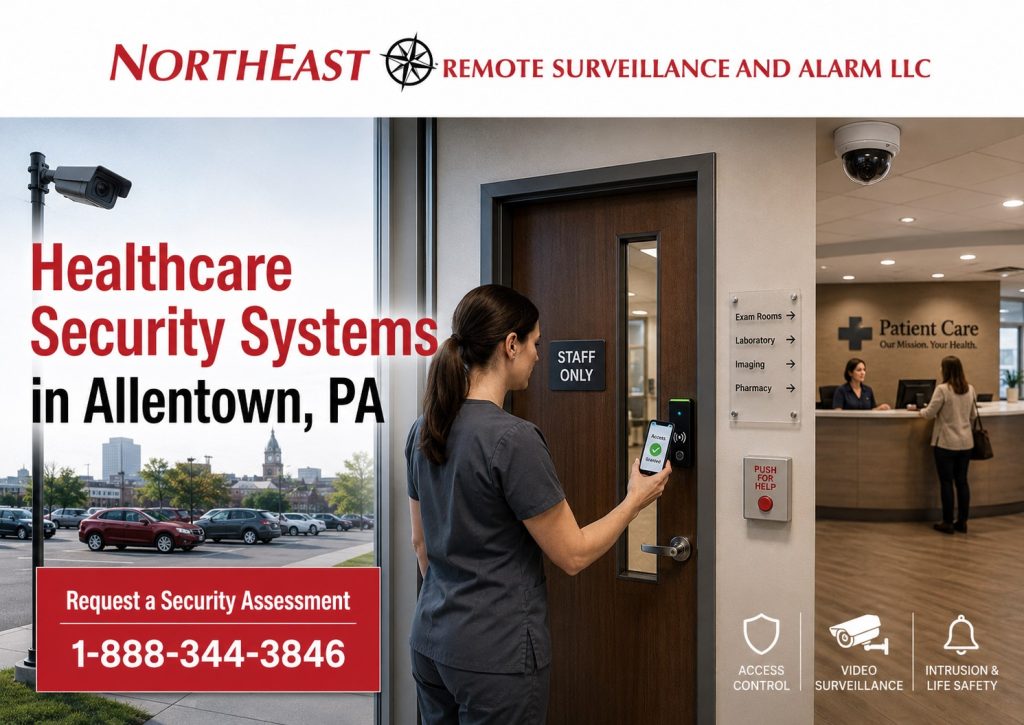
Healthcare security systems in Allentown PA showing medical office access control, parking lot cameras, panic buttons, intrusion alarms, staff-only doors, visitor entry, and Northeast Remote Surveillance and Alarm LLC branding.
Healthcare security systems in Allentown, PA graphic featuring a medical office entrance, staff access control, parking lot cameras, panic button protection, visitor entry, intrusion alarms, and Northeast Remote Surveillance and Alarm, LLC branding.

Healthcare Security Planning for Allentown Medical Properties

Healthcare properties have different security needs than standard offices or retail buildings. Patient flow, staff movement, records areas, medication storage, employee entrances, parking lots, waiting areas, exam-area boundaries, after-hours access, and privacy-sensitive spaces all affect how the system should be planned.

A healthcare security system should not be treated as a generic camera-and-alarm package. The system should help the property control access, document activity, protect staff, support visitor management, improve parking lot visibility, and provide dependable after-hours protection without interfering with patient care or privacy-sensitive operations.

NERSA designs healthcare security systems around how the property actually operates. That includes the building layout, front entrance, staff doors, reception workflow, restricted rooms, parking exposure, alarm zones, camera placement, user permissions, monitoring expectations, and future expansion needs.

Healthcare Security Planning Topics in Allentown

Medical Office Security Systems in Allentown, PA

Use [Medical Office Security Systems in Allentown, PA] for outpatient practices, clinics, dental offices, urgent care centers, and healthcare offices that need cameras, access control, alarms, staff safety, and after-hours protection.

Healthcare Access Control Systems in Allentown, PA

Use [Healthcare Access Control Systems in Allentown, PA] for staff-only doors, records rooms, medication areas, back offices, restricted storage, employee entrances, and controlled access between public and private areas.

Healthcare Parking Lot Security Cameras in Allentown, PA

Use [Healthcare Parking Lot Security Cameras in Allentown, PA] for patient parking areas, staff parking, exterior entrances, walkway visibility, vehicle incidents, lighting concerns, and after-hours exterior review.

Panic Button Systems for Medical Offices in Allentown, PA

Use [Panic Button Systems for Medical Offices in Allentown, PA] for reception desks, treatment-adjacent areas, staff workspaces, behavioral health settings, and healthcare properties that need discreet duress notification.

Pharmacy and Medication Storage Security in Allentown, PA

Use [Pharmacy and Medication Storage Security in Allentown, PA] for medication rooms, pharmacy areas, restricted cabinets, controlled storage, staff-only access, alarm points, and activity documentation.

Visitor Entry and Intercom Systems in Allentown, PA

Use [Visitor Entry and Intercom Systems in Allentown, PA] for healthcare properties that need better front-door communication, controlled visitor access, delivery entry, staff release workflows, and reception-area support.

Commercial Video Surveillance Systems in Allentown, PA

Use [Commercial Video Surveillance Systems in Allentown, PA] when a healthcare property needs camera coverage for entrances, parking areas, corridors, exterior doors, waiting-area boundaries, and after-hours activity zones.

Commercial Intrusion Alarm Systems in Allentown, PA

Use [Commercial Intrusion Alarm Systems in Allentown, PA] for after-hours protection, door contacts, motion detection, panic buttons, duress alerts, alarm monitoring, and intrusion protection for healthcare spaces.

Privacy-Aware Camera Placement

Healthcare camera placement requires careful planning. Cameras should support security and documentation without creating unnecessary privacy concerns or interfering with patient care areas.

Common camera locations may include public entrances, reception approaches, waiting-area boundaries, parking lots, exterior doors, hallways, staff entrances, delivery points, and common-area circulation paths. Cameras should not be placed casually in sensitive care areas, exam rooms, restrooms, changing areas, or other locations where privacy expectations are high.

The goal is usable visibility, not excessive recording. NERSA helps healthcare properties plan camera views around entrances, incidents, staff safety, parking exposure, visitor movement, and after-hours activity while keeping the system practical for daily operation.

Staff Access Control and Restricted Areas

Access control is one of the most important security layers for healthcare properties. Medical offices and healthcare support spaces often need to separate public areas from staff-only areas, treatment support spaces, records rooms, medication storage, back offices, utility rooms, and employee entrances.

Traditional keys can create problems when employees change roles, leave the organization, share access, or lose keys. Access control gives the property a cleaner way to manage credentials, schedules, user groups, and door activity.

A healthcare access control design may include keycards, fobs, mobile credentials, door readers, electrified hardware, request-to-exit devices, door position monitoring, and controlled entry workflows. The system should be easy for management to operate while still giving the property stronger control over sensitive spaces.

Panic Buttons, Duress, and Staff Safety

Healthcare environments can involve stressful interactions, late appointments, emotionally charged situations, cash or medication concerns, and staff working in smaller teams. Panic or duress systems can support staff safety when a discreet alert process is needed.

Panic button planning should consider where staff are located, who receives alerts, how alerts are verified, whether monitoring is involved, and what response process should follow. Reception desks, administrative areas, treatment-adjacent workspaces, back offices, and behavioral health settings may require different placement strategies.

A panic button is only useful when the response process is clear. NERSA helps healthcare properties think through device placement, alert routing, monitoring options, and how duress signals fit into the broader alarm and security plan.

Parking Lot and Exterior Security for Healthcare Properties

Parking lots are a major exposure point for many healthcare properties. Patients, visitors, employees, deliveries, after-hours staff, and service vehicles may all use the same exterior areas.

Healthcare parking lot cameras should account for lighting, vehicle movement, pedestrian paths, entrance approaches, staff parking, visitor parking, blind spots, and areas where incidents may occur. The system may need general overview coverage, identification-level views, or dedicated camera angles near entrances and walkways.

Exterior security should also consider side doors, rear doors, dumpsters, service entrances, employee exits, and after-hours access points. These areas often become more important when the business is closed, lightly staffed, or operating extended hours.

Intrusion Alarms and After-Hours Protection

Healthcare properties need dependable after-hours protection for exterior doors, interior zones, restricted rooms, medication storage, records areas, administrative offices, and high-value equipment locations.

A commercial intrusion alarm system may include door contacts, motion detectors, glass-break detection, panic buttons, duress devices, keypad control, monitoring, video verification, and zone planning based on how the facility is used.

The alarm system should match the operating schedule. A property with extended hours, multiple providers, cleaning crews, deliveries, or after-hours staff access may need different alarm zoning than a single-provider office with limited access points.

Visitor Entry, Intercoms, and Front-Door Control

Healthcare properties often need a balance between public access and controlled entry. Some offices need open access during business hours. Others need buzz-in entry, intercom communication, controlled delivery access, or visitor screening at certain times.

Visitor entry systems can support reception staff, reduce uncontrolled access, and give the property more control over who enters staff-only areas or restricted zones. Intercoms may also support back-door deliveries, after-hours appointments, employee entry, and controlled release workflows.

The right visitor-entry approach depends on the property layout, staffing model, hours of operation, public access needs, and whether the business wants a fully locked, partially controlled, or schedule-based entry process.

Fire Alarm, Life Safety, and Healthcare Operations

Fire alarm and life-safety systems must be planned carefully in healthcare environments. Security systems should not interfere with required egress, fire alarm operation, accessibility, emergency movement, inspection access, or life-safety procedures.

Access-controlled doors, electrified hardware, maglocks, fire alarm interfaces, alarm monitoring, notification pathways, and low-voltage work may require coordination with property managers, contractors, design professionals, fire alarm providers, or authorities having jurisdiction depending on the project.

NERSA does not treat security as a shortcut around life safety. Security improvements should support the healthcare operation while respecting the building’s emergency movement, fire alarm coordination, documentation, and inspection-sensitive conditions.

Compliance-Aware Healthcare Security Planning

Healthcare security systems should be designed with privacy-sensitive spaces, staff safety, patient movement, emergency egress, documentation, access accountability, and system reliability in mind. Security systems do not replace healthcare compliance programs, workplace safety policies, patient privacy procedures, training, supervision, or life-safety requirements.

For code-sensitive planning involving access control, cameras, fire alarm coordination, documentation, egress, OSHA-aware security planning, ADA access control, and Pennsylvania UCC considerations, use [Compliance-Aware Security Planning in Allentown, PA].

A strong healthcare security plan should help the property document incidents, control restricted access, review parking lot events, manage staff entry, support after-hours alarm response, and maintain dependable system operation over time.

Low-Voltage Infrastructure and Remote Access

Healthcare security systems depend on reliable infrastructure. Cameras, access control, alarms, intercoms, panic buttons, monitoring equipment, and remote access tools all require proper cabling, power, network planning, permissions, and long-term serviceability.

Weak infrastructure can create problems with video quality, access-control reliability, remote access, alarm communication, and system expansion. NERSA reviews low-voltage pathways, network conditions, equipment locations, power requirements, user access, and future growth before recommending system design.

Remote access should also be controlled carefully. Owners, practice managers, administrators, supervisors, and approved staff may need different levels of access depending on their role and the sensitivity of the system.

Why Allentown Healthcare Properties Choose NERSA

Northeast Remote Surveillance and Alarm, LLC focuses on commercial and industrial security systems, not residential alarm packages. Healthcare properties choose NERSA when they need security planning that accounts for staff safety, privacy-aware camera placement, controlled access, panic buttons, parking lot exposure, alarms, monitoring, and long-term support.

NERSA designs systems around actual operations. A dental practice, urgent care center, behavioral health provider, medical office building, specialty clinic, and healthcare support space will not require the same system layout.

Our goal is to help healthcare properties improve visibility, manage access, document incidents, protect staff, support after-hours security, and build a system that can be managed over time.

Request a Healthcare Security Assessment in Allentown

If your Allentown healthcare property needs security cameras, access control, panic buttons, intrusion alarms, staff-only door control, parking lot cameras, visitor entry, remote monitoring, fire/life-safety coordination, or low-voltage infrastructure support, Northeast Remote Surveillance and Alarm, LLC can help.

Use Request a Security Assessment to review your property, entrances, parking areas, staff doors, restricted rooms, panic-button needs, camera locations, alarm zones, monitoring requirements, and healthcare security goals.

Frequently Asked Questions About Healthcare Security Systems in Allentown, PA

What is a healthcare security system?

A healthcare security system uses cameras, access control, intrusion alarms, panic buttons, monitoring, intercoms, visitor entry, fire/life-safety coordination, and infrastructure planning to help protect medical offices, clinics, staff areas, parking lots, restricted rooms, and after-hours spaces.

Does NERSA install security systems for medical offices in Allentown?

Yes. Northeast Remote Surveillance and Alarm, LLC installs healthcare security systems for medical offices, clinics, urgent care centers, dental practices, behavioral health providers, healthcare support spaces, and medical office buildings in Allentown, PA.

Where should healthcare security cameras be placed?

Common camera locations include entrances, reception approaches, waiting-area boundaries, parking lots, exterior doors, hallways, staff entrances, delivery points, and common areas. Camera placement should avoid sensitive care areas and privacy-sensitive locations.

Can healthcare offices use access control?

Yes. Healthcare offices can use access control for staff-only doors, records rooms, medication storage, back offices, employee entrances, utility rooms, and controlled transitions between public and private areas.

Are panic buttons useful for medical offices?

Yes. Panic buttons and duress devices can support staff safety at reception desks, administrative areas, treatment-adjacent workspaces, behavioral health settings, and other areas where discreet alerting may be needed.

Do healthcare properties need parking lot cameras?

Many healthcare properties benefit from parking lot cameras because patients, visitors, staff, deliveries, and after-hours activity often create exterior security concerns. Parking lot cameras can help document vehicle incidents, entrances, walkways, lighting zones, and exterior activity.

Can healthcare security systems include intrusion alarms?

Yes. Healthcare intrusion alarm systems can include door contacts, motion detection, glass-break detection, restricted-area protection, panic buttons, monitoring, and zone planning based on the property’s operating schedule.

Can access control and cameras work together?

Yes. Access control events can often be paired with video review so management can see when a door was used and what happened around the opening. This is useful for staff entrances, restricted rooms, medication storage, and after-hours access points.

What makes healthcare security different from office security?

Healthcare security must account for patient flow, staff safety, privacy-sensitive spaces, restricted rooms, medication or records storage, panic-button needs, parking lot exposure, visitor access, and after-hours protection. Standard office security does not always address those operational concerns.

Can NERSA upgrade an existing healthcare security system?

Yes. NERSA can review existing cameras, alarms, access control, panic buttons, monitoring, user permissions, network conditions, door hardware, and coverage gaps to determine whether the system should be repaired, upgraded, expanded, or replaced.

Scroll to Top
1-888-344-3846