Access control should help secure a commercial building without creating unnecessary barriers for employees, visitors, customers, patients, students, vendors, or other lawful users. Northeast Remote Surveillance and Alarm, LLC supports ADA-aware access control planning as part of regulatory compliance and inspection readiness for commercial security systems for offices, warehouses, schools, municipal buildings, healthcare properties, industrial facilities, and multi-tenant commercial sites. This page focuses on accessibility-aware planning for card readers, keypads, intercoms, door releases, visitor entry, controlled entrances, gates, reception areas, and access-controlled openings.
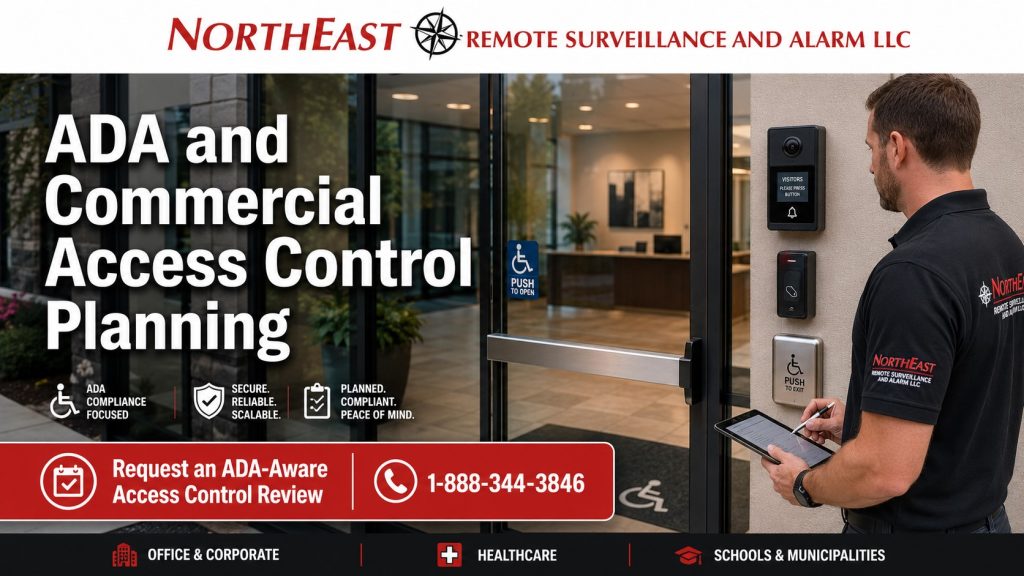
ADA and Commercial Access Control Planning for Commercial Buildings
Commercial access control is not only about locking and unlocking doors. It affects how people approach a building, request entry, present credentials, communicate with staff, pass through controlled openings, and move through secure areas.
When access control is planned without accessibility awareness, the system can create problems for lawful users. A reader may be mounted in a poor location. A keypad may be difficult to reach. An intercom may not support a usable visitor process. A door may unlock too quickly or too slowly. A gate may be difficult to operate. A reception entry may create confusion for visitors who need assistance.
NERSA helps commercial and industrial clients plan access control systems that support security while respecting building use, visitor access, emergency response, inspection readiness, and accessibility expectations.
ADA-aware access control planning may involve:
- Card readers
- Keypad readers
- Mobile credential readers
- Video intercom stations
- Visitor entry systems
- Remote door release
- Reception-controlled entrances
- Automatic door operator coordination
- Controlled vestibules
- Gate access systems
- Elevator area access control
- Staff-only entrances
- Public entrances
- Healthcare entrances
- School visitor entrances
- Municipal building entrances
- Employee entrances
- Delivery and vendor access points
The goal is a controlled entry system that is secure, practical, usable, and supportable.
Why Accessibility Matters in ADA and Commercial Access Control Planning
Access control can affect people before they ever enter the building. The location of a reader, intercom, call button, keypad, gate pedestal, door release, or visitor entrance can determine whether the system is easy to use or creates unnecessary difficulty.
Accessibility-aware planning matters most at:
- Public entrances
- Visitor entrances
- Reception doors
- Medical office entrances
- Municipal building entrances
- School main entrances
- Employee entrances
- Accessible routes
- Parking lot gates
- Pedestrian gates
- Delivery entrances
- Tenant entrances
- Controlled vestibules
- Intercom entry points
- Doors with automatic operators
A building can be secure without making entry confusing or difficult for lawful users. Access control should support the way the building is used, not create a barrier that could have been avoided with better planning.
Reader, Keypad, and Credential Placement
The placement of access control devices matters. A reader or keypad should be positioned so authorized users can reasonably approach it, identify it, and use it as intended.
Reader and keypad planning may include:
- Mounting location
- Approach space
- Visibility
- Lighting
- Weather exposure
- Door swing direction
- Nearby glass or wall conditions
- Traffic flow
- Pedestrian access
- Vehicle access
- Visitor instructions
- Staff workflow
- Accessible route coordination
- Protection from damage
- Future service access
Poor placement can lead to user frustration, failed reads, nuisance service calls, unnecessary staff assistance, and inconsistent building access. A well-planned reader location improves both security and usability.
Visitor Entry and Intercom Accessibility
Visitor entry systems must be planned carefully because they are often used by people who do not already know the building. A visitor may need to find the correct entrance, press a call button, speak with staff, wait for authorization, and enter through a controlled door.
Video intercom and visitor entry planning may include:
- Intercom mounting location
- Camera view of the visitor
- Audio clarity
- Call routing
- Remote door release
- Reception desk workflow
- Signage and instructions
- Lighting at the entrance
- Weather protection
- Visitor waiting area visibility
- Integration with access control
- Integration with video surveillance
- Door unlock timing
- Staff training
For schools, healthcare properties, municipal buildings, and public-facing offices, visitor entry should be controlled without creating confusion. The entry process should help staff verify who is at the door while still giving visitors a clear way to request access.
Controlled Entrances and Automatic Door Operators
Some entrances may include automatic door operators, push plates, intercoms, access control readers, remote release, or reception-controlled unlocking. These devices need to work together as a complete entry sequence.
A controlled entrance may involve:
- Exterior door hardware
- Interior vestibule door hardware
- Card reader
- Intercom station
- Door release relay
- Automatic operator
- Push plate
- Door position switch
- Request-to-exit device
- Camera view
- Reception desk control
- Access schedule
- Visitor entry procedure
When these pieces are planned separately, the entrance may become confusing or unreliable. NERSA helps coordinate the security technology side so the access control system supports the intended visitor and staff workflow.
Gates, Parking Areas, and Exterior Access
Accessibility-aware access control does not stop at the front door. Many commercial properties also use controlled gates, parking lot entrances, pedestrian gates, fenced areas, and exterior access points.
Gate and exterior access planning may involve:
- Vehicle reader placement
- Pedestrian gate access
- Intercom pedestal location
- Call box visibility
- Camera coverage
- Lighting
- Visitor instructions
- Remote gate release
- Staff access
- Delivery access
- Emergency responder access coordination
- Snow and weather considerations
- Accessible path coordination
A gate system should not be designed only for vehicles. If pedestrians, visitors, employees, vendors, or service providers use the entrance, the access control plan should account for how they will safely and reasonably request entry.
Public-Facing Buildings and Visitor Access
Public-facing buildings often require more careful access control planning because visitors may not be trained users. Schools, municipal buildings, healthcare offices, professional offices, and multi-tenant commercial buildings often need a balance between controlled entry and clear visitor access.
Public-facing access control planning may include:
- Main entrance control
- Reception desk release
- Visitor intercoms
- Vestibule security
- Staff-only area protection
- Elevator access
- Waiting room access
- Visitor camera coverage
- Door status monitoring
- Emergency release planning
- Clear entry instructions
- After-hours access procedures
The system should make it clear where visitors should go, how they request access, and how staff respond.
ADA-Aware Access Control for Healthcare and Medical Offices
Healthcare and medical office environments may include patients, staff, visitors, vendors, records areas, medication areas, treatment spaces, and restricted employee-only zones. Access control must protect sensitive areas while supporting patient-facing use.
ADA-aware access control planning for healthcare facilities may involve:
- Patient entrances
- Staff entrances
- Reception-controlled doors
- Waiting room doors
- Records rooms
- Medication rooms
- Treatment areas
- Staff-only corridors
- Delivery entrances
- Intercoms
- Door release timing
- Camera views
- Visitor management
The goal is to protect the facility without making lawful access more difficult for patients, visitors, or staff.
ADA-Aware Access Control for Schools and Municipal Buildings
Schools and municipal buildings often need controlled public entry. These properties may include visitors, students, staff, parents, vendors, public meetings, emergency responders, and after-hours users.
Access control planning may include:
- Main visitor entrances
- Secure vestibules
- Office-controlled door release
- Video intercoms
- Staff credential readers
- Public meeting entrances
- Gym or event entrances
- Administrative areas
- Records areas
- Police or public works support spaces
- Camera coverage
- Emergency communication support
For school and municipal environments, the access control system should support both security and clear public-facing operation.
ADA-Aware Access Control for Warehouses and Industrial Facilities
Warehouses and industrial properties may not always be public-facing, but they still need practical access control planning. Employees, vendors, drivers, contractors, inspectors, and visitors may all use different entry points.
Accessibility-aware planning may be needed for:
- Employee entrances
- Driver entrances
- Shipping and receiving offices
- Contractor entrances
- Visitor entrances
- Guard shack access
- Pedestrian gates
- Yard gates
- Office entrances
- Training rooms
- IT rooms
- HR entrances
- Administrative areas
A warehouse or manufacturing facility may have strong security needs, but the system still needs to be usable by authorized people who need legitimate access.
Access Control, Egress, and Life Safety Coordination
Accessibility is one part of controlled door planning. Egress and life safety are also critical. A controlled door should not interfere with safe exit, emergency release, fire door function, or inspection requirements.
For egress-specific planning, visit Access Control Egress and Life Safety Compliance.
Egress and life safety coordination may involve:
- Door release during emergency conditions
- Fire alarm interface
- Request-to-exit devices
- Door position switches
- Emergency release buttons
- Maglock release
- Electric strike operation
- Electrified hardware coordination
- Fire-rated opening awareness
- Door hardware review
- AHJ coordination
ADA-aware access control and egress-aware access control should work together. A door should be secure, accessible, and safe to exit.
Camera and Intercom Support for Accessible Entry
Cameras and intercoms can support better visitor access when they are planned correctly. A camera can help staff see who is requesting entry. An intercom can allow two-way communication. Access control can allow approved entry without requiring staff to walk to the door every time.
Camera and intercom support may be useful at:
- Main entrances
- Visitor vestibules
- Reception doors
- Loading entrances
- Delivery doors
- School entrances
- Medical office entrances
- Municipal entrances
- Parking lot gates
- Pedestrian gates
- After-hours entrances
When these systems are integrated, staff can make better decisions and visitors can follow a clearer entry process.
For broader system planning, visit commercial access control systems.
Documentation for Accessibility-Aware Access Control
Documentation helps facility managers, inspectors, service technicians, and future contractors understand how the controlled entry system is designed.
Access control documentation may include:
- Controlled door list
- Reader locations
- Intercom locations
- Gate access locations
- Door hardware notes
- Door release sequence
- Remote release locations
- Automatic operator coordination notes
- Access schedules
- User permission structure
- Visitor entry procedures
- Camera views supporting entry
- Service notes
- Testing records
- As-built information when applicable
Good documentation helps prevent confusion during service calls, renovations, inspections, ownership changes, or system upgrades.
AHJ and Project Team Coordination
Some access control projects may need review by the authority having jurisdiction or coordination with other project team members. This is especially true when controlled doors affect public entrances, emergency egress, fire-rated openings, building alterations, accessible routes, or life-safety systems.
Coordination may involve:
- AHJ review
- Architect coordination
- Engineer coordination
- Door hardware provider coordination
- Locksmith coordination
- Fire alarm contractor coordination
- General contractor coordination
- Facility manager review
- IT and network coordination
- Security system documentation
For inspection-sensitive access control projects, visit AHJ Coordination for Commercial Security and Fire Alarm Projects.
NERSA does not replace the AHJ, architect, engineer, ADA consultant, code consultant, legal advisor, or governing authority. Our role is to help plan, install, document, test, and support the security technology in a way that respects the building and the review environment.
Common ADA-Aware Access Control Problems
Many access control problems happen because the door, reader, intercom, and visitor process were not reviewed together.
Common problems include:
- Reader installed in a hard-to-use location
- Keypad placed without considering approach
- Intercom difficult to find
- Intercom camera not showing the visitor clearly
- Poor lighting at the entry point
- Remote release timing that causes confusion
- Gate call box poorly positioned
- No clear visitor instructions
- Controlled entrance not coordinated with automatic operator
- Public entrance secured without a clear visitor process
- Door hardware selected without reviewing the user workflow
- Lack of documentation for controlled openings
- No coordination with egress or fire alarm needs
A better design starts with the actual doorway, the people using it, and the process the building owner wants to support.
What This Page Does Not Cover
This page focuses specifically on ADA-aware commercial access control planning. It does not replace a complete access control system design page, an egress and life safety page, a full compliance hub, or legal accessibility consulting.
For full access control system planning, visit commercial access control systems.
For controlled door egress, emergency release, fire alarm interface, and life-safety coordination, visit Access Control Egress and Life Safety Compliance.
For broader compliance and inspection-readiness planning, visit Regulatory Compliance and Inspection Readiness for Commercial Security Systems.
Final ADA interpretation, code interpretation, approval, and enforcement remain with the appropriate AHJ, architect, engineer, ADA consultant, code consultant, legal advisor, or governing authority when required.
Why Choose Northeast Remote Surveillance and Alarm
Northeast Remote Surveillance and Alarm, LLC designs access control systems for real commercial buildings with real users, real doors, and real operating conditions. We understand that access control must support both security and usability.
Our team helps clients review entrances, readers, intercoms, gates, door release needs, visitor entry procedures, camera support, access schedules, user permissions, documentation, and long-term service requirements.
Businesses choose NERSA for ADA-aware commercial access control planning because we provide:
- Commercial and industrial access control experience
- Entrance-by-entrance planning
- Reader and keypad placement review
- Intercom and visitor entry coordination
- Gate and exterior access planning
- Camera support for controlled entrances
- Egress and life-safety awareness
- AHJ coordination support
- Documentation for service and inspection readiness
- Long-term service and support
A controlled entrance should be secure, understandable, usable, and supportable.
Request an ADA-Aware Access Control Review
If your commercial property needs card readers, keypads, video intercoms, gate access, visitor entry control, reception door release, accessible entrance planning, or documentation for controlled openings, Northeast Remote Surveillance and Alarm, LLC can help.
Call 1-888-344-3846 or request a security assessment to review your doors, entrances, access-control needs, visitor process, building conditions, and inspection-readiness concerns.
We support ADA-aware commercial access control planning for offices, warehouses, schools, municipal buildings, healthcare properties, industrial facilities, logistics sites, multi-tenant buildings, and commercial properties throughout the Lehigh Valley, Northeastern Pennsylvania, Central Pennsylvania, Greater Philadelphia, New Jersey, Delaware, and the Mid-Atlantic region.
Frequently Asked Questions
What does ADA-aware access control planning mean?
ADA-aware access control planning means controlled doors, readers, keypads, intercoms, visitor entry systems, gates, and door releases are reviewed with accessibility and lawful building use in mind.
Does access control have to consider ADA accessibility?
Access control can affect how people enter, request access, use credentials, communicate with staff, and move through controlled entrances. Accessibility should be considered when planning public entrances, visitor doors, intercoms, gates, reception areas, and controlled openings.
Can a card reader create an accessibility issue?
Yes. A card reader, keypad, or intercom can create usability problems if it is installed in a poor location, difficult to reach, hard to see, poorly lit, or not coordinated with the entrance design.
Do intercoms need accessibility planning?
Yes. Visitor intercoms should be planned so visitors can find them, use them, communicate with staff, and understand how to enter after authorization. The exact requirements depend on the building, entrance, user group, and project review.
Can automatic door operators work with access control?
Yes. Automatic door operators can often be coordinated with access control and remote release, but the sequence must be planned carefully so the entrance remains secure, usable, and safe.
Does this page replace ADA consulting?
No. NERSA provides access control system planning, installation, integration, documentation, and support. ADA interpretation and legal accessibility guidance should come from the appropriate AHJ, architect, engineer, ADA consultant, code consultant, legal advisor, or governing authority when required.
Are warehouse and industrial access control systems affected by accessibility planning?
They can be. Warehouses and industrial facilities may have employee entrances, driver entrances, visitor doors, guard shacks, pedestrian gates, offices, and public-facing areas that should be planned for lawful and practical use.
What is the difference between ADA-aware access control and egress compliance?
ADA-aware access control focuses on accessible and usable entry, visitor access, reader placement, intercoms, gates, and controlled entrances. Egress compliance focuses on safe exit, emergency release, fire alarm interface, request-to-exit devices, and life-safety coordination.
What should be documented for ADA-aware access control?
Useful documentation may include reader locations, intercom locations, controlled door lists, door release sequences, visitor entry procedures, gate access locations, camera views, access schedules, and service notes.
What is the best next step for ADA-aware access control planning?
The best next step is a site-specific review. NERSA can evaluate the entrances, users, access-control goals, visitor process, intercom needs, gate conditions, egress concerns, and documentation requirements before the system is installed.