
Automatic-door access control coordinates credentials, locks, actuators, and operator timing so authorized users can enter through a correctly sequenced opening.

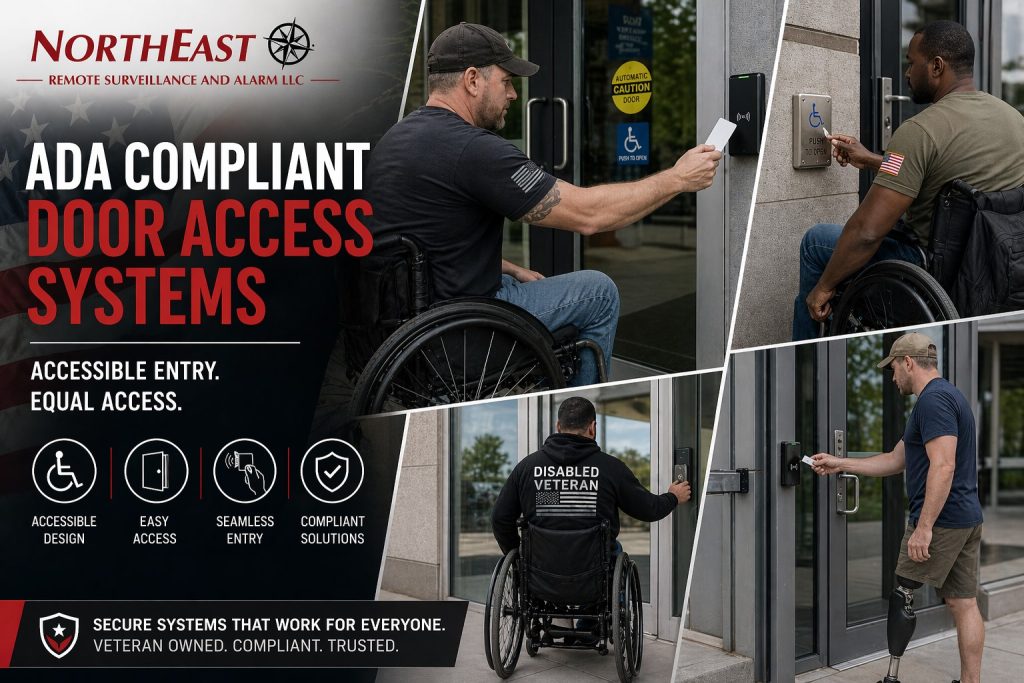
Separate Entry Authorization from Door Movement
The access-control system determines whether entry is authorized. The automatic operator physically opens and closes the door.
For the opening to work properly, those functions must be coordinated so the door can authorize entry, unlock, open, remain usable for the required period, close and return to a secure condition.
Northeast Remote Surveillance and Alarm, LLC (NERSA) designs and integrates commercial access-control systems with automatic door operators and related controlled-door equipment for offices, healthcare facilities, schools, municipal properties, industrial buildings, multi-tenant facilities and other business and professionally managed environments.
NERSA supports scalable applications ranging from a single controlled entrance for a small business through multi-door commercial facilities, industrial properties, campuses and enterprise environments.
For broader accessibility considerations involving readers, doors, gates and controlled openings, visit ADA Compliance for Electronic Access Control Systems.
How Access Control and an Automatic Door Operator Work Together
An automatic operator should not attempt to open a door that remains electronically locked.
The complete controlled opening may involve:
- Credential reader
- Keypad
- Mobile credential reader
- Access-control controller
- Electric strike
- Electrified trim
- Magnetic lock
- Automatic door operator
- Push plate or actuator
- Request-to-exit function
- Door-position monitoring
- Power supplies
- Door and frame
- System programming
When an authorized credential is presented, the access-control system may need to release the locking hardware before the automatic operator begins opening the door.
After authorized entry, the opening should close, relatch and return to its intended secure condition.
The exact sequence depends on the door, operator, locking hardware, controller and required building operation.
The objective is to make the equipment function as one coordinated controlled opening.
Credential-to-Open Door Sequencing
Timing is critical when electronic access control and an automatic operator share the same opening.
A typical controlled sequence may involve:
- The user presents an authorized credential.
- The access-control system verifies permission.
- Electrified locking hardware releases.
- The automatic operator receives the appropriate activation.
- The door opens.
- The authorized user passes through the opening.
- The operator closes the door.
- The locking hardware relatches.
- The opening returns to its secure condition.
If these functions are not coordinated properly, problems can include:
- Operator attempting to open against a locked door
- Door beginning to move before the lock releases
- Insufficient entry time
- Door failing to close completely
- Door failing to relatch
- Repeated operator cycling
- Intermittent access
- Excessive hardware wear
Plan the reader, controller, locking hardware and operator as one operating sequence.
Push Plates, Actuators and Credential Readers
Automatic doors may use push plates, touchless actuators or other approved activation devices.
An access-controlled opening may also require an authorized credential before automatic operation is permitted.
Depending on the design, a user may:
- Present a credential and then activate the operator
- Present a credential that initiates an approved opening sequence
- Use a push plate after access has been authorized
- Receive authorized remote release before operator activation
- Use an intercom-controlled entry process
The control sequence should be understandable and practical for the people using the entrance.
Position readers, actuators and intercom devices so users can follow the entry sequence without moving unnecessarily between controls.
Review the operating sequence together with the entrance’s applicable accessibility and safe-use requirements.
Electric Strikes, Electrified Trim and Automatic Operators
The locking hardware must work correctly with the automatic-door sequence.
An electric strike may release the latch at the frame before the operator opens the door.
Electrified trim may electronically enable exterior entry through compatible commercial locking or exit hardware.
Other approved locking arrangements may be appropriate depending on the opening.
Regardless of hardware type, the lock must release properly before the operator moves the door.
Reliable operation depends on factors such as:
- Hardware compatibility
- Door alignment
- Latch operation
- Release timing
- Available power
- Wiring
- Controller programming
- Operator configuration
- Secure relatching
For detailed electric-strike and electrified-trim planning, visit Access Control Trim & Strike Hardware for Commercial Doors.
Coordinating Access Control at Accessible Automatic Entrances
Automatic operators are frequently installed at entrances where accessible operation is important.
These may include:
- Main commercial entrances
- Healthcare facilities
- Schools
- Municipal buildings
- Offices
- Multi-tenant properties
- Public-facing entrances
- Employee entrances
When electronic access control is added to one of these doors, the credential authorization and automatic-opening sequence should support the intended operation of the entrance.
The reader, actuator, operator and locking hardware must work together without creating conflicting commands or unnecessary steps.
Review broader accessibility requirements as part of the complete entrance design.
For accessibility-focused planning involving reader placement, accessible routes, controlled gates, operators and door usability, visit ADA Compliance for Electronic Access Control Systems.
Existing Automatic Doors With New Access Control
A commercial property may already have an automatic operator and later require electronic access control.
Before connecting the systems, evaluate the existing opening.
Important conditions may include:
- Operator manufacturer and type
- Operator condition
- Existing activation devices
- Existing locking hardware
- Door and frame condition
- Available interface capabilities
- Door closing and relatching
- Existing power
- Existing wiring
- Required authorization sequence
Adding a card reader to an existing automatic entrance does not automatically create a properly integrated access-controlled door.
Establish the complete entry sequence first.
Existing components may remain in service when they are compatible, dependable and appropriate for the required integration.
Existing Access Control With a New Automatic Operator
The opposite situation also occurs.
A property may already have an electronically controlled entrance and later add an automatic operator.
Next, evaluate how to integrate the operator with the existing access-control system while preserving the locking and relatching sequence.
The project may require coordination involving:
- Controller outputs
- Lock release timing
- Operator activation
- Door-position monitoring
- Request-to-exit functions
- Power
- Wiring
- Programming
Existing access-control equipment does not automatically need replacement simply because an automatic operator is being added.
The appropriate approach depends on compatibility and the required operating sequence.
Door Closing and Secure Relatching
A successful automatic-door integration does not end when the door opens.
After authorized entry, the opening should close and return to the intended secured condition.
Problems may develop when:
- Operator timing is incorrect
- Door alignment is poor
- Latch does not engage
- Strike remains released too long
- Electrified hardware does not reset
- Door receives repeated activation
- Physical door conditions prevent complete closing
Reliable relatching is essential because the access-controlled entrance must return to security after authorized operation.
Test the complete sequence from credential presentation through final relatching.
Door Position and Sequence Verification
Door-position monitoring can provide useful information when coordinating access control with automatic operation.
Depending on the installed system, the controller may need to recognize conditions such as:
- Door closed
- Door opening
- Door open
- Door held open
- Door returned to closed position
Door status can help the access-control system determine whether the opening completed the intended sequence.
This can be especially important where automatic doors experience frequent traffic or where unreliable closing has previously created security problems.
Door-position monitoring should support the automatic-door integration rather than becoming a separate door-monitoring project.
Power and Interface Planning
Automatic operators and access-control equipment may use separate power sources and control interfaces.
Integration planning should consider how commands pass between the systems.
That may include:
- Access-control relay outputs
- Operator activation inputs
- Lock-release circuits
- Interface relays
- Voltage requirements
- Power-supply capacity
- Wiring pathways
- Sequence timing
Establish the required operating sequence before electrically connecting the systems.
Clear interface planning can reduce intermittent operation, conflicting commands and unnecessary stress on door hardware.
Life-Safety and Egress Coordination
Electronic access control should not improperly interfere with required exit operation.
An automatic operator, locking hardware and access-control system may also need to function with other building requirements depending on the opening.
That can include coordination involving:
- Required egress
- Exit hardware
- Emergency unlocking behavior
- Fire-alarm interfaces
- Door closing and latching
- Automatic-door operation
- Other life-safety requirements
The access-control integration should preserve the required operation of the opening while controlling authorized entry.
For broader life-safety planning involving controlled openings, visit NFPA 101 Life Safety Code and Access-Control Egress Compliance.
Small Business Through Enterprise Applications
Automatic-door access-control integration can apply at very different scales.
A small business may need one main entrance where a reader, electric strike and automatic operator must operate in the proper sequence.
A healthcare or municipal facility may have several controlled staff and public entrances.
A commercial or industrial campus may use automatic controlled openings across multiple buildings.
An enterprise environment may require consistent credential administration and controlled-door operation across numerous properties.
The number of doors changes, but every opening still needs a dependable authorization, release, opening, closing and relatching sequence.
NERSA plans scalable systems supporting single-door small-business applications through multi-door, multi-building, campus and enterprise environments.
Frequently Asked Questions
Can an automatic door operator work with electronic access control?
Yes. Compatible systems can be coordinated so access authorization releases the locking hardware and allows the automatic operator to function in the proper sequence.
Can a card reader activate an automatic door?
Depending on the system design and compatible equipment, credential authorization can be part of the sequence that permits or initiates automatic door operation.
Why does my automatic door try to open while it is still locked?
Possible causes include incorrect sequencing, programming, wiring, relay timing or locking-hardware operation. Evaluate the complete controlled opening to find the cause.
Can a push plate work with an access-controlled door?
Yes. Push plates and other operator actuators can be coordinated with access-controlled doors when their operation is properly sequenced with credential authorization and locking hardware.
Can an existing automatic entrance be converted to access control?
Often, yes. First, evaluate the existing operator, door, locking hardware, controls, wiring, power and interface capabilities.
Does adding an automatic operator require replacing the existing access-control system?
Not necessarily. Existing access-control equipment may remain usable if it can support the required operating sequence and remains compatible and serviceable.
Why does an automatic access-controlled door fail to relock?
Possible causes can include operator timing, door alignment, latch problems, locking-hardware operation, programming or repeated activation. Test the entire sequence to locate the fault.
Does an automatic access-controlled door still need proper emergency exit operation?
Yes. Electronic entry control and automatic operation should not improperly interfere with required egress or the intended life-safety function of the opening.
Request an Automatic Door Access Control Assessment
If your commercial or industrial property has an automatic door that needs electronic access control—or an access-controlled entrance that needs an automatic operator—NERSA can evaluate the reader, controller, locking hardware, operator, activation devices, power, interfaces and required operating sequence.
Whether the requirement involves one controlled entrance for a small business or coordinated automatic openings across a multi-building enterprise environment, the equipment should function together as one dependable controlled-door system.
Request a Security Assessment.
Small Business – Enterprise Scalable Solutions
Commercial & Industrial Systems Only • Automatic Door Operators • Access Control Integration • Controlled Entrances