
Plan security wiring so the system can be maintained, tested, and expanded after installation.

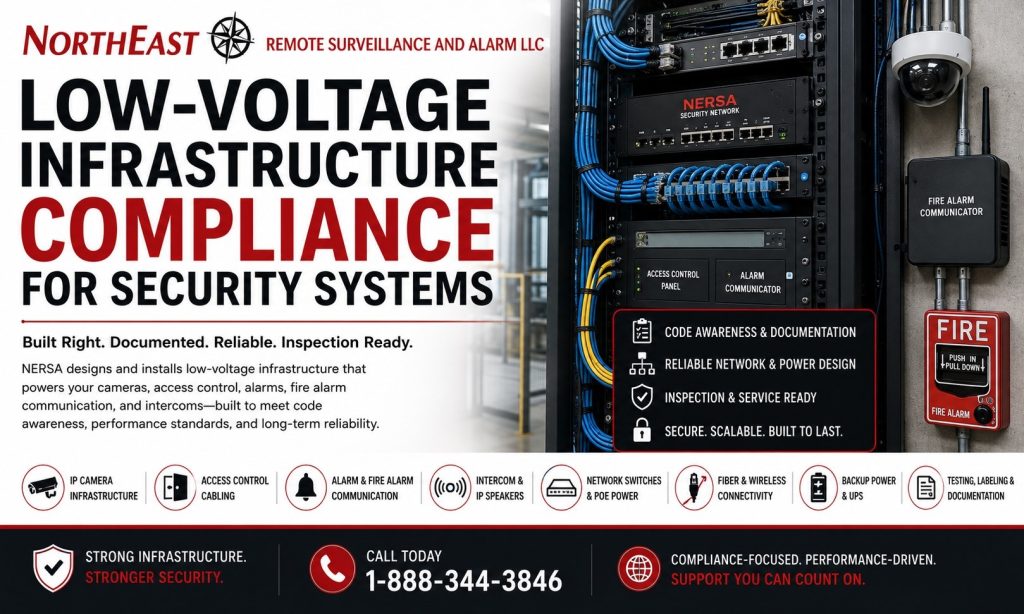
This guide covers cable routes, equipment spaces, network connections, power, labels, and service records.
It also addresses how those choices support cameras, controlled doors, alarms, and intercoms.
NERSA coordinates this work with commercial security compliance and inspection planning.
Low-Voltage Infrastructure Compliance Planning for Commercial Security Systems
Commercial security systems depend on the infrastructure behind the devices. Cameras, card readers, alarm contacts, intercoms, fire alarm communicators, monitoring equipment, network switches, wireless bridges, and control panels all need dependable cabling, power, pathways, equipment locations, and documentation.
A security system can look complete on the surface but still become difficult to support if the infrastructure is not planned correctly. Poor cable pathways, unlabeled wiring, weak equipment room planning, overloaded network switches, missing backup power, or undocumented communication paths can create problems during service, inspection, troubleshooting, expansion, and ownership changes.
Low-voltage infrastructure planning may involve:
- Camera cabling
- Access control cabling
- Intrusion alarm wiring
- Fire alarm communicator paths
- Intercom cabling
- IP speaker cabling
- Network switches
- PoE switching
- Fiber optic links
- Wireless bridges
- Cellular communicators
- Equipment rooms
- Security panels
- Power supplies
- UPS equipment
- Cable pathways
- Conduit coordination
- Device labeling
- Rack organization
- Network segmentation
- Testing records
- As-built documentation
The goal is not just to make devices turn on. The goal is to create a security infrastructure that can be inspected, serviced, expanded, and trusted over time.
Why Low-Voltage Infrastructure Compliance Matters
Low-voltage security work touches many parts of a commercial building. A camera may require network cabling and PoE power. An access-controlled door may require reader wiring, lock power, door position monitoring, request-to-exit wiring, and fire alarm interface coordination. An alarm panel may require device wiring, power, communication, cellular backup, and monitoring path documentation.
Infrastructure problems can affect:
- System reliability
- Camera recording quality
- Access control operation
- Alarm communication
- Fire alarm monitoring communication
- Intercom performance
- Remote access
- Cybersecurity
- Service response time
- Inspection readiness
- Future expansion
- Documentation handoff
- Long-term support
A low-voltage system should be planned around the building, not just the device list.
NFPA 70 and Low-Voltage Wiring Awareness
Security cabling should be planned with awareness of electrical installation practices, wiring methods, pathways, equipment mounting, fire-stopping, separation, power, grounding, and the building environment.
Low-voltage infrastructure planning may involve:
- Cable type selection
- Cable support methods
- Conduit pathways
- Plenum or riser considerations
- Penetrations
- Fire-stopping coordination
- Equipment mounting
- Power supply placement
- Separation from electrical hazards
- Grounding and bonding awareness
- Equipment room organization
- Labeling and service access
- Documentation for future review
For code-aware wiring planning, visit NFPA 70 Low-Voltage Wiring for Security Systems.
NERSA does not replace the AHJ, electrician, engineer, architect, code consultant, or legal advisor. Our role is to plan, install, document, and support commercial security infrastructure in a way that respects the building and the review environment.
Camera Networks and PoE Infrastructure
Modern commercial video surveillance systems often depend on network switches, PoE power, fiber links, wireless bridges, structured cabling, recording equipment, and remote access. A camera system is only as dependable as the network and power infrastructure behind it.
Camera infrastructure planning may include:
- Cat6 cabling
- Fiber backbone links
- PoE switch capacity
- PoE budget review
- Camera home-run locations
- Intermediate network points
- NVR or server location
- Rack mounting
- UPS backup
- Switch labeling
- Camera labeling
- Cable testing
- VLAN or network segmentation
- Remote access planning
- Bandwidth planning
- Recording retention support
- Service access
For camera system planning, visit commercial video surveillance systems.
A camera may fail because of infrastructure, not the camera itself. Poor cabling, weak power, overloaded switches, unstable network paths, and missing labels can all create avoidable service issues.
Access Control Infrastructure
Access control infrastructure is more complex than a reader on a wall. A controlled door may involve reader cabling, lock power, request-to-exit wiring, door contact wiring, access control panel wiring, fire alarm interface wiring, power supplies, backup batteries, and network communication.
Access control infrastructure planning may include:
- Reader cabling
- Lock power wiring
- Door contact wiring
- Request-to-exit wiring
- Emergency release wiring
- Intercom release wiring
- Access control panel locations
- Door controller locations
- Power supply locations
- Fire alarm interface coordination
- Battery backup planning
- Door labeling
- Panel labeling
- Cable pathway planning
- Door schedule documentation
For access-controlled door planning, visit commercial access control systems.
For egress and life-safety coordination, visit access control egress and life safety compliance.
Access control infrastructure should be planned door by door. A secure door should not become difficult to service because cables, power supplies, relays, or panel locations were not documented.
Intrusion Alarm and Detection Wiring
Commercial intrusion systems may include door contacts, overhead door contacts, motion detectors, glass-break detectors, panic buttons, keypads, sirens, strobes, environmental sensors, and alarm communicators. These devices depend on clean wiring, proper device placement, reliable communication, and clear documentation.
Alarm infrastructure planning may include:
- Door contact wiring
- Overhead door wiring
- Motion detector wiring
- Glass-break detector wiring
- Panic button wiring
- Keypad wiring
- Siren and strobe wiring
- Environmental sensor wiring
- Alarm panel locations
- Expansion module locations
- Power supply planning
- Cellular communicator placement
- IP communicator placement
- Zone labeling
- Partition documentation
- Testing records
For intrusion alarm planning, visit commercial alarm systems.
Alarm systems should be labeled and documented so facility managers and service technicians can understand which device protects which door, room, dock, gate, or area.
Fire Alarm Communication Paths
Fire alarm monitoring communication requires careful planning. When a fire alarm system uses cellular, IP, dual-path communication, legacy phone lines, network equipment, or backup power, the communication path should be documented and tested.
Fire alarm communication infrastructure may involve:
- Fire alarm communicator location
- Cellular communicator signal review
- IP communicator network path
- Dual-path communication
- Legacy phone line replacement
- Monitoring account information
- Signal testing
- Backup power support
- Network equipment support
- Communication trouble review
- Documentation for inspection readiness
For fire alarm monitoring and inspection support, visit fire alarm monitoring, testing, and inspection.
For inspection-readiness documentation, visit fire alarm inspection readiness for commercial buildings.
Fire alarm communication changes should never be treated like a basic phone or internet change. The path should be planned, tested, and documented.
Intercoms, IP Speakers, and Emergency Communication Infrastructure
Intercoms, IP speakers, paging systems, visitor entry systems, and emergency communication devices often rely on cabling, network switches, PoE power, door release wiring, audio paths, and remote management.
Communication infrastructure planning may include:
- Video intercom cabling
- Door release wiring
- IP speaker cabling
- Paging equipment location
- PoE switch capacity
- Network path planning
- Audio coverage planning
- Device labeling
- Emergency communication support
- Reception desk integration
- Gate communication
- Remote access support
- Testing and handoff
Intercoms and speakers should be planned as part of the building’s communication and security workflow, not as isolated devices.
Equipment Rooms, Racks, Panels, and Service Access
Security equipment should be installed in locations that support service, documentation, cooling, power, network access, and long-term maintenance. Equipment rooms and racks are often overlooked until service is needed.
Equipment room planning may involve:
- Security panel locations
- Access control panel locations
- Alarm panel locations
- Network switch locations
- NVR or server locations
- Fiber termination locations
- Power supply locations
- UPS locations
- Cable management
- Rack labeling
- Service clearances
- Environmental conditions
- Lockable enclosures
- Access permissions
- Documentation storage
A system is easier to support when technicians can identify equipment quickly, access it safely, and understand how the infrastructure is connected.
Pathways, Conduit, Penetrations, and Fire-Stopping Awareness
Low-voltage cabling often passes through walls, ceilings, risers, equipment rooms, offices, warehouses, production areas, exterior walls, and mechanical spaces. Pathway planning matters because poor routing can create service problems, damage risk, inspection concerns, or future renovation conflicts.
Pathway planning may include:
- Conduit coordination
- Cable tray coordination
- Ceiling pathway review
- Wall penetrations
- Fire-stopping awareness
- Exterior penetrations
- Weatherproofing
- Conduit fill awareness
- Pull box locations
- Service loops
- Cable protection
- Separation from hazards
- Future expansion capacity
- Labeling at endpoints
Security infrastructure should not be treated as temporary wiring. It should be planned for the life of the building and the security system.
Wireless Bridges, Fiber, and Multi-Building Infrastructure
Warehouses, industrial campuses, municipal sites, schools, truck yards, contractor yards, and multi-building commercial properties may require fiber links, wireless bridges, cellular backup, or remote network points to connect cameras, gates, intercoms, and alarms.
Multi-building infrastructure planning may include:
- Fiber optic backbone
- Point-to-point wireless bridges
- Point-to-multipoint wireless
- Remote PoE switches
- Outdoor enclosures
- Surge protection
- UPS backup
- Cellular backup
- Gate communication paths
- Remote building alarms
- Exterior camera links
- Bandwidth planning
- Line-of-sight review
- Weather exposure
- Service access
Wireless and fiber systems should be planned carefully. Poor alignment, weak signal paths, undocumented network points, or missing backup power can affect the entire security system.
Backup Power and Communication Reliability
Security systems depend on power. Cameras, access control panels, electric locks, alarm panels, network switches, fire alarm communicators, intercoms, and remote monitoring equipment may all need backup power planning.
Backup power planning may involve:
- UPS equipment
- Alarm panel batteries
- Access control power supply batteries
- Fire alarm communicator backup
- Network switch backup
- Router backup
- Cellular backup
- Generator coordination
- Power-loss notifications
- Battery replacement documentation
- Load review
- Runtime expectations
- Testing records
For power and communication reliability planning, visit backup power and communication path planning.
A system should not lose critical function because the network switch, router, or access control power supply was not backed up.
Cybersecurity and Network Segmentation
Low-voltage security infrastructure increasingly depends on networks, cloud services, remote access, software platforms, mobile apps, and user administration. Infrastructure compliance should include cybersecurity-aware planning.
Security network planning may involve:
- Camera network separation
- Access control network separation
- VLAN planning
- Firewall coordination
- Remote access control
- User permissions
- Administrator account management
- Firmware updates
- Vendor access control
- Password practices
- Device inventory
- IP address documentation
- Remote support procedures
- Deactivation of former users
For security system cybersecurity planning, visit cybersecurity and data protection standards for commercial security systems.
The cabling may be low-voltage, but the risk can be high if the system is poorly administered or connected to the wrong network.
Labeling, Testing, and Documentation
Low-voltage infrastructure becomes much easier to support when it is labeled, tested, and documented. Poor documentation can turn a simple service call into hours of tracing wires, guessing device locations, or reviewing old invoices.
Useful documentation may include:
- Cable labels
- Panel labels
- Camera location list
- Access-controlled door list
- Alarm zone list
- Intercom location list
- Network switch list
- Rack elevation notes
- Patch panel labels
- Fiber strand documentation
- Wireless bridge locations
- Power supply locations
- UPS locations
- Communication path notes
- IP address documentation
- Testing records
- Service notes
- As-built information when applicable
Documentation should support the owner, facility manager, IT team, inspector, and future service technician.
Inspection Readiness and AHJ Coordination
Low-voltage infrastructure may require inspection awareness when it affects fire alarm communication, access-controlled doors, egress, fire-rated openings, emergency communication, wiring pathways, building alterations, or life-safety systems.
Inspection readiness may involve:
- Device documentation
- Cable pathway notes
- Door release documentation
- Fire alarm interface notes
- Monitoring path documentation
- Communicator information
- Panel locations
- Testing records
- As-built information
- AHJ coordination
- Service notes
- Deficiency follow-up records
For AHJ-sensitive security and fire alarm projects, visit AHJ Coordination for Commercial Security and Fire Alarm Projects.
NERSA does not replace the AHJ, engineer, architect, code consultant, electrician, legal advisor, or governing authority. Our role is to help security infrastructure be planned, installed, documented, tested, and supported in a way that respects the building and the inspection environment.
Low-Voltage Infrastructure for Different Commercial Facilities
Different facilities need different infrastructure planning. A warehouse, school, medical office, municipal building, manufacturing plant, office building, and contractor yard should not all be wired the same way.
Low-voltage planning may vary for:
- Warehouses
- Manufacturing facilities
- Distribution centers
- Medical offices
- Schools
- Municipal buildings
- Office buildings
- Contractor yards
- Truck yards
- Multi-tenant buildings
- Industrial parks
- Multi-building campuses
- Utility sites
- Outdoor storage areas
A high-ceiling warehouse may need long cable paths, fiber, wireless bridges, and remote network points. A medical office may need privacy-aware camera placement and clean documentation. A municipal building may need NDAA-aware equipment selection and cybersecurity review. A contractor yard may need cellular, solar, wireless, and outdoor service planning.
Common Low-Voltage Infrastructure Problems
Many security system problems are caused by infrastructure decisions made early in the project.
Common issues include:
- Unlabeled cables
- No camera schedule
- No access-controlled door list
- No alarm zone documentation
- Poor rack organization
- Overloaded PoE switches
- No UPS backup for network equipment
- Weak cellular communicator signal
- Unknown monitoring path
- Poor cable routing
- Unprotected exterior cable
- Missing service loops
- No documentation of fire alarm interfaces
- No record of door release sequence
- Wireless bridges installed without line-of-sight planning
- No cybersecurity or network segmentation plan
- No as-built documentation
- Equipment installed where service access is difficult
A better project starts with infrastructure planning before devices are installed.
Related Planning
Coordinate low-voltage work with the project’s electrical, network, and life-safety requirements.
- regulatory compliance and inspection readiness for commercial security systems — Review project documentation and inspection coordination.
- commercial video surveillance systems — Connect infrastructure planning to camera coverage and recording needs.
- commercial access control systems — Review connections and power for controlled-door equipment.
- backup power and communication path planning — Plan for interruptions to normal power or communications.
Why Choose Northeast Remote Surveillance and Alarm
Northeast Remote Surveillance and Alarm, LLC designs commercial and industrial security systems with the infrastructure in mind. We understand that cameras, access control, alarms, fire alarm communicators, intercoms, monitoring, and remote access are only as reliable as the wiring, power, network, documentation, and service process behind them.
Our team helps clients plan cabling, pathways, equipment rooms, panels, PoE switches, wireless bridges, fiber, cellular communication, backup power, labeling, and documentation before the system becomes difficult to support.
Businesses choose NERSA for low-voltage infrastructure compliance planning because we provide:
- Commercial and industrial security experience
- Camera and access control infrastructure planning
- Alarm wiring and communicator support
- Fire alarm communication path awareness
- Equipment room and rack planning
- Fiber and wireless bridge planning
- Cellular and backup communication options
- Backup power planning
- Cybersecurity-aware network coordination
- Documentation for service and inspection readiness
- Long-term support after installation
A security system should be designed to work today and remain serviceable tomorrow.
Request a Low-Voltage Infrastructure Security Review
NERSA can help review security cabling, camera networks, door-control wiring, and alarm communication paths. We also assess fire alarm communicator support, intercom cabling, wireless bridges, fiber, PoE switching, and backup power. Documentation and inspection readiness should be part of that plan.
Call 1-888-344-3846 or request a security assessment to review your building, risk areas, cabling paths, equipment rooms, communication paths, network needs, documentation gaps, and long-term security goals.
We support low-voltage infrastructure compliance planning for commercial and industrial properties throughout the Lehigh Valley, Northeastern Pennsylvania, Central Pennsylvania, Greater Philadelphia, New Jersey, Delaware, and the Mid-Atlantic region.
Frequently Asked Questions about Low-Voltage Infrastructure Compliance
What is low-voltage infrastructure for security systems?
Low-voltage infrastructure includes the cabling, pathways, panels, switches, power supplies, network equipment, communicators, wireless links, fiber, labels, and documentation that support cameras, access control, alarms, intercoms, monitoring, and related security systems.
Why does low-voltage infrastructure matter?
Security devices depend on reliable wiring, power, network paths, communication paths, and documentation. Poor infrastructure can create camera failures, access control issues, alarm communication trouble, service delays, and inspection confusion.
Is low-voltage security wiring regulated?
Low-voltage security wiring may be affected by electrical codes, building conditions, local requirements, manufacturer instructions, fire alarm coordination, pathways, penetrations, and AHJ expectations depending on the project.
Can poor cabling affect camera performance?
Yes. Poor cable quality, long runs, bad terminations, overloaded switches, weak PoE power, missing labels, or unstable network paths can affect camera reliability and video recording.
Does access control need special wiring?
Yes. Access control may require reader wiring, lock power, door contacts, request-to-exit wiring, emergency release wiring, power supplies, panel wiring, fire alarm interface coordination, and documentation.
Why does backup power matter for security systems?
Backup power helps support cameras, access control, alarms, communicators, intercoms, network equipment, and monitoring paths during power trouble or outages.
What documentation should be kept for low-voltage security infrastructure?
Useful documentation may include cable labels, camera locations, access-controlled door lists, alarm zones, panel locations, switch locations, IP address records, communicator information, power supply locations, and testing records.
Can low-voltage infrastructure affect inspection readiness?
Yes. Inspection readiness can be affected when low-voltage work involves fire alarm communication, access-controlled doors, emergency release, fire alarm interfaces, wiring pathways, penetrations, or documentation.
What is the difference between low-voltage cabling and security infrastructure planning?
Low-voltage cabling focuses on the wiring itself. Security infrastructure planning also considers device function, communication paths, power, cybersecurity, documentation, monitoring, service access, and long-term support.
What is the best next step for low-voltage infrastructure compliance planning?
The best next step is a site-specific review. NERSA can evaluate cabling paths, equipment rooms, camera networks, access control panels, alarm wiring, communication paths, backup power, documentation, and inspection-readiness needs before recommending a system design.