
Berks County manufacturing facility security systems should be designed around production areas, employee movement, restricted spaces, loading activity, inventory protection, visitor control, utility rooms, exterior approaches, and after-hours exposure.

Request a Physical Plant Security Assessment
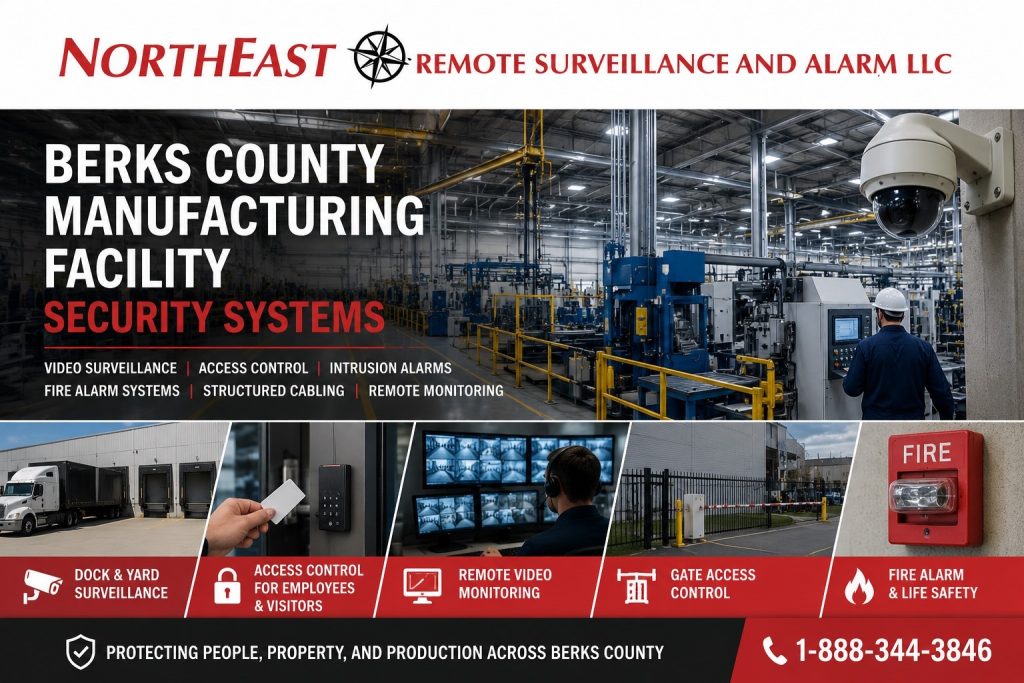
Northeast Remote Surveillance and Alarm, LLC designs and installs commercial and industrial security systems for manufacturing facilities throughout Reading and surrounding Berks County communities.
For broader regional planning across warehouses, logistics sites, truck yards, distribution centers, industrial parks, and multi-building properties, start with the Berks County Industrial & Logistics Corridor Security Systems page.
Boyertown Project Experience: Drug Plastics & Glass
NERSA’s Drug Plastics & Glass project in Boyertown coordinated structured cabling and cable certification with camera installation across production, testing, warehousing, and office areas, including clean-room work and controlled entry.
Plan Security Around Plant Operations
Manufacturing facilities operate differently from standard commercial buildings. They often include production floors, employee entrances, visitor areas, shipping and receiving points, equipment rooms, inventory zones, restricted work areas, loading docks, service entrances, exterior yards, and building sections that may not be directly visible to management.
A proper manufacturing security system should be designed around how the facility actually works. That includes shift changes, employee movement, vendor access, material flow, production schedules, after-hours exposure, equipment protection, safety documentation, and the need for long-term expansion.
Northeast Remote Surveillance and Alarm, LLC does not install single-family home systems. Our focus is commercial, industrial, municipal, institutional, healthcare, logistics, and enterprise environments where system design, infrastructure, compliance awareness, and long-term support matter.
Camera Coverage for Production and Material Movement
Plan manufacturing cameras around the footage staff need to review. Check employee entrances, production areas, restricted rooms and storage spaces. Review shipping and receiving points, docks, parking lots and exterior approaches too. Include areas where inventory or equipment may be exposed.
Good manufacturing camera coverage depends on the layout of the building, lighting conditions, production equipment, ceiling height, viewing distance, forklift activity, employee movement, and the type of incident the business may need to review.
For broader camera planning across Berks County commercial and industrial properties, use the Berks County Commercial Video Surveillance Systems page.
Access Control for Employee Entrances and Restricted Areas
Manufacturing facilities often need more than a locked front door. Employee entrances, production areas, tool rooms, server rooms, chemical storage areas, mechanical rooms, warehouse offices, visitor entrances, and management areas may need controlled access.
Access control can help manage who enters specific areas, when they can enter, and how access activity is documented. Card readers, key fobs, mobile credentials, door controllers, audit trails, and permission groups can support multi-shift operations and restricted-area protection.
For deeper planning around credentials, readers, doors, permissions, and multi-door systems, use the Berks County Commercial Access Control Systems page.
Intrusion Protection Between Shifts
Manufacturing facilities may have multiple exterior doors, overhead doors, employee entrances, warehouse areas, offices, utility spaces, dock doors, and restricted rooms that need intrusion protection. Alarm design should be based on the actual building layout and after-hours risk, not a generic alarm package.
A commercial intrusion alarm system may include door contacts, motion detection, glass protection, area partitioning, keypad placement, cellular communication, sirens, monitoring, and video verification support where appropriate.
For alarm zone planning, perimeter detection, and commercial intrusion protection, use the Berks County Commercial Intrusion Alarm Systems page.
Protect Loading, Shipping, and Receiving Areas
Shipping and receiving areas are important security points in many manufacturing facilities. These areas may include open dock doors, staged materials, incoming deliveries, outgoing products, vendor activity, forklift movement, driver access, and employee traffic.
Security planning around loading areas may include camera coverage, access control, door monitoring, alarm contacts, exterior lighting awareness, remote viewing, and recorded video review. The goal is to help management understand when deliveries arrived, who moved through the area, where material was staged, and what happened before or after a dispute, claim, or incident.
Manufacturing sites with heavy dock activity should make loading and receiving areas a major part of the overall security plan.
Inventory, Equipment, and Production Area Visibility
Manufacturing facilities often contain equipment, raw materials, finished goods, tools, parts, and work-in-progress inventory that may need better visibility. Camera placement should support review without interfering with safety, production flow, or normal operations.
Interior coverage may be useful around high-value product areas, tool storage, production aisles, stock rooms, warehouse sections, packaging areas, maintenance areas, and shared employee spaces. The system should help document movement without creating unnecessary blind spots or unusable footage.
A manufacturing camera layout should be reviewed around real facility activity, including shift schedules, forklift paths, racking, equipment placement, and the areas where management may need to investigate incidents.
Visitor, Vendor, and Contractor Access
Manufacturing facilities often have visitors, vendors, delivery drivers, service technicians, inspectors, contractors, and temporary staff entering the property. These access points should be planned carefully so visitors can be managed without leaving sensitive areas exposed.
Security planning may include visitor entrance cameras, intercoms, access control, reception-area visibility, controlled doors, escort procedures, and camera coverage near shared access points.
The right design should support daily operations while helping the facility maintain better control over who enters the building and where they are allowed to go.
Parking Lot and Exterior Building Coverage
Exterior areas are often overlooked in manufacturing security planning. Employee parking lots, visitor parking, rear approaches, side doors, service entrances, trailer areas, fenced zones, dumpsters, utility areas, and exterior equipment storage may all create risk.
Exterior camera planning should account for lighting, mounting height, viewing distance, vehicle movement, pedestrian movement, weather exposure, and network path. The system should be designed so exterior activity can be reviewed clearly when something happens around the building.
For parking-area and exterior visibility planning, use the Berks County Parking Lot Security Cameras page.
Structured Cabling and Security Infrastructure
Manufacturing security systems depend on reliable infrastructure. Cameras, access control panels, alarm devices, intercoms, fire alarm circuits, gate systems, monitoring connections, network switches, and wireless bridges all require properly planned communication pathways.
Infrastructure planning may include CAT6, CAT6A, fiber, network extensions, PoE switching, equipment rooms, cable pathways, wireless bridge design, rack organization, and room for future expansion.
For security cabling, network extension, and fiber planning, use the Berks County Structured Cabling and Fiber Infrastructure page.
Fire Alarm and Life-Safety Coordination
Manufacturing facilities may have life-safety needs that must be coordinated with building use, occupancy, detection requirements, notification appliances, monitoring, documentation, and local Authority Having Jurisdiction expectations.
Security planning should not ignore fire alarm coordination. Access control, door hardware, fire alarm systems, emergency egress, notification devices, monitoring pathways, and system documentation should be reviewed carefully when a facility is being upgraded or expanded.
For fire alarm installation and life-safety planning in Berks County, use the Berks County Commercial Fire Alarm Systems page.
Remote Viewing and After-Hours Awareness
Manufacturing risk often changes after the building is closed, lightly staffed, or operating with limited overnight personnel. Rear doors, side entrances, dock areas, parking lots, exterior equipment, fenced spaces, and receiving areas may become more vulnerable during nights, weekends, holidays, and shift changes.
Remote viewing and monitoring workflows can help authorized users review cameras, check exterior activity, verify alarm conditions, and improve visibility when management is not physically on site.
Manufacturing facilities with larger exterior areas, repeated after-hours activity, or high-value inventory should review whether self-monitoring, remote video monitoring, or alarm-based video verification is the right fit.
Multi-Building and Expansion-Ready Manufacturing Security
Many manufacturing facilities grow over time. New production areas, added offices, warehouse expansions, additional doors, new shifts, extra parking, added gates, or upgraded network infrastructure can change the security plan.
A scalable system should account for future cameras, added doors, additional alarm zones, expanded network paths, new user groups, and centralized management across one or multiple buildings.
The best manufacturing security design is not just built for the current layout. It should support the way the facility may operate as production, staffing, and building use change.
Modernize the Plant in Practical Phases
First, test existing equipment and confirm who controls the accounts. Then prioritize unreliable communication, critical entrances, and gaps in usable footage. Schedule installation around production and approved shutdown windows.
Also check dust, vibration, washdown, glare, and temperature where equipment will operate. Test the camera view during normal production, including moving machinery and forklifts. Security footage supports incident review; it does not replace machine guarding or workplace safety procedures.
For a broader migration, explore commercial security upgrades and takeovers.
Coordinate loading dock security and multi-building security as the plant expands.
Request a Berks County Manufacturing Security Assessment
NERSA can assess security at your Berks County manufacturing facility. We review cameras, access control, intrusion detection, fire alarm coordination, and supporting cabling. Planning can address parking, docks, restricted areas, remote viewing, and expansion across multiple buildings.
Request a Physical Plant Security Assessment to discuss manufacturing facility security systems in Berks County, PA.
Frequently Asked Questions About Berks County Manufacturing Facility Security Systems
What security systems do manufacturing facilities in Berks County need?
Manufacturing facilities may need video surveillance, access control, intrusion alarms, fire alarm coordination, structured cabling, remote viewing, parking lot cameras, dock-area coverage, restricted-area protection, and scalable system design depending on the property layout and operating schedule.
How are manufacturing security systems different from standard commercial security systems?
Manufacturing facilities often include production areas, equipment rooms, inventory zones, loading docks, employee entrances, restricted spaces, utility rooms, forklifts, vendors, and multiple shifts. Security planning should account for how people, materials, vehicles, and equipment move through the facility.
Should manufacturing facilities have access control?
Yes. Access control can help manage employee entrances, restricted rooms, production areas, tool rooms, server rooms, utility spaces, and visitor access points. It can also help document who entered specific areas and when.
Where should cameras be placed in a manufacturing facility?
Common camera locations include employee entrances, production areas, shipping and receiving points, dock areas, parking lots, exterior approaches, restricted rooms, inventory zones, warehouse sections, and areas where incidents may need to be reviewed.
Can manufacturing security systems support multiple shifts?
Yes. Multi-shift facilities may need credential schedules, access permissions, alarm partitions, remote viewing, after-hours alerts, and camera coverage that supports activity during days, nights, weekends, and holidays.
Can security cameras help with inventory and equipment review?
Yes. Properly placed cameras can help management review inventory movement, equipment areas, production-adjacent activity, tool storage, loading areas, and incidents involving employees, vendors, visitors, or deliveries.
Do manufacturing facilities need structured cabling for security systems?
Yes. Cameras, access control panels, intercoms, alarm devices, fire alarm pathways, network switches, and remote monitoring connections often require properly planned cabling, fiber, network extension, and equipment-room organization.
Can fire alarm and access control systems affect each other?
Yes. Access control, door hardware, emergency egress, fire alarm systems, and life-safety requirements should be coordinated carefully so the building remains secure while supporting safe emergency movement and code-aware operation.
Can NERSA support multi-building manufacturing facilities?
Yes. Multi-building manufacturing facilities may need coordinated video review, centralized access control, network extension, fiber connectivity, alarm partitioning, shared user management, and scalable system design.
How do we start a manufacturing security project in Berks County?
Start with a site assessment. Northeast Remote Surveillance and Alarm, LLC can review the facility layout, entrances, production areas, restricted rooms, loading points, parking areas, infrastructure, after-hours exposure, and long-term expansion needs.
Compliance, Codes & Project Standards
NERSA plans commercial and industrial security work with applicable code, documentation, inspection and authority-having-jurisdiction requirements in mind. Requirements vary by system, property and jurisdiction. These resources support project planning; they do not establish legal compliance, certification or AHJ approval.
Related guidance: Regulatory compliance & inspection readiness · Manufacturing compliance planning · NERSA project standards