
Berks County commercial intrusion alarm systems should be designed around exterior doors, overhead doors, employee entrances, restricted rooms, warehouse areas, office spaces, dock activity, after-hours schedules, and how each facility actually operates.

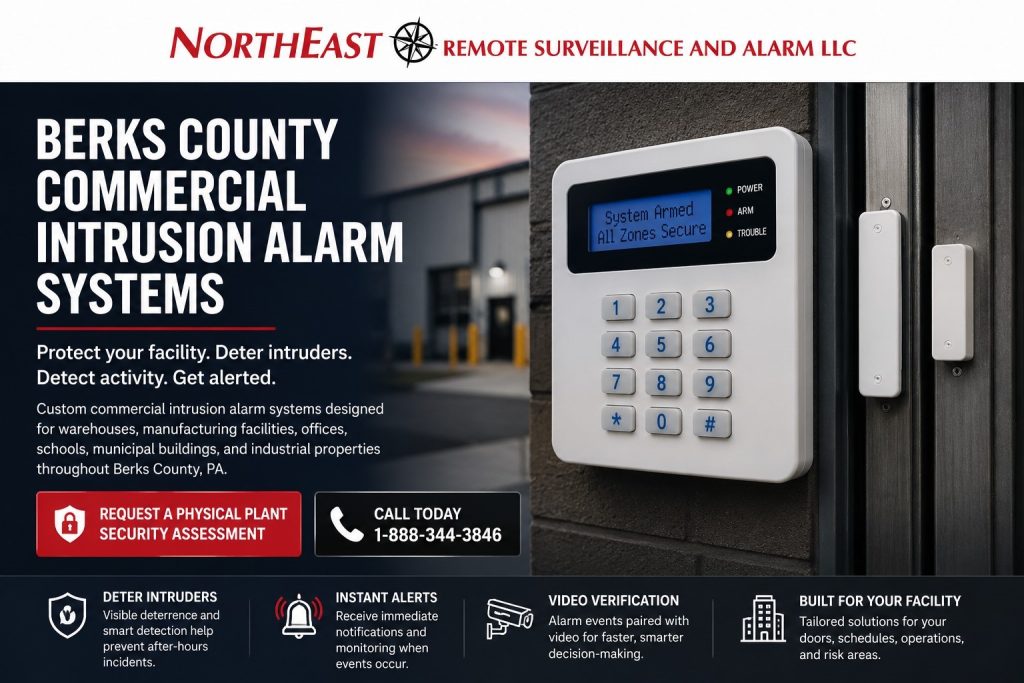
Northeast Remote Surveillance and Alarm, LLC designs and installs commercial intrusion alarms throughout Reading and Berks County.
We serve warehouses, manufacturing and distribution facilities, trucking operations and contractor yards.
We also work with municipal sites, healthcare properties, schools, offices and multi-building facilities.
Use Berks County Industrial & Logistics Corridor Security Systems when alarm changes also need to be coordinated with cameras, gates, or the rest of the industrial property.
Berks County Commercial Intrusion Alarm Systems Planning
Commercial intrusion alarms need to fit the building and its operating hours. Review entry points, restricted rooms and exterior doors. Account for employee shifts, dock activity and movement through warehouse and office areas. Then define which areas need protection after closing.
A commercial intrusion alarm system may include door contacts, overhead door contacts, motion detection, glass protection, partitions, keypads, sirens, monitoring communicators, user codes, schedules, and video verification support where appropriate.
Northeast Remote Surveillance and Alarm, LLC does not install single-family home systems. Our focus is commercial, industrial, municipal, institutional, healthcare, logistics, and enterprise environments where system design, alarm zoning, monitoring, infrastructure, and long-term support matter.
Where Commercial Intrusion Alarm Systems Should Focus
Intrusion alarm planning should start with the areas where unauthorized access is most likely to occur or where after-hours activity needs to be detected.
Common commercial alarm protection areas include:
- Main entrances
- Employee entrances
- Rear doors
- Side doors
- Overhead doors
- Loading dock doors
- Warehouse entrances
- Office areas
- Restricted rooms
- Utility rooms
- Server rooms
- Stock rooms
- Tool rooms
- Interior warehouse areas
- Exterior access points
- Multi-tenant entry points
- After-hours approach areas
The system should be designed around real movement, not just a generic device count. A warehouse, manufacturing facility, school, office, contractor yard, and municipal building may each require a different alarm layout.
Door Contacts, Motion Detection, and Perimeter Protection
Door contacts are commonly used to protect exterior doors, personnel doors, office entrances, warehouse doors, and restricted spaces. Motion detection may support interior areas where activity should not occur after hours.
Perimeter planning should account for the way the building is used during business hours and after closing. Some doors may be used regularly by employees, vendors, cleaners, delivery drivers, or managers, while others may need to remain protected most of the time.
A proper design should reduce nuisance alarms while still protecting the areas that matter most.
Overhead Doors, Loading Docks, and Shipping Entrances
Loading docks and overhead doors need special attention in Berks County alarm projects. Deliveries, forklifts and staged freight can keep these areas busy throughout the day. Plan protection for the hours when that activity stops.
Alarm planning around dock areas may include overhead door contacts, personnel door contacts, motion detection, camera verification, keypad placement, and schedules based on operating hours.
Facilities with heavy dock activity should review intrusion alarms together with camera coverage, lighting, access control, and monitoring workflows.
Intrusion Alarms for Warehouses and Distribution Facilities
Warehouses and distribution centers often need intrusion alarm systems designed around dock doors, employee entrances, shipping areas, receiving areas, warehouse offices, storage spaces, restricted rooms, and after-hours exterior exposure.
A warehouse alarm system may need partitions, multiple keypads, user codes, door contacts, motion detection, sirens, monitoring, and video verification support depending on the facility layout.
For broader warehouse security planning beyond alarms alone, use the Berks County Warehouse Security Systems page.
Intrusion Alarms for Manufacturing Facilities
Manufacturing facilities may need alarm protection around production areas, employee entrances, shipping and receiving points, warehouse offices, tool rooms, utility spaces, equipment rooms, stock areas, and restricted rooms.
Alarm planning should account for multiple shifts, employee schedules, contractors, vendors, overnight activity, weekend operations, and areas that need to remain protected while other parts of the facility are active.
For manufacturing-specific security planning, use the Berks County Manufacturing Facility Security Systems page.
Alarm Monitoring and Communication Paths
Commercial intrusion alarm monitoring should be planned with reliable communication in mind. A monitored alarm system may use cellular communication, network-supported communication, or another approved path depending on the system and property.
The communication path should be stable, serviceable, and appropriate for the building. Older phone-line-based systems, outdated communicators, poor signal locations, and unreliable network paths should be reviewed before they become a problem.
Alarm monitoring should support clear reporting of alarm, trouble, supervisory, and communication issues where applicable.
Video Verification and Camera Integration
Intrusion alarms are stronger when alarm activity can be reviewed with useful camera coverage. Video verification can help connect alarm events with camera views so management can better understand whether an event appears to involve a person, vehicle, employee, vendor, delivery activity, or unauthorized movement.
This can be especially useful around rear doors, dock areas, warehouse entrances, office areas, gated yards, restricted rooms, and after-hours approach points.
For broader camera planning across Berks County commercial and industrial properties, use the Berks County Commercial Video Surveillance Systems page.
Access Control and Alarm Schedule Coordination
Access control and intrusion alarms should be planned together when employees, vendors, managers, or tenants use the building at different times. A door may need to be controlled during the day and alarmed after hours.
Coordination may include door contacts, forced-door alerts, held-door alerts, user schedules, keypad placement, partitions, credential permissions, and alarm reporting.
For controlled door planning, card readers, key fobs, mobile credentials, permissions, and door hardware coordination, use the Berks County Commercial Access Control Systems page.
User Codes, Partitions, and Multi-Area Alarm Control
Larger commercial buildings may need more than one alarm area. Warehouses, offices, manufacturing spaces, tenant areas, restricted rooms, and shipping areas may need separate arming schedules or different user permissions.
Partitions can help divide the alarm system into manageable areas. This can be useful when one section of the building remains active while another section should be protected.
User codes should be assigned carefully. Shared codes, old codes, unmanaged users, and unclear permissions can weaken the value of the system.
Gate, Yard, and Exterior Alarm Considerations
Some properties need alarm planning beyond the building itself. Fenced yards, truck gates, trailer areas, exterior storage zones, fleet areas, service entrances, and controlled vehicle access points may need cameras, gate alerts, intrusion detection, or remote monitoring workflows.
Exterior alarm planning should be handled carefully because weather, animals, vehicle movement, lighting, and normal after-hours activity can create nuisance events if the system is not designed properly.
For controlled vehicle entry and gated access planning, use the Berks County Commercial Gate Access Control Systems page.
Fire Alarm Systems Are Separate Life-Safety Systems
Intrusion alarms and fire alarm systems serve different purposes. Intrusion alarms detect unauthorized activity. Fire alarm systems support life-safety detection, notification, monitoring, and emergency response workflows.
These systems should not be treated as interchangeable. When a facility has both systems, users should understand the difference between intrusion alarm events, fire alarm events, trouble conditions, supervisory signals, and monitoring responses.
For commercial fire alarm and life-safety planning in Berks County, use the Berks County Commercial Fire Alarm Systems page.
After-Hours Alarm Protection and Remote Monitoring
Many commercial intrusion alarm systems are most important when the building is closed, lightly staffed, or operating with limited supervision. Nights, weekends, holidays, shift changes, and low-staff periods can create different risks than normal business hours.
After-hours planning may include door contacts, motion detection, partitions, schedules, sirens, monitoring, camera verification, remote viewing, and remote video monitoring where appropriate.
For active off-site event review and after-hours monitoring planning, use the Berks County Remote Video Monitoring page.
Cabling and Infrastructure for Intrusion Alarm Systems
Commercial intrusion alarm systems depend on reliable infrastructure. Door contacts, motion detectors, glass protection, keypads, sirens, communicators, power supplies, control panels, relay connections, and monitoring paths all require properly planned wiring and equipment placement.
Infrastructure planning should account for ceiling access, wall construction, door locations, panel location, keypad placement, communicator signal, network access, labeling, documentation, and future expansion.
For security cabling, network extension, and low-voltage infrastructure planning, use the Berks County Structured Cabling and Fiber Infrastructure page.
Upgrading Existing Commercial Intrusion Alarm Systems
Many Berks County facilities already have alarm systems, but the system may no longer match the property’s needs. Common issues include outdated panels, poor zoning, old communicators, unmanaged user codes, limited partitions, missing overhead door protection, weak keypad placement, nuisance alarms, or no video verification.
An upgrade may include new alarm devices, better zoning, updated communicators, additional keypads, user code cleanup, partition changes, camera integration, monitoring improvements, or better documentation.
The best upgrade is not always replacing everything. The best upgrade is an alarm system that matches the facility’s current layout, users, schedules, risk areas, and long-term needs.
Request a Berks County Intrusion Alarm Assessment
NERSA can assess intrusion alarms for your Berks County facility. We review monitoring, overhead doors, motion detection, video verification, and after-hours protection. Existing systems may also need equipment upgrades, cleaner user permissions, or revised alarm partitions.
Request a Physical Plant Security Assessment to discuss commercial intrusion alarm systems in Berks County, PA.
Frequently Asked Questions About Berks County Commercial Intrusion Alarm Systems
What is a commercial intrusion alarm system?
A commercial intrusion alarm system is designed to detect unauthorized activity around doors, overhead doors, interior areas, restricted rooms, warehouse spaces, offices, and after-hours access points in a commercial or industrial property.
How is a commercial intrusion alarm different from a single-family home alarm?
Commercial intrusion alarms are usually designed around larger buildings, multiple doors, overhead doors, partitions, user schedules, employee access, restricted rooms, monitoring requirements, and after-hours business operations.
What areas should a commercial intrusion alarm protect?
Common areas include main entrances, employee doors, rear doors, side doors, overhead doors, loading docks, office areas, warehouse spaces, restricted rooms, utility rooms, stock rooms, tool rooms, and after-hours access points.
Can commercial alarms monitor overhead doors?
Yes. Overhead doors can often be protected with appropriate contacts or devices designed for the door type and environment. Dock areas and shipping doors should be reviewed carefully because they are high-activity areas.
Can intrusion alarms work with security cameras?
Yes. Intrusion alarms can be supported by camera coverage or video verification so alarm events can be reviewed with visual context.
Can access control work with intrusion alarms?
Yes. Access control and intrusion alarms can be planned together so door schedules, user permissions, forced-door events, held-door events, and after-hours activity support the way the facility operates.
Can a commercial alarm system be divided into partitions?
Yes. Partitions can allow different areas of a facility to be armed or disarmed separately. This may be useful for warehouses, offices, tenant spaces, restricted rooms, manufacturing areas, or multi-building properties.
What communication path does a commercial alarm use?
Commercial intrusion alarm systems may use cellular communication, network-supported communication, or another appropriate monitoring path depending on the system, property, and monitoring requirements.
Can an existing commercial alarm system be upgraded?
Yes. Existing systems can often be upgraded with new devices, updated communicators, better zoning, video verification, additional keypads, user code cleanup, partition changes, or improved documentation.
How do we start a commercial intrusion alarm project in Berks County?
Start with a site assessment. Northeast Remote Surveillance and Alarm, LLC can review the building layout, doors, overhead doors, restricted rooms, operating hours, user schedules, monitoring needs, existing alarm equipment, and after-hours exposure.
Plan Your Next Security Improvement
Tell NERSA about your commercial facility, existing systems, and project priorities. We can help you plan an installation, evaluate an upgrade, or coordinate security across multiple locations.
Compliance, Codes & Project Standards
NERSA plans commercial and industrial security work with applicable code, documentation, inspection and authority-having-jurisdiction requirements in mind. Requirements vary by system, property and jurisdiction. These resources support project planning; they do not establish legal compliance, certification or AHJ approval.
Related guidance: Regulatory compliance & inspection readiness · NERSA project standards · Documentation, testing & inspection readiness