
Plan parking cameras around vehicle routes, walking paths, entrances, and blind spots.

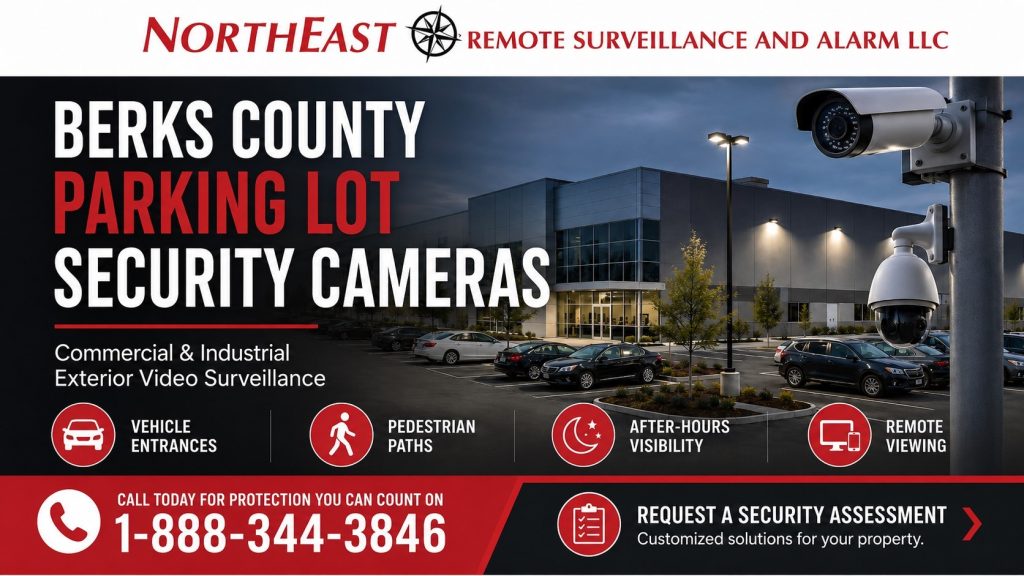
Check the lighting and the detail you need after dark.
NERSA designs and installs these systems for commercial, industrial, and institutional properties across Reading and Berks County.
For indoor coverage, recording, remote viewing, and video search, see Berks County commercial video surveillance.
Berks County Parking Lot Security Cameras for Parking Lot Camera Planning
Parking lots are often one of the most exposed areas of a commercial or industrial property. Employees, visitors, vendors, delivery drivers, service vehicles, customers, fleet vehicles, and unauthorized vehicles may all move through the same exterior space.
Plan parking lot cameras around vehicle and pedestrian routes. Review entrances, parking spaces, walking paths and loading areas. Choose views with enough detail to review activity, rather than relying only on a wide overview.
Northeast Remote Surveillance and Alarm, LLC does not install single-family home systems. Our focus is commercial, industrial, municipal, institutional, healthcare, logistics, and enterprise environments where system design, camera placement, infrastructure, and long-term support matter.
Where Parking Lot Security Cameras Should Focus
Commercial parking lot camera coverage should be based on the areas where activity actually happens. A strong design may include cameras aimed at entrances, exits, drive lanes, pedestrian paths, employee parking, visitor parking, loading-adjacent spaces, rear lots, side lots, service entrances, dumpster areas, exterior storage, and building approaches.
Common parking lot camera coverage areas include:
- Main vehicle entrances
- Parking lot exits
- Employee parking areas
- Visitor parking areas
- Rear and side lots
- Drive lanes
- Pedestrian walkways
- Building entrances
- Service entrances
- Delivery-adjacent parking areas
- Exterior storage zones
- Fleet parking areas
- Dumpster and utility areas
- After-hours approach points
The goal is to help management understand what happened, where movement occurred, and which camera view provides the clearest review.
Exterior Visibility Around Buildings and Approaches
Parking lot cameras should not be planned as isolated exterior cameras. They should support the full exterior visibility plan for the property.
Building approaches, side doors, rear doors, employee entrances, delivery paths, loading areas, walkways, and exterior gathering points may all connect to parking lot activity. If a camera system does not show how a person or vehicle moved between the parking lot and the building, important details may be missed.
A good exterior camera layout should help connect parking lot activity with entrances, exits, doors, docks, gates, and other areas where incidents may begin or continue.
Camera Placement, Lighting, and Viewing Distance
Parking lot camera performance depends heavily on lighting, mounting height, angle, distance, lens selection, and the direction of vehicle or pedestrian movement. A camera mounted too high, too far away, or aimed too wide may show activity but fail to provide useful detail.
Lighting should be reviewed carefully. Dark areas, glare from headlights, shadows, reflective pavement, rain, snow, and changing seasonal conditions can all affect footage quality.
The system should be designed for real review value. That means balancing overview cameras for context with more targeted views for entrances, exits, walkways, doors, and areas where clearer detail is needed.
Employee Parking and Visitor Parking Coverage
Employee and visitor parking areas often have different security needs. Employee parking may need after-hours visibility, shift-change review, vehicle incident documentation, and walking-path coverage. Visitor parking may need entrance visibility, building approach coverage, and review of activity near public-facing areas.
A commercial parking lot camera design should account for how the property operates during business hours, after hours, weekends, holidays, and shift changes.
For larger properties, parking coverage may need to be organized by zones so management can quickly find the correct camera view when reviewing an incident.
Parking Lot Cameras for Warehouses and Industrial Facilities
Warehouses, manufacturing facilities, and logistics properties often have parking lots connected to truck courts, dock areas, employee entrances, fenced yards, and service entrances. These sites may need stronger exterior camera planning than a standard office property.
Camera coverage may need to separate employee parking, visitor parking, truck movement, trailer-adjacent areas, delivery lanes, and pedestrian paths. This helps reduce confusion when reviewing footage and makes it easier to understand how activity moved through the site.
For broader industrial and logistics security planning across Berks County, use the Berks County Industrial & Logistics Corridor Security Systems page.
Vehicle Documentation and License Plate Views
Some Berks County properties need more than general parking lot visibility. Vehicle entrances, exits, gates, shared drive lanes, and high-traffic access points may require dedicated license plate views or vehicle documentation cameras.
General overview cameras are useful for context, but they are not always enough to capture plate information. License plate camera planning depends on vehicle speed, lane position, angle, lighting, mounting height, and whether the camera is designed for entrance, exit, gate, or drive-lane documentation.
For properties that need dedicated plate capture and searchable vehicle records, use the Berks County License Plate Recognition Camera Systems page.
After-Hours Parking Lot Security
Parking lots often become more vulnerable when the building is closed, lightly staffed, or operating with limited supervision. Rear lots, side lots, employee parking areas, visitor parking, exterior storage, drive lanes, and building approaches may become more exposed during nights, weekends, holidays, and shift changes.
After-hours parking lot security may include recorded video, motion-based review, analytic alerts, remote viewing, video verification, lighting coordination, and remote video monitoring workflows where appropriate.
For active off-site event review and after-hours exterior monitoring, use the Berks County Remote Video Monitoring page.
Gate, Fence, and Controlled Vehicle Entry Areas
Some parking lots include controlled entrances, fenced areas, employee-only parking, delivery gates, service entrances, or fleet access points. These areas may need cameras planned with gate access control, intercoms, keypads, card readers, remote release, and vehicle documentation.
A camera system can help management review who entered, when a gate opened, what vehicle approached, and what happened around the controlled entry point.
For properties with controlled vehicle entrances or fenced parking areas, use the Berks County Commercial Gate Access Control Systems page.
Remote Viewing and User Access for Parking Lot Cameras
Business owners, managers, facility directors, operations teams, school administrators, healthcare administrators, and security staff may need remote access to parking lot cameras. Remote viewing should be designed with secure login practices, proper user permissions, and organized camera groups.
Not every user should have access to every camera. A well-planned system can separate parking lot views, building entrances, dock areas, interior cameras, and restricted areas based on user responsibility.
Remote access should make review easier while keeping the system properly controlled.
Recording, Storage, and Incident Review
Parking lot camera footage is only useful if it can be found, reviewed, exported, and understood when needed. Recording and storage should be planned around camera count, resolution, activity level, incident history, operating schedule, review needs, and retention expectations.
Some properties may need standard retention. Others may need longer retention because of vehicle incidents, claims, disputes, vandalism, overnight activity, employee concerns, visitor incidents, or insurance-related review needs.
The system should be designed so management can quickly locate the correct camera view and time period when something happens.
AI Video Search and Smart Alerts for Parking Areas
Modern parking lot camera systems may support AI video search, vehicle detection, person detection, line crossing, area alerts, motion filtering, and faster event review. These tools can help reduce the time needed to search footage across large exterior areas.
AI features must be configured around the actual property layout. Poor camera angles, weak lighting, excessive distance, moving shadows, weather, and nuisance activity can reduce the usefulness of alerts.
The goal is not to create constant notifications. The goal is to create useful event awareness around the areas that matter most.
Upgrading Existing Parking Lot Camera Systems
Many Berks County businesses already have exterior cameras, but the system may no longer provide the visibility they need. Common issues include blind spots, poor night footage, low-resolution views, cameras aimed too wide, limited recording retention, weak remote access, outdated cabling, or missing coverage around entrances and exits.
An upgrade may include repositioning existing cameras, adding targeted views, improving night visibility, increasing recording quality, extending retention, adding license plate views, improving remote access, or connecting exterior cameras with access control, alarms, gates, or monitoring workflows.
The best upgrade is not always more cameras. The best upgrade is a parking lot camera design that provides clearer review where the property is actually exposed.
Request a Berks County Parking Lot Camera Assessment
NERSA can assess parking cameras and exterior coverage at your Berks County facility. Tell us about vehicle entrances, employee and visitor parking, and the activity you need to review. We can consider remote viewing, AI-assisted search, plate views, and after-hours monitoring.
Request a Physical Plant Security Assessment to discuss parking lot security cameras in Berks County, PA.
Frequently Asked Questions About Berks County Parking Lot Security Cameras
What areas should parking lot security cameras cover?
Parking lot cameras should commonly cover vehicle entrances, exits, drive lanes, employee parking areas, visitor parking areas, pedestrian walkways, building approaches, service entrances, rear lots, side lots, exterior storage areas, and after-hours approach points.
Are parking lot cameras different from general building cameras?
Yes. Parking lot cameras must account for longer distances, changing lighting, weather exposure, vehicle movement, pedestrian paths, headlights, mounting height, and the need to review exterior activity clearly.
Can parking lot cameras capture license plates?
Some parking lot cameras may show vehicle activity, but dedicated license plate views usually require specific camera placement, angle, lighting, lens selection, and lane control. Properties that need plate documentation should plan for that separately.
Do parking lot cameras work at night?
Yes, when they are designed correctly. Night performance depends on lighting, camera selection, mounting height, distance, lens choice, glare, shadows, weather, and whether the camera is placed for the activity being reviewed.
Can parking lot cameras be viewed remotely?
Yes. Authorized users can often view parking lot cameras remotely when the system is designed with secure access, proper user permissions, and reliable network connectivity.
How long should parking lot camera footage be stored?
Retention depends on the property’s risk level, camera count, resolution, traffic volume, incident history, operating schedule, and review needs. Properties with frequent vehicle incidents, after-hours exposure, or insurance-related concerns may need longer retention.
Can AI alerts help monitor parking lots?
Yes. AI video tools may help detect people, vehicles, motion, line crossing, or activity in defined areas. The system still needs proper camera placement, lighting, distance, and alert configuration to make those alerts useful.
Should parking lot cameras connect with gate access control?
For properties with fenced lots, controlled entrances, delivery gates, employee-only parking, or fleet areas, cameras can support gate access control by documenting vehicle movement, gate activity, and entry events.
Can parking lot cameras help with employee and visitor safety?
Parking lot cameras can help document activity around employee parking areas, visitor parking, walkways, entrances, exits, and exterior approaches. They support incident review and visibility, but they should be part of a broader property security plan.
How do we start a parking lot camera project in Berks County?
Start with a site assessment. Northeast Remote Surveillance and Alarm, LLC can review parking areas, lighting, vehicle movement, pedestrian paths, entrances, exits, camera locations, network infrastructure, recording needs, and after-hours exposure.
Plan Your Next Security Improvement
Tell NERSA about your commercial facility, existing systems, and project priorities. We can help you plan an installation, evaluate an upgrade, or coordinate security across multiple locations.
Compliance, Codes & Project Standards
NERSA plans commercial and industrial security work with applicable code, documentation, inspection and authority-having-jurisdiction requirements in mind. Requirements vary by system, property and jurisdiction. These resources support project planning; they do not establish legal compliance, certification or AHJ approval.
Related guidance: Regulatory compliance & inspection readiness · Video surveillance compliance · NERSA project standards