Call 1-888-344-3846 to request a multi-tenant commercial building access control assessment.
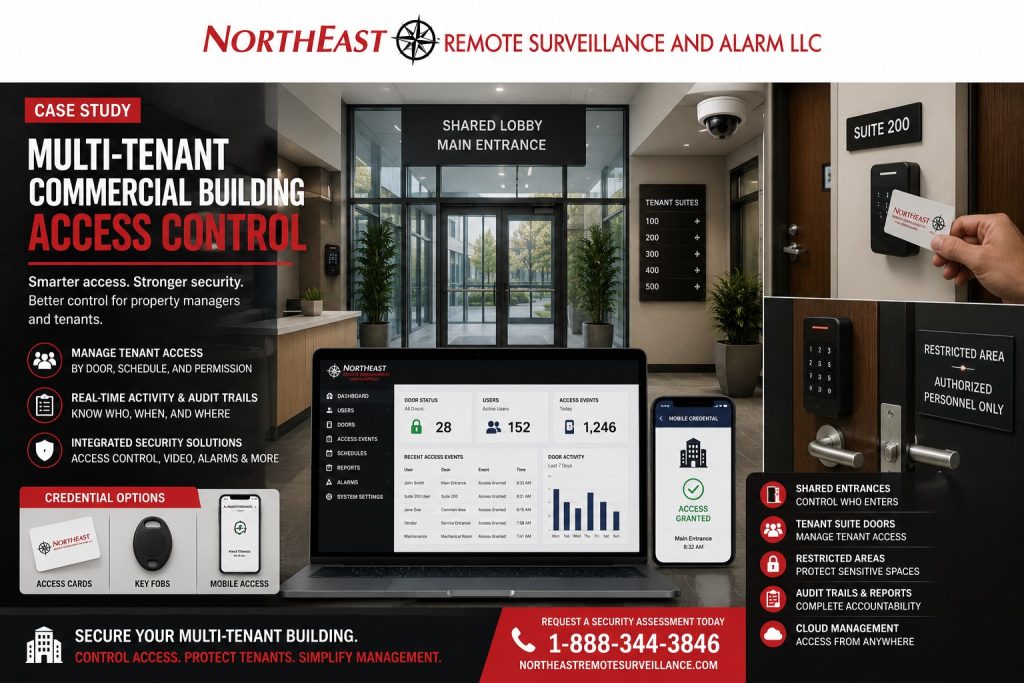
Case Study Overview
This case study is based on a common commercial property management challenge: a multi-tenant building relied too heavily on keys, informal access practices, and limited visibility into who was entering shared spaces and tenant-controlled areas.
The property did not need a residential-style door lock upgrade. It needed a commercial access control plan designed around tenants, shared entrances, property management, common areas, restricted rooms, schedules, credential management, and long-term building operation.
The goal was to improve control around:
- Shared building entrances
- Tenant suite doors
- Employee entrances
- Common corridors
- Mechanical rooms
- IT or utility rooms
- Management areas
- After-hours access
- Visitor movement
- Tenant turnover
- Lost or unreturned keys
- Access event history
- Door schedule management
- Commercial property accountability
This page focuses only on the multi-tenant commercial building access control case study. For broader controlled-entry planning, visit Commercial and Industrial Access Control Systems.
Property Type
The property was an anonymous multi-tenant commercial building with shared entrances, tenant suites, common areas, service rooms, management oversight, and after-hours access needs.
The site included:
- A shared main entrance
- Tenant suite entrances
- Common hallways
- Employee and tenant access points
- Utility or mechanical spaces
- Property management access needs
- Periodic tenant changes
- After-hours access requirements
- Existing mechanical key challenges
- A need for better access documentation
Like many multi-tenant commercial properties, the security challenge was not just locking doors. The real issue was managing different users, different permissions, different schedules, and different responsibilities inside the same building.
The Security Challenge
The main challenge was access accountability.
The property needed a cleaner way to manage who could enter the building, when they could enter, and which doors or spaces they were allowed to access.
Common concerns included:
- Tenants sharing keys
- Former tenants or employees retaining keys
- No easy way to remove access without rekeying
- Limited access event history
- Unclear after-hours entry activity
- Shared entrance exposure
- Common area access concerns
- Property management needing stronger control
- Tenant suite access needing better organization
- Restricted rooms needing tighter protection
- No simple way to update access permissions as tenants changed
This is a common issue for multi-tenant commercial buildings. Traditional keys may work at first, but they become harder to manage as tenants, employees, vendors, cleaning crews, maintenance teams, and property managers all need different access levels.
For broader access control education, visit The Ultimate Commercial and Industrial Access Control Guide.
Why Multi-Tenant Buildings Need Access Control
Multi-tenant properties have shared risk.
A single building may involve:
- Multiple businesses
- Shared exterior entrances
- Tenant suite entrances
- Common hallways
- Public or visitor movement
- Cleaning crews
- Maintenance vendors
- Property managers
- After-hours tenants
- Delivery activity
- Mechanical rooms
- IT rooms
- Storage rooms
- Emergency access needs
Mechanical keys do not provide enough accountability for many of these conditions. Once a key is copied, lost, or retained, the property manager may not know who has access.
Access control helps the building move toward credential-based control, permission management, event history, and easier offboarding.
Site Conditions Reviewed
Before recommending an access control layout, Northeast Remote Surveillance and Alarm, LLC reviewed how the building operated.
The review focused on:
- Which doors were shared by all tenants
- Which doors were tenant-specific
- Which doors needed property manager access
- Which rooms required restricted access
- How tenants entered after hours
- How cleaning or maintenance vendors accessed the building
- Whether visitors used the same entrances as tenants
- Which openings had existing door hardware
- Which doors had egress or life-safety concerns
- Whether fire alarm release coordination was needed
- Whether cameras should support door event review
- Whether cloud management or remote administration was appropriate
- How tenant turnover would be handled
The access control plan started with the property’s operating structure, not a fixed hardware package.
Access Control Design Strategy
The recommended access control approach focused on separating shared building control from tenant-specific control.
The goal was to create a system that could support the property manager while still giving tenants appropriate access to their own spaces.
Shared Entrance Control
Shared building entrances were treated as priority openings because they control the main flow into the property.
Shared entrance access control can help manage:
- Tenant entry
- Employee entry
- After-hours access
- Property management access
- Vendor access
- Cleaning crew access
- Door schedules
- Access event history
- Lost credential removal
- Temporary credential permissions
A controlled shared entrance gives the property manager more flexibility than mechanical keys because credentials can be added, removed, scheduled, or limited without rekeying the building.
Tenant Suite Access
Tenant suite doors may require a different access strategy than shared building entrances.
Some tenants may need controlled access only at the main building entrance. Others may need access control on their suite entrance, restricted rooms, private offices, storage areas, or IT spaces.
Tenant suite access control can help document:
- Employee entry
- After-hours entry
- Suite-level access
- Unauthorized attempts
- Door-held-open events
- Door-forced-open events
- User activity by credential
The final design should define who manages users, who can see reports, and how tenant permissions are updated.
Common Area and Restricted Room Control
Multi-tenant commercial buildings often include shared or restricted rooms that should not be available to every user.
These may include:
- Mechanical rooms
- Electrical rooms
- IT closets
- Utility spaces
- Roof access doors
- Storage rooms
- Management offices
- Records areas
- Maintenance closets
Access control can help limit these spaces to property managers, authorized maintenance staff, or approved vendors.
After-Hours Access Management
After-hours access is one of the most important reasons to use electronic access control in a multi-tenant building.
A property may need to know:
- Which tenant entered after hours
- Which door was used
- Whether the access was authorized
- Whether a door was held open
- Whether a visitor entered with an authorized user
- Whether access schedules should be adjusted
- Whether an incident happened before or after a door event
After-hours access control helps property managers improve accountability without physically being present at the building.
Door Hardware Considerations
Access control is only as strong as the opening it controls.
Each door must be reviewed for the correct hardware. A shared glass entrance, tenant suite door, fire-rated door, stairwell door, mechanical room door, or exterior door may require different hardware.
Hardware considerations may include:
- Electric strikes
- Electrified trim
- Magnetic locks where appropriate
- Request-to-exit devices
- Door contacts
- Door position switches
- Exit devices
- Door closers
- Power supplies
- ADA accessibility
- Fire alarm release where required
- Free egress requirements
- Authority Having Jurisdiction expectations
Access control should not be treated as simply adding a card reader. The door hardware, life-safety behavior, user flow, and code-sensitive conditions all matter.
For hardware planning, visit Access Control Trim & Strike Hardware.
Credential Management Strategy
The credential strategy was designed around tenant and property management needs.
Credential options may include:
- Cards
- Fobs
- Mobile credentials
- PIN codes where appropriate
- Temporary credentials
- Vendor credentials
- Cleaning crew credentials
- Management credentials
The strongest credential plan defines:
- Who issues credentials
- Who removes credentials
- What happens when a tenant leaves
- How lost credentials are handled
- Which users can access shared entrances
- Which users can access tenant suites
- Which users can access restricted rooms
- Which access levels are assigned by role
A multi-tenant building needs clean credential management because tenant turnover is a recurring reality.
Cloud and Remote Management Considerations
Many multi-tenant commercial buildings benefit from cloud or remotely managed access control because property managers may not always be on-site.
Remote management can help authorized administrators:
- Add users
- Remove users
- Change permissions
- Review events
- Adjust schedules
- Lock or unlock selected doors where permitted
- Support after-hours troubleshooting
- Manage multiple buildings
- Respond faster to tenant changes
Cloud access control should still be planned carefully with attention to internet dependency, cybersecurity, user permissions, administrator roles, and long-term licensing.
For broader architecture planning, visit The Ultimate Commercial and Industrial Access Control Guide.
Video Surveillance Support
Access control becomes more useful when door events can be reviewed with camera footage.
Video surveillance can help show:
- Who approached the door
- Whether someone tailgated behind an authorized user
- Whether a visitor entered with a tenant
- Whether a door was propped open
- Whether after-hours activity matched the access event
- Whether an attempted entry was suspicious
- What happened before or after a door event
Cameras do not replace access control. They provide visual context around access events.
For broader camera planning, visit Commercial Video Surveillance Systems.
Alarm Integration Considerations
Multi-tenant commercial buildings may also need access control to coordinate with intrusion alarms.
Depending on the property, the system may support:
- Tenant-specific alarm areas
- Shared entrance alarm review
- Door-forced-open alerts
- Door-held-open alerts
- After-hours access events
- Restricted-room alarms
- Video verification
- Management notifications
Access control and alarms should be planned together when tenants have different operating hours, different access levels, or separate protected areas.
For alarm planning, visit Commercial and Industrial Alarm Installation.
Life-Safety and Fire Alarm Coordination
Access control in a commercial building must be planned with life-safety requirements in mind.
Controlled doors may involve:
- Free egress
- Fire alarm release
- Fail-safe or fail-secure behavior
- Exit devices
- Request-to-exit devices
- ADA accessibility
- Door hardware listings
- Emergency exit paths
- Fire-rated openings
- Local Authority Having Jurisdiction expectations
The access control design must not trap people inside the building or interfere with required egress.
For broader life-safety planning, visit Commercial and Industrial Fire Alarm Installation and NFPA Standards and Commercial Security, Fire Alarm, and Life Safety Systems.
Operational Result
The access control design helped the multi-tenant commercial property move from key-based uncertainty toward credential-based accountability.
The system supported:
- Better shared entrance control
- Better tenant access management
- Easier credential removal
- Cleaner after-hours access review
- Better restricted room control
- Better property management oversight
- Better door event documentation
- Better support for tenant turnover
- Better remote administration options
- Better integration potential with cameras and alarms
No sensitive customer information, exact door lists, access schedules, credentials, tenant names, passwords, alarm zones, or security weaknesses are published in this case study.
The value of the project was the access control strategy, not just the hardware.
What This Case Study Does Not Cover
This page is focused specifically on a multi-tenant commercial building access control case study.
It is not the main access control service page. It is not the main access control cost page. It is not a door hardware-only page. It is not the main commercial video surveillance page. It is not the main alarm page. It is not a fire alarm page. It is not a city hub.
For direct access control planning, visit Commercial and Industrial Access Control Systems.
For access control cost planning, visit Commercial and Industrial Access Control Cost.
For commercial video planning, visit Commercial Video Surveillance Systems.
For alarm planning, visit Commercial and Industrial Alarm Installation.
For the full case-study hub, visit Commercial and Industrial Security Case Studies.
Lessons From This Multi-Tenant Access Control Case Study
This case study highlights several important lessons for commercial property owners and building managers.
Multi-Tenant Access Control Starts With User Groups
The system should separate tenants, property managers, maintenance users, vendors, cleaners, and restricted-area users into clear permission groups.
Shared Entrances Need Strong Accountability
The shared building entrance is often the most important controlled opening because it affects every tenant and every after-hours user.
Keys Become a Long-Term Liability
Mechanical keys are difficult to recover, track, and control as tenants and employees change. Electronic credentials give property managers more control.
Door Hardware Must Be Reviewed Before Installation
A reader cannot be planned correctly until the door, frame, lock, egress path, and life-safety requirements are reviewed.
Cameras Add Context to Access Events
Access logs show that a credential was used. Cameras help show what happened around the door.
Recommended Multi-Tenant Access Control Assessment
A multi-tenant commercial building access control assessment should review how the building is managed before equipment is selected.
Northeast Remote Surveillance and Alarm, LLC may review:
- Shared entrances
- Tenant suite doors
- Common corridors
- Restricted rooms
- Mechanical rooms
- IT closets
- Utility spaces
- Management areas
- Vendor access needs
- Cleaning crew access needs
- After-hours access needs
- Tenant turnover procedures
- Existing keys
- Existing door hardware
- Fire alarm release needs
- Egress-sensitive openings
- ADA considerations
- Camera support
- Alarm integration needs
- Remote management needs
- Future expansion
The goal is to design an access control system that supports how the building actually operates.
Frequently Asked Questions About Multi-Tenant Commercial Building Access Control
What is multi-tenant commercial building access control?
Multi-tenant commercial building access control is an electronic system used to manage shared entrances, tenant suite doors, restricted rooms, common areas, and after-hours access for properties with multiple businesses or occupants.
Why do multi-tenant buildings need access control?
Multi-tenant buildings need access control because multiple tenants, employees, vendors, cleaners, visitors, and property managers may need different access levels. Electronic access control provides stronger accountability than mechanical keys.
Can access control reduce key problems?
Yes. Access control can reduce key-copying, lost-key, unreturned-key, and rekeying problems because credentials can be added, removed, or changed electronically.
Can different tenants have different access permissions?
Yes. Access control systems can assign permissions by tenant, user group, schedule, door, or restricted area depending on the system design.
Can access control manage after-hours entry?
Yes. Access control can document who entered after hours, which door was used, and whether the access matched approved schedules.
Can property managers remove tenant access quickly?
Yes. Authorized administrators can deactivate credentials when a tenant, employee, vendor, or contractor should no longer have access.
Can cameras support access control events?
Yes. Cameras can provide visual context around door events, including tailgating, visitor entry, after-hours movement, and door-held-open conditions.
Can access control integrate with intrusion alarms?
Yes. Access control can support alarm workflows, door-forced-open events, door-held-open alerts, restricted-area alarms, and after-hours activity review when designed correctly.
Does access control need to coordinate with fire alarm systems?
Some doors may require fire alarm release or life-safety coordination. Access control must be designed so it does not interfere with required egress or Authority Having Jurisdiction expectations.
What doors should be controlled in a multi-tenant building?
Common controlled doors may include shared entrances, tenant suite entrances, management offices, IT rooms, utility rooms, mechanical rooms, storage rooms, roof access doors, and restricted spaces.
Is cloud access control useful for property managers?
Yes. Cloud access control can help property managers add users, remove users, change permissions, review events, and manage doors remotely when the system is designed securely.
Can access control support multiple buildings?
Yes. Multi-site access control can support multiple buildings, tenant groups, shared doors, and centralized administration.
Can existing locks be reused?
Sometimes. Existing door hardware may be reused if it is compatible, code-appropriate, serviceable, and aligned with the access control design. Many projects require door-by-door hardware review.
Does NERSA publish exact customer door layouts?
No. Northeast Remote Surveillance and Alarm, LLC does not publish sensitive customer door schedules, access permissions, credential details, alarm zones, passwords, tenant names, or security weaknesses in public case studies.
Does NERSA install residential access control?
No. Northeast Remote Surveillance and Alarm, LLC focuses on commercial, industrial, warehouse, logistics, manufacturing, institutional, municipal, healthcare, and enterprise security systems.
How do I request a multi-tenant access control assessment?
Call 1-888-344-3846 or request a security assessment at Northeast Remote Surveillance and Alarm, LLC can review your building entrances, tenant doors, access groups, hardware, life-safety needs, remote management requirements, and long-term security goals.
Request a Multi-Tenant Commercial Building Access Control Assessment
Multi-tenant commercial building access control should be designed around real building operations. Shared entrances, tenant suites, common areas, restricted rooms, after-hours access, tenant turnover, door hardware, cameras, alarms, and life-safety requirements all affect the final design.
If your office building, commercial property, medical office building, industrial flex building, mixed-use commercial property, or multi-tenant facility needs better access accountability, Northeast Remote Surveillance and Alarm, LLC can evaluate the building and recommend a practical access control layout.
Call 1-888-344-3846 or request a security assessment.