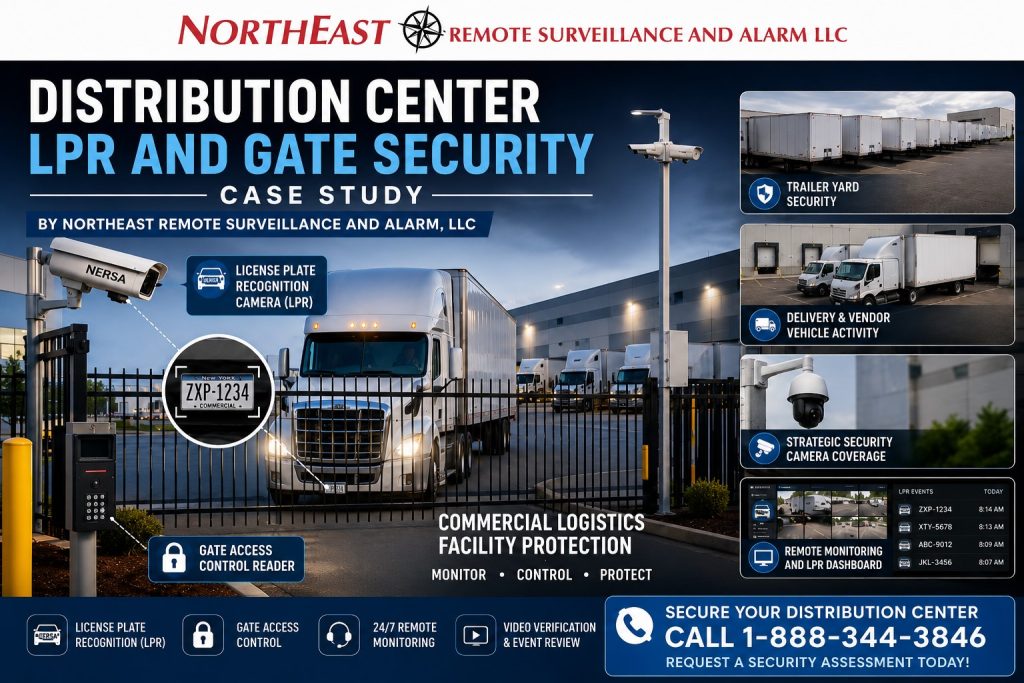
Distribution center LPR and gate security systems help logistics properties improve vehicle documentation, truck entrance control, trailer yard awareness, delivery access review, and after-hours gate visibility. This anonymous case study shows how Northeast Remote Surveillance and Alarm, LLC approaches a distribution center security project when a facility needs better control around vehicle entrances, stronger license plate documentation, gate-area camera coverage, and practical review of truck, employee, vendor, and service vehicle movement. For the full proof library, visit Commercial and Industrial Security Case Studies.
Call 1-888-344-3846 to request a distribution center LPR and gate security assessment.
Case Study Overview
This case study is based on a common distribution center security challenge: the property had active truck traffic, service vehicles, employee parking, delivery activity, trailer staging, and after-hours gate exposure, but management needed stronger documentation around vehicle movement and controlled entry.
The facility did not need a basic camera package aimed at the driveway. It needed a coordinated gate security and license plate recognition strategy built around vehicle lanes, truck flow, trailer activity, exterior access points, and operational review.
The goal was to improve security around:
- Truck entrances
- Vehicle gate lanes
- Trailer yard access
- Employee parking entrances
- Vendor and service vehicle access
- Delivery vehicle movement
- Visitor vehicle movement
- License plate documentation
- Gate camera coverage
- Vehicle entry and exit review
- After-hours gate activity
- Remote management visibility
- Incident investigation
- Commercial logistics protection
This page focuses only on the distribution center LPR and gate security case study. For broader logistics security planning, visit Warehouse Security Systems. For gate-specific planning, visit Commercial Gate Access Control Systems.
Property Type
The property was an anonymous distribution center and logistics-style facility with truck entrances, trailer activity, employee parking, shipping and receiving operations, and exterior vehicle exposure.
The site included:
- A controlled vehicle entrance
- Truck and delivery traffic
- Trailer yard activity
- Employee parking areas
- Service vehicle access
- Shipping and receiving movement
- Gate-area exposure
- Exterior camera needs
- After-hours access concerns
- A need for stronger vehicle documentation
- A need for better gate event review
Like many distribution centers, the most important security challenge was not only inside the warehouse. It was also at the property edge where trucks, cars, vendors, drivers, and trailers moved through the site.
The Security Challenge
The main challenge was vehicle accountability.
The property needed a better way to document which vehicles entered, which vehicles left, what time gate activity occurred, and whether vehicle movement matched normal operations.
Common concerns included:
- Truck traffic entering and leaving throughout the day
- Delivery vehicles using shared access points
- Limited documentation of vehicle plates
- Gate activity that was hard to review after an incident
- Trailer yard access needing stronger visibility
- Employee and vendor vehicle movement
- After-hours gate activity
- Suspicious vehicles near the property
- Camera views that did not capture plate detail
- No clear connection between gate events and video review
- Management needing better remote review capability
This is a common issue for distribution centers, warehouses, freight terminals, logistics sites, and industrial yards. A general overview camera may show that a vehicle entered, but it may not capture the plate, lane, direction, or event context needed for investigation.
For cargo and trailer exposure planning, visit Cargo Theft Prevention Systems.
Why Distribution Centers Need LPR and Gate Security Together
License plate recognition and gate security solve different problems, but they are stronger when planned together.
Gate security helps manage controlled entry, vehicle flow, schedules, and access procedures.
LPR cameras help document vehicle plates and support event review.
Together, they help answer questions such as:
- Which vehicle approached the gate?
- What time did the vehicle enter?
- What time did the vehicle leave?
- Was the vehicle authorized?
- Was the vehicle connected to a delivery, employee, vendor, or unknown activity?
- Was the same vehicle seen before?
- Did the vehicle enter during normal hours or after hours?
- Did the event connect to trailer yard, dock, or parking lot activity?
A gate camera may show the vehicle. An LPR camera is positioned specifically to capture the license plate. Both views matter.
Site Conditions Reviewed
Before recommending the final layout, Northeast Remote Surveillance and Alarm, LLC reviewed how the distribution center operated.
The review focused on:
- Truck entrance locations
- Vehicle lane layout
- Gate position
- Trailer yard access
- Employee parking movement
- Delivery traffic
- Service vehicle access
- Visitor vehicle movement
- Lane speed
- Camera mounting locations
- Camera angle options
- Lighting conditions
- Headlight glare
- Existing camera views
- Existing gate equipment
- Remote review needs
- After-hours activity
- Network and low-voltage pathways
- Future expansion needs
The system design started with vehicle movement, not a fixed camera count.
LPR Camera Strategy
License plate recognition requires a different design approach than general security cameras.
A standard overview camera may provide a useful wide view, but LPR cameras must be positioned for plate capture. Placement depends on the lane, vehicle speed, angle, lighting, distance, mounting height, and the expected direction of travel.
The LPR design reviewed:
- Entry lane plate capture
- Exit lane plate capture
- Vehicle approach direction
- Plate angle
- Headlight glare
- Night performance
- Camera height
- Lane width
- Distance to target
- Vehicle speed
- Weather exposure
- Search and review requirements
The goal was to create useful vehicle documentation, not just a wide-angle view of the gate.
For broader LPR planning, visit License Plate Recognition Camera Systems.
Gate Camera Coverage
Gate cameras support LPR by showing the full vehicle and gate-area context.
Gate-area cameras may help document:
- Vehicle type
- Driver-side movement
- Gate opening and closing
- Vehicles waiting at the entrance
- Delivery activity
- Vendor movement
- Tailgating
- Vehicles stopping near the gate
- After-hours gate activity
- Pedestrian or driver interaction near the entrance
LPR cameras are not intended to replace overview gate cameras. The best layout uses both.
One camera captures the plate. Another camera shows the broader event.
Gate Access Control Strategy
Depending on the property, gate access control may include:
- Keypads
- Card readers
- Fob readers
- Mobile credential access
- Intercom-assisted entry
- Remote gate release
- Scheduled access
- Vendor credentials
- Employee access
- Driver access rules
- Gate status monitoring
- Event logs
Gate access control helps manage who can enter and when they can enter.
For distribution centers, the system must account for truck traffic, delivery timing, employee parking, visitor access, contractor access, and after-hours movement.
For broader gate security planning, visit Commercial Gate Access Control Systems.
Trailer Yard and Truck Court Visibility
Distribution centers often have trailer yards, truck courts, drop trailer areas, and dock approaches that need additional camera coverage.
The gate may document vehicle entry, but management may still need to see where that vehicle went after entering.
Camera planning may include:
- Trailer rows
- Truck courts
- Dock approaches
- Drive lanes
- Trailer staging areas
- Yard corners
- Fence lines
- Parking areas
- After-hours approach points
This helps connect gate activity with broader site movement.
For yard-focused planning, visit Truck Yard Security Systems.
Employee, Vendor, and Delivery Vehicle Review
Distribution centers often involve several different types of vehicles using the same property.
A gate and LPR strategy may support review of:
- Employee vehicles
- Delivery trucks
- Vendor vehicles
- Contractor vehicles
- Service vehicles
- Visitor vehicles
- Recurring vehicles
- Unknown vehicles
- After-hours vehicles
The system should help management distinguish normal operating activity from unusual or suspicious vehicle activity.
That does not mean every vehicle is a threat. It means the facility has a better record when review is needed.
After-Hours Gate Activity
After-hours gate activity can be one of the highest-risk areas for a distribution center.
Risks may include:
- Unauthorized vehicles near the entrance
- Vehicles following another vehicle through the gate
- Drivers stopping at the gate after hours
- Suspicious vehicles circling the property
- Trailer yard access outside normal schedules
- Gate-left-open conditions
- Vehicles using side or service entrances
- People approaching the gate on foot
Gate cameras, LPR, lighting, gate access control, and monitoring procedures can help management review after-hours activity more effectively.
For monitored response and live talk-down planning, visit Remote Video Monitoring and Live Talk-Down.
Remote Review and Management Dashboard
Distribution center managers may not always be at the gate when vehicle activity occurs.
Remote review can help authorized users:
- Check live gate activity
- Search vehicle events
- Review entry and exit footage
- Confirm delivery activity
- Investigate after-hours vehicle movement
- Review trailer yard activity
- Support multi-site operations
- Coordinate with internal operations
- Export footage when needed
Remote access should be managed with strong credentials, role-based permissions, cybersecurity awareness, and clear internal procedures.
For broader cybersecurity and standards planning, visit ISO Standards and Their Application to Commercial and Industrial Security.
Lighting and Camera Placement Considerations
Lighting can make or break LPR and gate camera performance.
A camera that performs well during the day may struggle at night if there is glare, poor illumination, backlighting, reflective plates, weather exposure, or headlights aimed directly into the camera.
The layout reviewed:
- Existing pole lights
- Vehicle headlight direction
- Gate lighting
- Camera angle
- Night capture conditions
- Shadows
- Glare
- Distance to vehicles
- Lane speed
- Mounting locations
- Camera field of view
The system needed to support useful review during the hours when vehicle activity actually occurs, not just during ideal daylight conditions.
Alarm and Monitoring Coordination
Gate and LPR systems may also support broader alarm and monitoring workflows.
Depending on the facility, the system may coordinate with:
- Gate status alerts
- Door-forced-open events
- Trailer yard motion alerts
- Building intrusion alarms
- After-hours activity review
- Video verification
- Remote monitoring workflows
- Contact notification
- Incident documentation
For alarm planning, visit Commercial and Industrial Alarm Installation. For monitoring planning, visit Commercial and Industrial Security Monitoring.
Operational Result
The distribution center LPR and gate security design helped the property move toward better vehicle accountability and gate-area visibility.
The system supported:
- Better license plate documentation
- Better gate-area video review
- Better truck entrance visibility
- Better after-hours gate awareness
- Better trailer yard context
- Better review of employee, vendor, and delivery vehicles
- Better remote management visibility
- Better support for incident investigation
- Better documentation around vehicle movement
No sensitive customer information, exact camera angles, gate codes, access schedules, plate lists, network details, passwords, alarm zones, or security weaknesses are published in this case study.
The value of the project was the vehicle documentation strategy, not just the cameras or gate hardware.
What This Case Study Does Not Cover
This page is focused specifically on a distribution center LPR and gate security case study.
It is not the main LPR service page. It is not the main gate access control page. It is not the main truck yard security page. It is not the main warehouse security page. It is not the main remote monitoring page. It is not a city hub.
For LPR planning, visit License Plate Recognition Camera Systems.
For gate access planning, visit Commercial Gate Access Control Systems.
For truck yard planning, visit Truck Yard Security Systems.
For warehouse and logistics planning, visit Warehouse Security Systems.
For the full case-study hub, visit Commercial and Industrial Security Case Studies.
Lessons From This Distribution Center LPR and Gate Security Case Study
This case study highlights several practical lessons for logistics and distribution center security.
LPR Cameras Are Not General Overview Cameras
License plate recognition cameras need specific positioning, lighting, angle, and lane design. They should not be treated like standard parking lot or overview cameras.
Gate Views Need Context
A plate capture is useful, but a full gate camera view helps show the vehicle, gate activity, driver behavior, and surrounding context.
Truck Entrances Need Purposeful Security Design
Distribution center gates often handle trucks, vendors, visitors, employees, and service vehicles. The security plan should account for all of them.
After-Hours Gate Activity Should Be Reviewed
Gate activity after normal hours may require stronger camera coverage, LPR review, remote visibility, or monitoring procedures.
Vehicle Documentation Supports Investigations
LPR and gate cameras can help management review vehicle movement when investigating incidents, delivery disputes, yard activity, or after-hours concerns.
Recommended Distribution Center LPR and Gate Security Assessment
A distribution center LPR and gate security assessment should review the full vehicle flow before equipment is selected.
Northeast Remote Surveillance and Alarm, LLC may review:
- Truck entrances
- Employee entrances
- Visitor vehicle paths
- Delivery vehicle routes
- Gate lanes
- Trailer yard access
- Dock approaches
- Vehicle speed
- Lane width
- Camera mounting locations
- LPR camera placement
- Gate camera views
- Existing gate hardware
- Existing camera coverage
- Lighting conditions
- Network infrastructure
- Remote review needs
- Monitoring needs
- After-hours activity
- Future expansion
The goal is to design a system that fits the way vehicles actually move through the distribution center.
Frequently Asked Questions About Distribution Center LPR and Gate Security
What is distribution center LPR and gate security?
Distribution center LPR and gate security combines license plate recognition cameras, gate-area cameras, access control, vehicle entrance planning, and video review to document and manage vehicle movement around logistics and distribution facilities.
Why do distribution centers need LPR cameras?
Distribution centers often have high vehicle volume, truck traffic, deliveries, vendors, employees, and after-hours activity. LPR cameras help document which vehicles entered or left the property.
Is an LPR camera the same as a regular security camera?
No. An LPR camera is designed and positioned specifically for license plate capture. A regular camera may show the vehicle but may not reliably capture the plate.
Where should LPR cameras be installed?
LPR cameras are commonly installed at controlled vehicle lanes, gate entrances, exits, truck entrances, employee parking entrances, or other defined vehicle paths where plates can be captured at the proper angle and distance.
Can LPR work at night?
Yes, when the system is designed correctly. Night performance depends on camera selection, lighting, angle, headlight glare, distance, mounting height, and lane conditions.
Can gate access control work with LPR?
Yes. Gate access control and LPR can support each other. Gate control manages entry, while LPR and camera views document vehicle activity.
Can LPR support cargo theft prevention?
Yes. LPR can support cargo theft prevention by documenting vehicles near truck entrances, trailer yards, dock areas, gate lanes, and after-hours access points.
Can distribution center gate cameras be viewed remotely?
Yes. Authorized users can be given secure remote access to review live or recorded gate activity when the system is configured properly.
Can LPR help with after-hours incidents?
Yes. LPR can help identify vehicles that approached, entered, or left the property during after-hours events when the system is positioned and recorded correctly.
Do all gates need LPR?
No. LPR should be used where plate documentation is valuable and where lane conditions allow reliable capture. Some gates may only need overview cameras or access control.
Can existing cameras be reused?
Sometimes. Existing cameras may be reused if they are compatible, reliable, properly positioned, and able to support the required review process. LPR usually requires purpose-built placement and may require dedicated cameras.
Does NERSA publish exact customer LPR camera angles or gate layouts?
No. Northeast Remote Surveillance and Alarm, LLC does not publish sensitive customer gate layouts, camera angles, plate lists, access schedules, passwords, network details, or security weaknesses in public case studies.
Does NERSA install residential gate or LPR systems?
No. Northeast Remote Surveillance and Alarm, LLC focuses on commercial, industrial, warehouse, logistics, manufacturing, institutional, municipal, healthcare, and enterprise security systems.
How do I request a distribution center LPR and gate security assessment?
Call 1-888-344-3846 or request a security assessment at. Northeast Remote Surveillance and Alarm, LLC can review your truck entrances, gate lanes, trailer yard access, lighting, camera placement, access control needs, and vehicle documentation goals.
Request a Distribution Center LPR and Gate Security Assessment
Distribution center LPR and gate security should be designed around real vehicle movement. Truck entrances, gate lanes, trailer yard access, employee parking, delivery vehicles, after-hours activity, lighting, camera angles, access control, and remote review needs all affect the final system design.
If your distribution center, logistics facility, warehouse, freight terminal, trailer yard, truck entrance, or industrial property needs better vehicle documentation and gate security, Northeast Remote Surveillance and Alarm, LLC can evaluate the site and recommend a practical LPR and gate security layout.
Call 1-888-344-3846 or request a security assessment.