ISO standards help commercial and industrial organizations think about security as more than cameras, card readers, alarm panels, and monitoring accounts. In warehouses, logistics hubs, manufacturing plants, industrial parks, healthcare facilities, office campuses, cold storage facilities, food processing sites, municipal buildings, and regulated commercial properties, security now intersects with risk management, cybersecurity, documentation, continuity, supply chain protection, and audit readiness. For broader compliance planning, start with the Regulatory and Compliance Hub for Commercial Security, Fire Alarm and Life Safety, and for regional system planning, visit Lehigh Valley Commercial and Industrial Security
Systems.Northeast Remote Surveillance and Alarm, LLC uses ISO-aware thinking to help commercial and industrial clients plan security systems that are documented, cyber-aware, resilient, operationally useful, and easier to support over time.
Call 1-888-344-3846 or request a security assessment to review ISO-aligned security planning for your facility.
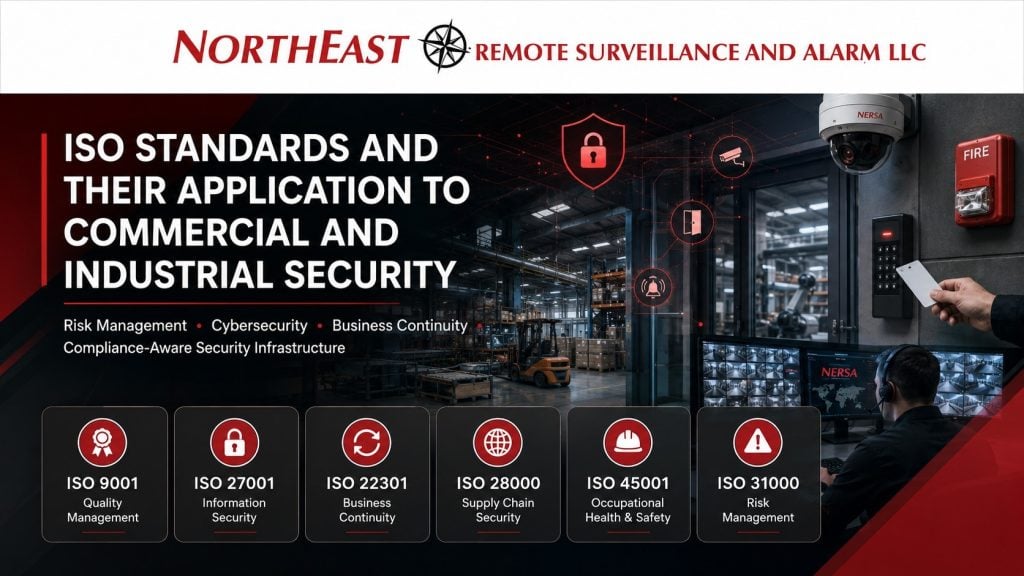
ISO standards help commercial and industrial organizations think about security as more than cameras, card readers, alarm panels, and monitoring accounts. In warehouses, logistics hubs, manufacturing plants, industrial parks, healthcare facilities, office campuses, cold storage facilities, food processing sites, municipal buildings, and regulated commercial properties, security now intersects with risk management, cybersecurity, documentation, continuity, supply chain protection, and audit readiness. For broader compliance planning, start with the Regulatory and Compliance Hub for Commercial Security, Fire Alarm and Life Safety, and for regional system planning, visit Lehigh Valley Commercial and Industrial Security Systems.
Northeast Remote Surveillance and Alarm, LLC uses ISO-aware thinking to help commercial and industrial clients plan security systems that are documented, cyber-aware, resilient, operationally useful, and easier to support over time.
Call 1-888-344-3846 or request a security assessment to review ISO-aligned security planning for your facility.
What This ISO Security Page Covers
This page explains how ISO standards apply to commercial and industrial security systems.
It focuses on security planning, not ISO certification services.
This page is designed to support:
- Commercial video surveillance systems
- Commercial and industrial access control systems
- Intrusion alarm systems
- Commercial alarm monitoring
- Remote video monitoring
- Fire alarm and life-safety coordination
- Security system documentation
- Cybersecurity planning
- Supply chain security
- Business continuity
- Industrial facility risk management
- Audit readiness
- Insurance defensibility
- Multi-site security standards
- Compliance-aware security planning
This page does not replace a formal ISO consultant, certification auditor, legal review, engineering review, insurance review, or Authority Having Jurisdiction decision. It explains how ISO-based thinking can strengthen commercial and industrial security design.
Why ISO Matters in Commercial and Industrial Security
ISO standards help organizations create structured, repeatable, documented processes.
In security system planning, that matters because a modern commercial security system is no longer a standalone device package. Cameras, access control panels, alarm communicators, cloud platforms, mobile credentials, monitoring workflows, video retention, network switches, user permissions, and remote access tools all create operational and cybersecurity responsibilities.
ISO-aware security planning helps organizations think through:
- Physical security
- Cybersecurity
- Risk management
- Access governance
- Supply chain protection
- Operational continuity
- Incident documentation
- Vendor accountability
- Audit readiness
- Insurance defensibility
- Long-term serviceability
- System change control
A business does not need to be ISO-certified for ISO concepts to be useful. The value comes from using structured security planning before problems appear during an audit, incident, insurance review, customer requirement, or operational failure.
Why ISO Is Critical for High-Risk Facilities
ISO-based thinking is especially important in facilities where security affects operations, safety, revenue, compliance, contracts, or continuity.
These facilities may include:
- Manufacturing plants
- Warehouses
- Distribution centers
- Logistics hubs
- Freight terminals
- Cold storage buildings
- Food processing facilities
- Pharmaceutical facilities
- Healthcare properties
- Municipal buildings
- Industrial parks
- Multi-tenant commercial buildings
- Contractor yards
- Office campuses
- Utility and infrastructure sites
- Multi-site enterprise facilities
These properties often face overlapping risks: cargo loss, unauthorized access, insider misuse, workplace safety concerns, cyber exposure through IP-connected devices, vendor access, contractor movement, supply chain risk, product loss, regulatory scrutiny, and insurance exposure.
A basic camera or alarm installation may not be enough. High-risk facilities need security infrastructure that is planned, documented, managed, and maintained.
Core ISO Standards That Apply to Security Systems
ISO 9001 and Quality Management in Security Installation
ISO 9001 is commonly associated with quality management, documented processes, corrective action, and continuous improvement.
In commercial and industrial security, that mindset applies to:
- Security assessment procedures
- Camera placement planning
- Access control design standards
- Alarm zone documentation
- Device testing
- Commissioning checklists
- Installation notes
- As-built drawings
- User training
- Service documentation
- Corrective action tracking
- Closeout packages
- Long-term maintenance planning
A quality-managed security installation should not depend on memory, shortcuts, or undocumented field decisions. It should produce a repeatable result that the client, service team, and future technicians can understand.
That matters when a facility expands, changes tenants, adds doors, upgrades cameras, changes managers, or needs records for an incident review.
ISO 27001 and Security System Cybersecurity
ISO/IEC 27001 is one of the most important ISO standards for modern commercial security planning because security systems are now network-connected systems.
A modern facility may have:
- IP cameras
- Network video recorders
- Cloud video platforms
- Access control servers
- Mobile credential platforms
- Alarm communicators
- Remote monitoring connections
- Video analytics
- Door controllers
- Intercoms
- Network switches
- Remote user accounts
- Vendor support access
Every one of these can create cybersecurity exposure if not designed correctly.
ISO 27001-style thinking supports:
- Role-based permissions
- Strong password practices
- Secure remote access
- Network segmentation
- Access logging
- Encryption where supported
- Account management
- Firmware management
- Change control
- Vendor access control
- Cloud platform governance
- Incident response procedures
- Evidence access control
For system-specific planning, this page should support Commercial Video Surveillance Systems and Commercial & Industrial Access Control Systems.
ISO 22301 and Business Continuity
ISO 22301 focuses on business continuity and operational resilience.
For commercial and industrial security systems, continuity planning may include:
- Backup power
- UPS-supported network equipment
- Cellular alarm communication
- Dual-path monitoring
- Recorder redundancy
- Cloud access planning
- Generator-backed infrastructure
- Alternate notification paths
- Monitoring continuity
- Access control failover behavior
- Emergency response procedures
- Documentation of system dependencies
Security systems should be designed with outages in mind.
A power failure, internet outage, server failure, storm event, equipment failure, or communication interruption can affect alarms, cameras, access control, monitoring, and incident review. ISO-aware planning helps identify what must keep working, what can fail safely, and how the organization will respond.
For monitoring and response planning, visit Commercial and Industrial Security Monitoring.
ISO 28000 and Supply Chain Security
ISO 28000 is especially relevant for logistics, freight, warehouse, distribution, food processing, cold storage, and industrial facilities.
Supply chain security often depends on visibility, accountability, and controlled movement.
Security systems can support supply chain protection through:
- Dock camera coverage
- Trailer yard surveillance
- Gate access control
- License plate recognition
- Visitor tracking
- Driver documentation
- Shipping and receiving review
- Chain-of-custody support
- Access control logs
- Alarm event records
- Video retention planning
- Yard monitoring
- Remote video monitoring
- Incident export procedures
A warehouse camera system should not only record video. It should help the business understand who entered, what vehicle arrived, which dock was used, when product moved, where freight staged, and whether the footage can be reviewed when needed.
For warehouse-specific planning, visit Lehigh Valley Warehouse Security Systems.
ISO 45001 and Occupational Safety
ISO 45001 focuses on occupational health and safety management.
Security systems can support workplace safety when they are designed around real operational risk.
Commercial video surveillance, access control, alarms, and monitoring can support:
- Restricted area control
- Incident documentation
- Workplace violence response
- Parking lot visibility
- Loading dock review
- Production area visibility
- Contractor access accountability
- Employee entrance review
- Panic or duress response
- After-hours safety monitoring
- Safety event investigation
- PPE or restricted-zone awareness where appropriate
Security systems do not replace OSHA programs, safety training, emergency procedures, or employer safety responsibilities. They can support documentation, accountability, and event review when planned correctly.
For broader workplace-safety security context, visit OSHA and Electronic Security Systems.
ISO 31000 and Risk-Based Security Design
ISO 31000 focuses on risk management.
In commercial security design, this moves planning away from basic “camera per corner” thinking and toward a real risk-based process.
A risk-based security assessment should consider:
- Critical assets
- Unauthorized access risk
- Employee movement
- Visitor movement
- Vendor access
- Contractor access
- Loading activity
- Yard exposure
- Perimeter conditions
- Parking lot risk
- Interior restricted areas
- Data and network exposure
- Alarm response requirements
- Business interruption risk
- Insurance concerns
- Compliance-sensitive operations
- Future expansion
The right system design should match the risk. A multi-shift warehouse, a food processing plant, a healthcare facility, a municipal building, and a contractor yard should not receive the same security layout.
For a structured facility review, request an assessment.
ISO-Aligned, ISO-Ready, and ISO-Certified Security Planning
These terms should not be treated as the same thing.
ISO-aligned means a security system is planned using concepts that support ISO-style governance, documentation, cybersecurity, risk management, continuity, and operational control.
ISO-ready means the system and documentation may be structured in a way that helps an organization prepare for internal review, customer requirements, vendor qualification, or future ISO-related efforts.
ISO-certified means a formal certification body has audited and certified a management system against a specific ISO standard.
A security integrator should not casually claim a client is ISO-certified because a camera system, access control system, or alarm system was installed. The correct approach is to design security infrastructure that can support the client’s broader ISO, compliance, audit, risk, and documentation goals.
Applying ISO to Commercial Video Surveillance
Commercial video surveillance systems are no longer isolated recording tools. They are part of the facility’s risk, documentation, cybersecurity, continuity, and evidence strategy.
ISO-aligned video surveillance planning may include:
- Camera placement documentation
- Retention policy planning
- Evidence export procedures
- User permission control
- Secure remote access
- Network segmentation
- Firmware management
- Privacy-aware camera placement
- Event review procedures
- Video health monitoring
- Time synchronization
- Recorded incident documentation
- Chain-of-custody awareness
- Backup power planning
- Storage capacity planning
A camera system should help the business review events quickly, protect video access, document decisions, and maintain consistent standards over time.
For broader camera planning, visit Commercial Video Surveillance Systems. For retention-specific planning, visit Commercial Video Retention and Evidence Strategy.
Applying ISO to Access Control Systems
Access control is one of the strongest security tools for ISO-aligned governance because it connects identity, permission, accountability, and event history.
ISO-aware access control planning may include:
- Credential lifecycle management
- Role-based access permissions
- Department-based access levels
- Termination revocation procedures
- Visitor access controls
- Contractor access controls
- Audit log review
- Emergency access procedures
- Lockdown planning where appropriate
- Door hardware documentation
- Fire alarm release coordination where required
- Admin account control
- Remote access governance
- Multi-site access standards
A commercial access control system should not only unlock doors. It should help management control who enters, when they enter, where they can go, and how the business documents that activity.
For controlled-entry planning, visit Commercial & Industrial Access Control Systems.
Applying ISO to Intrusion Alarm and Monitoring Systems
Intrusion alarms and commercial monitoring systems should be engineered for reliability, verification, documentation, and response.
ISO-aligned alarm planning may include:
- Risk-based alarm zoning
- Asset-priority detection
- Perimeter-first detection where appropriate
- Door and overhead door protection
- Panic or duress planning
- Alarm partitioning
- Central station procedures
- Dual-path communication
- Cellular backup
- User code management
- False alarm reduction
- Video verification
- Alarm event history
- Contact list documentation
- Escalation procedures
- After-hours response planning
An industrial alarm system should not be treated like a basic commodity burglar alarm. It should support the facility’s risk profile, business continuity expectations, and incident response procedures.
For alarm system planning, visit Commercial & Industrial Alarm Installation. For monitored response planning, visit Commercial and Industrial Security Monitoring.
Applying ISO to Remote Video Monitoring and Live Talk-Down
Remote video monitoring and live talk-down can support ISO-aligned security when monitoring workflows are documented, consistent, and tied to real operational risk.
These systems can help support:
- Exterior after-hours awareness
- Parking lot monitoring
- Yard monitoring
- Gate activity review
- Loading dock event review
- Trespassing deterrence
- Verified event response
- Escalation procedures
- Incident documentation
- Operator response standards
- Reduced uncertainty during alarm events
Remote monitoring should be planned with clear rules. The business should know what is being monitored, when monitoring is active, who receives notifications, how events are escalated, and how incident documentation is handled.
For active deterrence and operator response planning, visit Remote Video Monitoring and Live Talk-Down.
Applying ISO to Fire Alarm and Life-Safety Coordination
Fire alarm and life-safety systems are regulated systems with code, inspection, notification, monitoring, and Authority Having Jurisdiction requirements.
ISO-aware thinking can still support life-safety coordination by improving documentation, communication, testing awareness, maintenance records, and system integration planning.
Security projects may need fire alarm coordination when they involve:
- Access-controlled doors
- Door release requirements
- Elevator recall coordination
- Monitoring communication paths
- Fire alarm communicator upgrades
- Low-voltage pathways
- Emergency power concerns
- Life-safety documentation
- Inspection readiness
- AHJ review
Security systems should never interfere with lawful egress or required life-safety behavior. Access control, alarms, cameras, intercoms, door hardware, and fire alarm interfaces must be planned carefully.
For life-safety planning, visit Commercial & Industrial Fire Alarm Installation. For broader standards planning, visit NFPA Standards and Commercial Security, Fire Alarm, and Life Safety Systems.
ISO and Cyber-Physical Security Convergence
Modern security systems sit at the intersection of physical security, IT networks, cloud platforms, operational technology, and facility management.
That is why ISO 27001-style thinking matters.
Cyber-physical convergence affects:
- Camera networks
- Recorder access
- Cloud video platforms
- Access control servers
- Door controllers
- Alarm communicators
- Intercom systems
- Remote monitoring workflows
- Mobile credentials
- Vendor support access
- Network switches
- Firewalls
- User permissions
- Firmware management
- Event logs
A cyber-physical security plan should involve both the facility team and the IT or network team. Security devices should not be added to the network without considering segmentation, permissions, updates, remote access, and long-term support.
For wiring and infrastructure context, visit NFPA 70 NEC and Low-Voltage Security System Wiring.
ISO and Industrial Parks, Logistics Facilities, and Multi-Tenant Sites
Industrial parks, logistics facilities, and multi-tenant commercial properties often involve shared risk.
These sites may include:
- Shared drives
- Shared parking lots
- Multiple tenants
- Common entrances
- Truck traffic
- Trailer storage
- Gate lanes
- Exterior yards
- Vendor access
- Contractor movement
- Shared utility areas
- Long perimeters
- After-hours exposure
ISO-based planning can help create structure around access policy, video retention, visitor movement, gate procedures, monitoring standards, incident review, and shared-risk documentation.
For industrial park planning, visit Industrial Park Security Systems Directory.
ISO and Insurance Defensibility
Insurance carriers and risk reviewers may evaluate whether a facility has reasonable controls in place.
Security documentation can help support the business when questions arise about:
- Alarm coverage
- Monitoring procedures
- Video retention
- Access logs
- Door control
- Fire alarm coordination
- Restricted area management
- Maintenance records
- Incident response
- Exterior security
- Cybersecurity controls
- Equipment sourcing
- System reliability
ISO-aligned security planning does not guarantee insurance approval or premium reduction. It can, however, help the organization demonstrate that security decisions were planned, documented, and maintained instead of improvised.
ISO and Supply Chain, Procurement, and Vendor Risk
Security equipment selection is part of supply chain risk.
A commercial or industrial facility may need to consider:
- Camera manufacturer selection
- Recorder and server selection
- Cloud platform governance
- Service provider access
- OEM and rebranded equipment concerns
- Vendor support procedures
- Procurement restrictions
- Documentation of installed equipment
- Lifecycle replacement
- NDAA-sensitive sourcing
This is especially important for public-sector, federally funded, critical infrastructure, government-adjacent, defense-adjacent, and procurement-sensitive environments.
For procurement-sensitive security planning, visit NDAA Compliance for Commercial Security Systems.
ISO and Local Commercial Security Planning
This ISO page should strengthen regional and local pages without replacing them.
For local market planning, use:
- Allentown Commercial Security Systems
- Bethlehem Commercial and Industrial Security Systems
- Easton Commercial and Industrial Security Systems
Those pages should own local service-area intent. This ISO page should own the standards, compliance, risk, documentation, cybersecurity, continuity, and governance conversation.
What This Page Does Not Cover
This page is not the main page for video surveillance, access control, alarms, monitoring, fire alarm installation, Lehigh Valley security, Allentown security, Bethlehem security, Easton security, warehouse security, or industrial park security.
Those pages own their respective buying and local search intent.
This page exists to explain how ISO standards and ISO-aligned thinking apply to commercial and industrial security infrastructure.
When the buyer needs a camera system, use Commercial Video Surveillance Systems.
When the buyer needs controlled entry, use Commercial & Industrial Access Control Systems.
When the buyer needs intrusion, environmental, or sensor-based alarms, use Commercial & Industrial Alarm Installation.
When the buyer needs monitoring, use Commercial and Industrial Security Monitoring.
When the buyer needs fire alarm or life-safety installation, use Commercial & Industrial Fire Alarm Installation.
When the buyer needs broader compliance planning, use the Regulatory and Compliance Hub.
Schedule an ISO-Aligned Security Assessment
If your facility is planning video surveillance, access control, alarm upgrades, monitoring, perimeter security, fire alarm coordination, warehouse security, industrial park protection, or broader compliance-driven security improvements, Northeast Remote Surveillance and Alarm, LLC can help evaluate the system before small gaps become audit problems, operational problems, contract problems, or insurance concerns.
An ISO-aligned security assessment may review:
- Security system documentation
- Camera coverage
- Video retention
- Access control permissions
- Alarm zones
- Monitoring procedures
- Remote access
- Network exposure
- Backup power
- Communication paths
- Equipment sourcing
- Vendor access
- Service documentation
- Incident review procedures
- Fire alarm coordination
- Egress-sensitive openings
- System lifecycle planning
- Compliance-sensitive areas
Call 1-888-344-3846 or request an assessment at https://northeastremotesurveillance.com/request-a-security-assessment/.
Frequently Asked Questions About ISO and Commercial Security
What does ISO mean in commercial security?
ISO refers to international standards that help organizations structure risk management, cybersecurity, quality control, documentation, continuity planning, supply chain protection, and operational governance. In commercial security, ISO concepts can guide how cameras, access control, alarms, monitoring, and fire alarm coordination are planned and documented.
Does ISO apply to video surveillance systems?
Yes. ISO concepts can apply to video surveillance through cybersecurity controls, retention policies, evidence access, user permissions, remote access, privacy-aware placement, documentation, storage planning, and continuity of recording.
Does ISO apply to access control systems?
Yes. ISO concepts can support access control planning through credential governance, role-based permissions, access logs, user lifecycle management, termination procedures, contractor access, emergency protocols, and multi-site access standards.
Does ISO apply to intrusion alarm systems?
Yes. ISO concepts can support intrusion alarm design through risk-based detection, alarm zoning, redundant communication, monitoring procedures, user code management, video verification, documentation, and continuity planning.
Why is ISO 27001 important for security systems?
ISO 27001 is important because modern commercial security systems are networked systems. Cameras, access control servers, cloud video platforms, mobile credentials, alarm communicators, intercoms, and monitoring platforms all create cybersecurity responsibilities.
Why is ISO 22301 important for industrial security?
ISO 22301 is important because security systems must support continuity during outages, disruptions, emergencies, equipment failures, network problems, or power loss. Backup power, dual-path communication, monitoring continuity, and documented response procedures all matter.
Why is ISO 28000 important for warehouses and logistics environments?
ISO 28000 is relevant because warehouses, logistics hubs, freight terminals, truck yards, loading docks, and distribution centers rely on supply chain security. Cameras, gate control, access logs, visitor tracking, trailer yard monitoring, and chain-of-custody documentation can all support stronger supply chain protection.
Can ISO help strengthen audit readiness?
Yes. ISO-aligned security planning can strengthen audit readiness by improving documentation, user controls, system standards, testing procedures, incident records, retention planning, change control, and evidence access.
Is ISO alignment the same as ISO certification?
No. ISO alignment means a facility is using ISO-style principles to guide security planning. ISO certification requires a formal audit and certification process by an authorized certification body for a specific management standard.
Can NERSA certify my company to ISO standards?
No. Northeast Remote Surveillance and Alarm, LLC is not an ISO certification body. NERSA can help design and document commercial security infrastructure in a way that supports ISO-aware, compliance-aware, and audit-conscious planning.
Why should ISO-aware security planning happen before installation?
ISO-aware planning should happen before installation because camera locations, network design, access permissions, alarm zones, documentation, retention, monitoring procedures, and backup requirements are much easier to design correctly at the beginning than to repair after the system is installed.
What NERSA pages should this ISO page support?
This ISO page should support the broader Regulatory and Compliance Hub, Commercial Video Surveillance Systems, Commercial & Industrial Access Control Systems, Commercial & Industrial Alarm Installation, Commercial and Industrial Security Monitoring, Commercial & Industrial Fire Alarm Installation, NFPA Standards, NDAA Compliance, and Lehigh Valley Commercial and Industrial Security Systems.
Build Security Infrastructure Around Risk, Documentation, and Continuity
ISO standards help commercial and industrial organizations think about security as structured infrastructure instead of disconnected equipment. Cameras, access control, alarms, monitoring, fire alarm coordination, network planning, user permissions, documentation, and system maintenance all affect risk, continuity, and operational credibility.
Northeast Remote Surveillance and Alarm, LLC helps commercial and industrial clients plan security systems that are practical, documented, cyber-aware, resilient, and aligned with real facility operations.
Call 1-888-344-3846 or request an assessment at to discuss ISO-aligned security planning for your facility.