
Allentown commercial alarm upgrades modernize one aging panel or scale through phased, multi-site, and enterprise improvements without replacing every usable device.

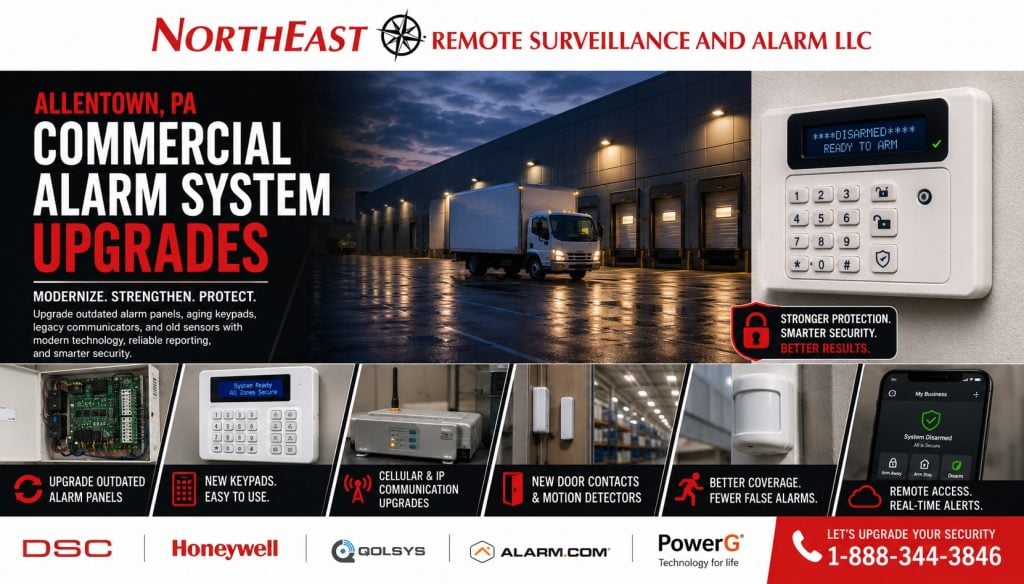
Northeast Remote Surveillance and Alarm, LLC upgrades panels, keypads, communicators, door contacts, motion detectors, reporting paths, user codes, partitions, monitoring, and after-hours protection.
For coordinated local upgrades, review Allentown Commercial Security System Upgrades and Retrofits.
Businesses planning new alarm design, device layout, detection, partitions, user codes, and after-hours protection should review Commercial Intrusion Alarm Systems in Allentown, PA.
Commercial Alarm System Upgrades for Allentown Businesses
Start by checking the panel model, firmware, and support status. Review the communicator, zone list, devices, wiring, monitoring account, and administrator access. Record the fault or change that prompted the upgrade so the work addresses a clear problem.
Related guidance: Commercial Alarm Systems in Allentown, PA.
When a Commercial Alarm System Should Be Upgraded
Review the system if alarm signals are unreliable, faults persist, or replacement parts are unavailable. Building changes may also leave doors or occupied areas outside the original design. Shared codes, unclear zone names, and outdated schedules may only need new programming and staff training.
Alarm Panel, Keypad, and Communicator Upgrades
Replace a panel when its capacity, supported reporting paths, or serviceability cannot meet the agreed scope. Check field-device compatibility before promising reuse. Locate keypads where authorized staff can complete entry and exit procedures without crossing protected areas unnecessarily. Include batteries, power supplies, circuit labeling, and an updated zone schedule in the estimate.
Related guidance: Legacy Phone Line Security System Upgrades.
Door, Motion, and Perimeter Detection Upgrades
Test door contacts with the door fully closed and through normal operation; worn hinges, loose magnets, and damaged cable can produce intermittent faults. Review motion-detector views for shelving changes, moving equipment, heat sources, and after-hours activity. Label each zone with a location that staff and monitoring operators can identify.
Wireless and Hardwired Alarm System Retrofits
Reuse wiring and detectors only after condition and compatibility checks. For wireless additions, verify supported device types, signal quality at the installed location, supervision, and battery maintenance. Test with normal doors, racks, and equipment in place. Document retained and replaced devices separately so future service does not depend on guesswork.
Alarm Upgrades for Warehouses and Logistics Facilities
Plan partitions and arming around shipping schedules, overnight occupancy, dock operations, and separate office areas. Test overhead-door contacts across actual door travel. Confirm who can disarm each area, how late deliveries are handled, and what monitoring should do when an alarm occurs during an authorized shift.
Alarm Upgrades for Offices, Healthcare, Schools, and Municipal Buildings
Separate public, staff, tenant, and restricted areas according to actual occupancy. Confirm cleaning and contractor schedules, entry delays, staff training, and responsibility for code removal. Security changes must preserve required exit operation; coordinate affected doors and life-safety interfaces with the responsible project team.
Video Verification and Camera-Supported Alarm Upgrades
Video support makes alarm upgrades more useful. Video verification can help determine whether an alarm event appears to be a real intrusion, employee activity, delivery issue, weather-related event, or false alarm.
Camera-supported alarm upgrades may help with:
- After-hours door openings
- Warehouse motion events
- Parking lot activity
- Loading dock alarms
- Restricted-area movement
- Gate or yard activity
- Remote incident review
- Faster decision-making during alarm events
Video verification does not replace proper alarm detection. It strengthens the response process by connecting alarm activity with visual information.
Reducing False Alarms During an Upgrade
False alarms often result from weak device placement, poor user training, aging equipment, environmental movement, loose contacts, failing batteries, unclear arming procedures, or outdated programming.
A commercial alarm upgrade can help reduce false alarms by improving:
- Door contact reliability
- Motion detector placement
- Wireless signal strength
- User code accountability
- Partition programming
- Entry and exit delays
- Zone descriptions
- Keypad locations
- Employee training
- Alarm verification workflows
- Maintenance and testing procedures
Design the system around real building movement, not old programming.
Alarm Monitoring Path and Cellular Upgrade Planning
Alarm communication is one of the most important parts of a commercial alarm upgrade. If the system cannot reliably report alarms, troubles, openings, closings, low batteries, and communication failures, the rest of the system is weaker.
Monitoring path upgrades may include:
- Replacing legacy phone line reporting
- Adding cellular alarm communication
- Adding IP or network-based reporting where appropriate
- Using dual-path communication where needed
- Improving communicator location and signal strength
- Replacing outdated alarm modules
- Testing alarm signal transmission
- Confirming account information and zone reporting
- Reviewing monitoring procedures
The right communication method depends on the property, available services, signal strength, monitoring requirements, and long-term reliability needs.
Access Control and Alarm Integration
Many Allentown businesses eventually need the alarm system to work with access control. This can be useful when employees enter through controlled doors, managers need access history, or the business wants better control over who can enter and disarm the building.
Alarm and access control integration may support:
- Employee entry accountability
- Door access event review
- Restricted-area control
- Scheduled access
- Reduced key dependence
- Easier user removal
- Better incident investigation
- Camera review tied to door events
Acceptance Testing and Handover
Before handover, place the account on an agreed test procedure with monitoring. Activate each affected zone and verify the received location, event type, and restoration. Test the agreed communication-failure and backup-power behavior, then confirm normal service is restored. Deliver the final zone list, user responsibilities, monitoring contacts, and unresolved exceptions.
What the Upgrade Proposal Should Document
NERSA reviews the existing equipment, site operation, and monitoring arrangements before defining work. The proposal should identify what will remain, what will change, any account or provider dependencies, the expected service interruption, and how the result will be tested.
Related Allentown Security Services
For broader modernization work, review Commercial Security System Takeovers, Upgrades, and Retrofits.
Frequently Asked Questions About Commercial Alarm System Upgrades in Allentown, PA
Do I need to replace my entire alarm system?
However, not always. Some existing wiring, door contacts, motion detectors, keypads, or wireless devices may be reusable if they are reliable and compatible with the upgrade plan. NERSA can evaluate the system and recommend what to keep, replace, or add.
Can I upgrade from phone line alarm monitoring?
Yes. Technicians can upgrade many older alarm systems from phone-line reporting to cellular, IP, or dual-path communication depending on the system, property, signal strength, and monitoring requirements.
Can an alarm upgrade reduce false alarms?
Yes. Teams can often reduce false alarms by replacing failing devices, improving motion detector placement, correcting door contacts, improving wireless signal strength, updating programming, reviewing entry and exit delays, and improving user training.
Can cameras be connected to an alarm system?
Yes. Cameras can support alarm review, video verification, after-hours event review, and faster incident investigation. This is especially useful for warehouses, loading docks, parking lots, yards, and restricted areas.
Can wireless alarm devices be added to an existing system?
Yes. Installers may add wireless devices when compatible with the system or when the panel is upgraded to support them. Wireless devices are useful where new wiring is difficult or disruptive.
Can different areas of the building be armed separately?
Yes. Technicians can program many commercial alarm systems with partitions so offices, warehouses, stockrooms, tenant areas, or restricted spaces can be controlled separately.
Is this the same as a new commercial alarm system installation?
No. An alarm upgrade modernizes an existing commercial alarm system. For new intrusion alarm design, review Commercial Alarm Systems in Allentown, PA.
Takeover Assessments for Existing Alarm Systems
An alarm upgrade can often preserve useful wiring and field devices, but only after technicians document and test the existing system. A takeover assessment identifies panel and communicator models, account ownership, device condition, zone labels, user permissions, monitoring paths, and any equipment that is locked to a former provider.
Northeast Remote Surveillance and Alarm separates three decisions: retain compatible equipment, modernize weak components, and replace only parts that vendors cannot support reliably. Typical priorities include correcting false-alarm sources, replacing obsolete cellular or phone-line communication, reorganizing partitions and schedules, and cleaning up codes for former employees or vendors.
Request a Commercial Alarm System Upgrade in Allentown, PA
For the assessment, gather the panel and communicator models, recent fault history, monitoring contact, and any available zone list. Note building changes and the times when testing or service interruptions can be accommodated.
Request a Security Assessment to schedule a commercial alarm upgrade review in Allentown, PA.
Compliance, Codes & Project Standards
NERSA plans commercial and industrial security work with applicable code, documentation, inspection and authority-having-jurisdiction requirements in mind. Requirements vary by system, property and jurisdiction. These resources support project planning; they do not establish legal compliance, certification or AHJ approval.
Related guidance: Regulatory compliance & inspection readiness · NERSA project standards · Documentation, testing & inspection readiness