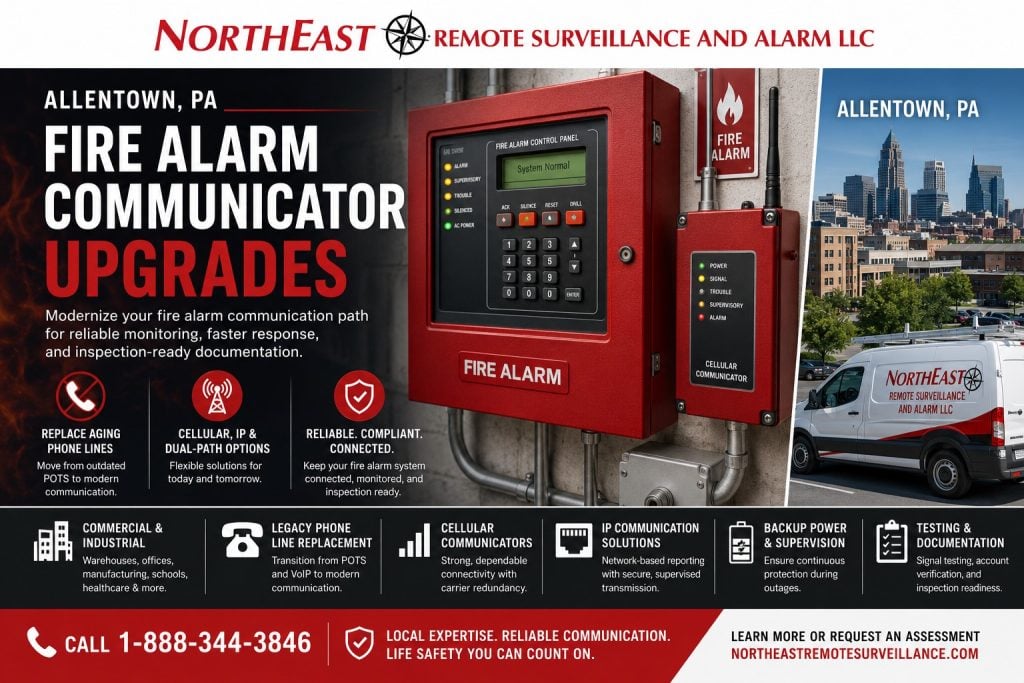
Allentown fire alarm communicator upgrades are part of NERSA’s Allentown retrofits and services program for commercial and industrial properties that need older fire alarm communication paths reviewed, replaced, or modernized without treating the entire fire alarm system as a full replacement. Northeast Remote Surveillance and Alarm, LLC helps Allentown facilities upgrade fire alarm communicators, replace aging phone-line paths, support cellular, IP, or dual-path reporting where accepted, clean up monitoring documentation, and improve inspection readiness around the fire alarm panel and supervising station connection. For broader citywide planning, start with Allentown Commercial Security Systems; for local fire alarm planning, use Commercial Fire Alarm Systems in Allentown, PA; for existing-system modernization, visit Commercial Security System Upgrades, Retrofits, and Takeovers; and for service-level fire alarm planning, visit Commercial & Industrial Fire Alarm Installation.

Fire Alarm Communicator Upgrades for Allentown Commercial Properties
A fire alarm communicator is the equipment that helps transmit fire alarm, supervisory, and trouble signals from the fire alarm control panel to the approved monitoring path or supervising station arrangement. When the communication path is outdated, unstable, poorly documented, or no longer supported, the fire alarm system may still appear normal at the panel while the monitoring side becomes harder to verify, service, or explain during testing.
Many Allentown commercial buildings still have fire alarm communication paths that were installed years ago. Some rely on aging copper phone lines. Some were affected by carrier changes, VoIP conversions, building network changes, cellular signal issues, or undocumented service history. Others have communicators that work but no longer match the owner’s long-term monitoring, testing, inspection, or documentation needs.
NERSA helps commercial and industrial properties evaluate the communicator, the fire alarm panel, the monitoring account, the signal path, the backup power condition, the documentation, and the long-term serviceability of the system before recommending a practical upgrade path.
For broader monitoring, testing, inspection, and documentation planning, visit Fire Alarm Monitoring, Testing, and Inspection Requirements.
What This Page Covers
This page is focused specifically on Allentown fire alarm communicator upgrades.
It is not the main Allentown commercial fire alarm page. It is not a complete fire alarm engineering guide. It is not a general intrusion alarm monitoring page. It is not a replacement for AHJ review, code design, inspection, or fire alarm engineering. It is a focused page for properties that need the communication path between the fire alarm system and monitoring arrangement evaluated or upgraded.
Use this page when the issue involves:
- Replacing old fire alarm phone-line communicators
- Upgrading to cellular fire alarm communication
- Reviewing IP or network-based fire alarm communication paths
- Supporting dual-path communication where appropriate
- Cleaning up monitoring account information
- Testing fire alarm signal transmission
- Replacing outdated communicator hardware
- Reviewing fire alarm trouble, supervisory, and alarm reporting
- Preparing for inspection or service documentation
- Coordinating communication upgrades with the fire alarm panel
- Reducing dependence on aging phone service
- Improving long-term support for commercial fire alarm monitoring
For full system planning, panel replacement, device layout, notification coverage, and broader life-safety work, use Commercial Fire Alarm Systems in Allentown, PA.
Why Fire Alarm Communicator Upgrades Matter
A fire alarm system is only useful if the correct signals can be transmitted, received, documented, and acted on through the monitoring arrangement. A building may have smoke detectors, pull stations, sprinkler monitoring, notification appliances, and a functioning fire alarm panel, but the communication path still needs to be reliable and supportable.
A communicator upgrade can help address weak points such as aging phone lines, poor signal transmission, unsupported equipment, unclear account information, trouble conditions, failed test signals, inconsistent monitoring records, or a lack of documentation around what signals are being sent.
Fire alarm communication should not be treated as a casual add-on. It is part of the life-safety system’s support structure and should be reviewed with attention to the building, panel, monitoring provider, AHJ expectations, power conditions, service history, and inspection requirements.
For code-aware fire alarm planning, visit NFPA 72 Fire Alarm Standards for Commercial Buildings.
Common Reasons Allentown Businesses Upgrade Fire Alarm Communicators
Many fire alarm communicator upgrades happen because the existing communication path is no longer the best fit for the building.
Common reasons include:
Old copper phone lines are being removed, changed, or priced higher.
The building converted to VoIP or cable-based phone service.
The fire alarm panel shows communication trouble.
The monitoring station is not receiving signals consistently.
The business needs better inspection documentation.
The communicator is outdated or unsupported.
The owner is changing monitoring providers.
The facility is preparing for an inspection or deficiency correction.
The building is being renovated or expanded.
The property needs a more supportable cellular or IP reporting path.
The system has no clear record of recent signal testing.
The communication path does not match the current use of the building.
A communicator upgrade may be a smaller, focused project compared with replacing the full fire alarm system, but it still needs to be planned correctly.
Legacy Phone Line Replacement for Fire Alarm Systems
Many older fire alarm systems were originally connected to traditional phone lines. As telephone infrastructure changes, businesses may need to review whether the old path is still reliable, approved, documented, and cost-effective.
Legacy phone-line replacement may involve moving to an approved cellular communicator, IP communicator, dual-path communicator, or other accepted communication method based on the fire alarm panel, monitoring provider, local requirements, and AHJ expectations.
The important point is that the fire alarm system should not be moved casually from one communication method to another without proper testing and documentation. A phone-line change can affect signal transmission, trouble reporting, monitoring procedures, and inspection readiness.
For broader phone-line modernization, visit Legacy Phone Line Security System Upgrades.
Cellular Fire Alarm Communicator Upgrades
Cellular fire alarm communicators are often used when a property wants to reduce dependence on older phone lines or create a more supportable monitoring path. A cellular communicator may be appropriate when the building has reliable cellular signal, the fire alarm panel can support the communicator, the monitoring arrangement is properly configured, and the method is acceptable for the project.
A proper cellular communicator upgrade should consider:
- Cellular signal strength
- Carrier availability
- Panel compatibility
- Communicator supervision
- Battery backup
- Power requirements
- Monitoring account setup
- Alarm, supervisory, and trouble signal testing
- AHJ expectations
- Documentation and labeling
- Long-term service access
The installation should end with verified signal transmission, not just equipment mounted near the panel.
IP and Network-Based Fire Alarm Communication
Some fire alarm systems may support IP or network-based communication paths. These systems require careful coordination because the fire alarm communicator may depend on building network equipment, internet service, routers, switches, firewalls, backup power, and network management practices.
If the network path is not dependable, the fire alarm communication path may become vulnerable to outages, configuration changes, equipment replacement, or power interruptions.
When IP communication is used, NERSA evaluates the practical infrastructure questions around the system:
Does the network equipment have backup power?
Who controls the router or firewall?
Is the communication path documented?
What happens during an internet outage?
Is the fire alarm communicator supervised?
Can signal transmission be tested clearly?
Will future IT changes affect the fire alarm path?
For supporting cabling, racks, fiber, UPS, and network infrastructure, visit Commercial & Industrial Infrastructure and Cabling.
Dual-Path Fire Alarm Communication
Some facilities may benefit from dual-path communication, depending on the fire alarm panel, communicator, monitoring provider, building conditions, and approval requirements. Dual-path communication may combine cellular, IP, or other approved paths so the system has a stronger reporting arrangement.
Dual-path planning should consider reliability, supervision, backup power, signal priority, monitoring configuration, testing procedures, and documentation. The goal is not simply to add another device. The goal is to create a monitoring path that can be verified, serviced, and explained.
Fire Alarm Communicator Upgrade Process
NERSA’s fire alarm communicator upgrade process starts with the existing system.
The review may include:
- Fire alarm control panel identification
- Existing communicator review
- Current phone, cellular, or IP path review
- Monitoring account review
- Trouble condition review
- Signal history discussion
- Battery and power supply review
- Cellular signal testing where needed
- Network pathway discussion where applicable
- AHJ or inspection-sensitive concerns
- Communicator selection
- Installation planning
- Signal testing
- Documentation cleanup
- Owner turnover information
The goal is to leave the property with a more supportable communication path and better understanding of how fire alarm signals are being transmitted.
Signal Testing and Monitoring Verification
A communicator upgrade is not complete until signals are tested and the monitoring arrangement is verified.
Testing may include alarm signals, supervisory signals, trouble signals, communication failure conditions, restore signals, and other required or relevant reporting conditions based on the system and monitoring setup.
Signal testing helps confirm that the fire alarm panel, communicator, communication path, and monitoring account are aligned. It also helps reduce confusion during inspections, service calls, tenant questions, insurance reviews, or emergency response procedures.
Documentation and Inspection Readiness
Documentation is one of the most important parts of a fire alarm communicator upgrade.
A commercial property should know:
What communicator is installed.
What communication path is being used.
What account information applies.
What signals were tested.
Who receives the signals.
What phone numbers, IP paths, or cellular paths are involved.
What changes were made.
What documentation was provided.
What issues still need attention.
Clean documentation helps the building owner, facility manager, monitoring provider, service technician, inspector, and AHJ understand the system more quickly.
For broader inspection readiness planning, visit Fire Alarm Monitoring, Testing, and Inspection Requirements.
When a Communicator Upgrade Is Not Enough
A communicator upgrade can solve many monitoring-path problems, but it does not fix every fire alarm issue.
A full system review may be needed if the fire alarm panel is obsolete, the system has unresolved trouble conditions, the building has changed occupancy or layout, notification coverage is incomplete, documentation is missing, devices are failing, batteries are weak, wiring is damaged, or the system has deficiencies beyond communication.
In those cases, the communicator may still be part of the solution, but the project may also require panel replacement, device repair, system expansion, documentation updates, or AHJ coordination.
For broader fire alarm system planning, visit Commercial & Industrial Fire Alarm Installation.
Fire Alarm Communicator Upgrades for Allentown Warehouses
Allentown warehouses, distribution centers, storage buildings, and logistics properties often rely on monitored fire alarm systems because the buildings may be large, partially occupied, active after hours, or connected to sprinkler supervisory systems.
A communicator upgrade may help improve reporting for waterflow, tamper, trouble, supervisory, and fire alarm signals. It may also support better documentation for facility managers who need to understand how the fire alarm system is monitored after normal business hours.
Warehouse communicator upgrades should be planned around the panel location, sprinkler monitoring points, communications path, backup power, service accessibility, and testing procedures.
Fire Alarm Communicator Upgrades for Manufacturing and Industrial Facilities
Manufacturing and industrial buildings may have demanding fire alarm conditions because of production areas, utility rooms, machinery, environmental factors, storage areas, shift work, and restricted spaces.
A fire alarm communicator upgrade in an industrial setting should account for electrical conditions, equipment room access, cellular signal reliability, network stability, backup power, documentation, and any existing trouble conditions.
The communicator is one part of the system, but it is often a critical part of how the facility documents and transmits life-safety events.
Fire Alarm Communicator Upgrades for Offices, Healthcare, Schools, and Municipal Buildings
Office buildings, healthcare properties, schools, churches, municipal facilities, and multi-tenant commercial buildings may need communicator upgrades during renovations, monitoring changes, phone-line replacement, inspection preparation, or ownership transitions.
These environments often require clear documentation because multiple stakeholders may be involved. Building owners, tenants, administrators, facility managers, service contractors, monitoring providers, and inspectors may all need confidence that the communication path is reliable and properly tested.
Fire Alarm, Security, and Infrastructure Coordination
Fire alarm communicator upgrades often intersect with security, access control, monitoring, and low-voltage infrastructure.
A fire alarm communicator should remain part of the fire alarm and life-safety system. It should not be casually blended with intrusion alarm monitoring, access control, video surveillance, or IT equipment without understanding the life-safety requirements.
At the same time, supporting infrastructure matters. A communicator may depend on power, cabling, network equipment, cellular signal, building pathways, or equipment room organization. NERSA evaluates these supporting conditions so the communicator upgrade is not treated as an isolated device swap.
For broader service planning across cameras, access control, alarms, monitoring, infrastructure, and fire alarm coordination, visit Commercial & Industrial Security Services.
Related NERSA Resources
For the main Allentown fire alarm planning page, visit Commercial Fire Alarm Systems in Allentown, PA.
For citywide commercial security planning in Allentown, visit Allentown Commercial Security Systems.
For fire alarm installation and life-safety service planning, visit Commercial & Industrial Fire Alarm Installation.
For monitoring, testing, inspection, and documentation readiness, visit Fire Alarm Monitoring, Testing, and Inspection Requirements.
For NFPA 72 planning and signal-transmission context, visit NFPA 72 Fire Alarm Standards for Commercial Buildings.
For low-voltage pathways, racks, UPS, cabling, and network support, visit Commercial & Industrial Infrastructure and Cabling.
For broader upgrade, retrofit, and takeover planning, visit Commercial Security System Upgrades, Retrofits, and Takeovers.
Request an Allentown Fire Alarm Communicator Upgrade Review
If your Allentown commercial or industrial property has old fire alarm phone lines, communication trouble, failed signal tests, outdated communicator hardware, monitoring documentation problems, or an upcoming inspection, Northeast Remote Surveillance and Alarm, LLC can help evaluate the system and recommend a practical upgrade path.
NERSA can review the existing fire alarm panel, communicator, signal path, monitoring account, backup power, cellular or IP options, testing needs, documentation gaps, and long-term service requirements.
Call 1-888-344-3846 or use Request a Commercial Security Assessment to schedule an Allentown fire alarm communicator upgrade review.
Code and AHJ Note
This page is general planning information for commercial and industrial property owners. Fire alarm communicator requirements depend on the adopted code edition, local amendments, building use, fire alarm panel, communicator listing, monitoring arrangement, communication path, and authority having jurisdiction. Northeast Remote Surveillance and Alarm, LLC supports practical fire alarm communication upgrades, monitoring coordination, documentation, and service planning, but final acceptance and requirements are controlled by the AHJ and applicable code path.
Frequently Asked Questions About Allentown Fire Alarm Communicator Upgrades
What is a fire alarm communicator?
A fire alarm communicator is the equipment that transmits fire alarm, supervisory, and trouble signals from a fire alarm control panel to the approved monitoring path or supervising station arrangement.
Why would a commercial building need a fire alarm communicator upgrade?
A building may need an upgrade because old phone lines are being removed, the communicator is outdated, the monitoring path is unreliable, the panel shows communication trouble, signal tests are failing, or documentation needs to be cleaned up before inspection.
Can a fire alarm system use cellular communication?
Many commercial fire alarm systems can use cellular communication when the communicator, panel, monitoring provider, signal strength, backup power, supervision, and AHJ acceptance are properly addressed.
Can a fire alarm communicator use internet or IP communication?
Some systems can use IP or network-based communication paths. These systems should be planned carefully because routers, switches, internet service, backup power, and firewall changes can affect reliability.
Is dual-path communication better?
Dual-path communication may be helpful in some applications because it can provide more than one reporting path. The correct answer depends on the system, building, communicator, monitoring provider, and approval requirements.
Can old fire alarm phone lines be replaced?
Yes. Many older phone-line communication paths can be reviewed and replaced with approved modern communication methods when the fire alarm panel, communicator, monitoring setup, and AHJ requirements support the change.
Does upgrading the communicator replace the whole fire alarm system?
No. A communicator upgrade is usually focused on the monitoring communication path. If the panel, devices, wiring, notification appliances, batteries, or documentation have other problems, those issues may need separate review.
What signals should be tested after a communicator upgrade?
Testing may include alarm, supervisory, trouble, restore, communication failure, and other relevant signal types based on the system and monitoring arrangement. Signal testing should confirm that the monitoring path is working correctly.
Will a communicator upgrade help with inspection readiness?
Yes. A properly documented communicator upgrade can help support inspection readiness by clarifying the communication path, installed equipment, monitoring account setup, and signal testing results.
Can NERSA help if my fire alarm panel has a communication trouble?
Yes. NERSA can review the fire alarm panel, communicator, phone line, cellular path, IP path, monitoring account, power condition, and signal testing history to identify the next practical step.
Does NERSA provide fire alarm communicator upgrades in Allentown, PA?
Yes. Northeast Remote Surveillance and Alarm, LLC provides commercial and industrial fire alarm communicator upgrades in Allentown, PA, including legacy phone-line replacement planning, cellular communicator upgrades, IP communication review, signal testing, monitoring coordination, and documentation support.
How do I schedule a fire alarm communicator upgrade review?
Call Northeast Remote Surveillance and Alarm, LLC at 1-888-344-3846 or use Request a Commercial Security Assessment to schedule a review for your Allentown commercial or industrial property.