Bethlehem Municipal Building Security Systems

Integrated Security for Government Offices, Public Works Facilities, Community Buildings, and Municipal Operations in Bethlehem, PA

Bethlehem municipal building security systems should protect employees, visitors, public records, government assets, fleet vehicles, critical equipment, restricted rooms, and public operations without creating unnecessary barriers for residents who need access to municipal services.

Northeast Remote Surveillance and Alarm, LLC designs, installs, integrates, monitors, upgrades, and supports commercial-grade security systems for municipal offices, government administration buildings, public works facilities, maintenance garages, fleet operations, utility properties, parks buildings, community centers, records facilities, and other publicly owned properties throughout Bethlehem, Pennsylvania.

Every municipal property operates differently. A public-facing administrative building does not have the same visitor traffic, employee movement, restricted areas, vehicle activity, operating schedule, or security responsibilities as a public works garage, utility building, fleet yard, parks facility, records archive, or community center.

NERSA begins with the property, its public function, its employees, its visitors, its infrastructure, and its operating risks—not a predetermined equipment package.

For broader citywide planning, begin with Commercial and Industrial Security Systems in Bethlehem, PA.

Request a Bethlehem Municipal Security Assessment
Call 1-888-344-3846

Commercial, municipal, and institutional systems only • Established in 2008 • New installations, upgrades, expansions, integrations, monitoring, and takeovers

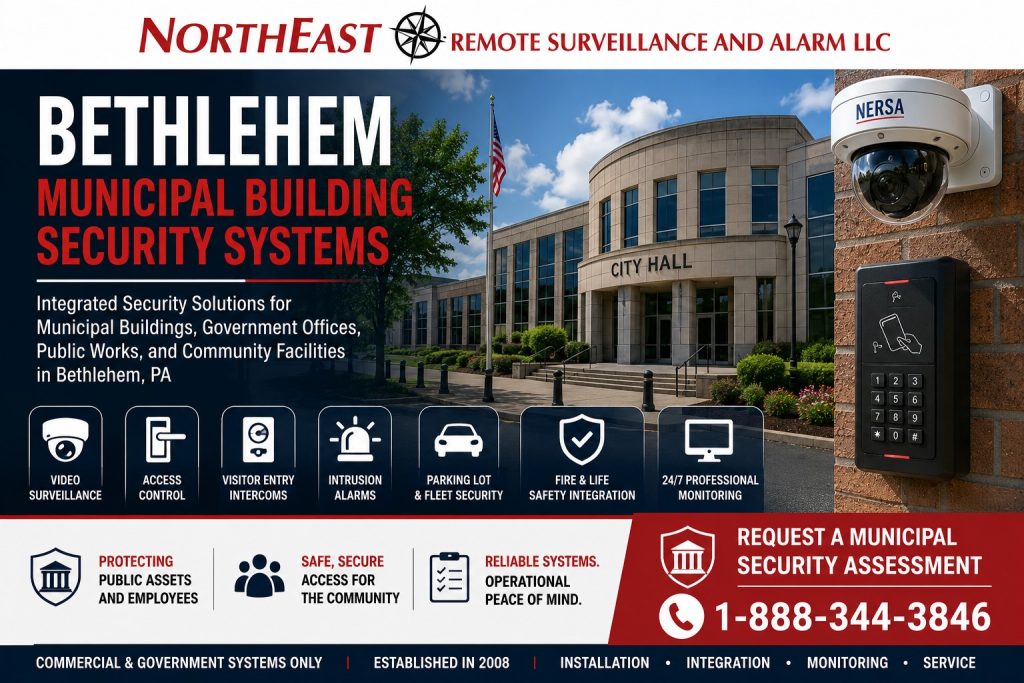
Bethlehem municipal building security systems featuring a city hall, commercial video surveillance, access control, visitor entry intercoms, intrusion alarms, parking lot and fleet security, fire and life-safety integration, and 24/7 professional monitoring by Northeast Remote Surveillance and Alarm, LLC.

Security Planning for Bethlehem Municipal Properties

Municipal security should not begin with a few cameras, a basic alarm panel, or card readers placed beside randomly selected doors. It should begin with an understanding of how the building serves the public and how employees, officials, visitors, contractors, vendors, deliveries, vehicles, records, equipment, and emergency responders move through the property.

A Bethlehem municipal security assessment may review:

  • Public entrances
  • Employee entrances
  • Visitor reception areas
  • Public service counters
  • Administrative offices
  • Council or public meeting rooms
  • Finance and payment areas
  • Human resources offices
  • Records and document storage
  • Information-technology rooms
  • Utility and mechanical spaces
  • Employee-only corridors
  • Public works garages
  • Vehicle maintenance areas
  • Fleet parking and storage
  • Fueling stations
  • Equipment and material yards
  • Parks and recreation buildings
  • Community centers
  • Detached municipal structures
  • Loading and delivery entrances
  • Parking lots and pedestrian routes
  • Vehicle gates
  • Existing cameras and recorders
  • Access-control systems
  • Intrusion alarms
  • Intercoms and visitor-entry systems
  • Fire alarm and life-safety interfaces
  • Low-voltage and network infrastructure
  • Monitoring and emergency-response procedures
  • Future building or system expansion

The objective is to provide appropriate public access while protecting staff-only areas, sensitive information, municipal assets, operational equipment, and critical infrastructure.

Layered Municipal Building Security

No single device can address every municipal security concern. Cameras cannot control a door. Access control cannot show what occurred in a parking lot. An intrusion alarm cannot manage a visitor during business hours. A stronger municipal security system combines several coordinated layers, with each system serving a defined operational purpose.

A layered Bethlehem municipal security system may include:

  • Commercial video surveillance
  • Employee access control
  • Controlled visitor entry
  • Video intercoms
  • Intrusion detection
  • Panic or duress devices
  • Professional alarm monitoring
  • Parking-lot surveillance
  • Fleet and vehicle-yard cameras
  • Gate access control
  • Door-position monitoring
  • Fire alarm and life-safety coordination
  • Low-voltage cabling and network infrastructure
  • Centralized system administration
  • Multi-building event review
  • Mobile and desktop management
  • System-health supervision
  • Documented response procedures

The systems should support the municipality’s established policies, staffing, public-access procedures, emergency plans, and departmental responsibilities.

Public Entrance and Visitor Management

Municipal buildings must often remain accessible to residents, taxpayers, applicants, vendors, contractors, meeting attendees, and other visitors. The security design should preserve appropriate public access while separating visitor areas from employee-only and restricted spaces.

Controlled visitor entry may include:

  • Exterior video intercom stations
  • Reception-area communication
  • Remote door release
  • Visitor-facing cameras
  • Controlled vestibules
  • Door-position monitoring
  • Public service counters
  • Accessible entrance hardware
  • Contractor and vendor check-in
  • Temporary visitor credentials
  • Delivery procedures
  • After-hours entry communication
  • Recorded intercom or entrance events
  • Secondary answering locations
  • Staff notification procedures

The visitor process should be based on the way the property actually operates. A system that rings only at an unattended desk, releases the wrong door, provides a poor camera view, or allows visitors to bypass reception will not provide effective control.

Public access and employee security should be planned together rather than treated as competing goals.

Municipal Access Control Systems

Mechanical keys can become difficult to manage across municipal facilities with employees, elected officials, maintenance personnel, seasonal workers, contractors, cleaning crews, vendors, department heads, and temporary users.

Commercial access control provides administrators with a more manageable way to issue, change, suspend, limit, and remove entry permissions without rekeying an entire building every time responsibilities change or a key is lost.

Access control may secure:

  • Employee entrances
  • Administrative offices
  • Finance departments
  • Human resources areas
  • Records rooms
  • Information-technology rooms
  • Utility control spaces
  • Mechanical rooms
  • Evidence or controlled storage
  • Fleet-maintenance areas
  • Public works garages
  • Parks and recreation buildings
  • Community-center offices
  • Equipment rooms
  • Supply storage
  • Council or executive areas
  • Detached facilities
  • Vehicle gates
  • After-hours entrances

Permissions can be organized by employee, department, facility, schedule, shift, door, or responsibility.

A public works employee may require different access than an administrator, finance employee, information-technology specialist, parks employee, contractor, or temporary worker. Access-control planning should reflect those differences.

For broader system design involving credentials, controllers, readers, door hardware, permissions, audit trails, and emergency egress, review Commercial and Industrial Access Control Systems.

Door Hardware, Emergency Egress, and Accessibility

An access-control system is only as dependable as the controlled opening. A card reader cannot correct a damaged frame, failing closer, misaligned latch, inappropriate locking device, or door that does not close consistently.

Municipal door planning may involve:

  • Electric strikes
  • Electrified locksets
  • Electrified panic hardware
  • Door-position switches
  • Request-to-exit devices
  • Accessible door operators
  • Power supplies
  • Emergency-release devices
  • Mechanical override
  • Door closers
  • Power-transfer hardware
  • Fire alarm release
  • Lockdown-capable openings
  • Forced-door alerts
  • Door-held-open alerts

Controlled doors must continue to support emergency egress, accessibility, fire alarm operation, and other applicable building requirements.

NERSA approaches each controlled opening as a complete door system rather than treating the reader as the entire installation.

Municipal Video Surveillance Systems

Video surveillance can improve situational awareness, incident documentation, public-area review, employee safety, fleet protection, property management, and investigation support when cameras are placed around defined operational objectives.

Potential camera locations include:

  • Main public entrances
  • Employee entrances
  • Reception areas
  • Public service counters
  • Building lobbies
  • Shared corridors
  • Stairways
  • Meeting-room entrances
  • Parking lots
  • Pedestrian approaches
  • Delivery areas
  • Building perimeters
  • Vehicle gates
  • Public works yards
  • Fleet parking areas
  • Fuel islands
  • Maintenance garages
  • Equipment-storage areas
  • Utility buildings
  • Parks facilities
  • Community centers
  • Detached structures
  • Loading areas
  • Restricted-room entrances

Camera placement should begin with the question the municipality needs the system to answer.

A general overview camera may show movement through a lobby or parking lot. A more focused camera may be required to identify a person at an entrance, document a vehicle entering a yard, review activity at a public counter, or verify access to a restricted room.

The system should also consider:

  • Daytime and nighttime image quality
  • Camera field of view
  • Identification distance
  • Lighting conditions
  • Video retention
  • Recording reliability
  • User permissions
  • Cybersecurity
  • Remote access
  • Export procedures
  • System-health alerts
  • Multi-building management
  • Future camera expansion

The goal is not to install the largest possible number of cameras. The goal is to create useful views, dependable recording, secure administration, and efficient incident review.

Privacy-Aware Video Planning

Municipal video surveillance should be planned with attention to public expectations, employee policies, records-management procedures, and areas where occupants may have a reasonable expectation of privacy.

The municipality should establish clear procedures addressing:

  • Who may view live video
  • Who may review recorded footage
  • Why video may be accessed
  • How long footage is retained
  • How exports are authorized
  • How exported footage is stored
  • How access is documented
  • How public-record requests are handled
  • How user permissions are reviewed
  • How former employees are removed
  • Where cameras should not be installed

Security technology should support municipal policy rather than substitute for it.

Public Works and Maintenance Facility Security

Public works properties may contain vehicles, tools, fuel, repair equipment, road materials, machinery, storage areas, and other municipal assets that remain exposed during evenings, weekends, and periods of reduced staffing.

Security planning may include:

  • Garage-door monitoring
  • Personnel-door alarms
  • Vehicle-yard cameras
  • Equipment-storage surveillance
  • Employee access control
  • Contractor access
  • Fuel-island cameras
  • Material-yard monitoring
  • Gate access control
  • Perimeter cameras
  • Building intrusion detection
  • Cellular communication
  • Video verification
  • Remote system management
  • Professional monitoring

Public works facilities often operate at unusual hours during weather events, emergencies, snow removal, road repairs, utility work, and seasonal operations. Alarm partitions, access schedules, monitoring instructions, and user permissions should account for these changing conditions.

Municipal Fleet and Vehicle-Yard Security

Municipal fleets can include service vehicles, public works trucks, maintenance vehicles, utility vehicles, snow-removal equipment, trailers, mowers, and specialty equipment.

Vehicle-yard security may support:

  • Vehicle entry and exit review
  • Fleet parking surveillance
  • Fueling activity
  • Equipment movement
  • Contractor vehicle access
  • After-hours activity
  • Gate events
  • License-plate documentation
  • Vandalism investigation
  • Theft investigation
  • Perimeter awareness
  • Remote monitoring

Exterior camera design requires attention to lighting, weather exposure, mounting height, distance, network connectivity, power, surge protection, and the difference between general awareness and identification-quality video.

A camera that merely shows that a vehicle was present may not provide the detail needed to identify the vehicle or review the event.

Parking-Lot and Exterior Security

Parking areas may serve employees, visitors, elected officials, contractors, public-meeting attendees, and municipal vehicles. Exterior visibility can be especially important during evening meetings, shift changes, community events, and periods of reduced staffing.

Parking-lot security planning may include:

  • Vehicle-lane coverage
  • Pedestrian routes
  • Accessible parking spaces
  • Employee parking
  • Visitor parking
  • Building approaches
  • Sidewalks
  • Exterior doors
  • Lighting conditions
  • Gathering areas
  • Emergency call or alert locations
  • After-hours monitoring
  • Camera views connected to entrance events

Exterior security should be designed around the actual movement of people and vehicles rather than around arbitrary camera spacing.

Intrusion Alarm Systems for Municipal Properties

Municipal buildings may remain vacant overnight while containing records, technology, tools, vehicles, equipment, and sensitive infrastructure.

A commercial intrusion alarm system may include:

  • Exterior-door contacts
  • Interior motion detection
  • Glass-break detection
  • Roof-hatch monitoring
  • Garage-door protection
  • Vehicle-gate monitoring
  • Restricted-room protection
  • Individual user codes
  • Area partitions
  • Open-and-close reporting
  • Cellular or IP communication
  • Dual-path communication
  • Professional monitoring
  • Video verification
  • Environmental alerts
  • Unexpected after-hours activity notifications

The system should be designed around the municipality’s operating schedule. A community room, meeting chamber, public works garage, administrative wing, or detached building may need to remain accessible while other areas are secured.

Partitioning can allow departments and buildings to operate independently without leaving the entire municipal property unprotected.

Panic, Duress, and Emergency Alerts

Public-facing employees may work at reception desks, payment counters, administrative offices, public meeting rooms, or other locations where they interact directly with visitors.

Panic or duress devices may be considered for areas identified during the municipality’s security assessment.

Emergency-alert planning should define:

  • Who is authorized to activate the device
  • Where devices are located
  • Whether devices are fixed, wireless, or software-based
  • What type of signal is transmitted
  • Who receives the notification
  • Whether professional monitoring is involved
  • Whether video is associated with the event
  • What escalation procedure follows
  • How devices are tested
  • How staff members are trained
  • How accidental activation is handled

A panic button is one component of an emergency-response plan. It does not replace employee training, written procedures, internal communication, law-enforcement coordination, or other municipal emergency planning.

Video Intercom and Remote Entry Communication

Video intercom systems can help municipal employees communicate with visitors at entrances, gates, service buildings, utility properties, public works facilities, and detached structures.

Applications may include:

  • Main public entrances
  • Employee entrances
  • After-hours entrances
  • Delivery doors
  • Public works gates
  • Fleet-yard entrances
  • Maintenance facilities
  • Utility buildings
  • Community centers
  • Parks buildings
  • Remote municipal sites

Depending on the selected platform, authorized personnel may answer from a reception station, administrative desk, computer, mobile device, or centralized security location.

The intercom should provide a clear view, dependable audio, proper door control, and a defined answering procedure.

Professional Monitoring and Alarm Response

Professional monitoring can support intrusion alarms, panic signals, communication failures, system troubles, environmental events, and other defined conditions.

Municipal monitoring instructions should identify:

  • Primary contacts
  • Secondary contacts
  • Department-specific contacts
  • Authorized users
  • Building names
  • Alarm partitions
  • Dispatch procedures
  • Verification requirements
  • Special operating schedules
  • Public-meeting schedules
  • Weather-emergency operations
  • Holiday changes
  • Escalation procedures
  • Testing requirements

Monitoring information should be reviewed when employees change, departments move, facilities are renovated, responsibilities shift, or communication services are replaced.

Outdated contact lists and unclear building descriptions can weaken the response even when the alarm equipment operates properly.

Fire Alarm and Life-Safety Coordination

Municipal security systems must not interfere with required emergency egress, accessibility, fire alarm operation, occupant notification, or other life-safety functions.

Security and life-safety coordination may involve:

  • Fire alarm release of controlled doors
  • Emergency egress behavior
  • Accessible entrance operation
  • Magnetic door-holder release
  • Elevator-related interfaces
  • Sprinkler supervisory monitoring
  • Fire alarm communication paths
  • Emergency notification
  • Backup power
  • Door-position supervision
  • Testing procedures
  • Inspection access
  • System documentation

Security equipment should support the building’s life-safety operation without attempting to replace required fire alarm functions.

Final design and approval may require coordination with municipal representatives, architects, engineers, fire officials, code officials, information-technology personnel, door-hardware professionals, and the Authority Having Jurisdiction.

Low-Voltage and Network Infrastructure

Modern municipal security systems depend on dependable cabling, network capacity, power, communication pathways, equipment locations, and cybersecurity controls.

Infrastructure planning may include:

  • Category cabling
  • Fiber-optic connections
  • Power-over-Ethernet switching
  • Network segmentation
  • Secure remote access
  • Equipment racks
  • Lockable enclosures
  • Uninterruptible power supplies
  • Surge protection
  • Wireless building links
  • Cellular backup communication
  • Exterior-rated cabling
  • Conduit and pathway planning
  • Cable labeling
  • Device naming
  • As-built documentation
  • Capacity for future expansion

Many system problems that appear to be camera, access-control, or alarm failures are actually caused by weak cabling, overloaded switches, poor power protection, undocumented networks, or inadequate communication paths.

Infrastructure should be treated as part of the security system rather than as an afterthought.

Unified Municipal Security Management

Municipal departments may inherit separate camera, access-control, intrusion, intercom, and monitoring platforms installed at different times.

Disconnected systems can make an incident harder to understand. One platform may record a door event, another may store video, and another may transmit an alarm without providing administrators with a complete timeline.

Depending on the selected platforms, integrated management may allow authorized users to:

  • Review video associated with a controlled door
  • Investigate forced-door events
  • Review invalid credential attempts
  • Associate alarms with camera views
  • Manage users and credentials
  • Monitor several municipal buildings
  • Standardize system naming
  • Receive system-health notifications
  • Search recorded events
  • Produce useful reports
  • Apply role-based permissions
  • Coordinate intercom communication with entry release
  • Review activity across several departments

Integration should serve a defined operational purpose. Systems should not be connected merely because integration is technically possible.

Multi-Building Municipal Security Systems

Bethlehem municipal operations may involve administrative buildings, public works properties, community facilities, parks buildings, utility locations, garages, and other geographically separated sites.

A multi-building security platform may support:

  • Centralized credential management
  • Department-specific permissions
  • Standardized camera naming
  • Consistent alarm reporting
  • Shared monitoring procedures
  • Building-specific user roles
  • Remote administration
  • Unified system-health monitoring
  • Common documentation standards
  • Scalable licensing
  • Coordinated support
  • Easier future expansion

Centralized management does not require every user to have access to every building or every system. Permissions can be limited according to responsibility, department, and location.

New Municipal Construction and Renovations

New construction and major renovation projects provide an opportunity to coordinate security, electrical, information technology, doors, fire alarm, communications, and building operations before walls and ceilings are completed.

Early security planning may address:

  • Camera locations
  • Reader locations
  • Door-hardware requirements
  • Visitor vestibule operation
  • Equipment-room space
  • Network connections
  • Fiber between buildings
  • Power supplies
  • Conduit and pathways
  • Gate communication
  • Emergency release requirements
  • Fire alarm interfaces
  • Future expansion capacity
  • Device naming
  • Testing responsibilities
  • Documentation and commissioning

Early coordination can reduce avoidable change orders, exposed cabling, incompatible door hardware, missing network connections, and poorly positioned devices.

Existing-System Upgrades and Takeovers

An aging or inherited municipal security system does not always need to be removed completely.

Existing cameras, cabling, door hardware, access-control panels, alarm devices, power supplies, network equipment, and communication pathways may still provide value when they are compatible, supportable, properly documented, and appropriate for the municipality’s current needs.

An upgrade or takeover assessment may review:

  • Camera image quality
  • Recorder age
  • Video retention
  • Unsupported software
  • Remote-access security
  • Existing access-control panels
  • Reader and credential compatibility
  • Door-hardware condition
  • Intrusion-alarm panels
  • Alarm communication paths
  • Intercom performance
  • Monitoring procedures
  • User and password control
  • Cabling condition
  • Network capacity
  • Backup power
  • Fire alarm interfaces
  • Missing documentation
  • Potential for phased modernization

A phased plan may allow the municipality to correct the most important risks first while maintaining a documented path for later improvement.

Scalable Security for Small Municipal Offices and Larger Operations

NERSA supports security projects ranging from individual municipal offices and small community buildings to multi-department properties and groups of municipal facilities.

A smaller property may need:

  • A controlled entrance
  • Several cameras
  • A monitored intrusion alarm
  • Staff access control
  • A video intercom

A larger municipal operation may require:

  • Centralized credential administration
  • Multiple buildings
  • Extensive exterior coverage
  • Fleet-yard cameras
  • Vehicle gates
  • Separate alarm partitions
  • Fiber connections
  • Department-specific user roles
  • Unified event review
  • Standardized documentation

The design should match the actual scale of the municipality. Smaller offices should not be forced into an unnecessarily complicated enterprise platform, while larger operations should not be restricted by equipment that cannot support additional users, doors, cameras, buildings, or administrative requirements.

Why Bethlehem Municipal Facilities Choose NERSA

Northeast Remote Surveillance and Alarm, LLC is based in Bethlehem and has served non-residential properties since 2008.

NERSA approaches municipal security as an operational, infrastructure, and long-term management project rather than as a collection of isolated devices.

Planning may consider:

  • Public access
  • Employee safety
  • Visitor communication
  • Staff credentials
  • Restricted areas
  • Records protection
  • Parking and vehicle activity
  • Fleet assets
  • Public works operations
  • Intrusion detection
  • Alarm response
  • Fire alarm coordination
  • Low-voltage infrastructure
  • Existing equipment
  • Documentation
  • Cybersecurity
  • Departmental responsibilities
  • Future expansion
  • Multi-building administration

The recommended system may involve a focused improvement to one entrance or a coordinated project across several municipal properties. The objective is to provide a dependable system the municipality can operate, understand, document, maintain, and expand.

Request a Bethlehem Municipal Security Assessment

A municipal security assessment should review the property before equipment is selected.

NERSA can evaluate public entrances, visitor procedures, employee access, restricted rooms, records areas, parking lots, fleet operations, public works yards, exterior exposure, cameras, alarms, intercoms, fire alarm coordination, monitoring procedures, existing infrastructure, system condition, and long-term expansion requirements.

Request a Commercial Security Assessment or call 1-888-344-3846 to discuss a Bethlehem municipal building or government-facility security project.

Commercial, municipal, and institutional systems only • Established in 2008 • New installations, upgrades, expansions, integrations, monitoring, and takeovers


Frequently Asked Questions About Bethlehem Municipal Building Security Systems

What types of municipal properties does NERSA support in Bethlehem?

NERSA supports municipal offices, government administration buildings, public works facilities, maintenance garages, fleet operations, parks buildings, community centers, utility properties, records facilities, storage buildings, and other non-residential municipal properties.

What security systems can be included in a Bethlehem municipal project?

A project may include commercial video surveillance, access control, controlled visitor entry, video intercoms, intrusion alarms, panic or duress devices, parking-lot cameras, fleet-yard surveillance, gate access control, professional monitoring, fire alarm coordination, and supporting low-voltage infrastructure.

Can public entrances remain accessible while employee areas are controlled?

Yes. Security can be designed so visitors reach reception areas, service counters, meeting spaces, or other approved public areas while employee offices, records rooms, technology rooms, maintenance areas, and other restricted spaces remain controlled.

Can access permissions be separated by municipal department?

Yes. Permissions may be organized by department, employee, role, building, door, schedule, shift, or responsibility. Administrators can change or remove credentials without rekeying every affected opening.

Can several municipal buildings use one access-control or video platform?

Yes. Many commercial systems support centralized administration across multiple buildings while maintaining location-specific permissions, user roles, camera access, reporting, and departmental separation.

Can existing municipal cameras, alarms, or access-control systems be upgraded?

Yes. NERSA can evaluate existing cameras, recorders, access-control panels, readers, door hardware, alarm devices, communication paths, intercoms, cabling, networks, users, and documentation to determine what can be retained, corrected, expanded, integrated, or replaced.

Can cameras be coordinated with access-control and alarm events?

Depending on the selected platforms, camera footage may be associated with forced doors, denied credentials, after-hours access, intrusion alarms, intercom calls, gate events, and other activity. Integration should be selected when it improves incident review, administration, reporting, or response.

Does NERSA support both small municipal buildings and larger multi-facility operations?

Yes. NERSA designs scalable systems for individual municipal offices and smaller community properties as well as larger public works sites, administrative buildings, fleet facilities, and multi-building municipal operations.

Can NERSA work in an occupied municipal building?

Many installations and upgrades can be completed in occupied properties with appropriate scheduling, access coordination, work-area control, public-notification planning, and communication with municipal representatives.

How should a Bethlehem municipality begin a security project?

Begin with a facility-specific security assessment. The assessment should review the property, public access, employees, visitors, departments, doors, restricted spaces, parking areas, vehicles, existing systems, infrastructure, monitoring procedures, life-safety considerations, and future goals before equipment is selected.


Scroll to Top
1-888-344-3846