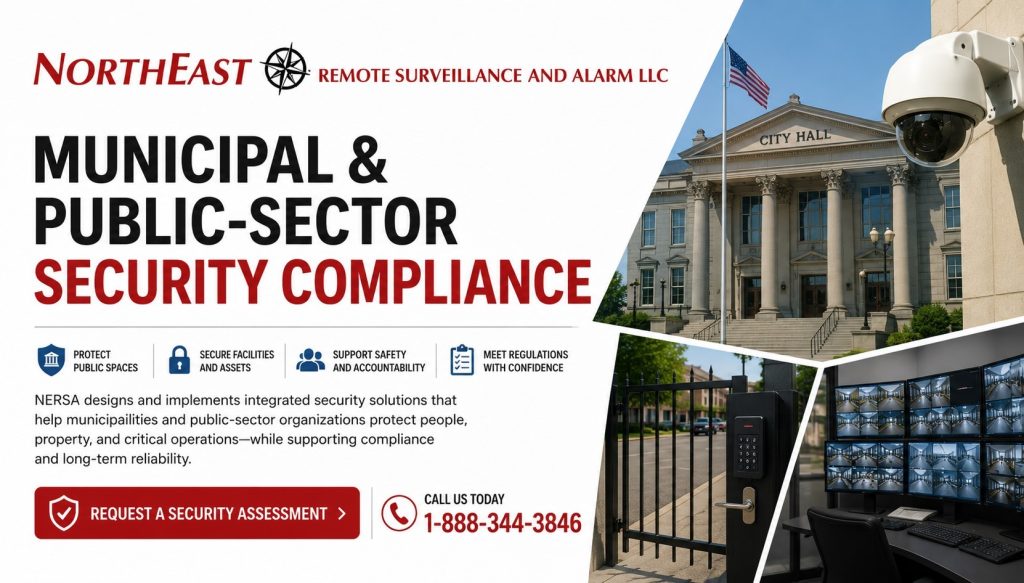
Municipal and public-sector security compliance planning helps government buildings, public works facilities, schools, utilities, parks departments, administrative offices, and public-facing properties improve security without creating avoidable access, documentation, procurement, life-safety, or inspection problems.
Northeast Remote Surveillance and Alarm, LLC supports municipal security planning as part of regulatory compliance and inspection readiness for commercial security systems for public-sector facilities across Pennsylvania and the Mid-Atlantic.
This guide covers compliance-aware planning for video surveillance, access control, intrusion alarms, fire alarm coordination, intercoms, emergency communication, cybersecurity, NDAA-aware equipment selection, documentation, and long-term service readiness.
Municipal and Public-Sector Security Compliance Planning for Municipal and Public-Sector Facilities
Municipal and public-sector buildings are different from standard private commercial properties. They may serve employees, residents, visitors, vendors, elected officials, contractors, emergency responders, utility workers, public works crews, students, and members of the public.
Review the building before selecting equipment. Include public entrances, staff-only areas, restricted records, payment offices, utility spaces and police support areas. Also assess public works yards, parks facilities, school entrances and activity after hours.
Municipal and public-sector security planning may involve:
- Public entrance video surveillance
- Staff entrance access control
- Visitor entry intercoms
- Public meeting room visibility
- Records room access control
- Police or administrative support space protection
- Public works facility cameras
- Parks and recreation building security
- Utility site monitoring
- School entry security technology
- Intrusion alarm systems
- Panic and duress alerts
- Door-forced-open alerts
- Door-held-open alerts
- Fire alarm monitoring coordination
- Emergency communication support
- Video retention and evidence export planning
- NDAA-aware camera and equipment selection
- Cybersecurity-aware system administration
- Inspection-ready documentation
Security systems do not create legal, procurement, ADA, OSHA, fire code, or public records compliance by themselves. They can support better visibility, access accountability, event documentation, response, and long-term service when they are planned correctly.
Public Buildings Need Security Without Blocking Access
Public-sector properties often need to balance security with public access. A municipal office, township building, borough hall, authority office, public works building, school facility, or recreation building may need to remain accessible to lawful visitors while protecting staff-only areas and sensitive rooms.
Security planning should consider:
- Main public entrances
- Reception areas
- Public counters
- Meeting rooms
- Staff-only corridors
- Records rooms
- Payment areas
- Administrative offices
- Evidence or secure storage areas
- IT rooms
- Mechanical and electrical rooms
- Public works garages
- Utility equipment spaces
- Parks and recreation buildings
- After-hours entrances
- Emergency responder access
The system should make it clear where visitors may go, where staff-only access begins, and how restricted spaces are protected.
Video Surveillance for Public-Sector Facilities
Video surveillance can support public-sector security by improving visibility around entrances, parking lots, public counters, exterior doors, meeting areas, public works yards, utility sites, and after-hours activity.
Municipal camera planning may include:
- Main entrance cameras
- Reception and lobby views
- Public meeting room entrances
- Parking lot cameras
- Exterior door cameras
- Public works yard cameras
- Fleet parking cameras
- Equipment storage cameras
- Utility site cameras
- Parks facility cameras
- School entrance cameras
- Hallway and common-area cameras
- Restricted room exterior views
- After-hours activity review
For permanent camera system design, visit commercial video surveillance systems.
Camera placement should be planned carefully. The system should provide useful visibility without creating unnecessary privacy concerns, weak evidence quality, unclear user permissions, or footage that is difficult to locate when an event needs to be reviewed.
Access Control for Staff-Only and Restricted Areas
Access control helps public-sector facilities separate public areas from staff-only areas. Instead of relying only on keys, municipalities and public agencies can use credentials, schedules, user permissions, and event history to manage access.
Access control may be useful for:
- Staff entrances
- Employee-only corridors
- Administrative offices
- Police support areas
- Records rooms
- IT rooms
- Mechanical rooms
- Electrical rooms
- Public works garages
- Utility control rooms
- Evidence or secure storage areas
- Parks department buildings
- Gate entrances
- School staff entrances
- Maintenance areas
- Payment offices
For complete access control system planning, visit commercial access control systems.
Access control is strongest when credentials are managed properly. Former employees, shared codes, unclear access groups, and unmanaged schedules can create avoidable accountability problems.
Visitor Entry, Intercoms, and Public Counter Security
Many municipal and public-sector buildings need controlled visitor entry without making the building confusing or difficult to use. Video intercoms, reception-controlled doors, visitor instructions, camera views, and remote door release can help staff manage entry points more safely.
Visitor entry planning may include:
- Main entrance intercoms
- Reception desk release
- Video verification of visitors
- Public counter camera views
- After-hours entry procedures
- Staff-only interior doors
- Delivery entrance communication
- Gate intercoms
- Visitor waiting area visibility
- Remote release procedures
- Integration with access control
- Integration with video surveillance
A public visitor process should be clear. People should know where to enter, how to request access, and when a door is restricted.
Door Hardware, Egress, and Accessibility
Public-sector access control must be planned around safe exit, emergency release, fire-rated openings, door hardware, accessibility, and inspection expectations. A secure door should not create a barrier for lawful use or an issue during emergency exit.
Controlled door planning may involve:
- Card readers
- Keypad readers
- Mobile credentials
- Electric strikes
- Electrified locks
- Electrified trim
- Door contacts
- Request-to-exit devices
- Emergency release buttons
- Fire alarm interface
- Door position monitoring
- Automatic operator coordination
- Door release timing
- Access control power supplies
For controlled door egress planning, visit access control egress and life safety compliance.
For accessibility-focused entry planning, visit ADA and Commercial Access Control Planning.
A public-sector security system should support secure access while respecting public use, staff workflow, emergency egress, and accessibility planning.
Fire Alarm, Emergency Communication, and AHJ Coordination
Municipal and public-sector facilities may have fire alarm systems, sprinkler monitoring, fire alarm communicators, emergency communication systems, elevator interfaces, access-controlled doors, or other life-safety systems that require coordination.
Security work may need fire alarm awareness when it involves:
- Fire alarm monitoring changes
- Fire alarm communicator upgrades
- Legacy phone line replacement
- Cellular or IP monitoring paths
- Access-controlled door release
- Maglock release
- Fire alarm interface relays
- Emergency communication equipment
- Monitoring account changes
- Documentation for inspection
- Testing after system changes
For fire alarm monitoring and inspection support, visit fire alarm monitoring, testing, and inspection.
For AHJ-sensitive projects, visit AHJ coordination for commercial security and fire alarm projects.
Fire alarm communication and access-controlled door changes should be planned, tested, and documented so the facility does not create avoidable trouble conditions, missed signals, or inspection confusion.
NDAA-Aware Equipment Selection and Public-Sector Procurement
Municipal, school, utility, public works, and publicly funded projects may need additional attention to manufacturer selection, procurement rules, grant requirements, equipment trust, and long-term support.
NDAA-aware planning may be important when a project involves:
- Public-sector procurement
- Federal funding concerns
- Grant-funded security projects
- Sensitive government facilities
- Utility or critical infrastructure sites
- Schools and municipal buildings
- Police, public works, or emergency support spaces
- Long-term camera manufacturer trust
- Video surveillance replacement
- Security system standardization
For equipment-selection planning, visit NDAA Compliance for Commercial Security Systems.
Public-sector buyers should avoid treating camera selection as a low-bid equipment decision only. The manufacturer, firmware support, cybersecurity practices, remote access method, warranty, documentation, and procurement requirements all matter.
Cybersecurity, Remote Access, and User Administration
Modern public-sector security systems may include cloud cameras, mobile apps, remote viewing, video management software, access control databases, intercom platforms, user permissions, and vendor administration. These systems should be managed carefully.
Cybersecurity-aware planning may involve:
- User account control
- Administrator permissions
- Remote viewing access
- Mobile credential management
- Camera network separation
- Firmware management
- Password practices
- Vendor access control
- Network segmentation
- Audit trails
- Deactivation of former users
- Role-based permissions
- Shared agency access review
- IT department coordination
For security system cybersecurity planning, visit cybersecurity and data protection standards for commercial security systems.
Security systems should not create unnecessary technology risk for a public agency. Cameras, access control platforms, remote monitoring tools, and cloud services should be administered as part of the agency’s broader technology environment.
Public Works, Utility, and Fleet Security
Public works and utility sites often include equipment yards, fleet parking, salt storage, fuel areas, garages, remote buildings, maintenance shops, and utility infrastructure. These properties may have fewer public visitors but higher exposure to theft, vandalism, after-hours access, and operational disruption.
Security planning may include:
- Yard cameras
- Fleet parking cameras
- Gate access control
- License plate recognition
- Equipment storage cameras
- Fuel area visibility
- Maintenance shop access control
- Utility room protection
- Remote building alarms
- Environmental monitoring
- After-hours video monitoring
- Live talk-down where appropriate
- Intrusion detection
- Cellular backup communication
Public works security should be planned around the facility’s actual movement patterns, vehicle traffic, outdoor storage, and after-hours activity.
Schools, Recreation Buildings, and Public Gathering Spaces
Some municipal and public-sector facilities include schools, recreation buildings, community centers, athletic facilities, parks buildings, public meeting areas, and event spaces. These sites may require stronger attention to visitor entry, after-hours use, emergency communication, camera coverage, and public access.
Security planning may support:
- Visitor entrance control
- Video intercoms
- Door status monitoring
- Panic and duress alerts
- Public meeting room visibility
- Parking lot cameras
- Exterior building cameras
- Athletic entrance cameras
- After-hours access control
- Event entrance monitoring
- Emergency communication support
- Remote monitoring
For school-focused security planning, visit weapons detection and school security technology.
Public gathering spaces require practical security that helps staff see, communicate, and respond without creating unnecessary barriers for lawful public use.
Intrusion Alarms and After-Hours Protection
Municipal and public-sector facilities often have after-hours risks. Offices, public works yards, schools, parks buildings, garages, utility spaces, records rooms, and remote facilities may be unoccupied overnight, on weekends, or during holidays.
Intrusion detection may protect:
- Main entrances
- Staff entrances
- Rear doors
- Garage doors
- Public works buildings
- Parks buildings
- Utility buildings
- Records rooms
- IT rooms
- Evidence or secure storage
- Offices
- Yard gates
- Detached buildings
- Interior trap areas
For alarm system planning, visit commercial alarm systems.
An alarm system should match the facility schedule. A municipal building with evening meetings, public events, cleaning crews, public works staff, and weekend access should not be programmed like a standard office.
Remote Monitoring and Managed Security Response
Remote monitoring and managed response can support public-sector properties when activity occurs after hours or when staff are limited. Event-based monitoring can help verify alarms, review camera activity, document events, and notify the proper contacts.
Managed response may support:
- After-hours exterior activity
- Public works yard activity
- Parking lot events
- Gate activity
- Parks facility activity
- Utility site events
- Door-forced-open alerts
- Alarm verification
- Live talk-down where appropriate
- Manager notification
- Police or emergency response coordination when appropriate
- Event documentation
For event handling and response planning, visit security operations center and managed security response.
Remote monitoring should be tied to site-specific instructions. The agency should define who is contacted, when video is reviewed, when live talk-down may be used, and when escalation is appropriate.
Video Retention, Public Records, and Evidence Documentation
Public-sector camera footage and access records may be subject to internal policies, legal review, public records rules, evidence handling procedures, or agency retention requirements. Security systems should be planned so authorized personnel can locate, review, export, and document footage responsibly.
Video documentation planning should consider:
- Recording duration
- Important camera views
- Storage capacity
- Time and date accuracy
- User permissions
- Export process
- Clip naming
- Incident notes
- Manager review process
- Who can view footage
- Who can export footage
- How footage is shared
- How requests are handled
- How law enforcement support is coordinated
For evidence-focused planning, visit video surveillance documentation and evidence retention planning.
NERSA can help with the security system side of retention and export planning. Public records handling, legal release decisions, and formal evidence policies should be set by the agency, solicitor, legal counsel, or governing authority.
Low-Voltage Infrastructure and Long-Term Reliability
Municipal and public-sector buildings often need long-term serviceability. Security systems may remain in use through budget cycles, leadership changes, renovations, grants, upgrades, and department changes.
Infrastructure planning may include:
- Camera cabling
- Access control cabling
- Alarm wiring
- Intercom cabling
- Fiber links
- Wireless bridges
- Network switches
- Equipment rooms
- PoE switching
- UPS power
- Cellular backup
- Device labeling
- Cable pathways
- Conduit needs
- Service access
- Security network segmentation
For infrastructure-specific planning, visit low-voltage infrastructure compliance for security systems.
A public-sector security system should be maintainable. Poor infrastructure, unlabeled equipment, short-term wiring decisions, and missing documentation can create avoidable problems years after installation.
Documentation for Procurement, Inspection, and Service
Municipal and public-sector security systems are easier to inspect, service, troubleshoot, and upgrade when documentation is clean. Documentation also helps the agency understand what it owns, how it operates, and what should be maintained.
Useful documentation may include:
- Camera location list
- Camera view descriptions
- Access-controlled door list
- Alarm zone list
- Door hardware notes
- Intercom locations
- Panic button locations
- Panel locations
- Power supply locations
- Network equipment locations
- Monitoring information
- Fire alarm interface notes
- Communication path notes
- User permission structure
- Access schedules
- Video retention settings
- Response procedures
- Testing records
- Service notes
- As-built information when applicable
- Warranty and support details
Documentation should support future service, inspections, procurement records, grant files, ownership changes, renovations, insurance review, and system expansion.
Common Municipal and Public-Sector Security Compliance Problems
Many public-sector security problems happen because equipment is installed without reviewing the full operation.
Common issues include:
- Cameras selected without procurement or NDAA awareness
- Public entrances controlled without clear visitor procedures
- Staff-only doors protected only by keys
- Former employees not removed from access control
- Shared alarm codes
- Weak user permission management
- No evidence export procedure
- No video retention plan
- Cameras placed without privacy review
- Intercoms placed where visitors cannot find them
- Controlled doors installed without egress review
- Fire alarm communication changes without testing
- Security networks installed without cybersecurity planning
- Poor documentation for controlled doors or alarm zones
- No clear after-hours response instructions
- Unlabeled equipment and incomplete service records
A better plan starts with the public use of the building, the staff workflow, the restricted areas, the agency’s documentation needs, and the long-term service environment.
Related Planning
Coordinate municipal security with procurement, public access, records, accessibility, and project requirements.
- regulatory compliance and inspection readiness for commercial security systems — Review project requirements, documentation and inspection coordination.
- commercial access control systems — Plan approved-user access to public-sector buildings and restricted spaces.
- commercial video surveillance systems — Review camera coverage and incident documentation for the property.
- access control egress and life safety compliance — Coordinate controlled openings with egress and life-safety requirements.
Why Municipal and Public-Sector Facilities Choose Northeast Remote Surveillance and Alarm
Northeast Remote Surveillance and Alarm, LLC designs commercial and institutional security systems for public-sector environments where access, visibility, documentation, cybersecurity, and dependable support matter.
Our team helps municipalities, agencies, schools, utilities, and public works departments review security before installation. We evaluate cameras, access control, alarms, panic buttons, intercoms, and monitoring. We also review door hardware, cabling, network needs, user permissions, video retention, and documentation.
Municipal and public-sector facilities choose NERSA because we provide:
- Commercial and public-sector security planning experience
- Public entrance and visitor flow review
- Staff-only area access control
- Camera planning with documentation awareness
- NDAA-aware equipment selection support
- Alarm and panic alert options
- Intercom and visitor entry support
- Fire alarm coordination awareness
- Cybersecurity-aware system administration
- Documentation for service and inspection readiness
- Long-term support after installation
A public-sector security system should help protect people, support staff, guide visitors, document events, and remain serviceable over time.
Request a Municipal and Public-Sector Security Compliance Assessment
NERSA can help plan security for municipal buildings, public works facilities, schools, utilities, parks departments, and government offices. We review cameras, access control, alarms, panic alerts, intercoms, monitoring, and facility alerts. Fire alarm coordination, cybersecurity, and documentation are also part of the planning discussion.
Call 1-888-344-3846 or request a security assessment to review your facility, entrances, public access points, staff-only areas, camera coverage, access-control doors, alarm needs, monitoring procedures, procurement concerns, and documentation gaps.
We support municipal and public-sector security compliance planning throughout the Lehigh Valley, Northeastern Pennsylvania, Central Pennsylvania, Greater Philadelphia, New Jersey, Delaware, and the Mid-Atlantic region.
Frequently Asked Questions about Municipal and Public-Sector Security Compliance
Does a security system make a municipal building compliant?
No. A security system does not make a municipal building compliant by itself. Cameras, access control, alarms, and monitoring can support visibility, documentation, access accountability, and response procedures, but they do not replace legal review, procurement policies, ADA requirements, public records policies, life-safety requirements, or AHJ approval.
Why does NDAA-aware equipment selection matter for public-sector buyers?
Municipal, school, utility, and grant-funded projects may need stronger attention to camera manufacturer selection, equipment trust, procurement requirements, federal funding concerns, and long-term support. NDAA-aware planning helps reduce equipment selection risk.
How can access control support municipal security?
Access control can protect staff entrances, employee-only corridors, records rooms, IT rooms, public works buildings, utility rooms, evidence storage, gate entrances, and other restricted areas. It can also document which users accessed controlled openings and when access occurred.
Where should cameras be placed in a public-sector building?
Common camera locations include public entrances, reception areas, parking lots, exterior doors, public counters, hallways, public works yards, fleet areas, utility sites, and staff entrances. Camera placement should avoid unnecessary privacy concerns and should be planned with retention and access permissions in mind.
Can public-sector access control affect ADA or egress requirements?
Yes. Controlled doors, intercoms, readers, automatic operators, maglocks, electric locks, and door release systems should be planned with accessibility, safe egress, emergency release, and inspection readiness in mind.
Can municipal security systems support public records or evidence requests?
Security systems can support responsible retention, export, and documentation of video or event records. Public records release, evidence policy, and legal handling should be set by the agency, solicitor, legal counsel, or governing authority.
Can remote monitoring support public works or parks facilities?
Yes. Remote monitoring can support after-hours awareness, alarm verification, video review, live talk-down where appropriate, manager notification, and event documentation for public works yards, parks buildings, parking lots, gates, and remote facilities.
Why does cybersecurity matter for municipal security systems?
Municipal security systems may include cloud cameras, mobile apps, access control software, remote viewing, user accounts, and vendor administration. Cybersecurity-aware planning helps protect system access, permissions, remote administration, and agency networks.
What documentation should be kept for a public-sector security system?
Useful documentation may include camera locations, access-controlled doors, alarm zones, panic button locations, intercom locations, monitoring information, user permissions, video retention settings, response procedures, testing records, service notes, and warranty details.
What is the best next step for Municipal and Public-Sector Security Compliance planning?
The best next step is a site-specific assessment. NERSA can review public entrances, staff-only areas, restricted rooms, camera coverage, access-control doors, alarm needs, monitoring procedures, procurement concerns, cybersecurity issues, and documentation requirements before recommending a system design.