
Northeast Remote Surveillance and Alarm, LLC designs, installs, upgrades and supports security systems for qualifying behavioral healthcare and related institutional facilities throughout the Lehigh Valley.

Request a Behavioral Healthcare Security Assessment
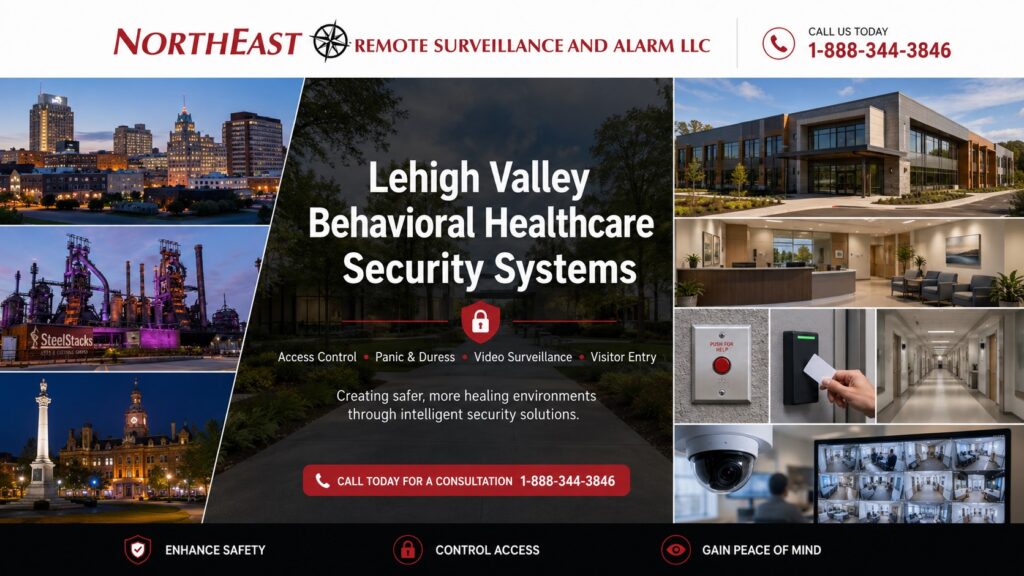
Commercial & Institutional Security for Behavioral Healthcare Facilities in Allentown, Bethlehem, Easton and the Lehigh Valley
Behavioral healthcare properties can present security requirements that differ significantly from conventional offices and other commercial buildings. Staff safety, patient and visitor movement, controlled entrances, restricted areas, emergency signaling, privacy considerations and after-hours operation may all need to function within the same facility.
Behavioral healthcare security is part of NERSA’s broader Lehigh Valley Healthcare Security Systems planning for medical, clinical and institutional properties throughout the region.
Call 1-888-344-3846 to discuss a behavioral healthcare security project.
Commercial & Institutional Systems Only • Allentown • Bethlehem • Easton • Lehigh County • Northampton County
Security Planning for Behavioral Healthcare Environments
A behavioral healthcare security system should begin with an understanding of how the facility actually operates.
Patients, visitors, clinicians, administrative employees, contractors and support personnel may use different entrances and move through different portions of the property. Some areas may remain publicly accessible while others must be limited to employees or specifically authorized personnel.
Security planning may need to consider:
- Staff safety
- Patient and visitor movement
- Reception and intake
- Employee entrances
- Staff-only areas
- Restricted clinical spaces
- Medication and records areas
- Administrative offices
- Emergency signaling
- After-hours operation
- Exterior approaches
- Existing security infrastructure
- Multiple departments or buildings
- Future expansion
The objective is not simply to install additional cameras, locks or alarm devices.
The security environment should support the facility’s operating procedures while helping employees control access, recognize security events, protect restricted spaces and respond appropriately when assistance is required.
Security Should Follow the Way People Move Through the Facility
Behavioral healthcare properties frequently contain several levels of access within the same building.
A main entrance may need to remain welcoming and accessible while employee areas, medication spaces, records rooms, administrative offices and other restricted locations require stronger control.
Planning should begin by identifying:
- Where patients and visitors normally enter
- Where employees enter
- Where reception or intake occurs
- Which areas should remain staff-only
- Which locations contain sensitive assets or information
- Where employees may require assistance
- How visitors are handled after normal business hours
- Which departments remain occupied when other areas are closed
- How a security event should be communicated and managed
These operational differences help determine where security measures are useful without treating every door, room or department the same way.
Door conditions are equally important. Locks, latches, closers, exit hardware, position monitoring and electronic security equipment must work together so controlled openings operate reliably while maintaining required egress.
Staff Safety and Coordinated Emergency Response
Staff safety can be an important part of behavioral healthcare security planning.
Employees may work at reception desks, intake areas, staff stations, administrative offices, consultation spaces and other locations where rapid assistance could occasionally be required.
Panic or duress technology can support that need, but the device itself is only one part of the response.
The organization should establish who receives an emergency event, how the location is identified, whether signaling should be silent or audible, who is expected to respond and what happens after the event is initiated.
Security technology should reinforce that response procedure rather than create uncertainty during an emergency.
Facilities requiring a more detailed review of employee emergency signaling can visit Lehigh Valley Healthcare Panic & Duress Systems.
Controlled Entry and Visitor Boundaries
Behavioral healthcare facilities often need to maintain a welcoming public entrance while limiting unrestricted movement farther into the building.
Reception personnel may need to communicate with visitors, confirm the purpose of the visit or release a controlled opening before access is provided beyond the public portion of the facility.
Different procedures may also apply during evenings, weekends or periods of reduced staffing.
Depending on the property, planning may consider:
- Main public entrances
- Employee entrances
- Reception and intake areas
- Staff-only corridors
- Controlled interior doors
- Visitor communication
- Door-release procedures
- After-hours entry
- Door-status awareness
- Appropriate separation between public and restricted areas
The objective is to support legitimate visitors without unnecessarily exposing employee-only or sensitive portions of the facility.
For facilities requiring dedicated entrance communication and controlled visitor admission, see Lehigh Valley Healthcare Visitor Entry & Video Intercom Systems.
Privacy-Conscious Situational Awareness
Video surveillance can provide useful situational awareness and incident documentation where cameras are appropriate for the facility.
Potential coverage may include public entrances, exterior approaches, parking areas, employee entrances and selected common spaces where recorded video provides a legitimate security benefit.
Behavioral healthcare environments require more deliberate camera planning than simply attempting to record every available area.
Important considerations may include:
- The purpose of each camera
- Facility policy
- Patient privacy
- Staff procedures
- Appropriate camera locations
- Authorized video users
- Evidence requirements
- Recording retention
- Lighting conditions
- Exterior operating conditions
The goal should be useful security visibility rather than indiscriminate coverage.
Where systems are compatible and appropriately designed, video may also provide valuable context around selected access, intrusion or emergency-signaling events.
Restricted Areas, After-Hours Operations and Exterior Movement
Security requirements may change considerably as employees, patients and visitors move between public, controlled and restricted portions of a behavioral healthcare property.
Medication rooms, records areas, staff offices, IT rooms, administrative spaces, mechanical rooms and other sensitive locations may require different protection than reception or public waiting areas.
The same principle applies after normal business hours.
One department may remain occupied while another closes. Employees may use a different entrance in the evening. Visitor procedures may change when reception is no longer staffed. Alarm instructions and controlled-door schedules may also need to reflect those operating differences.
Exterior conditions should be considered as part of the same facility-wide plan.
Employees may arrive early, leave late or travel between parking areas and the building during periods of reduced staffing. Main entrances, staff entrances, walkways, parking areas, service approaches and other exterior locations should therefore be evaluated according to how the property actually operates.
The result should be a coordinated security environment rather than separate systems functioning independently without a common operating plan.
Existing, Expanded and Multi-Site Behavioral Healthcare Facilities
Many behavioral healthcare organizations already have security equipment in place.
Existing cameras, controlled doors, alarm systems, panic devices, intercoms, cabling, power supplies and network infrastructure should be evaluated before complete replacement is recommended.
A system review may consider:
- Equipment condition
- Compatibility
- Reliability
- Existing administrative access
- Door hardware
- Cabling and pathways
- Network infrastructure
- Power supplies
- Current monitoring
- Available documentation
- Expansion requirements
Useful infrastructure may be retained where practical, while obsolete, unsupported or unreliable components can be repaired, reconfigured or replaced as necessary.
The same planning becomes especially important when an organization operates multiple locations or buildings.
Outpatient centers, treatment facilities, counseling offices, administrative buildings and other sites may benefit from more consistent user management, administrative permissions, naming standards and operating procedures when compatible systems are deployed.
Organizations evaluating an existing healthcare security environment can also review Lehigh Valley Healthcare Security Upgrades & Retrofits.
New Construction and Behavioral Healthcare Renovations
New construction, expansion and renovation projects provide an opportunity to address security requirements before walls, ceilings and finished surfaces make changes more complicated.
Early coordination can identify:
- Controlled openings
- Staff emergency-signaling locations
- Appropriate camera positions
- Visitor-entry points
- Equipment locations
- Cable pathways
- Network requirements
- Power requirements
- Future expansion capacity
Security planning should also account for affected door hardware, information technology, building systems and required life-safety operation.
Addressing these requirements during the design and construction process can help create a cleaner installation and reduce avoidable modifications later in the project.
Behavioral Healthcare Security Assessment
NERSA approaches behavioral healthcare security by evaluating the facility before recommending a particular equipment package.
A site-specific assessment may review:
- Facility operation
- Staff locations
- Patient and visitor movement
- Public and employee entrances
- Restricted spaces
- Emergency-signaling requirements
- Existing security systems
- Exterior conditions
- Parking and building approaches
- Monitoring requirements
- Available infrastructure
- Administrative responsibilities
- Future expansion
The assessment establishes what the organization needs the security system to accomplish and identifies where technology can realistically support those requirements.
This approach can also help determine which existing components remain useful, where security gaps exist and which improvements should receive priority.
Frequently Asked Questions About Behavioral Healthcare Security Systems
What is different about security in a behavioral healthcare facility?
Behavioral healthcare security may need to address staff safety, patient and visitor movement, controlled access, emergency signaling, privacy considerations and normal facility operations within the same property.
Does NERSA provide behavioral healthcare security systems throughout the Lehigh Valley?
Yes. NERSA supports qualifying behavioral healthcare and institutional facilities throughout Allentown, Bethlehem, Easton, Lehigh County, Northampton County and surrounding Lehigh Valley communities.
Can staff use panic or duress devices?
Yes. Fixed or wireless emergency-signaling devices may be appropriate in selected locations when they are supported by a clearly defined response procedure.
Can access be restricted to employee-only areas?
Yes. Controlled entry can help establish appropriate separation between public areas and employee-only, administrative, medication, records and other restricted spaces.
Can visitor entrances be controlled?
Yes. Depending on the facility, visitor entry may involve reception procedures, intercom communication, controlled door release and other appropriate entry-management methods.
Can security cameras be used in behavioral healthcare facilities?
Yes, where appropriate. Camera placement should consider the purpose of the view, facility policies, privacy requirements, authorized access and the operating environment.
Can an existing behavioral healthcare security system be upgraded?
Potentially. Existing equipment and infrastructure should be evaluated for condition, compatibility, reliability and future support before unnecessary replacement is recommended.
Can multiple behavioral healthcare locations be managed together?
Potentially. Compatible systems may provide more consistent user management, administrative control and operating procedures across multiple facilities.
Does NERSA support residential behavioral healthcare facilities?
NERSA does not provide residential home-security services. Qualifying residential treatment centers and behavioral healthcare properties operating as commercial or institutional facilities may be evaluated according to the property and project scope.
How does a behavioral healthcare security project begin?
The process begins with a site-specific review of facility operations, employee locations, entrances, restricted areas, emergency-signaling requirements, existing systems, exterior conditions and future plans.
Request a Lehigh Valley Behavioral Healthcare Security Assessment
NERSA can assess security at an existing, new, or renovated behavioral healthcare facility. We review staff protection, employee-only spaces, visitor entry, and the equipment needed to support the facility’s operating procedures.
Request a Behavioral Healthcare Security Assessment.
Northeast Remote Surveillance and Alarm, LLC
Commercial & Institutional Security Systems
Allentown • Bethlehem • Easton • Lehigh County • Northampton County
Compliance, Codes & Project Standards
NERSA plans commercial and industrial security work with applicable code, documentation, inspection and authority-having-jurisdiction requirements in mind. Requirements vary by system, property and jurisdiction. These resources support project planning; they do not establish legal compliance, certification or AHJ approval.
Related guidance: Regulatory compliance & inspection readiness · Healthcare security compliance · NERSA project standards