
Northeast Remote Surveillance and Alarm, LLC (NERSA) designs, installs, upgrades, and supports healthcare visitor entry systems throughout Allentown, Bethlehem, Easton, Lehigh County, Northampton County, and the surrounding Lehigh Valley.

Request a Lehigh Valley Healthcare Visitor Entry Assessment
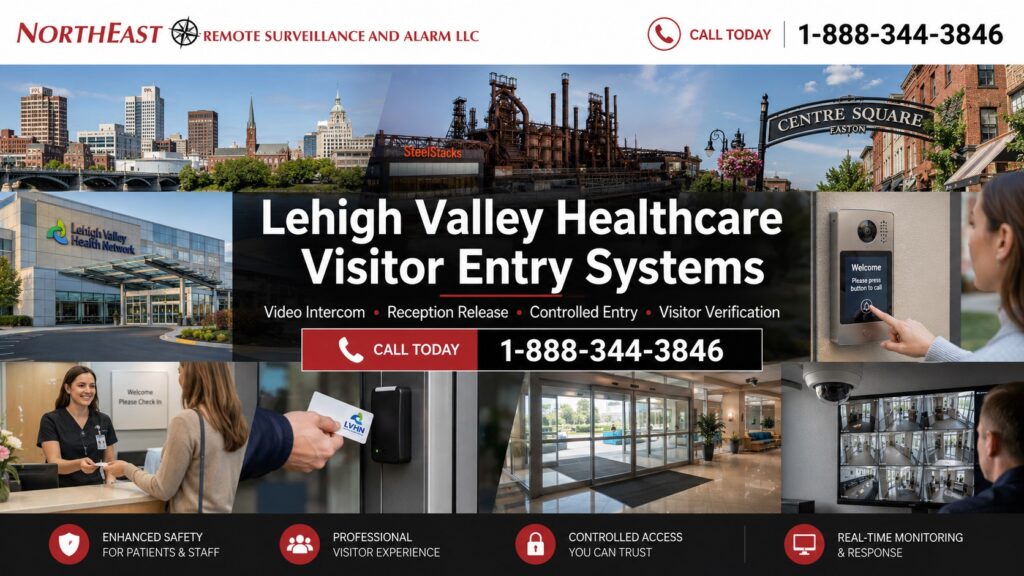
Healthcare visitor entry systems may include:
- video intercoms;
- audio intercoms;
- receptionist door release;
- remote door release;
- controlled vestibules;
- card and mobile credential access;
- keypad entry;
- visitor verification;
- door-position monitoring;
- entrance cameras;
- after-hours entry;
- multi-building visitor entry;
- centralized remote answering.
For broader healthcare-security planning, visit Lehigh Valley Healthcare Security Systems.
For regional access-control planning, visit Lehigh Valley Commercial Access Control Systems.
Commercial and institutional systems only.
Call NERSA: 1-888-344-3846
Healthcare Visitor Entry Designed Around the Entrance
A healthcare visitor-entry system should not begin with a doorbell or intercom model.
It should begin with the question:
Who is arriving, where are they trying to go, who should authorize entry, and what should happen after the door is released?
Different entrances may have completely different requirements.
A healthcare property may include:
- a public main entrance;
- an after-hours entrance;
- an employee entrance;
- a behavioral-health entrance;
- a pharmacy entrance;
- a loading entrance;
- a restricted clinical entrance;
- a multi-tenant medical-building entrance.
NERSA evaluates each entrance according to how the facility actually operates.
The goal is to provide controlled access without creating unnecessary obstacles for legitimate visitors.
Video Intercom Systems for Healthcare Facilities
Video intercom systems can allow staff to see and communicate with a visitor before releasing a controlled door.
A healthcare video intercom may include:
- exterior call station;
- integrated camera;
- microphone and speaker;
- receptionist answering station;
- desktop client;
- mobile answering capability where supported;
- remote door release;
- access-control integration;
- entrance-camera integration.
Potential applications include:
- after-hours patient entry;
- behavioral-health facilities;
- staff-only entrances;
- administrative offices;
- pharmacies;
- outpatient facilities;
- controlled treatment areas;
- medical office buildings.
Video intercom systems should be planned around the actual answering workflow.
A sophisticated intercom is ineffective if no one is clearly responsible for answering it.
Receptionist-Controlled Door Release
Reception-controlled entry is appropriate where staff can verify visitors before allowing them farther into the facility.
A typical workflow may include:
- Visitor approaches the controlled entrance.
- Visitor initiates a call.
- Reception or designated staff communicate with the visitor.
- Staff visually verify the visitor where video is available.
- The appropriate door is released.
- The opening returns to a secure state after entry.
The system should also define what happens when:
- reception is temporarily unattended;
- the facility is closed;
- the primary receptionist cannot answer;
- the intercom call is not answered;
- the door fails to close;
- the entrance is held open.
After-Hours Healthcare Entry
Many healthcare facilities operate outside normal business hours.
After-hours access may be required for:
- employees;
- clinicians;
- emergency contractors;
- approved patients;
- service personnel;
- pharmacy staff;
- maintenance personnel.
After-hours entry can combine:
- video intercom;
- card access;
- mobile credentials;
- PIN access;
- remote answering;
- scheduled permissions.
Not every visitor should use the same entrance procedure during closed hours.
The system should distinguish between permanent staff access and visitor verification.
Staff and Visitor Entry Should Be Separated
Permanent employees and temporary visitors have different access requirements.
Employees may receive:
- cards;
- fobs;
- mobile credentials;
- scheduled access;
- department-specific permissions.
Visitors may require:
- intercom verification;
- receptionist release;
- temporary credentials;
- escorted access;
- limited-area access.
Combining these two workflows without planning can create unnecessary security gaps.
For broader credential and controlled-door planning, visit Lehigh Valley Commercial Access Control Systems.
Behavioral Healthcare Visitor Entry
Behavioral healthcare facilities may require particularly careful entrance planning.
Potential considerations include:
- controlled reception;
- staff visibility;
- visitor verification;
- door-status monitoring;
- panic and duress capability;
- staff-only interior doors;
- controlled patient movement;
- emergency procedures.
For broader facility planning, visit Lehigh Valley Behavioral Healthcare Security Systems.
For emergency signaling, visit Lehigh Valley Healthcare Panic & Duress Systems.
Medical Office Building Visitor Entry
Multi-tenant medical buildings may have several layers of access.
A property may have:
- common exterior entrances;
- tenant suite doors;
- after-hours controlled entrances;
- elevators;
- staff-only areas;
- parking entrances.
Building ownership and tenant operations should be clearly separated.
A visitor may be allowed into a common lobby without being allowed into every tenant suite.
Controlled Vestibules
A vestibule can provide another layer between the exterior and the secure interior of a healthcare facility.
Depending on the operational requirements, a vestibule may include:
- first controlled exterior door;
- intercom;
- camera;
- second controlled interior door;
- receptionist release;
- access-control reader;
- visitor instructions.
Vestibules should be designed carefully around:
- egress;
- accessibility;
- emergency operation;
- door hardware;
- staffing;
- life-safety requirements.
A controlled vestibule is not automatically appropriate for every healthcare entrance.
Visitor Entry and Access Control Integration
Visitor-entry systems can work with access control to improve entrance management.
Possible integrations include:
- receptionist release of an access-controlled door;
- temporary visitor credentials;
- intercom call associated with a specific controlled opening;
- visitor events associated with door status;
- centralized multi-site administration.
Integration should simplify operations.
It should not create unnecessary complexity.
The access-control platform remains responsible for permissions and door control, while the visitor-entry system manages the temporary or verified entry workflow.
Visitor Entry with Video Surveillance
Entrance video can provide additional context when staff evaluate a visitor.
Potential uses include:
- visual verification;
- incident review;
- entrance monitoring;
- documentation of arrival;
- after-hours verification.
Door Position Monitoring
A visitor-entry system should know whether the controlled door actually returned to a secure position.
Door-position monitoring can identify:
- door forced open;
- door held open;
- door not fully closed;
- repeated propping;
- abnormal entrance conditions.
A successful release event should end with the door closed and secured.
That requires coordination between:
- electronic locking;
- door closer;
- latch;
- frame;
- request-to-exit device;
- door-position switch.
Healthcare Entrance Door Hardware
Visitor-entry reliability depends heavily on the physical door.
Potential hardware may include:
- electric strikes;
- electrified locksets;
- electrified trim;
- exit devices;
- magnetic locks where appropriate;
- request-to-exit hardware;
- automatic operators;
- door closers;
- position switches;
- power supplies.
The hardware should support:
- normal entry;
- emergency egress;
- accessibility;
- facility workflow;
- fire/life-safety requirements.
Electronic entry control should never be designed independently of the physical opening.
Video Intercom vs Doorbell
A basic doorbell tells staff that someone is waiting.
A commercial video intercom can provide additional information and control.
A properly designed system may allow staff to:
- see the visitor;
- communicate with the visitor;
- determine which entrance is calling;
- release the correct door;
- redirect the visitor;
- decline entry;
- transfer the call where supported.
For healthcare facilities, this can be significantly more useful than a simple call button.
Remote Visitor Entry
Some healthcare organizations may need to answer entrance calls from another room, building, or location.
Remote answering can be useful for:
- satellite offices;
- multi-building campuses;
- after-hours operation;
- centralized security;
- administrative offices;
- low-staffed locations.
System planning should evaluate:
- network reliability;
- call routing;
- responsible personnel;
- backup answering procedures;
- cybersecurity;
- door-release permissions.
Remote control should never be provided without clear administrative authority.
Visitor Entry for Multi-Site Healthcare Organizations
Healthcare organizations operating multiple facilities may benefit from standardized visitor-entry systems.
A multi-site standard can include:
- common intercom platform;
- consistent naming;
- standardized call-routing;
- centralized remote answering;
- consistent entrance hardware;
- standardized staff procedures.
This can reduce training requirements and simplify administration as the organization grows.
Visitor Entry and Panic/Duress Coordination
Reception staff may be positioned at the point where visitors first interact with the organization.
For some facilities, the reception area may therefore require both:
- visitor-entry control;
- panic or duress signaling.
The two systems should have separate purposes.
The intercom handles normal visitor entry.
The panic or duress system provides a defined emergency-signaling method.
For detailed emergency signaling, visit Lehigh Valley Healthcare Panic & Duress Systems.
Visitor Entry for Pharmacy and Medication Areas
Certain medication or pharmacy areas may require stronger entry controls.
Potential approaches may include:
- credentialed staff access;
- intercom verification;
- restricted public entry;
- controlled delivery entry;
- camera support;
- door-position monitoring.
For medication-room access, monitoring, and documentation, review:
Visitor Entry for Deliveries and Vendors
Healthcare facilities may receive:
- medical supplies;
- food deliveries;
- equipment;
- pharmacy deliveries;
- service technicians;
- contractors;
- maintenance vendors.
Delivery personnel should not automatically use the same entry path as patients or staff.
A controlled receiving workflow may include:
- dedicated intercom;
- camera verification;
- remote release;
- scheduled vendor access;
- controlled interior doors;
- delivery-area monitoring.
Existing Visitor Entry System Upgrades
Healthcare facilities may already have older:
- intercoms;
- call stations;
- analog door phones;
- card readers;
- door-release buttons;
- electric strikes;
- cameras.
NERSA can evaluate whether existing components can be:
- retained;
- integrated;
- upgraded;
- migrated;
- replaced.
Upgrade decisions should consider:
- reliability;
- supportability;
- network compatibility;
- video quality;
- door hardware;
- expansion requirements;
- cybersecurity.
New Construction and Healthcare Entrance Planning
Visitor-entry planning should begin early during:
- new medical-office construction;
- behavioral-health construction;
- facility renovations;
- lobby redesigns;
- expansions;
- new outpatient facilities.
Early planning can determine:
- intercom locations;
- camera placement;
- door hardware;
- cable pathways;
- reader locations;
- network requirements;
- receptionist workstations;
- automatic door operators;
- power requirements.
Early coordination can prevent expensive changes after the entrance is already finished.
Healthcare Visitor Entry Assessment
NERSA should evaluate the entrance before specifying equipment.
A typical assessment may examine:
Visitor Types
Patients, family members, vendors, contractors, delivery personnel, and other visitors.
Entrance Hours
Whether the entrance is public all day or controlled during certain hours.
Staff Responsibility
Who answers the intercom and who is authorized to release the door.
Door Hardware
The physical lock, closer, exit device, frame, and door condition.
Existing Access Control
Whether the entrance already uses credentials or a controlled-door system.
Video
Whether camera verification is useful.
Emergency Requirements
How the door should behave during fire, evacuation, or other emergency conditions.
After-Hours Procedures
How visitors are handled when reception is closed.
Expansion
Whether more entrances, buildings, or facilities may need to be added later.
Related Lehigh Valley Healthcare Security Resources
For broader planning, visit Lehigh Valley Healthcare Security Systems or the Lehigh Valley commercial security resource. Related needs include healthcare panic and duress systems and behavioral healthcare security systems.
Plan Healthcare Visitor Entry in the Lehigh Valley
NERSA can assess visitor entry at your healthcare facility. We review intercoms, receptionist-controlled entrances, after-hours access, remote door release, and controlled vestibules. Recommendations can include compatible access-control integration or replacement of an older intercom.
Northeast Remote Surveillance and Alarm, LLC
Commercial & Institutional Security Systems
Allentown • Bethlehem • Easton • Lehigh County • Northampton County
Call 1-888-344-3846
Request a Lehigh Valley Healthcare Visitor Entry Assessment
Compliance, Codes & Project Standards
NERSA plans commercial and industrial security work with applicable code, documentation, inspection and authority-having-jurisdiction requirements in mind. Requirements vary by system, property and jurisdiction. These resources support project planning; they do not establish legal compliance, certification or AHJ approval.
Related guidance: Regulatory compliance & inspection readiness · Access control & door hardware standards · NFPA 101 & egress planning · ADA access-control planning