
Plan commercial video retention around incident discovery, recording capacity, authorized access, evidence export, and the business’s retention requirements.

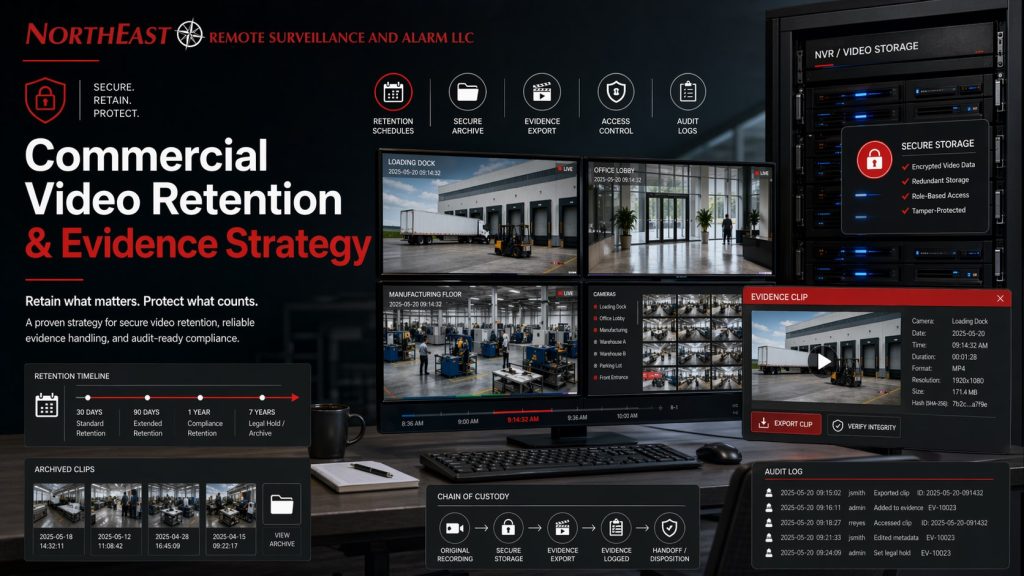
It should help businesses keep the right footage for the right amount of time, preserve usable evidence when incidents occur, control who can view or export video, and support investigations, insurance review, internal documentation, and operational accountability.
Northeast Remote Surveillance and Alarm, LLC helps commercial and industrial facilities plan video retention and evidence workflows for real business conditions.
For broader service-level planning, continue to Commercial & Industrial Video Surveillance Systems.
Why Retention Strategy Matters
Many businesses install cameras first and think about retention later. That usually creates one of two problems: footage is deleted too quickly to be useful, or video is stored without a clear reason, structure, or review process.
A stronger retention strategy helps support:
- incident review
- insurance documentation
- employee and visitor incident reconstruction
- property damage review
- theft investigations
- management review
- legal and liability documentation
- internal accountability
The goal is not just to keep footage. The goal is to keep the right footage in a way that is usable when it matters.
What Video Retention Strategy Includes
A commercial video retention strategy should define:
- how long footage is retained
- which cameras or areas need longer retention
- who can view recorded video
- who can export footage
- how exported video is labeled
- how important clips are preserved
- how access to footage is documented
- how storage can scale over time
For camera coverage, recording architecture, and the equipment supporting your retention plan, review Commercial & Industrial Video Surveillance Systems.
Choose a Retention Period for Your Facility
There is no single retention period that fits every facility. A small office may not need the same retention window as a warehouse, healthcare environment, industrial site, or multi-tenant property.
Set the retention period around the time needed to discover, report, and review the events the system is intended to document.
- Document when relevant incidents are normally discovered and reported.
- Confirm the business’s applicable recordkeeping, insurance, contractual, and privacy requirements with the responsible advisers.
- Define who may preserve an incident clip beyond routine overwrite and who approves its eventual release or deletion.
Check that the selected period is supported by the recording design and operating procedures, including:
- property type
- incident frequency
- number of cameras
- recording resolution
- operating hours
- internal review needs
- legal or insurance expectations
What Affects How Much Video You Can Keep
Retention is not only a policy issue. It is also a storage and infrastructure issue.
How long footage can be retained depends on:
- number of cameras
- frame rate
- resolution
- motion activity
- continuous versus event-based recording
- codec efficiency
- analytics use
- available storage capacity
- local, cloud, or hybrid recording design
That is why businesses should not set retention targets without also considering the recording architecture behind them.
For cloud-focused recording options, continue to Cloud Video Surveillance.
Evidence Strategy Is More Than Retention
Keeping footage is only one part of the process. A usable evidence strategy should also address what happens after an incident.
That can include:
- identifying the correct clip quickly
- reviewing multiple camera angles
- exporting the right time window
- labeling the clip clearly
- restricting who handles the export
- documenting what was saved and why
- preserving the clip long enough for review or follow-up
A business that stores video but cannot retrieve and preserve the right event efficiently may still struggle when an incident happens.
Who Should Have Access to Recorded Video
A strong evidence strategy should limit who can view, search, export, and share footage.
That usually means defining:
- administrators
- managers
- investigators
- security personnel
- IT support roles
- outside viewers if needed for claims or law enforcement
Role-based access helps reduce confusion, supports better accountability, and limits unnecessary exposure of recorded footage.
Retention and Evidence in Different Facility Types
Offices and Commercial Buildings
Office properties often need retention strategies built around entrances, lobbies, hallways, parking areas, and after-hours review.
Warehouses and Logistics Facilities
Warehouses often need stronger retention planning because of dock disputes, trailer activity, employee traffic, after-hours exposure, and broader incident-documentation needs.
Manufacturing and Industrial Facilities
Industrial sites may need retention strategies that account for production-floor incidents, machinery-area review, contractor activity, yard exposure, and longer review cycles for operational or safety-related events.
For production-floor, equipment-area, and exterior camera planning, review Industrial Video Surveillance Systems.
Multi-Tenant and Mixed Commercial Properties
Shared spaces, common areas, parking lots, and delivery zones often create overlapping liability and documentation concerns, which can affect how long footage should be retained and how incidents are reviewed.
Video Retention and Monitoring
Retention and evidence strategy also matter when a system is monitored. If a site uses live monitoring, talk-down, verified events, or event-triggered workflows, recorded footage may become part of a larger documentation trail.
That can affect:
- event review
- dispatch support
- post-incident reconstruction
- internal reporting
- evidence preservation after a verified event
Video Retention and Compliance Awareness
Commercial and industrial retention strategy may also sit inside a broader framework of safety, privacy, documentation, and compliance awareness.
Depending on the facility type, that may include:
- workplace incident documentation
- life safety event review
- healthcare privacy-sensitive areas
- cyber-secure video access
- internal policy enforcement
- export and review accountability
Use these resources to identify the workplace, fire-safety, and building requirements relevant to your project.
- OSHA and Electronic Security Systems — Review the relationship between security systems and workplace operations.
- NFPA Standards and Commercial Security, Fire Alarm, and Life Safety Systems — Explore the standards context for coordinated building systems.
- Pennsylvania Uniform Construction Code (UCC) and Commercial Security Systems — Review the Pennsylvania building-code context for security projects.
Use these guides to connect retention planning with camera design, installation budgets, recording architecture, and facility coverage.
- Commercial & Industrial Video Surveillance Systems — Plan camera coverage and recording around the property’s evidence needs.
- Commercial Video Surveillance Installation Cost — Review the factors that affect camera-system scope and cost.
- Cloud Video Surveillance — Explore cloud-based recording and management considerations.
- Industrial Video Surveillance Systems — Plan camera coverage for industrial operations and incident review.
Why Businesses Choose NERSA for Retention Planning
Businesses do not just need cameras that record. They need a surveillance system that keeps footage long enough to be useful, makes important events easier to retrieve, and supports better documentation when something actually happens.
Northeast Remote Surveillance and Alarm, LLC helps commercial and industrial facilities plan retention and evidence workflows around their operational needs. Review when incidents are usually discovered, who needs access to the recordings, and how footage will be preserved for review.
Request a Video Retention and Evidence Review
Need a clearer plan for keeping and exporting video?
NERSA can review your property, recording setup, storage needs, and incident workflow.
Request an assessment to discuss what footage your team needs and how staff will find and preserve it.
Compliance, Codes & Project Standards
NERSA plans commercial and industrial security work with applicable code, documentation, inspection and authority-having-jurisdiction requirements in mind. Requirements vary by system, property and jurisdiction. These resources support project planning; they do not establish legal compliance, certification or AHJ approval.
Related guidance: Regulatory compliance & inspection readiness · NERSA project standards · Documentation, testing & inspection readiness