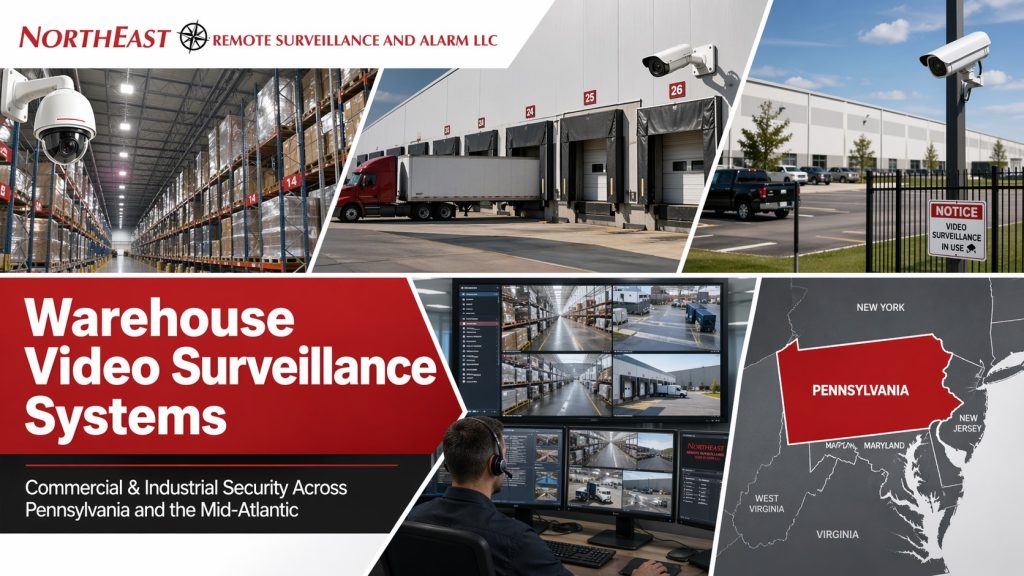
Warehouse video surveillance systems should do more than record activity after a loss. They should help businesses monitor loading docks, shipping and receiving areas, warehouse aisles, employee entrances, overhead doors, exterior approaches, trailer positions, and other operationally important areas with usable footage and dependable long-term performance.

Northeast Remote Surveillance and Alarm, LLC provides warehouse video surveillance systems for commercial and industrial facilities that need stronger visibility, better incident documentation, improved accountability, and broader operational awareness. This page is focused specifically on warehouse surveillance applications. For broader service-level coverage, visit [Commercial & Industrial Video Surveillance Systems]. For integrated door control, visit [Commercial & Industrial Access Control Systems]. For intrusion detection and after-hours protection, visit [Commercial & Industrial Alarm Systems].
Why Warehouse Video Surveillance Systems Need a Different Surveillance Strategy
Warehouse environments are not the same as offices, storefronts, or standard commercial interiors. They often involve high ceilings, wide aisles, forklift traffic, dock activity, employee entrances, inventory movement, trailer staging, variable lighting, and large exterior areas that create different camera-planning requirements.
A warehouse surveillance system should be designed around:
- dock door visibility
- shipping and receiving oversight
- employee entrance coverage
- warehouse-to-office transition points
- aisle and cross-aisle visibility
- overhead door monitoring
- trailer and yard-facing views
- parking and perimeter approaches
- incident review and evidence retention
What Warehouse Video Surveillance Systems Help Monitor
Warehouse video surveillance systems can support visibility across both security-sensitive and operations-sensitive areas.
Loading Docks and Shipping Areas
Docks are one of the most important surveillance zones in warehouse environments. They often need camera coverage for:
- trailer positioning
- dock activity
- shipping and receiving movement
- package or pallet disputes
- after-hours dock approaches
- employee and contractor traffic
Warehouse Interior Aisles
Warehouse aisles often require broad overview coverage combined with more targeted views near high-value or high-traffic zones. Interior surveillance can help support:
- incident review
- movement visibility
- safety documentation
- inventory-area awareness
- forklift traffic observation
- restricted-area oversight
Employee and Service Entrances
Warehouse facilities often need stronger documentation around employee entries, side doors, office-to-warehouse transitions, and other non-public access points.
Exterior Doors and Overhead Doors
Overhead doors, man doors, and service openings are often among the most important after-hours camera locations because they affect both security and operational accountability.
Yard-Facing and Perimeter Views
Some warehouse facilities also need camera coverage that looks beyond the building to trailer lots, fenced areas, access lanes, and vehicle approaches. For broader perimeter-specific technology planning, see [Parking Lot and Perimeter Surveillance Systems].
Common Camera Types Used in Warehouse Environments
Warehouse video surveillance systems should be built around the actual coverage need, not a one-size-fits-all camera list.
Commonly used camera types may include:
- fixed dome cameras for interior views
- bullet cameras for longer directional coverage
- multi-sensor cameras for broader warehouse areas
- PTZ cameras for larger open spaces or yards
- thermal cameras for harder outdoor environments
- license plate recognition cameras at vehicle approaches where appropriate
For narrower spoke topics, continue to:
- [License Plate Recognition Camera Systems]
- [Thermal Camera Systems for Commercial and Industrial Facilities]
- [AI Video Analytics for Commercial Security]
Warehouse Video Surveillance Systems and Operations
Warehouse surveillance is not only about theft deterrence. In many facilities, it also supports broader operational review and documentation.
A properly designed system can help support:
- loading dispute review
- trailer and dock event reconstruction
- employee movement visibility
- restricted inventory area monitoring
- after-hours activity review
- operational accountability
- incident documentation for management or insurance review
That is one reason warehouse surveillance should remain a tightly scoped spoke. It serves a clear use case inside the larger surveillance pillar without trying to replace it.
Warehouse Video Surveillance Systems and Integration
Warehouse video surveillance systems are often strongest when they are not isolated.
They may be integrated with:
- access control at employee or service entrances
- intrusion alarms for after-hours notification
- monitored event review
- intercoms at gated or controlled entry points
- broader unified security workflows
Retention and Evidence in Warehouse Environments
Warehouse facilities often need surveillance retention strategies that reflect the pace and liability profile of the operation. A small warehouse with limited public interaction may need a different retention approach than a higher-volume logistics site with dock disputes, employee traffic, contractor access, and trailer activity.
The right retention strategy depends on:
- the number of cameras
- recording resolution
- operating hours
- incident frequency
- customer or carrier requirements
- management review expectations
- insurance or legal documentation needs
For a more specific spoke on retention, see [Commercial Video Retention and Evidence Strategy].
Warehouse Video Surveillance Systems and AI Analytics
AI-assisted analytics can be useful in warehouse environments where the facility needs more than passive recording. Depending on the site, analytics may support:
- line-crossing detection
- activity alerts at dock or perimeter zones
- after-hours person or vehicle alerts
- restricted-area monitoring
- event filtering for review efficiency
This page should mention AI only as it applies to warehouse surveillance. Broader AI topic ownership belongs on [AI Video Analytics for Commercial Security].
That means this page should own warehouse surveillance use-case intent, while the broader and adjacent topics belong on:
- [Commercial & Industrial Video Surveillance Systems]
- [Commercial Video Surveillance Installation Cost]
- [Industrial Video Surveillance Systems]
- [Cloud Video Surveillance]
- [Parking Lot and Perimeter Surveillance Systems]
Why Businesses Choose NERSA for Warehouse Video Surveillance
Warehouses need more than cameras placed wherever there is open wall space. They need surveillance planned around dock workflow, employee movement, office-to-warehouse transitions, wider interior visibility, after-hours exposure, and long-term system usability.
Northeast Remote Surveillance and Alarm, LLC designs warehouse video surveillance systems for commercial and industrial facilities that need cleaner documentation, stronger visibility, and more usable security infrastructure. For broader company and service context, continue to [About Northeast Remote Surveillance and Alarm, LLC].
Request a Warehouse Video Surveillance Systems Assessment
If your warehouse or logistics facility needs stronger dock visibility, better aisle coverage, improved employee entrance documentation, broader after-hours awareness, or a more scalable surveillance system, Northeast Remote Surveillance and Alarm, LLC can help assess the property, the operational needs, and the level of video infrastructure the site actually requires.
For broader surveillance planning, continue to [Commercial & Industrial Video Surveillance Systems]. For local market coverage, continue to [Allentown Commercial Security Systems], [Bethlehem Commercial Security Systems], and [Easton Commercial Security Systems].