
Access control repair in Allentown, PA, should address the complete opening—not only the card reader—so credentials, locks, doors, controllers, power, and software operate together.

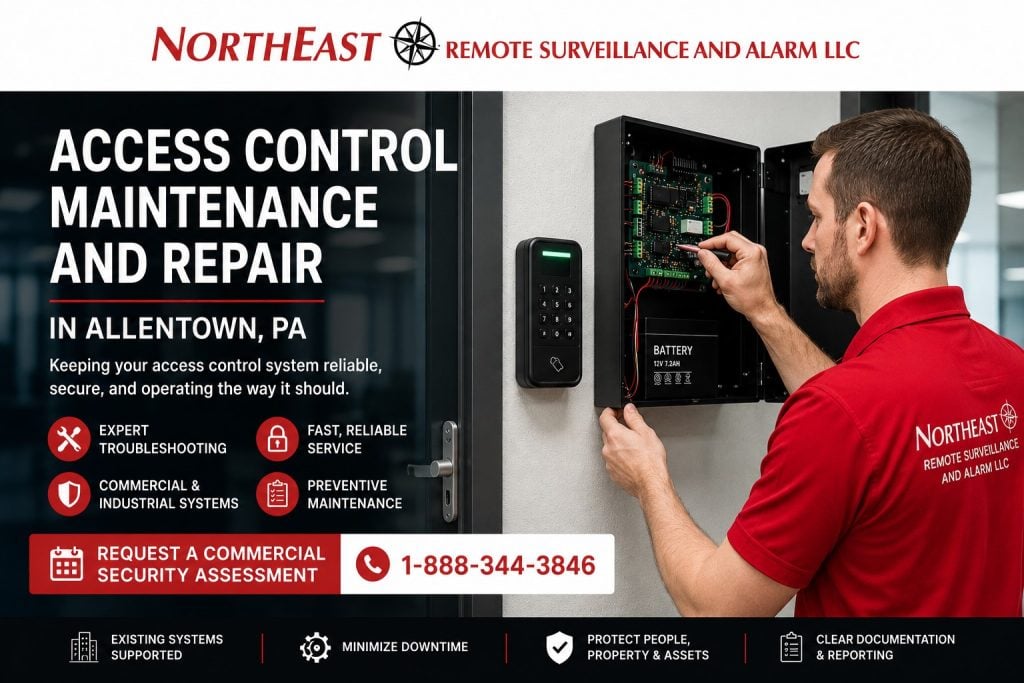
Coordinate doors, permissions and administration with Allentown access control systems.
Access Control Repair in Allentown
Northeast Remote Surveillance and Alarm, LLC troubleshoots, repairs, and maintains commercial and industrial access-control systems in Allentown and surrounding Lehigh Valley communities. Service can address a single unreliable door, recurring communication faults, damaged field equipment, administrator problems, or a system that no longer operates as intended.
For new doors, expansions, major upgrades, and broader local planning, visit commercial access-control systems in Allentown.
Signs the System Needs Repair
- The system rejects valid cards, fobs, or mobile credentials.
- The reader responds, but the door does not unlock or relock.
- Doors report false forced-open or held-open events.
- A controller, panel, or building repeatedly goes offline.
- Access schedules or permissions do not operate correctly.
- Administrators cannot add, change, or remove users.
- The system fails after electrical, network, or server changes.
For example, these symptoms can originate at the credential, reader, wiring, controller, power supply, network, software, lock, door contact, request-to-exit device, or physical door. Replacing the most visible component without testing the complete transaction can leave the real problem unresolved.
Complete Controlled-Opening Troubleshooting
A service visit begins with the reported condition and follows the access request through the system. Testing may include credential records, reader response, voltage, wiring, controller inputs and outputs, event history, schedules, door contacts, request-to-exit operation, locking hardware, mechanical latching, and network communication.
In addition, the door itself matters. A correctly programmed system cannot compensate for a closer that does not shut the opening, a misaligned latch, damaged exit hardware, or a lock that cannot operate consistently. Therefore, review the electronic controls and the physical door together.
Preventive Access Control Maintenance
Routine maintenance can find weak batteries, loose connections, worn hardware, and door alignment problems. It can also reveal missed events or unstable communication before the system fails. The service schedule depends on traffic, environment, system age, operating hours, and the importance of each opening.
- Inspect readers, controllers, enclosures, and field wiring.
- Test locks, door contacts, request-to-exit devices, and closing operation.
- Review power supplies, batteries, and communication status.
- Confirm schedules, permissions, event records, and administrator access.
- Update labels and available system documentation.
Existing-System Takeovers and Documentation
Inherited systems often lack drawings, passwords, licensing details, programming records, or accurate equipment labels. NERSA can evaluate the installed platform, document accessible components, identify immediate faults, and explain which equipment appears serviceable.
However, a takeover does not automatically mean complete replacement. NERSA can retain useful equipment when it remains compatible and supported. NERSA then prioritizes unsupported or unreliable parts for a planned upgrade.
Repair, Upgrade, or Replace?
Repair is usually appropriate when the system remains supportable and the fault is limited. An upgrade may be better when recurring failures, obsolete software, unavailable parts, weak administration, or expansion limits create ongoing risk. However, replacement may make sense when repairs cannot restore reliable operation.
NERSA reviews existing conditions before recommending a path. The objective is a dependable and maintainable system, not unnecessary replacement.
Life-Safety and Door-Hardware Coordination
Access control must not prevent required emergency egress. Coordinate repairs with the relevant hardware requirements, design documents, and reviewing authority. In particular, review work involving electric locks, exit devices, and fire-alarm connections. NERSA does not treat a safety-related door problem as a software-only issue.
Frequently Asked Questions
Can NERSA repair a system installed by another company?
Often, yes. The first step is identifying the equipment, access available, documentation, licensing, system condition, and whether the platform remains supportable.
Why does a reader beep when the door does not unlock?
The reader may accept the credential even when a lock, wiring fault, or door problem prevents release. A technician then tests the opening to find the cause.
How often should access control be maintained?
The interval depends on system age, traffic, environment, operating hours, and risk. High-use industrial openings may require more frequent review than lightly used office doors.
Does an unreliable system need complete replacement?
Not necessarily. An assessment identifies which parts need repair, an upgrade, or replacement. It also identifies useful equipment and missing records.
Request Access-Control Service
For commercial access-control maintenance or repair in Allentown, request a security assessment.
Compliance, Codes & Project Standards
NERSA plans commercial and industrial security work with applicable code, documentation, inspection and authority-having-jurisdiction requirements in mind. Requirements vary by system, property and jurisdiction. These resources support project planning; they do not establish legal compliance, certification or AHJ approval.
Related guidance: Regulatory compliance & inspection readiness · Access control & door hardware standards · NFPA 101 & egress planning · ADA access-control planning