
Manufacturing access control systems in Allentown, PA secure employee entrances, production areas, maintenance rooms, inventory spaces, and restricted facilities.

request a commercial security assessment
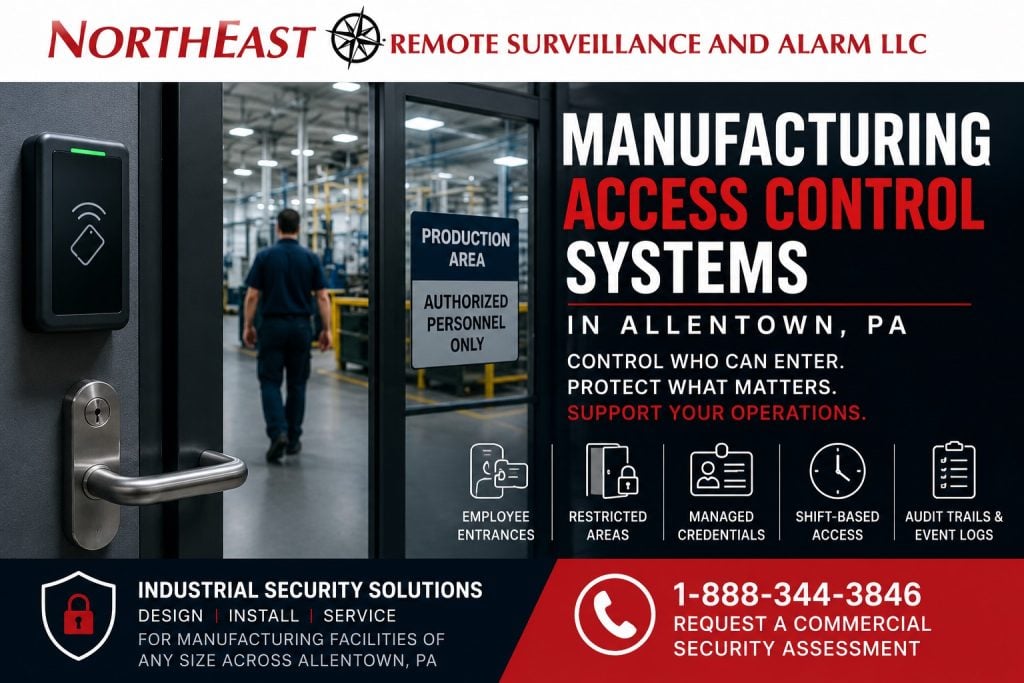
Northeast Remote Surveillance and Alarm, LLC designs access control around shifts, employee roles, contractor procedures, door hardware, daily workflow, and growth.
For credentials, readers, controllers, permissions, software, and multi-door management, review Commercial Access Control Systems in Allentown, PA.
Manufacturing Access Control for Allentown Facilities
Manufacturing access control manages who enters each door, department, production zone, and support area. It also records access events for later review.
A small production shop may need one controlled entrance and one tool room. A larger plant may require hundreds of permissions.
Plan door permissions and installation windows around shift changes, maintenance access, and production routes. Agree on temporary access arrangements before taking an opening out of service.
Employee Entrances and Shift-Based Permissions
Manufacturing access control replaces shared keys and common codes with individual credentials. Each employee receives permissions that match a role and schedule.
Administrators can manage first, second, and third shifts without changing locks. They can also limit weekend and holiday access.
A production employee may use one entrance during assigned hours. Meanwhile, a maintenance supervisor may need broader access for emergency callouts.
The system should handle busy shift changes without delays or unsafe door holding. Clear entry rules also strengthen accountability.
Production, Maintenance, and Restricted Areas
Manufacturing access control can separate offices, production floors, warehouses, laboratories, and support departments. It can also protect rooms that require trained personnel.
Facilities may restrict electrical rooms, mechanical rooms, tool cribs, engineering areas, server rooms, and controlled storage. Managers assign access by responsibility.
Door schedules can support shutdowns, maintenance periods, equipment testing, and after-hours work. Authorized teams keep access when operations change.
However, access rules must preserve safe movement and emergency egress. NERSA coordinates the opening, hardware, lock, reader, and door monitoring.
Contractor, Vendor, and Temporary-Worker Access
Manufacturers regularly host contractors, technicians, vendors, delivery teams, and temporary workers. These users rarely need the same access as permanent employees.
Manufacturing access control can issue individual credentials with approved doors, schedules, departments, and expiration dates. Administrators can remove access quickly.
A contractor may use one employee entrance and one maintenance area. The credential can expire when the project ends.
Temporary workers can receive shift-based permissions without sharing cards or PINs. Individual records make access easier to review.
Credentials, Readers, and Industrial Door Hardware
Manufacturing access control may use cards, fobs, mobile credentials, keypads, or selected biometric readers. NERSA matches each option to the operating environment.
Mobile credentials may suit managers and traveling technicians. Physical credentials may work better for production employees with restrictive phone policies.
However, no credential can correct a door that fails to close, latch, lock, or release. Heavy use and vibration can affect industrial openings.
Dust, moisture, temperature changes, damaged frames, and poor alignment can reduce reliability. NERSA reviews the complete opening before installation.
For egress, fire-interface, accessibility, and inspection considerations, review Compliance-Aware Security Planning in Allentown, PA.
Door Monitoring, Video Verification, and Alerts
Manufacturing access control should record more than accepted credentials. Door contacts can report forced openings, held-open doors, denied attempts, and schedule violations.
Management can investigate unusual events without searching unrelated activity. Current user records make that history more useful.
Compatible video systems can associate footage with credential use and door alarms. Authorized teams can verify what happened at the opening.
For facility-wide protection, review Manufacturing Facility Security Systems in Allentown, PA.
Multi-Building and Multi-Site Scalability
NERSA scales manufacturing access control from a small business with several doors to an enterprise with multiple plants. The platform can grow in phases.
One credential can serve approved doors across a campus. It can still block locations outside the employee’s role.
Central management can standardize users, schedules, reports, and credential removal across several facilities. Local administrators can retain appropriate control.
Expansion does not require the manufacturer to rebuild its access structure. New doors, departments, buildings, and sites can join the existing plan.
Upgrades and Existing-System Takeovers
Many Allentown facilities already use older readers, cards, controllers, locks, or access software. NERSA can evaluate the current system before recommending changes.
A facility may only need permission cleanup, new schedules, door monitoring, or selected hardware repairs. Another site may need a phased migration.
However, NERSA does not replace working equipment without a reason. The assessment identifies what the facility can retain, repair, expand, or modernize.
NERSA can upgrade controllers, migrate credentials, improve communications, and modernize access software. The plan can limit operational disruption.
What NERSA Reviews
A manufacturing access-control assessment begins with facility operations. NERSA reviews how people, materials, and responsibilities move through the property.
- Employee entrances, production areas, warehouses, offices, maintenance rooms, utility spaces, and separate buildings.
- Shifts, department movement, supervisor access, maintenance callouts, shutdowns, and after-hours entry.
- Employees, temporary workers, contractors, vendors, managers, visitors, and emergency responders.
- Door type, frame condition, locking hardware, exit devices, traffic, environmental exposure, and monitoring needs.
- Cards, fobs, mobile credentials, PINs, biometrics, temporary credentials, and removal procedures.
- Permissions, schedules, denied attempts, forced doors, held-open doors, alerts, and reporting.
- Controllers, power supplies, networks, cabling, backup power, and equipment enclosures.
- Future doors, departments, production lines, buildings, users, and manufacturing locations.
The recommended system fits daily operations and future expansion. It avoids unnecessary hardware and confusing permissions.
Verify Permissions Before Handover
Before handover, test an authorized credential, a denied credential, an expired contractor credential, and the agreed schedule at representative doors. Confirm door-event timestamps and user permissions, and document who manages changes after installation. Record any offline-operation or integration limitations in the handover notes.
Frequently Asked Questions
Can permissions follow employee shifts?
Yes. Administrators can assign permissions by shift, weekend, holiday, department, role, and approved after-hours access.
Can contractors receive temporary access?
Yes. Contractor credentials can limit doors, schedules, departments, and expiration dates. Access can end with the project.
Can one credential work across several buildings?
Yes. A compatible platform can grant selected doors across several buildings. However, it can still block unauthorized locations.
Can access control work with video surveillance?
Yes. Compatible systems can connect door events with video. Authorized teams can review credential use and alarm activity.
Can NERSA upgrade an existing access-control system?
Yes. NERSA can review readers, credentials, controllers, software, permissions, power, wiring, networks, and door hardware before recommending improvements.
For related facility protection, review Manufacturing Plant Security Systems in Allentown, PA.
Request Manufacturing Access Control Planning in Allentown
Northeast Remote Surveillance and Alarm, LLC designs, installs, upgrades, integrates, and supports manufacturing access control across Allentown.
To discuss employee entrances, shifts, contractors, restricted areas, door monitoring, or multi-site growth, request a commercial security assessment.
Compliance, Codes & Project Standards
NERSA plans commercial and industrial security work with applicable code, documentation, inspection and authority-having-jurisdiction requirements in mind. Requirements vary by system, property and jurisdiction. These resources support project planning; they do not establish legal compliance, certification or AHJ approval.
Related guidance: Regulatory compliance & inspection readiness · Access control & door hardware standards · NFPA 101 & egress planning · ADA access-control planning