
Video-verified intrusion alarm systems in Allentown, PA pair alarm detection with event-based images or video so authorized contacts can assess activity quickly.

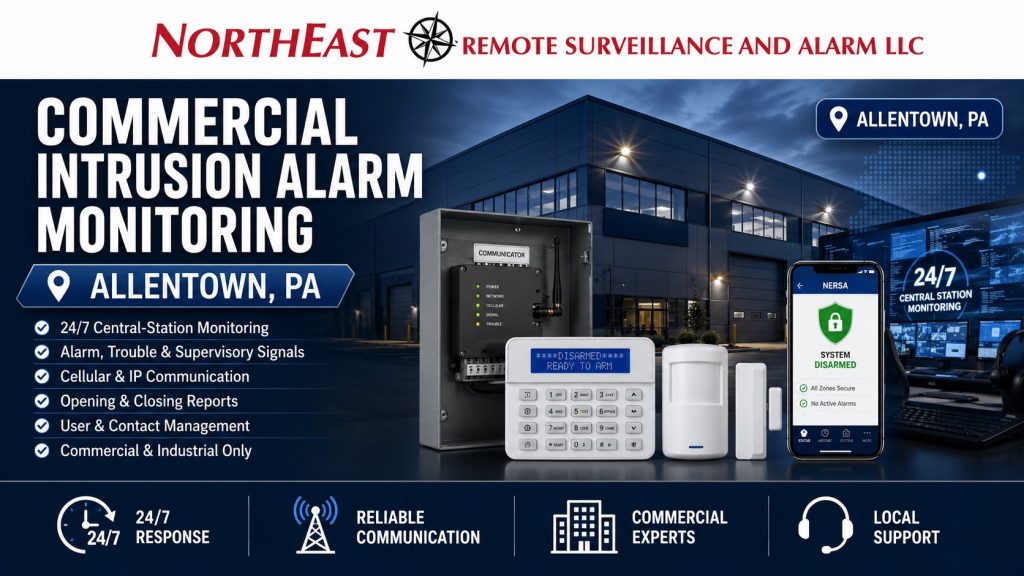
Northeast Remote Surveillance and Alarm, LLC designs, installs, upgrades, and supports video-verified intrusion alarms for offices, warehouses, retail sites, medical properties, manufacturers, and multi-site organizations.
For alarm panels, sensors, keypads, communications, and complete intrusion protection, review Commercial Intrusion Alarm Systems in Allentown, PA.
How Video-Verified Intrusion Alarms Work
A sensor first detects a defined event, such as a door opening or motion in an armed area. The system then links that alarm with images or a short video clip from the affected space. As a result, monitoring personnel and authorized contacts receive more context than a standard signal alone can provide.
Depending on the equipment, the video may show activity before, during, or after the event. Clear device names also help users match the alarm zone with the correct camera. For example, “Rear Shipping Door” is more useful than an unclear label such as “Zone 12.”
- Door and window contacts
- Interior motion detectors
- Glass-break sensors
- Overhead-door contacts
- Selected perimeter devices
- Panic or duress devices when procedures allow
Benefits of Video Verification
Video verification can help distinguish a person entering the property from an unsecured door, animal, weather event, or operating issue. Therefore, it can support faster decisions and reduce avoidable escalation. It can also preserve useful evidence for an incident review.
However, video verification does not guarantee a police response or remove every false alarm. Proper sensor placement, camera views, lighting, communications, testing, and user training still matter. Response procedures must also match local requirements and the customer’s approved plan.
Camera Placement and Event Coverage
Each camera should show the area connected to its alarm event. Useful views often include exterior doors, rear entrances, shipping doors, lobby approaches, restricted rooms, and warehouse aisles. In addition, the image should remain clear during the lighting conditions expected at that location.
Wide overview cameras may confirm general movement but miss identifying detail. Close views can provide more detail but may not show the full path of travel. For that reason, many sites use a planned mix of overview and targeted cameras.
Applications Across Allentown Properties
Warehouses and distribution centers may verify loading doors, employee entrances, trailer areas, and motion in armed zones. Manufacturers may cover production access, tool rooms, or restricted storage. Likewise, offices and medical properties may protect rear doors, records areas, medication storage, and low-staff entrances.
Retail sites may use video verification at storefront doors, stockrooms, and receiving areas. Multi-tenant properties may apply it to shared entrances or selected service spaces. In every setting, the alarm event and camera view should serve a clear operating need.
Monitoring, Communications, and Response
A reliable design defines how alarm signals, images, and video clips travel during normal service and an outage. Alarm reporting may use cellular communications while cameras use the property network. Backup power can also keep selected equipment operating during short utility interruptions.
Monitoring instructions should identify authorized contacts, call order, escalation steps, and special conditions.
Clear procedures help personnel act consistently.
For central-station service and response planning, review Commercial Intrusion Alarm Monitoring in Allentown, PA.
New Systems, Upgrades, and Takeovers
Video verification can be included in a new alarm design or added to a compatible system. Before an upgrade, NERSA reviews the alarm panel, sensors, cameras, recorder, network, power, communications, and available integrations. Existing equipment may remain when it is compatible, reliable, and appropriate for the required coverage.
During a system takeover, technicians also verify zone names, user permissions, camera labels, mobile access, and monitoring instructions. Afterward, each linked event should be tested from detection through notification. This confirms that the correct video reaches the correct recipients.
Privacy, Retention, and Secure Access
Only approved users should receive video clips or access recorded footage. Role-based permissions can limit who views cameras, changes settings, or exports evidence. In addition, retention periods should reflect business needs, storage capacity, incident patterns, and applicable policies.
Network planning matters because cameras and alarm integrations may share business infrastructure. Strong passwords, supported firmware, controlled remote access, and documented ownership reduce avoidable risk. NERSA coordinates these details with the customer’s authorized technology contacts.
Scalable Protection from Small Business to Enterprise
A small office may need verification for two doors and one interior area. A warehouse may require many zones, camera views, schedules, and contacts. Meanwhile, an enterprise may need consistent naming, permissions, reporting, and escalation across several locations.
NERSA designs systems that can grow without losing clarity.
New devices, partitions, cameras, and sites can be added as operations change.
For cameras, access control, alarms, monitoring, and related services, review Commercial Security Systems in Allentown, PA.
Video-Verified Intrusion Alarm FAQs
Does video verification replace alarm sensors?
No. Sensors detect the event, while linked video provides visual context. Both parts must be designed and tested together.
Does someone continuously watch the cameras?
Usually not. Video verification is generally event based, so selected images or clips are reviewed after a defined alarm activates.
Can existing cameras be used?
Sometimes. Compatibility depends on the cameras, recorder, alarm platform, software, network, and required event workflow.
Does every alarm zone need a camera?
No. Camera coverage should focus on events where visual confirmation adds meaningful value to the response plan.
Is video verification the same as remote video monitoring?
No. Video verification normally follows an intrusion-alarm event. Remote video monitoring may use analytics, scheduled tours, or live review without a traditional alarm zone activating first.
Can the system grow with the property?
Yes. A properly planned system can add zones, cameras, users, partitions, and locations as the organization grows.
Request a Video-Verified Alarm Assessment
Northeast Remote Surveillance and Alarm, LLC will review your alarm risks, camera views, communications, monitoring plan, and response needs. The recommendation will match the property, daily operations, and growth plans.
Request a security assessment for video-verified intrusion alarms in Allentown, PA.
Compliance, Codes & Project Standards
NERSA plans commercial and industrial security work with applicable code, documentation, inspection and authority-having-jurisdiction requirements in mind. Requirements vary by system, property and jurisdiction. These resources support project planning; they do not establish legal compliance, certification or AHJ approval.
Related guidance: Regulatory compliance & inspection readiness · NERSA project standards · Documentation, testing & inspection readiness