
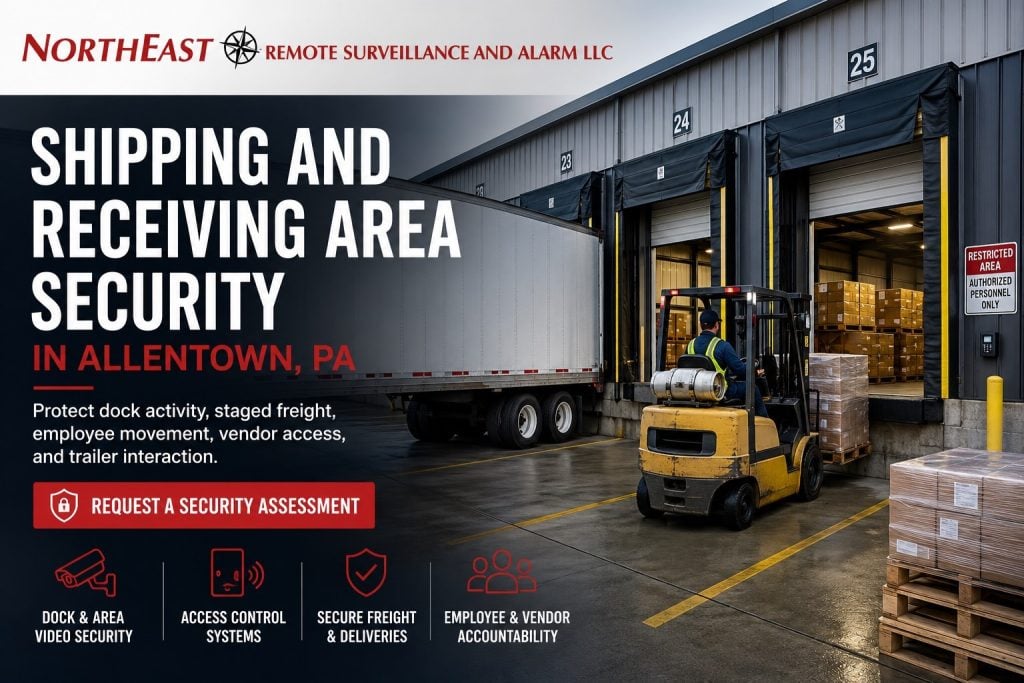
Shipping and receiving security in Allentown helps businesses document freight handoffs, driver visits, staging activity, and goods entering or leaving the facility.

For broader dock-area planning, explore loading dock security systems in Allentown.
Secure the Busiest Part of the Facility
Separate internal inventory and employee-access controls from cargo-theft exposure.
High-throughput operations can also use the Allentown freight-terminal and cross-dock guide to plan vehicle and shipment handoffs.
Shipping and receiving areas bring drivers, staff, vehicles, and freight into the same working zone. First, identify where goods change hands and which records help resolve missing or damaged shipments. NERSA plans visibility around those handoffs for Allentown warehouses, distribution centers, and manufacturers.
What the System Can Cover
- Dock doors, dock aprons, trailer positions, and overhead doors
- Driver check-in, shipping offices, receiving rooms, and exterior man doors
- Staging lanes, high-value freight, returns, and temporary inventory
- Forklift paths, employee transitions, vendor movement, and delivery handoffs
- After-hours access, door status, alarm events, and selected exterior activity
Use Cameras for Useful Detail
For example, camera views should help establish which trailer arrived, what freight moved, and when a handoff happened. Overview views show movement, while focused views capture important detail. Lighting, obstructions, trailer height, retention, and accurate timestamps all affect the result.
For a camera-specific guide, see loading dock security cameras in Allentown.
Control Dock-Area Doors
In addition, access control can assign permissions by person, role, door, and schedule. Employees, supervisors, drivers, vendors, and contractors do not need identical access. Shipping offices, receiving rooms, warehouse-to-dock doors, restricted storage, and nearby exterior entrances can each follow appropriate rules.
See loading dock access control systems in Allentown for door-focused planning.
Add Alarms and Monitoring Where They Help
After closing, commercial alarms may monitor overhead doors, exterior doors, interior zones, and other defined openings after hours. Selected exterior areas may also benefit from video analytics, operator review, audio talk-down, and agreed escalation procedures. These layers should support—not replace—lighting, physical barriers, staff procedures, and clear closing responsibilities.
Connect the Dock to the Rest of the Warehouse
Freight also moves through storage, production, offices, and yards.
Therefore, connect shipping and receiving procedures to the wider warehouse plan.
The network, cabling, power, recording, user permissions, and documentation must support the complete workflow.
For property-wide planning, see warehouse security systems in Allentown.
Identify the custody transition at every receiving point
Shipping and receiving security should document when a delivery is accepted, where a driver may wait, who can access the shipping office, and who authorizes material movement into the warehouse. Mark doors where public-facing dock activity transitions into controlled inventory or production areas. An intercom or credential can regulate a personnel door, but it does not replace verification of a purchase order, seal condition, delivery appointment or shipping documentation. Separate drivers, office staff, forklift operators and inventory supervisors by role.
Plan evidence around the right transaction
For disputed deliveries or missing product, useful evidence may include the approach lane, trailer number or seal condition, dock-door opening, physical handoff area and the time material leaves controlled staging. Coordinate camera perspectives and lighting so parked equipment, people and pallet movement do not obscure the required view. Align video timestamps with dock records where authorized. Avoid describing every camera as theft prevention; the recording objective should be specific enough that staff know which clip to retrieve during an investigation.
Align access with dock operations
Truck deliveries occur during shift overlap, overtime, seasonal surges and after-hours emergencies. Define how temporary drivers obtain limited entry, who approves a warehouse-side exception and how expired permissions are removed. Keep the overhead door and a nearby staff entrance as separate controlled conditions; material handling equipment safeguards remain independent from badge authorization. Door-held alerts must allow legitimate unloading durations without being so generous that an unexpected open door is ignored.
Acceptance and records for operations managers
Test a scheduled delivery, an unscheduled driver, an authorized staff crossing, an after-hours opening and a communication failure. Verify the correct recipient receives a clearly named alert with the proper door or camera. Document device labels, camera coverage zones, shift schedules, driver approval rules, evidence retention and a handover process. Review exceptions with shipping personnel because the best-looking system may fail when actual truck circulation differs from the drawing.
Frequently Asked Questions
Which shipping and receiving areas should have cameras?
For example, common priorities include dock doors, trailer positions, check-in points, staging, receiving, outbound lanes, and nearby entrances. Final placement depends on the desired evidence and site conditions.
Can cameras and access control work together?
Yes. Compatible systems can help authorized users compare door activity with recorded video and manage permissions more efficiently.
Can existing dock cameras or cabling be reused?
Often. First, we review condition, coverage, compatibility, account ownership, capacity, power, and recording needs.
Is shipping-area security different from general warehouse security?
Yes. It concentrates on freight handoffs, docks, drivers, nearby doors, staging, and the high volume of movement where goods enter and leave.
For broader city planning, visit commercial security systems in Allentown.
Request an Allentown Site Assessment
To review a specific facility, request a security assessment.
Compliance, Codes & Project Standards
NERSA plans commercial and industrial security work with applicable code, documentation, inspection and authority-having-jurisdiction requirements in mind. Requirements vary by system, property and jurisdiction. These resources support project planning; they do not establish legal compliance, certification or AHJ approval.
Related guidance: Regulatory compliance & inspection readiness · NERSA project standards · Documentation, testing & inspection readiness