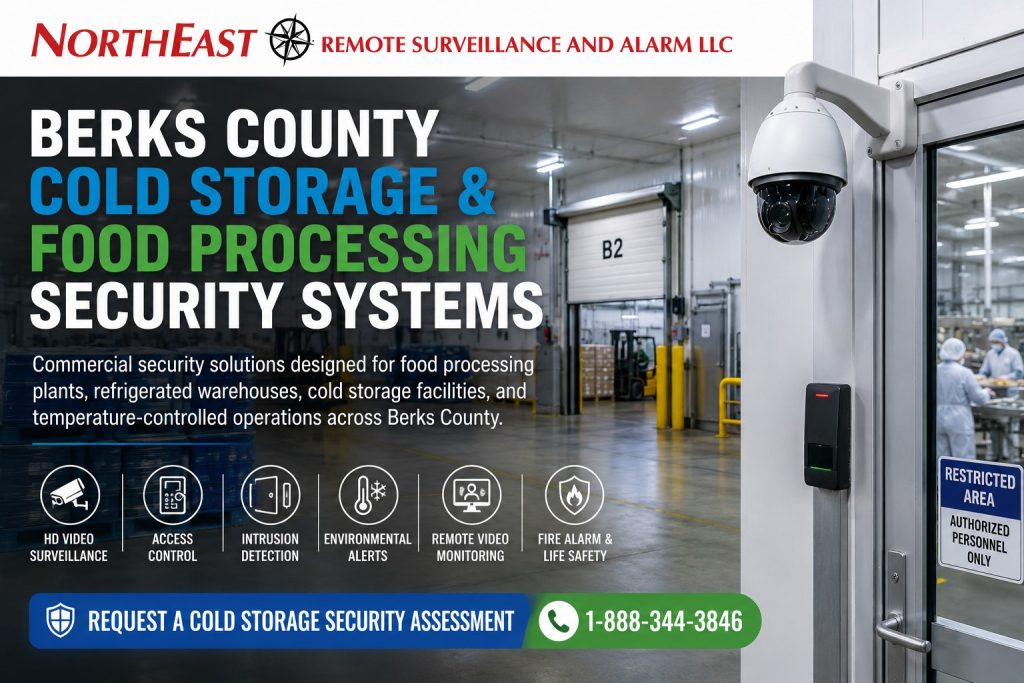
Cold storage facilities, refrigerated warehouses, food processing plants, packaging operations, and temperature-controlled distribution properties in Berks County need security systems designed around sanitation requirements, controlled environments, employee movement, restricted production areas, loading activity, inventory protection, and after-hours exposure.
Request a Physical Plant Security Assessment
Northeast Remote Surveillance and Alarm, LLC designs, installs, upgrades, integrates, monitors, and supports commercial security systems in Reading and Berks County. We serve food and beverage facilities, cold storage warehouses, refrigerated distribution buildings, processing plants, packaging operations, and related industrial properties.
NERSA focuses on commercial, industrial, municipal, institutional, healthcare, logistics, and enterprise environments. We do not install single-family home security systems.
Use Berks County Industrial & Logistics Corridor Security Systems to connect cold-storage security with the wider property, including delivery areas, shared entrances, and other buildings.
Security Planning for Cold Storage and Food Operations
Plan security around the way the facility operates. Frequent trailer turnover shapes the needs of a refrigerated warehouse. Food-processing plants may need restricted production areas and sanitation-controlled access. Packaging operations must account for multiple shifts and controlled ingredient or finished-goods areas. A small cold room within a larger industrial building may need a different plan.
A properly planned system should account for:
- Employee entrances and shift changes
- Visitor, vendor, and contractor procedures
- Production and processing areas
- Refrigerated, frozen, and controlled-temperature spaces
- Raw material receiving and finished-goods shipping
- Loading docks and trailer activity
- Restricted ingredients, packaging, or storage areas
- Quality-control rooms and maintenance spaces
- Offices, server rooms, and utility areas
- Exterior approaches, parking, and fenced areas
- After-hours alarm and monitoring procedures
- Existing equipment and infrastructure that may be reusable
- Future expansion, cooler additions, or new production areas
The objective is not simply to install cameras around the building. The objective is to create a system that supports accountability, usable evidence, controlled access, after-hours awareness, and long-term facility management without interfering unnecessarily with production or sanitation procedures.
Why Cold Storage and Food Facilities Need Specialized Security Planning
Food and cold storage facilities operate differently from standard commercial buildings. Temperature-controlled spaces, washdown procedures, condensation, insulated walls, dock activity, production schedules, sanitation expectations, and restricted food-handling areas all affect how security equipment should be selected and installed.
Security planning may need to address:
- High-humidity or low-temperature conditions
- Transition areas between conditioned and non-conditioned spaces
- Condensation near cooler and freezer openings
- Regular washdown or sanitation procedures
- Strict control over who can enter certain processing zones
- Monitoring of ingredient, product, or packaging movement
- Multiple employee shifts
- Exterior trailer and dock exposure
- Delayed discovery of product-loss or operational incidents
- Infrastructure challenges inside insulated or temperature-controlled environments
A security system should reflect these operating realities. Camera placement, device selection, credential permissions, recording retention, and system maintenance all need to be planned around how the site actually functions.
Facility Areas That Often Need Focused Protection
Employee Entrances and Controlled Interior Access
Many food and cold storage properties need tighter control over employee movement, especially when a facility includes production zones, maintenance areas, storage rooms, offices, break areas, refrigeration spaces, or restricted support rooms.
Access control can help manage:
- Employee entrances
- Shift-based permissions
- Department-based access
- Temporary worker and contractor access
- Management-only areas
- Ingredient or product control rooms
- Server and communications rooms
- Quality-control or inspection areas
- Mechanical and refrigeration support spaces
A properly planned access-control system can improve accountability, reduce reliance on uncontrolled keys, simplify changes when staffing changes, and provide a usable record of entry events when an incident must be reviewed.
Raw Materials, Ingredients, and Controlled Storage
Raw materials, ingredients, packaging supplies, and controlled inventory may require higher accountability than general plant space.
Security planning may need to address:
- Who can enter the area
- When the area is accessed
- Whether activity can be visually reviewed
- Whether a product or ingredient was moved
- Whether after-hours access occurred
- Whether the area needs alarm protection when unattended
A controlled room or storage area may benefit from both video coverage and access control, especially when several departments or shifts use the same space.
Production and Processing Areas
Production-floor security should be designed around a defined purpose. In one facility, management may need broad documentation of employee and product movement. In another, the priority may be restricted access, quality-review support, incident investigation, or verification of activity near sensitive processing equipment.
Camera design should consider:
- Machinery and moving obstructions
- Washdown or moisture exposure
- Temperature variation
- Lighting differences
- Steam or condensation
- Forklift or pallet-jack traffic
- The exact detail management expects the video to provide
Security cameras can support operational review and investigation, but they are not a replacement for required food-safety procedures, employee training, quality systems, sanitation controls, or regulatory compliance programs.
Cold Rooms, Coolers, and Freezers
Refrigerated and frozen spaces often require more planning than ordinary interior rooms. Device placement, cable routing, housing selection, mounting conditions, and transitions between conditioned and non-conditioned spaces all affect long-term performance.
These spaces may require attention to:
- Temperature range
- Condensation risk
- Frost or moisture
- Insulated-wall penetration methods
- Maintenance access
- Door-position monitoring
- Lighting conditions
- Limited routing options for cabling
- Device locations that remain practical for service
A security system should be designed so equipment remains dependable and serviceable in the environment where it is installed.
Shipping, Receiving, and Loading Docks
Food-processing and cold-storage properties often depend on active dock operations, trailer movement, and regular inbound and outbound shipments.
A loading-area security plan may need to document:
- Trailer arrival and dock position
- Dock-door activity
- Interior shipping and receiving movement
- Product staging
- Forklift traffic
- Employee and driver interaction
- Activity before and after a freight or damage claim
- After-hours dock exposure
A single wide shot of a dock wall may not provide the level of detail needed for investigation. Camera positions should be based on the actual events management may need to review.
Exterior Areas, Parking, and Trailer Activity
Cold storage and food facilities may also need visibility around parking areas, perimeter approaches, employee routes, exterior equipment, fenced sections, trailer rows, and service entrances.
Exterior security planning should account for:
- Lighting
- Distance
- Vehicle movement
- Trailer obstructions
- Weather
- Employee and visitor movement
- Vulnerable exterior assets
- After-hours activity levels
Properties with recurring concerns about trespassing, theft, vandalism, or suspicious vehicle activity may need more than recording alone.
Security Systems Commonly Used at Cold Storage and Food Facilities
Video Surveillance
Video surveillance often serves as the visual foundation of the system. It can help management document activity at employee entrances, production areas, coolers, dock lanes, shipping offices, parking areas, and exterior approaches.
Useful camera coverage should be selected around the objective of each view, such as:
- General awareness
- Person identification
- Activity review in production areas
- Controlled-room documentation
- Dock and shipment review
- Exterior incident review
- Searchable evidence during an investigation
The goal is not maximum camera count. The goal is usable evidence.
Access Control
Access control helps manage who can enter a particular door, room, processing area, storage area, or building and when that permission is valid.
This is especially useful for:
- Employee entrances
- Department-based access
- Temporary labor
- Restricted food-handling or storage zones
- Offices and support areas
- Maintenance rooms
- Mechanical and utility spaces
- Server and communications rooms
A properly planned system should consider not only the reader and controller, but also the physical door, lock, request-to-exit device, closer, contact, power, and emergency operation.
Intrusion Detection
Intrusion detection helps protect the facility when parts of the building are closed or lightly staffed. A food or cold storage property may need alarm protection for offices, dock areas, support rooms, detached spaces, exterior doors, utility rooms, and selected storage areas.
Alarm design should reflect the way the building is occupied. A facility that stays active in one section while another area is closed may require a different approach than a property that shuts down fully overnight.
Remote Video Monitoring
Some facilities need more than recording and alerts going only to an owner or manager’s phone.
Remote video monitoring can support properties that want stronger after-hours awareness around parking areas, exterior doors, trailer positions, loading docks, gates, and building approaches.
For a platform-specific approach to sensor placement and temperature alerts, see Alarm.com commercial temperature monitoring.
Monitoring schedules and activity rules should be planned around the property’s actual operating conditions rather than generating unnecessary alerts from normal movement.
Facilities that need active after-hours visibility can also review our Remote Video Monitoring and Live Talk-Down page.
Structured Cabling and Infrastructure
Security systems depend on infrastructure. Cameras, access-control panels, alarms, intercoms, wireless links, and remote devices all rely on cabling and communications pathways that can support the system over time.
A project may require:
- CAT6 or CAT6A cabling
- Fiber connections
- PoE switching
- Wireless links
- Equipment enclosures
- Organized pathways
- Protected penetrations
- Capacity for future expansion
Infrastructure should be evaluated before deciding what is reusable and what should be replaced.
Cold Storage and Food Facility Security Upgrades and Takeovers
Many facilities already have some combination of cameras, recorders, access-control devices, alarm panels, door hardware, or network equipment. Before everything is removed, the existing system should be evaluated.
A review may identify reusable assets such as:
- Existing cabling
- Selected camera locations
- Door hardware
- Readers
- Enclosures
- Power supplies
- Equipment-room infrastructure
It may also reveal limitations such as:
- Unsupported devices
- Equipment unsuited for the environment
- Poor night visibility
- Inadequate retention
- Weak camera angles
- Unmanaged credentials
- Incomplete documentation
- Communication problems
- Expansion limitations
For broader upgrade planning, review our Commercial Security System Upgrades, Retrofits and Takeovers page.
The goal is to retain dependable assets when it makes sense while correcting the equipment or infrastructure that limits security, usability, or long-term support.
How NERSA Plans a Cold Storage or Food Processing Security Project
Facility and Operational Review
NERSA begins by learning how the facility operates. That includes employee movement, production activity, dock use, restricted zones, shift schedules, visitor procedures, exterior exposure, sanitation requirements, existing concerns, and future expansion plans.
Existing-System Assessment
Installed cameras, recorders, readers, locks, alarm devices, cabling, switching, fiber, and communications pathways are reviewed to determine what is reusable, what should be tested further, and what is limiting performance.
Risk and Coverage Planning
The facility is divided into operating areas such as entrances, controlled storage, production spaces, coolers, freezers, docks, offices, utility rooms, parking areas, and exterior approaches. Each area is assigned a purpose such as identification, access control, incident review, or after-hours response.
Infrastructure and Expansion Planning
The design should account for cable routing, equipment locations, building conditions, insulated areas, switching capacity, storage requirements, remote connectivity, and long-term growth.
Installation, Testing, and Training
Completed systems should be tested under the conditions that matter to the facility, including lighting, environmental conditions, schedules, and controlled access procedures. Management should receive the information needed to retrieve video, manage users, review events, and request service or expansion.
Security for One Building or a Larger Food or Cold Storage Operation
A smaller food-processing or refrigerated facility may need a focused combination of cameras, controlled employee entrances, alarm protection, and after-hours monitoring.
A larger property may require:
- Multiple access-controlled doors
- Several coolers or freezer spaces
- Dock and trailer visibility
- Several restricted rooms
- Longer recording retention
- Multi-building connectivity
- Centralized user management
- Standardized naming and documentation
- Coordinated monitoring across several areas
NERSA can support both smaller commercial facilities and larger enterprise-scale operations. The design is based on the property, its workflows, and its risk profile rather than forcing every site into the same package.
Cold Storage and Food Security Throughout Berks County
NERSA serves commercial and industrial properties throughout Reading and surrounding Berks County communities.
Projects may involve a refrigerated warehouse, food-processing plant, packaging operation, temperature-controlled distribution building, industrial food facility, or a broader multi-building operation.
Mentioning these communities does not imply that NERSA maintains an office in each municipality. Service is provided through NERSA’s established regional operation.
Why Berks County Cold Storage and Food Facilities Choose NERSA
Since 2008, Northeast Remote Surveillance and Alarm, LLC has focused on commercial and industrial security design, installation, upgrades, integration, monitoring, and long-term support.
NERSA’s approach emphasizes:
- Commercial and industrial work rather than single-family home packages
- Planning around actual cold storage and food-facility operations
- Useful evidence rather than generic camera placement
- Coordination between cameras, access control, alarms, monitoring, and infrastructure
- Evaluation of existing equipment before replacement
- Scalable planning for one building or multiple locations
- Clear communication with facility, operations, and IT personnel
- Long-term serviceability and expansion
Request a Berks County Cold Storage or Food Facility Security Assessment
NERSA can assess security at your cold storage, refrigerated warehouse, food-processing, or packaging facility. Tell us about camera coverage, access control, intrusion protection, and after-hours monitoring. We can review your existing system and recommend appropriate improvements.
Request a Physical Plant Security Assessment.
Frequently Asked Questions About Berks County Cold Storage and Food Processing Security Systems
What types of facilities does this guide cover?
Cold storage and food-processing sites need security that fits refrigerated spaces, packaging lines, delivery routines, and the people who work there.
Does NERSA install single-family home security systems?
No. Northeast Remote Surveillance and Alarm, LLC focuses on commercial, industrial, municipal, institutional, healthcare, logistics, and enterprise environments.
What parts of a food or cold storage facility usually need the most security attention?
Common priority areas include employee entrances, production areas, restricted storage, cooler and freezer access points, loading docks, trailer activity, offices, support rooms, parking areas, and building approaches.
Can cameras be used to help review shipping issues or operational incidents?
Yes. When the system is designed around the movement of people, product, trailers, and staging activity, video can help management review damage claims, shortage concerns, unauthorized access, and after-hours activity.
Can access control be used for restricted production or storage areas?
Yes. Access control can help manage employee entrances, controlled storage, production zones, support rooms, offices, utility areas, and IT rooms. Permissions can be organized by shift, department, job role, or temporary assignment.
Can security equipment be installed in refrigerated or temperature-controlled areas?
Yes, but the equipment and installation method should be selected around the environment. Temperature, condensation, washdown procedures, cable routing, mounting conditions, and long-term serviceability all need to be considered.
Can remote video monitoring be limited to nights and weekends?
Yes. Monitoring can be scheduled around the property’s actual hours of concern, such as nights, weekends, holidays, or low-staff periods.
Can an existing cold storage or food facility security system be upgraded instead of replaced?
Sometimes. Existing cameras, cabling, door hardware, readers, power supplies, fiber, and other infrastructure should be evaluated for condition, compatibility, and long-term usefulness before replacement is recommended.
Can NERSA support a multi-building food or refrigerated operation?
Yes. Multi-building properties may require fiber, wireless links, distributed equipment, centralized management, shared monitoring procedures, and scalable access-control planning.
Can security installation be phased around active operations?
Yes. Larger projects may be planned in phases so improvements can be completed while the facility remains active.
Can NERSA support both a smaller refrigerated building and a larger enterprise facility?
Yes. A smaller property may need a focused combination of cameras, controlled doors, alarms, and monitoring, while a larger operation may need a broader system with more buildings, more restricted spaces, additional infrastructure, longer retention, and centralized management.
How does a Berks County cold storage or food processing security project begin?
It begins with a site assessment. NERSA reviews the property, operating workflows, existing systems, infrastructure, risk areas, and future needs before recommending a commercial security design.
Compliance, Codes & Project Standards
NERSA plans commercial and industrial security work with applicable code, documentation, inspection and authority-having-jurisdiction requirements in mind. Requirements vary by system, property and jurisdiction. These resources support project planning; they do not establish legal compliance, certification or AHJ approval.
Related guidance: Regulatory compliance & inspection readiness · NERSA project standards · Documentation, testing & inspection readiness