
Start plate-camera planning with the lanes and vehicle movements you need to review.

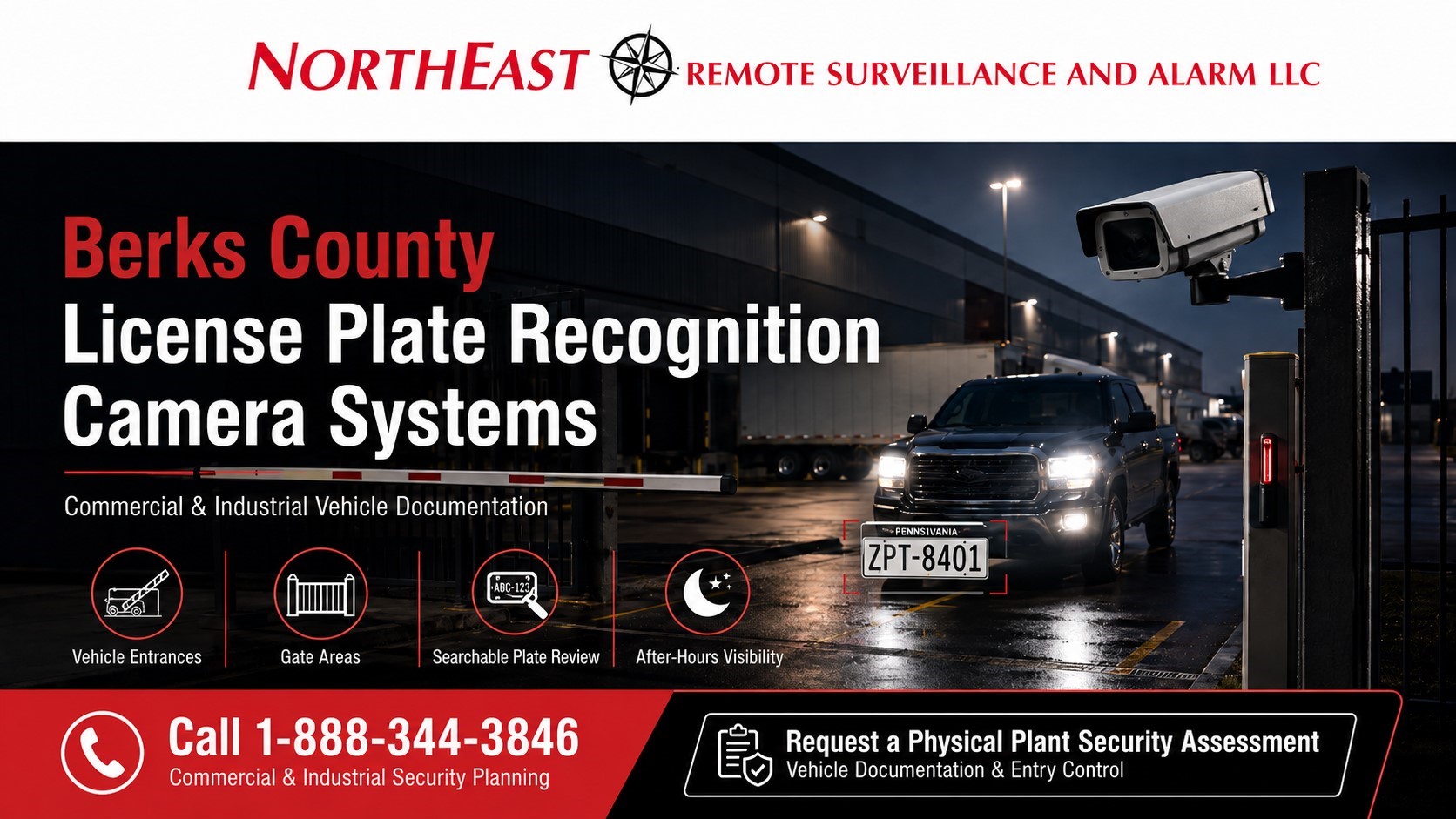
Check lighting, camera angle, speed, and whether plates remain visible at the capture point.
NERSA designs and installs commercial plate-recognition systems across Reading and Berks County.
The Berks County security guide covers the gates, cameras, and other systems around those vehicle routes.
License Plate Recognition Camera Planning in Berks County
A general parking lot camera may show a vehicle entering without capturing a readable license plate. License plate recognition systems need views designed for plate capture. Review that requirement separately from overall parking lot or exterior coverage.
A proper license plate recognition system should be planned around the exact lane, approach angle, lighting, vehicle speed, mounting location, camera distance, plate position, and review needs of the property. The goal is to support clearer vehicle documentation at the points where vehicles enter, exit, pass through, or access controlled areas.
Northeast Remote Surveillance and Alarm, LLC does not install single-family home systems. Our focus is commercial, industrial, municipal, institutional, healthcare, logistics, and enterprise environments where system design, camera placement, infrastructure, and long-term support matter.
When Plate Capture Is Useful
License plate recognition cameras are most useful where vehicles move through predictable lanes or controlled access points. They should not be treated as general-purpose parking lot cameras.
Common license plate recognition camera locations include:
- Main vehicle entrances
- Exit lanes
- Gate entrances
- Employee parking entrances
- Visitor parking entrances
- Truck yard entrances
- Trailer yard entrances
- Delivery lanes
- Fleet access points
- Service entrances
- Municipal or institutional drive lanes
- Controlled vehicle access points
- High-traffic property entrances
- After-hours vehicle approach points
A proper design should determine whether the goal is to document entering vehicles, exiting vehicles, employee vehicles, vendor vehicles, delivery traffic, after-hours movement, or vehicle activity tied to a specific gate, dock, lot, or building approach.
License Plate Recognition vs General Parking Lot Cameras
General parking lot cameras are designed to show activity across a wider area. They may help document vehicle movement, pedestrian paths, parking activity, building approaches, and exterior incidents.
License plate recognition cameras are more specialized. They are usually aimed at a narrower vehicle path so the system can better capture plate details at a specific entrance, exit, or lane.
Both systems can work together.
Parking lot cameras provide context, while license plate recognition cameras provide more targeted vehicle documentation.
For broader parking-area planning, use the Berks County Parking Lot Security Cameras page.
Entrance and Exit Lane Design
License plate recognition works best when vehicle movement is controlled, predictable, and properly framed. The system should be designed around the lane geometry, vehicle approach direction, mounting height, camera angle, distance, lighting, and expected vehicle speed.
A camera placed too far away, too high, too wide, or at the wrong angle may show the vehicle but fail to provide usable plate detail. Headlights, glare, shadows, weather, reflective plates, snow, rain, dirt, and nighttime conditions can also affect performance.
A site assessment should review where vehicles actually travel, where they slow down, where they stop, and which direction plates face as they enter or leave the property.
Gate Access and Controlled Vehicle Entry
License plate recognition can support properties with gated entrances, employee-only lots, fleet areas, delivery gates, service entrances, and controlled vehicle access points. In these environments, vehicle documentation may be part of a broader gate access control plan.
Camera coverage around gates can help management review which vehicle approached, when the gate opened, what direction the vehicle traveled, and whether the event matched the access activity.
For properties with gate readers, keypads, intercoms, remote release, and controlled vehicle entry, use the Berks County Commercial Gate Access Control Systems page.
Truck Yards and Trailer Areas
Truck yards, trailer lots, distribution centers, freight operations, and logistics properties often need stronger vehicle documentation than a standard commercial lot. These sites may have tractors, trailers, box trucks, delivery vehicles, employee vehicles, vendor vehicles, and after-hours movement in the same exterior space.
License plate recognition may help support review around truck entrances, trailer staging areas, fleet parking, delivery lanes, fenced yards, and controlled vehicle access points. It can also help management search vehicle activity when reviewing an incident, delivery dispute, after-hours event, or unauthorized approach.
For yard and trailer-focused security planning, use the Berks County Truck Yard and Trailer Security Systems page.
Commercial Video Surveillance and Vehicle Context
License plate recognition cameras should usually be supported by broader video surveillance coverage. A plate camera may help document a vehicle, but overview cameras can show where that vehicle went, what happened nearby, who exited, what door was approached, or which area of the property was affected.
A strong design may combine license plate recognition cameras with parking lot cameras, dock cameras, gate cameras, building approach cameras, and exterior overview cameras. This gives management better context when reviewing an event.
For broader camera planning across Berks County commercial and industrial properties, use the Berks County Commercial Video Surveillance Systems page.
Lighting, Speed, Distance, and Angle
License plate recognition camera performance depends heavily on physical conditions. The camera must be positioned for the plate, not just the vehicle.
Important design factors include:
- Vehicle speed
- Lane width
- Camera distance
- Mounting height
- Horizontal angle
- Vertical angle
- Day and night lighting
- Headlight glare
- Weather exposure
- Plate reflectivity
- Vehicle approach direction
- Stop points or speed-control areas
- Network and recording reliability
A system should be planned to capture plates under the conditions the property actually experiences, including nighttime activity, rain, snow, glare, and changing seasonal light.
Searchable Vehicle Records and Review
Many businesses choose license plate recognition because they need faster vehicle review. Instead of searching through hours of footage manually, a properly planned system may help users review plate events, vehicle movement, timestamps, lane activity, and related video clips.
Searchable vehicle records can be useful when reviewing delivery activity, gate events, parking lot incidents, unauthorized vehicles, repeat visitors, after-hours activity, vendor access, employee vehicle movement, or vehicle-based disputes.
The system should be configured so authorized users can find, review, and export information when needed without making the review process overly complicated.
Remote Viewing and User Permissions
License plate recognition data should be handled with proper user access and security controls. Owners, managers, facility directors, security teams, municipal administrators, or operations personnel may need different access levels depending on their responsibilities.
Not every user should have access to every camera or vehicle record. A properly configured system should support secure logins, role-based permissions, and organized camera groups so the right users can review the right information.
Remote viewing should make vehicle review easier while keeping the system properly controlled.
Integration with Access Control, Gates, and Monitoring
License plate recognition may provide more value when it is planned with other security systems. Depending on the property, LPR cameras may support gate access events, parking lot review, remote video monitoring, intrusion alarm investigation, delivery activity review, or after-hours vehicle alerts.
For some properties, the priority is recorded documentation. For others, the priority is active awareness around after-hours vehicles, gate activity, or unauthorized movement. The right design depends on the property layout, operating hours, risk level, and response expectations.
License plate recognition should be treated as one part of the broader security plan, not as a replacement for cameras, access control, alarms, gates, or monitoring workflows.
Privacy, Policy, and Responsible Use
License plate recognition systems should be planned with responsible use in mind. The business should understand who has access, how records are reviewed, how long data is retained, what the system is used for, and how vehicle information fits into the property’s security operations.
A commercial LPR system should support legitimate property security, vehicle documentation, access review, and incident investigation. It should not be installed casually without clear operational purpose, proper permissions, secure access, and appropriate retention planning.
Clear internal procedures can help the property use the system consistently and responsibly.
Upgrading Existing Vehicle Camera Coverage
Many Berks County properties already have parking lot or entrance cameras, but those cameras may not provide usable plate detail. Common problems include poor angle, too much distance, wide overview views, low resolution, weak night visibility, headlight glare, excessive vehicle speed, or no dedicated lane view.
An upgrade may add dedicated plate cameras, reposition existing cameras, or narrow their field of view. Other improvements may involve lighting, entrance and exit views, or recording retention. Vehicle records can also be connected to gate and video review procedures.
The best upgrade is not always more cameras. The best upgrade is a camera design that matches the property’s vehicle movement and review needs.
Request a Berks County License Plate Recognition Assessment
NERSA can assess plate-capture needs at your Berks County property. We review entrances, exits, parking, gates, and truck yard lanes. Tell us whether you need searchable vehicle records, after-hours activity review, or better documentation of daily traffic.
Request a Physical Plant Security Assessment to discuss license plate recognition camera systems in Berks County, PA.
Frequently Asked Questions
What is a license plate recognition camera system?
A license plate recognition camera system is a specialized video system designed to help capture and review license plate information at vehicle entrances, exits, gates, drive lanes, parking areas, truck yards, and controlled access points.
How is license plate recognition different from a normal security camera?
A normal security camera usually provides a wider overview of an area. A license plate recognition camera is aimed and configured for a specific vehicle path so it can better capture plate detail at an entrance, exit, gate, or lane.
Where should license plate recognition cameras be installed?
Common locations include vehicle entrances, exit lanes, gate areas, employee parking entrances, visitor parking entrances, truck yard access points, trailer yard entrances, fleet areas, service entrances, and controlled vehicle access points.
Can license plate recognition cameras work at night?
Yes, when they are designed correctly. Night performance depends on camera selection, lighting, headlight control, mounting height, angle, distance, vehicle speed, and the exact lane being monitored.
Can license plate recognition cameras be used in parking lots?
Yes, but they should be placed where vehicles move through predictable paths. General parking lot overview cameras can show context, while LPR cameras should focus on entrances, exits, gates, or defined lanes.
Do truck yards need license plate recognition cameras?
Many truck yards, trailer areas, distribution centers, and logistics properties can benefit from license plate recognition because they often have frequent vehicle movement, delivery activity, after-hours exposure, and controlled access points.
Can license plate recognition integrate with gate access control?
Yes. LPR cameras can support gate-area documentation and vehicle review. Depending on the system design, they may also support broader gate access workflows, event review, and vehicle activity documentation.
How long should license plate recognition records be stored?
Retention depends on the property’s risk level, review needs, incident history, vehicle traffic, operating schedule, storage design, and internal policies. Retention should be planned before the system is installed.
Who should have access to license plate recognition records?
Access should be limited to authorized users with a legitimate need to review vehicle activity. User permissions, secure logins, camera groups, and retention policies should be planned as part of the system design.
How do we start a license plate recognition project in Berks County?
Start with a site assessment. Northeast Remote Surveillance and Alarm, LLC can review vehicle lanes, entrances, exits, gate areas, parking lots, lighting, camera angles, network infrastructure, recording needs, and vehicle review goals.
Plan Your Next Security Improvement
Tell NERSA about your commercial facility, existing systems, and project priorities. We can help you plan an installation, evaluate an upgrade, or coordinate security across multiple locations.
Compliance, Codes & Project Standards
NERSA plans commercial and industrial security work with applicable code, documentation, inspection and authority-having-jurisdiction requirements in mind. Requirements vary by system, property and jurisdiction. These resources support project planning; they do not establish legal compliance, certification or AHJ approval.
Related guidance: Regulatory compliance & inspection readiness · Video surveillance compliance · NERSA project standards